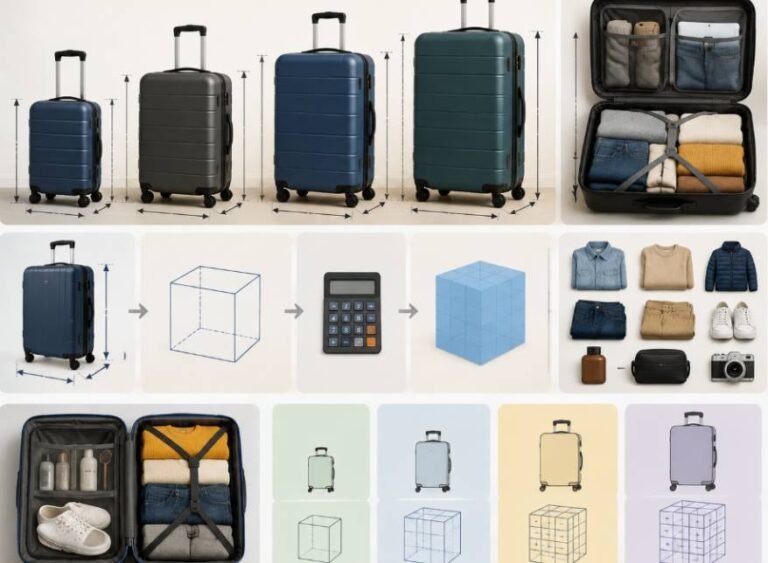

A luggage set can look surprisingly roomy in a product photo, but suitcase height alone does not tell you how much you can actually pack. If you are comparing sets for a family vacation, a long-haul trip, or simply trying to figure out how much closet space your luggage will occupy, cubic feet gives you a much clearer answer.
So, How Many Cubic Feet Is a Luggage Set? A typical three-piece set provides about 6.8 to 8.4 cubic feet of combined packing capacity, while larger sets can approach 9.5 cubic feet or more. The real number depends on the size of each suitcase, its interior design, and whether you are measuring usable packing space or exterior dimensions.
What Is the Average Luggage Set Capacity in Cubic Feet?
Most three-piece luggage sets combine a 20- to 22-inch carry-on, a 24- to 26-inch medium checked bag, and a 28- to 30-inch large checked bag. An individual travel bag often falls around 1.5 to 2.5 cubic feet.
| Bag Type | Typical Capacity | Approximate Volume |
| Carry-on or weekender | 35–45 liters | 1.3–1.6 ft³ |
| Medium checked bag | 65–80 liters | 2.3–2.8 ft³ |
| Large checked bag | 90–110 liters | 3.2–4.0 ft³ |
| Typical 3-piece set | 190–235 liters | 6.8–8.4 ft³ |
| Roomier 3-piece set | Up to about 269 liters | Up to 9.5 ft³ |
| Typical 4-piece set | About 227–297 liters | 8.0–10.5 ft³ |
Actual luggage capacity varies because shell shape, wheels, handles, pockets, internal frames, and expandable sections affect usable packing space. Current luggage-set examples also show that a cabin, medium, and large combination can exceed 200 liters of total capacity.
How Much Space Does Each Suitcase Size Hold?

How Much Does a Carry-On Suitcase Hold?
A carry-on bag or weekender commonly provides about 1.3 to 1.6 cubic feet, or roughly 35 to 45 liters. Many US airlines use carry-on dimensions around 22 × 14 × 9 inches, although every carrier can set its own requirements. A bag near this size usually works well for weekends, short business trips, and travelers who prefer packing light.
For a closer look at carry-on and personal-item sizing specifically, see how many cubic feet a travel bag holds.
How Much Does a Medium Checked Bag Hold?
A medium checked suitcase generally provides around 2.3 to 2.8 cubic feet, or approximately 65 to 80 liters. These bags commonly fall within the 24- to 26-inch suitcase category and work well for several days to about a week of travel.
How Much Does a Large Checked Suitcase Hold?
A large checked suitcase usually provides about 3.2 to 4.0 cubic feet, or around 90 to 110 liters. Many models measure 28 to 30 inches tall, making them useful for long vacations, family travel, winter clothing, and bulkier items.
US travelers should also check airline baggage restrictions rather than focusing only on suitcase volume. Delta, for example, states that standard checked luggage must not exceed 62 linear inches when length, width, and height are added together.
How Do I Calculate Luggage Capacity in Cubic Feet?
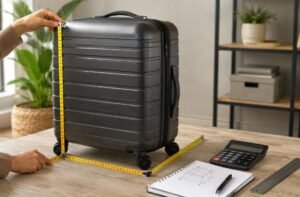
If I know a bag’s outside measurements in inches, I can estimate its exterior cubic footage with this formula:
Length × Width × Depth ÷ 1,728 = cubic feet
There are 1,728 cubic inches in one cubic foot.
For example, a suitcase measuring 28 × 18 × 12 inches has 6,048 cubic inches of exterior volume. Dividing 6,048 by 1,728 gives 3.5 cubic feet.
This calculation provides estimated exterior volume rather than exact usable packing capacity. Wheels, handles, rounded corners, shell thickness, dividers, pockets, and telescoping handle channels reduce the actual space available inside the suitcase.
Why Are Liters and Cubic Feet Different on Luggage Listings?
Most luggage manufacturers publish suitcase capacity in liters. Cubic feet can be easier for US shoppers when comparing luggage with closet space, car cargo areas, moving boxes, or household storage.
One cubic foot equals approximately 28.3 liters. Therefore, a 100-liter suitcase offers around 3.5 cubic feet, while a 200-liter luggage set provides approximately 7.1 cubic feet.
Whenever possible, I compare the manufacturer’s listed internal capacity with the outside dimensions. External dimensions help determine whether luggage complies with airline restrictions, while internal volume gives me a better idea of how much I can actually pack.
Does a Nested Luggage Set Take Up the Same Space at Home?
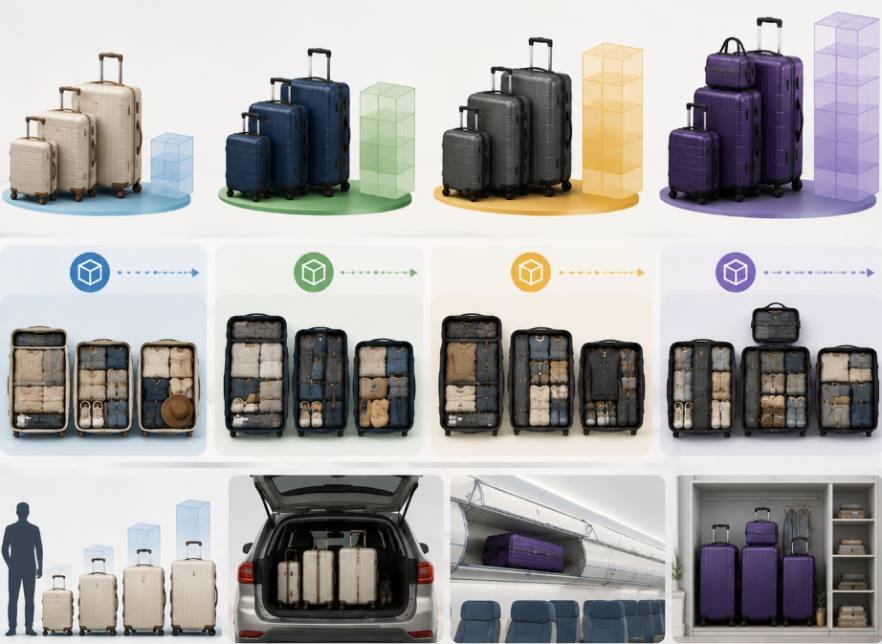
No. Combined packing capacity and storage footprint are two different measurements. A three-piece luggage set may provide more than seven cubic feet of combined packing room, yet many matching sets nest together. The carry-on fits inside the medium case, and the medium case fits inside the large suitcase.
Aerolite, for example, states that its three-piece luggage set nests within the footprint of the largest case. This means a set offering more than 200 liters of total packing capacity does not necessarily require that much separate closet space when stored. When comparing different luggage sizes, I use a luggage capacity calculator tool to better understand the actual space each piece occupies.
Is a 2-Piece, 3-Piece, or 4-Piece Luggage Set Better?
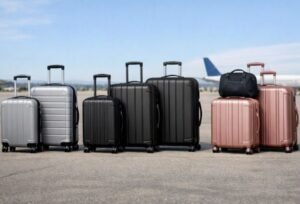
A two-piece set often works well for solo travelers or couples taking shorter trips. It typically combines a carry-on with either a medium or large checked suitcase.
A three-piece set offers more flexibility because it normally covers carry-on, medium, and large checked-luggage needs. This is the most useful configuration for travelers who take a mix of weekend trips and longer vacations.
A four-piece luggage set may provide around 8 to 10.5 cubic feet of total packing space. The fourth piece may be an extra-large suitcase, underseat tote, duffel, or backpack, so total capacity depends heavily on the set’s configuration. Some four-piece sets with an extra-large suitcase can exceed this range substantially.
Frequently Asked Questions
1. How Many Cubic Feet Is a Luggage Set?
A typical three-piece luggage set provides about 6.8 to 8.4 cubic feet of combined packing capacity. Larger and roomier designs may approach 9 to 9.5 cubic feet, while four-piece sets commonly provide around 8 to 10.5 cubic feet or more depending on the pieces included.
2. How Many Cubic Feet Is a 28-Inch Suitcase?
A typical 28-inch suitcase provides roughly 3.2 to 4.0 cubic feet of usable packing capacity. Width, depth, shell shape, handles, wheels, and internal construction can change the final volume.
3. Is 22 × 14 × 9 Inches About 1.6 Cubic Feet?
Yes. Multiplying 22 × 14 × 9 gives 2,772 cubic inches. Divide that figure by 1,728, and the calculated exterior volume is approximately 1.60 cubic feet.
4. Should I Compare Luggage in Liters or Cubic Feet?
I use both. Liters are more commonly listed by suitcase manufacturers, while cubic feet make it easier for US shoppers to compare luggage capacity with household storage, vehicle cargo space, and other familiar measurements.
Final Takeaway
A typical three-piece luggage set provides about 6.8 to 8.4 cubic feet of combined packing space, while roomier models may reach closer to 9.5 cubic feet. Carry-ons usually provide around 1.3 to 1.6 cubic feet, medium checked bags about 2.3 to 2.8 cubic feet, and large checked bags approximately 3.2 to 4.0 cubic feet.
When I shop for luggage, I compare internal capacity, exterior measurements, airline restrictions, and nesting design rather than relying on suitcase height alone. That gives me a much clearer picture of how much I can actually pack, whether the luggage will work for my flights, and how much space the entire set will require at home.

Ryan Mitchell
Ryan Mitchell holds a degree in Civil Engineering and spent over a decade working in construction project estimation, where accurate volume and material calculations were part of his daily work — from concrete pours to landscaping material orders. He founded this site to bring that same precision to everyday calculations, helping DIYers, contractors, and students get fast, accurate cubic footage results without the guesswork. Ryan reviews every calculator and formula on this site for accuracy and writes guides based on real-world measurement scenarios he's encountered on job sites.