
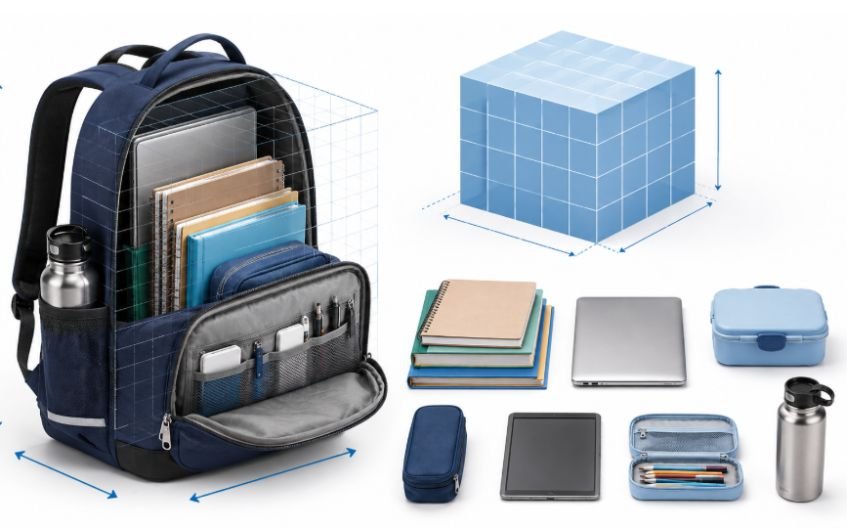
School bags may look similar on the outside, but the amount they can actually hold can vary dramatically. If you have ever compared backpack sizes and wondered, How Many Cubic Feet Is a School Bag?, the typical answer is about 0.7 to 1.2 cubic feet, or roughly 20 to 35 liters. Smaller elementary backpacks usually sit below that range, while larger high school and college bags can offer considerably more space.
I find cubic feet especially useful for comparing bags because it turns confusing liter ratings and exterior dimensions into a measurement that makes it easier to picture how much room students really have for books, laptops, lunch, and everyday school essentials.
What Is the Average School Backpack Capacity?
For a typical student, I consider 20 to 35 liters a useful general range. That works out to approximately 0.7 to 1.2 cubic feet.
Current backpack sizing guides support a similar picture. Standard everyday backpacks often fall around 20 to 30 liters, while larger school packs can reach approximately 30 to 35 liters. For US students, the right school backpack size depends on grade level, body size, laptop requirements, textbooks, sports equipment, and how much the student carries each day.
Because backpack capacity varies by design, these numbers should be treated as practical averages rather than strict industry standards. When comparing different bag sizes, I use a find cubic feet of an item tool to better understand the actual storage capacity.
How Big Is a School Bag for Elementary Students?
A primary or elementary school backpack typically provides around 15 to 20 liters, or approximately 0.5 to 0.7 cubic feet.
Smaller children usually need enough space for folders, a few notebooks, a lunch box, a water bottle, pencils, and perhaps a light jacket. They rarely need the capacity of an adult-size backpack.
The North Face notes that younger elementary students commonly use backpacks around 12 to 18 liters, while older elementary students may move into roughly 16 to 22 liters. This overlap explains why I would never choose an elementary backpack based on volume alone. The bag also needs to fit the child’s torso comfortably.
What Size Backpack Is Best for Middle and High School?
Middle and high school students usually need more storage because they carry larger textbooks, three-ring binders, notebooks, laptops, chargers, gym clothes, and other school supplies.
A practical middle or high school backpack generally falls around 22 to 30 liters, equal to approximately 0.8 to 1.1 cubic feet.
For middle school, 20 to 26 liters often provides enough room for everyday school supplies. Students who regularly carry a laptop or several large books may benefit from something closer to 25 or 30 liters.
High school students often do well with a 24- to 32-liter bag. At that size, I would pay close attention to organization. A separate laptop compartment, main textbook section, smaller accessory pockets, and water-bottle storage can make a 25-liter bag feel more useful than a poorly designed 30-liter one.
How Large Is a College or Heavy-Duty School Backpack?
College students and students carrying sports equipment or several large textbooks may need approximately 32 to 40 liters, or around 1.1 to 1.4 cubic feet.
Backpacks in the 30- to 39-liter category can hold several books, binders, electronics, clothing, and other bulky items. They may also work for students who move directly from class to work, practice, or the gym.
However, I would not automatically choose a 40-liter backpack simply because it offers more storage. Larger capacity encourages overpacking, and the physical dimensions can feel awkward on a smaller student.
If off-season gear or bulkier backpacks end up in a closet or a rented unit over the summer, my storage locker size guide walks through how much a locker actually holds once you account for its usable height.
How Do Liters Convert to Cubic Feet?
Backpack manufacturers commonly advertise capacity in liters, so a quick conversion makes comparison easier.
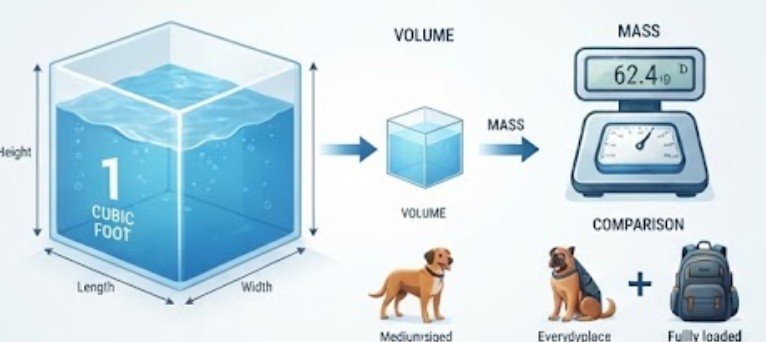
One cubic foot equals approximately 28.3 liters. That means a 20-liter backpack holds about 0.71 cubic feet, a 25-liter backpack holds about 0.88 cubic feet, a 30-liter backpack holds about 1.06 cubic feet, and a 35-liter backpack holds about 1.24 cubic feet.
These conversions are especially helpful when comparing backpacks from different brands because one company may emphasize liters while another provides only exterior dimensions.
How Do I Calculate the Cubic Feet of a School Bag?
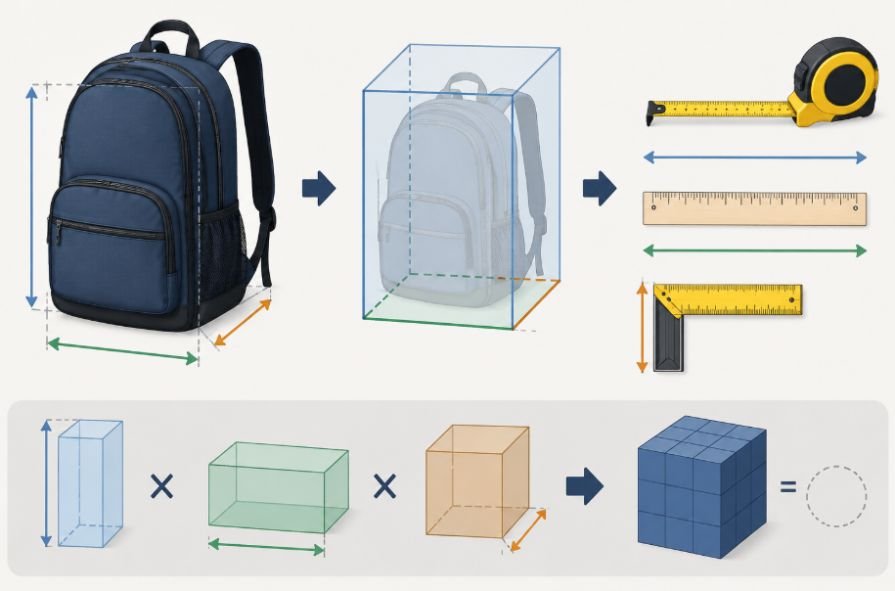
If a backpack does not provide a capacity rating, I can estimate its volume from its dimensions.
The formula is:
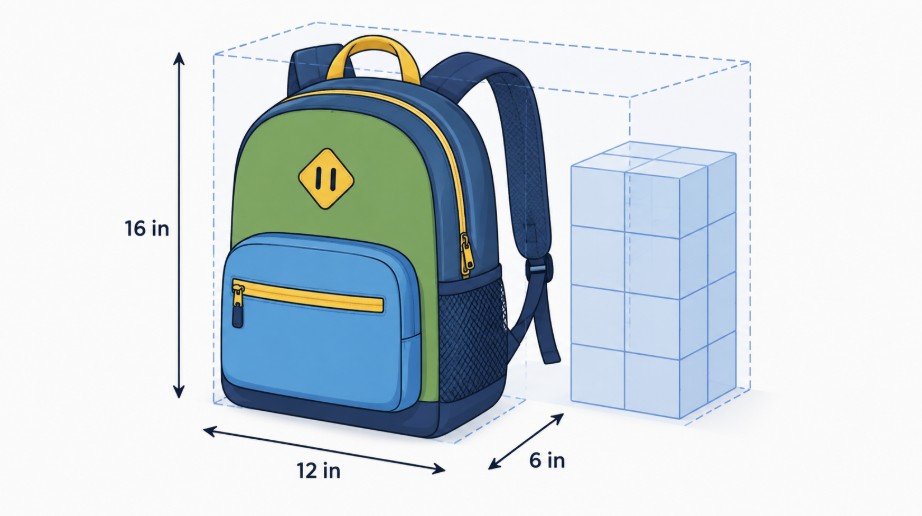
Height in inches × Width in inches × Depth in inches ÷ 1,728 = Cubic Feet
Suppose a school backpack measures 18 inches high, 12 inches wide, and 7 inches deep.
Multiplying 18 × 12 × 7 gives 1,512 cubic inches. Dividing 1,512 by 1,728 gives approximately 0.88 cubic feet.
This formula provides a useful estimate when shopping online or comparing several backpacks.
The same length × width × depth ÷ 1,728 approach works for any soft-sided bag I use the same method in my suitcase sizing guide when comparing “medium” vs “large” luggage labels that don’t actually tell you much.
Why Can Actual Backpack Capacity Be Smaller?
The calculation above assumes that a backpack is a perfect rectangular box. Real backpacks are not.
Rounded corners, padding, reinforced panels, laptop sleeves, curved tops, internal dividers, and thick fabric all reduce usable storage space. Exterior pockets may increase the bag’s overall dimensions without adding the same amount of usable main-compartment volume.
That is why I treat a dimensions-based calculation as an estimate. Two backpacks with identical exterior measurements can hold different amounts depending on their shape and internal organization.
A standard backpack may measure around 18 to 20 inches tall, 12 to 14 inches wide, and 6 to 8 inches deep, but its advertised internal capacity could still vary considerably.
Is a 1-Cubic-Foot Backpack Good for School?
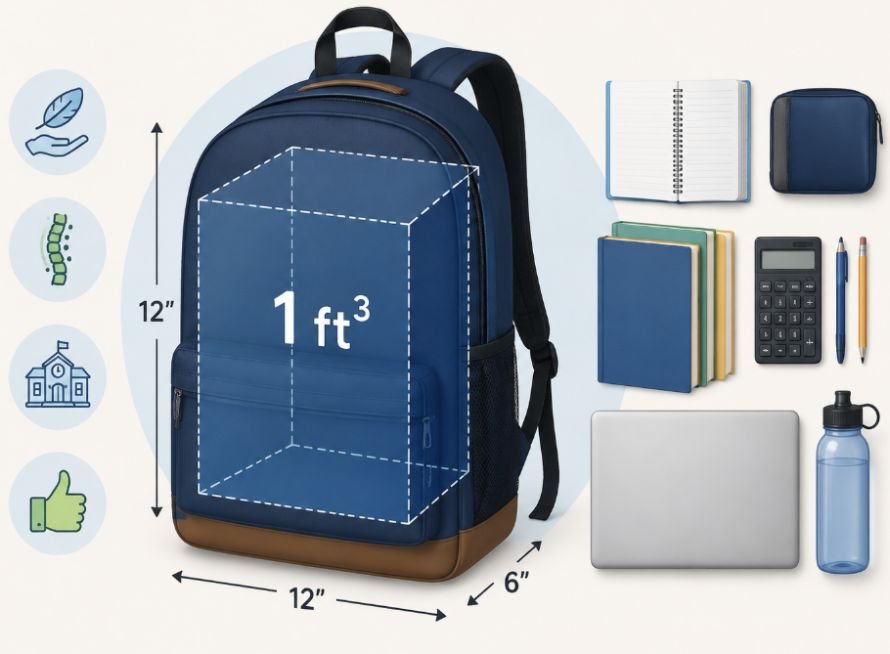
For many middle school, high school, and college students, one cubic foot is a very practical size.
One cubic foot equals about 28.3 liters, placing it squarely within the common school backpack capacity range. A backpack this size can usually accommodate notebooks, several books, a laptop, lunch, a water bottle, chargers, and smaller personal items.
For younger elementary students, however, one cubic foot may be unnecessarily large.
How Heavy Should a School Backpack Be?
Storage capacity tells me how much a backpack can hold, but it does not mean a student should fill every inch.
The American Academy of Pediatrics Healthy Children guidance says a child’s loaded backpack should generally weigh no more than about 15% of the child’s body weight. A 100-pound student, for example, should keep the loaded backpack around 15 pounds or less.
The same guidance recommends placing heavier books and computers closest to the body and using both shoulder straps. I would therefore prioritize fit, padded straps, sensible organization, and daily carrying weight just as much as total school bag volume.
Frequently Asked Questions
1. How Many Cubic Feet Is a School Bag?
A standard school bag is usually around 0.7 to 1.2 cubic feet, or roughly 20 to 35 liters. Smaller elementary backpacks can fall near 0.5 cubic feet, while larger high school and college backpacks may exceed 1.2 cubic feet.
2. How many cubic feet is a 20-liter backpack?
A 20-liter backpack holds approximately 0.71 cubic feet. This capacity works well for many students who carry notebooks, lunch, a few books, and smaller electronics.
3. How many cubic feet is a 30-liter school backpack?
A 30-liter backpack equals approximately 1.06 cubic feet. It is a common larger size for high school students who need room for books, binders, laptops, and extra gear.
4. What is the best school backpack size?
I would choose the size according to the student’s grade and daily load. Elementary students commonly need around 15 to 20 liters, middle and high school students often need 22 to 30 liters, and heavy-duty or college use can move into the 32- to 40-liter range.
Final Thoughts
When I compare school backpack sizes, I find that How Many Cubic Feet Is a School Bag? has a more useful answer when I think in ranges rather than one fixed number. Most standard school bags fall around 0.7 to 1.2 cubic feet, while smaller children’s backpacks may sit closer to 0.5 cubic feet and larger heavy-duty bags can reach 1.4 cubic feet.
For US students and parents, I would compare liters, cubic feet, exterior dimensions, fit, and daily carrying needs together. The best school backpack is not simply the largest one available. It is the bag that comfortably carries the student’s books, electronics, lunch, and school supplies without adding unnecessary bulk or weight.

Ryan Mitchell
Ryan Mitchell holds a degree in Civil Engineering and spent over a decade working in construction project estimation, where accurate volume and material calculations were part of his daily work — from concrete pours to landscaping material orders. He founded this site to bring that same precision to everyday calculations, helping DIYers, contractors, and students get fast, accurate cubic footage results without the guesswork. Ryan reviews every calculator and formula on this site for accuracy and writes guides based on real-world measurement scenarios he's encountered on job sites.