

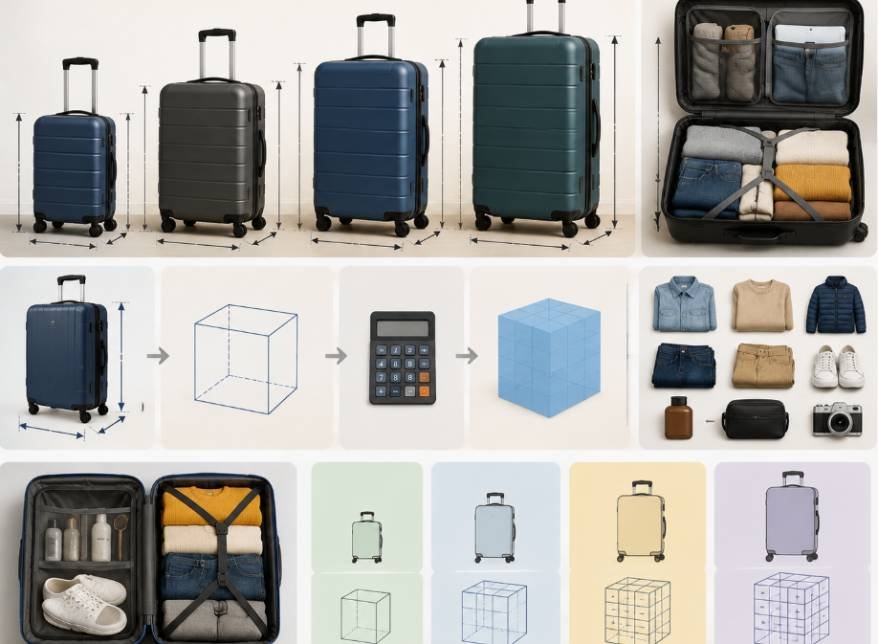
Suitcase sizes can be surprisingly misleading. A bag may be labeled “medium,” “large,” or “28-inch,” but those descriptions do not tell me exactly how much space I am getting. That is why I prefer looking at actual capacity before deciding what to pack or which bag to buy. So, How Many Cubic Feet Is a Suitcase?
Most standard suitcases hold about 1.5 to 4.5 cubic feet, with compact carry-ons near the lower end and large checked luggage or travel trunks reaching the upper end. Knowing that number makes it much easier to compare luggage sizes, estimate packing space, and understand how a suitcase will fit into a car trunk, closet, or other storage area.
Standard Suitcase Sizes in Cubic Feet
Because luggage capacity is commonly listed in liters, converting liters to cubic feet gives a practical comparison.
| Suitcase Type | Typical Capacity | Approx. Cubic Feet | Common Use |
| Underseat bag | 25–35 L | 0.9–1.2 ft³ | Short trips or personal-item packing |
| Carry-on suitcase | 40–45 L | 1.4–1.6 ft³ | Overhead-bin travel |
| Medium checked bag | 60–75 L | 2.1–2.6 ft³ | About a one-week trip |
| Large checked bag | 90–110 L | 3.2–3.9 ft³ | About a two-week trip |
| Extra-large trunk | 120+ L | 4.2+ ft³ | Long trips, moving, or bulky gear |
How Do You Calculate Suitcase Cubic Feet?

If I know the capacity in liters, I divide the number of liters by 28.32:
Liters ÷ 28.32 = cubic feet
For example, 45 liters ÷ 28.32 = about 1.59 cubic feet.
If I only know the exterior dimensions, I use:
Length × Width × Height ÷ 1,728 = cubic feet
There are 1,728 cubic inches in one cubic foot. A 22 × 14 × 9-inch suitcase equals 2,772 cubic inches, or about 1.60 cubic feet.
This cubic inches to cubic feet formula works for carry-ons, checked luggage, travel bags, and trunks.
How Many Cubic Feet Is a Carry-On Suitcase?
A typical carry-on suitcase rated at 40 to 45 liters provides roughly 1.4 to 1.6 cubic feet of capacity. A 22 × 14 × 9-inch bag also occupies about 1.60 cubic feet when treated as a rectangular exterior box.
American Airlines currently states that a carry-on cannot exceed 22 × 14 × 9 inches, including handles and wheels. That makes exterior measurements especially important even when two bags advertise similar carry-on suitcase capacity.
How Much Space Does a Medium or Large Checked Suitcase Have?
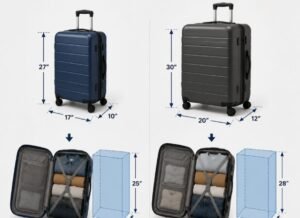
A medium checked bag of 60 to 75 liters converts to roughly 2.1 to 2.6 cubic feet and often works well for a one-week trip. A large 90- to 110-liter suitcase converts to about 3.2 to 3.9 cubic feet and may suit a two-week trip, depending on what I pack.
A 28-inch suitcase does not have one fixed volume because “28-inch” usually describes only its height. For example, a 28 × 20 × 12-inch suitcase has an exterior rectangular volume of about 3.89 cubic feet. A wider or deeper 28-inch model could hold more.
Why Exterior Volume and Actual Packing Capacity Differ
A dimension-based calculation treats a suitcase like a perfect box. Real luggage has rounded corners, shell thickness, wheels, telescoping-handle channels, liners, dividers, and reinforcement, all of which reduce usable interior space.
That is why exterior cubic feet may not match the manufacturer’s advertised liter capacity. Exterior volume estimates how much physical space the suitcase occupies, while the liter rating is usually intended to represent usable luggage capacity.
This same gap between labeled capacity and actual volume can also appear with storage totes, so understanding plastic container capacity can help when converting gallons to cubic feet.
Do US Airlines Measure Luggage in Cubic Feet?
Generally, no. US airlines typically use exterior dimensions for carry-ons and linear inches for checked baggage.
Linear inches are calculated by adding length, width, and height. A bag measuring 30 × 20 × 12 inches equals 62 linear inches because 30 + 20 + 12 = 62.
American Airlines currently lists 62 inches as the standard maximum total outside dimensions for checked baggage on most routes. Delta also states that standard checked baggage must not exceed 62 inches when length, width, and height are totaled.
For US travelers, this distinction matters. Cubic feet tell you about suitcase volume, while linear inches help determine whether checked luggage falls within an airline’s standard size limit.
Liters vs. Cubic Feet: Which Is Better for Luggage?

Liters are usually more useful for comparing how much different suitcases can hold because luggage manufacturers commonly publish capacity in liters. Cubic feet are useful when comparing a suitcase with a car trunk, closet, moving box, or storage space.
One cubic foot equals about 28.32 liters. A 100-liter suitcase is therefore about 3.53 cubic feet.
Neither measurement replaces exterior dimensions when airline compliance matters, so I prefer to check luggage capacity, suitcase dimensions, and airline size limits separately.
Frequently Asked Questions
1. How Many Cubic Feet Is a Suitcase?
Most standard suitcases range from about 1.5 to 4.5 cubic feet. Carry-ons generally fall near 1.4 to 1.6 cubic feet, medium checked bags around 2.1 to 2.6 cubic feet, and large checked bags around 3.2 to 3.9 cubic feet.
2. How many cubic feet is a 28-inch suitcase?
It depends on all three dimensions. A 28 × 20 × 12-inch suitcase has an exterior volume of about 3.89 cubic feet, but another 28-inch bag could have a different capacity if its width or depth changes.
3. How do I convert suitcase liters to cubic feet?
Divide the capacity in liters by 28.32. A 90-liter suitcase, for example, equals approximately 3.18 cubic feet.
4. Should I include wheels and handles when measuring luggage?
Yes, especially when checking airline size limits. Fixed wheels and handles contribute to a suitcase’s exterior dimensions and may count toward an airline’s maximum measurements.
Final Takeaway
When I compare luggage, I use cubic feet to understand overall volume, liters to compare packing capacity, and exterior measurements to check airline limits. A carry-on usually falls around 1.4 to 1.6 cubic feet, while large checked luggage can reach roughly 3.2 to 3.9 cubic feet and extra-large trunks can exceed 4.2 cubic feet.
The math is simple: divide liters by 28.32, or multiply length, width, and height in inches and divide by 1,728. To make these calculations easier, I use a calculate cubic feet of luggage tool to quickly estimate suitcase volume. That gives me a clearer picture of luggage capacity than relying only on labels such as “medium,” “large,” or “28-inch.”

Ryan Mitchell
Ryan Mitchell holds a degree in Civil Engineering and spent over a decade working in construction project estimation, where accurate volume and material calculations were part of his daily work — from concrete pours to landscaping material orders. He founded this site to bring that same precision to everyday calculations, helping DIYers, contractors, and students get fast, accurate cubic footage results without the guesswork. Ryan reviews every calculator and formula on this site for accuracy and writes guides based on real-world measurement scenarios he's encountered on job sites.