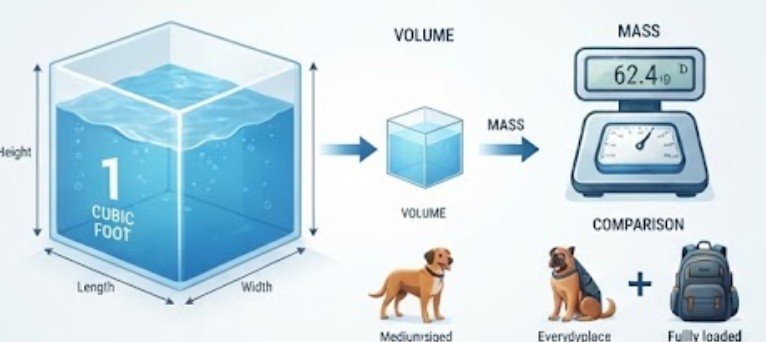

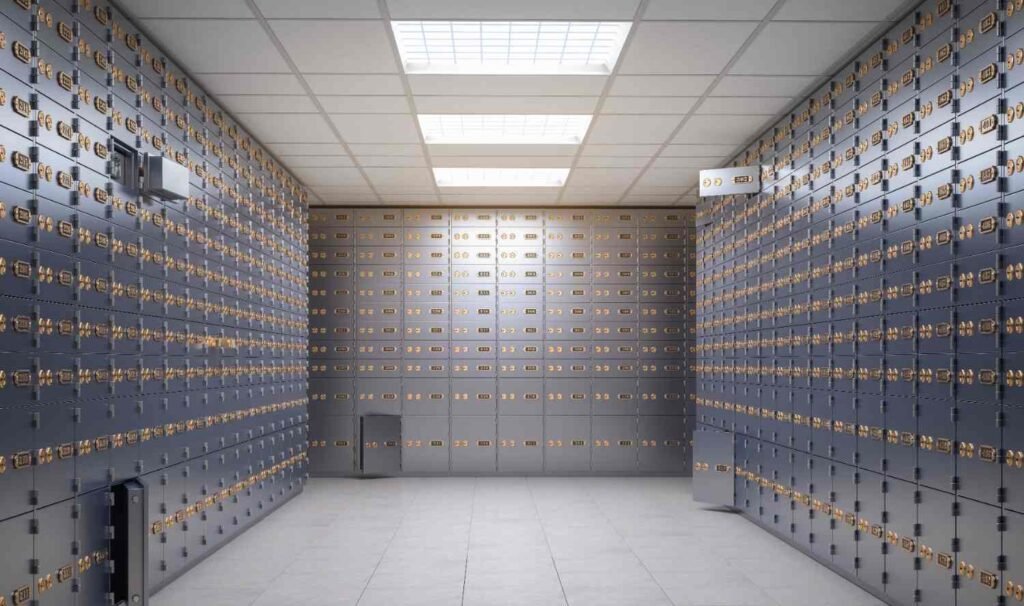
A storage locker can look surprisingly roomy until boxes, luggage, and seasonal gear start filling the available height. That is why I prefer to look beyond floor dimensions and calculate the full volume before renting one. So, How Many Cubic Feet Is a Storage Locker? Most storage lockers in the US provide about 12 to 125 cubic feet, while an 80-cubic-foot locker is a common mid-size example.
The actual capacity depends heavily on the locker’s length, width, and reduced ceiling height, which is often only 3 to 5 feet. Knowing those numbers upfront makes it much easier to choose enough space without paying for a larger unit than I really need.
What Are the Most Common Storage Locker Sizes?
Storage locker dimensions vary by facility, but several size ranges are common across US self-storage providers.
| Locker Size | Typical Height | Approximate Volume | Best For |
| 2 × 2 to 3 × 3 ft | 3–5 ft | 12–45 cu ft | Luggage, backpacks, small boxes |
| 4 × 5 ft | About 4 ft | About 80 cu ft | Boxes, seasonal items, sports gear |
| 5 × 5 ft | 4–5 ft | 100–125 cu ft | More boxes, compact furniture |
A 4-by-5-foot locker with a 4-foot ceiling provides 80 cubic feet. A 5-by-5 locker can provide 100 to 125 cubic feet depending on height. Very small reduced-height lockers may offer only about 12 cubic feet.
How Do I Calculate Storage Locker Cubic Feet?
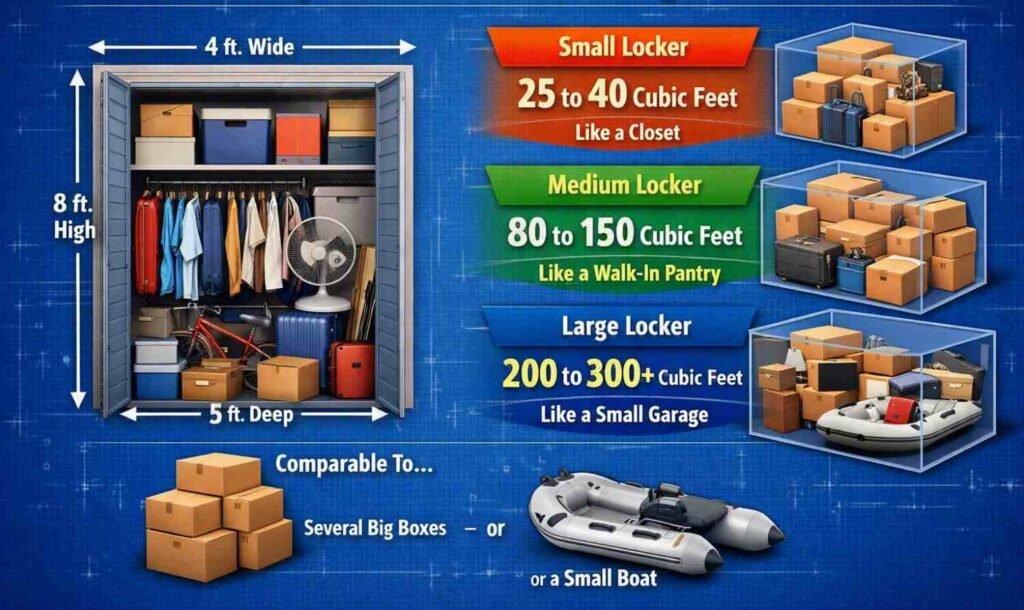
I use one simple formula when dimensions are given in feet:
Length × Width × Height = Cubic Feet
A 4-by-5-by-4-foot locker gives me:
4 × 5 × 4 = 80 cubic feet
A 5-by-5-by-5-foot locker gives me 125 cubic feet.
How Do I Calculate Cubic Feet From Inches?
When measurements are listed in inches, I multiply length, width, and height and divide by 1,728:
Length × Width × Height ÷ 1,728 = Cubic Feet
For example, 48 × 60 × 48 inches equals 138,240 cubic inches. Divide by 1,728, and the result is 80 cubic feet.
What Is the Difference Between Square Feet and Cubic Feet?
Square footage measures floor area, while cubic footage measures total three-dimensional volume. I find cubic footage more useful for storage because vertical space determines how many boxes and stackable items I can actually fit.
A 5-by-5 locker has 25 square feet of floor space. With a 4-foot ceiling, it contains 100 cubic feet. A standard 5-by-5 unit with an 8-foot ceiling has the same floor area but about 200 cubic feet of volume.
Is a Storage Locker Smaller Than a Standard Storage Unit?
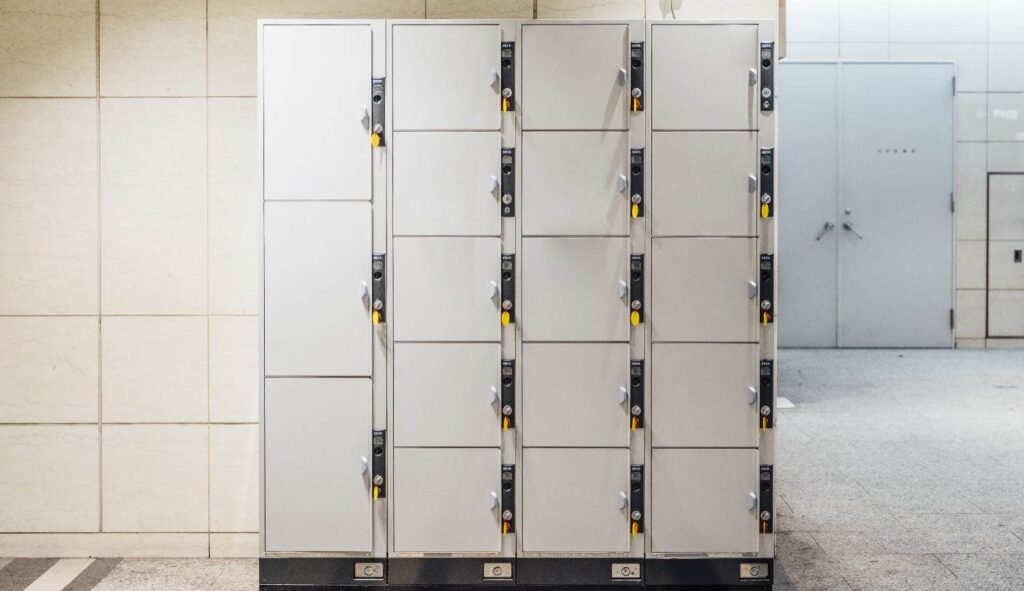
Usually, yes. Storage lockers typically have reduced ceilings, while standard units offer full-height space for taller belongings and larger furniture.
| Unit Type | Floor Dimensions | Approx. Height | Approx. Volume |
| Storage locker | 4 × 5 or 5 × 5 ft | About 4 ft | 80–125 cu ft |
| Standard small unit | 5 × 5 ft | About 8 ft | 200 cu ft |
| Standard walk-in unit | 5 × 10 ft | About 8 ft | 400 cu ft |
I would choose a locker for compact storage. If I needed room for mattresses, couches, major appliances, or several furniture pieces, I would usually move up to a standard 5-by-5 or 5-by-10 unit.
What Can I Fit Inside an 80- to 125-Cubic-Foot Locker?
An 80- to 125-cubic-foot locker can work well for decluttering a bedroom, apartment, dorm, or garage. Depending on box size and stacking efficiency, it may hold roughly 10 to 15 standard packing boxes plus seasonal clothing, shoes, holiday decorations, luggage, and documents.
Sports gear such as skis, golf clubs, or surfboards may fit when the door opening allows it. Small stackable furniture, folding chairs, or a disassembled desk may also fit.
Cubic volume does not guarantee that every item will fit. A long surfboard or wide chair may exceed the locker opening even when the total cubic footage appears sufficient.
Why Is Usable Storage Capacity Sometimes Lower?
Calculated volume assumes a perfect rectangular space. Real lockers may include door hardware, framing, fixed shelving, support beams, or other features that reduce usable storage space. If I plan to store equipment, I also check the size of a generator or any other bulky item separately, since its shape can affect how efficiently the locker can be packed.
The shape of my belongings matters too. Moving boxes stack efficiently, while bicycles, chairs, sports equipment, and oddly shaped furniture leave gaps. I treat advertised cubic footage as an estimate rather than a guarantee that every cubic foot can be used.
How Do I Choose the Right Storage Locker Size?
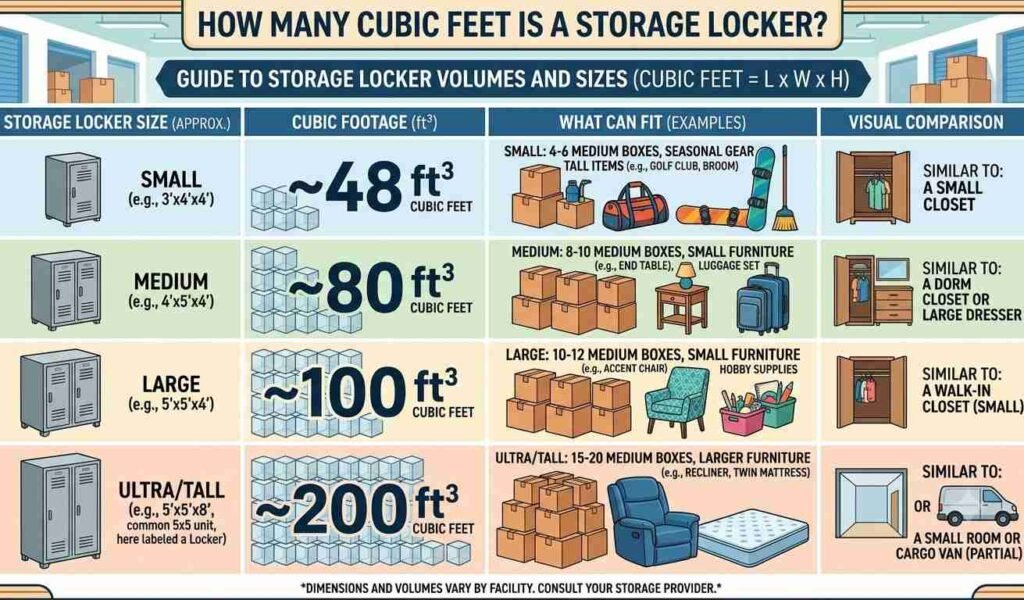
I first measure my largest item and make sure it can pass through the locker door. Then I estimate how many boxes and other belongings I need to store and whether they can be stacked safely. If I am storing equipment, I also check bulky dimensions separately, since specifications such as the cubic feet of air compressor capacity do not necessarily reflect the physical space the machine occupies.
I also consider access because filling every inch can make retrieval difficult. For US renters, I would compare climate control, facility security, insurance requirements, rental terms, and prohibited-item policies before choosing.
Frequently Asked Questions About Storage Locker Capacity
1. How Many Cubic Feet Is a Storage Locker?
A standard locker can range from approximately 12 to 125 cubic feet, with around 80 cubic feet serving as a useful common reference. Actual capacity depends on length, width, and ceiling height.
2. How many cubic feet is a 5×5 storage locker?
A 5-by-5 locker contains 100 cubic feet with a 4-foot ceiling and 125 cubic feet with a 5-foot ceiling.
3. Is an 80-cubic-foot locker enough for moving boxes?
It can be. An 80-cubic-foot locker may hold roughly 10 to 15 packing boxes depending on box dimensions, stacking efficiency, and what else you store.
4. Should I rent a locker or a 5×10 storage unit?
I would use a locker for boxes, seasonal belongings, luggage, sports equipment, and compact furniture. A 5-by-10 unit is more practical for larger furniture, mattresses, appliances, or the contents of a small room.
Final Takeaway
I find storage decisions easier when I compare cubic volume instead of size labels alone. Storage lockers can range from tiny 12-cubic-foot spaces to larger models around 125 cubic feet, while 80 cubic feet is a practical reference for a medium reduced-height locker.
Before renting, I measure my belongings, calculate length × width × height, verify the door opening, and allow room for imperfect stacking. That helps me avoid paying for unnecessary space or choosing a locker that is too small.

Ryan Mitchell
Ryan Mitchell holds a degree in Civil Engineering and spent over a decade working in construction project estimation, where accurate volume and material calculations were part of his daily work — from concrete pours to landscaping material orders. He founded this site to bring that same precision to everyday calculations, helping DIYers, contractors, and students get fast, accurate cubic footage results without the guesswork. Ryan reviews every calculator and formula on this site for accuracy and writes guides based on real-world measurement scenarios he's encountered on job sites.