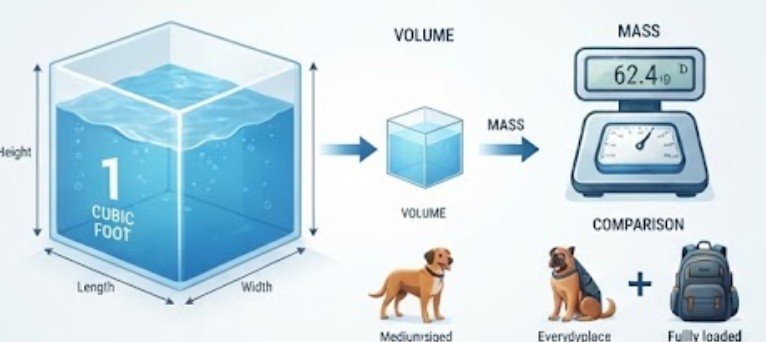
A single cubic foot of water is heavy enough to crush a cardboard box, strain a homeowner’s back, and cause structural sagging if improperly supported on a deck. While water feels light and fluid when you swim through it, standard tap water weighs roughly 62.4 pounds per cubic foot at room temperature.
That deceptively heavy density catches DIY builders, aquarium hobbyists, and home pool owners off guard every single day. Knowing how much does a cubic foot of water weigh isn’t just a high school physics question—it is a vital calculation for home engineering, plumbing, and structural safety.
Understanding the weight of water helps you calculate load capacities for everything from backyard hot tubs to indoor fish tanks.
The Core Math Behind Water’s Density
To get exact numbers, pure water at its maximum density (around 39.2°F or 4°C) weighs 62.42 pounds (28.32 kilograms) per cubic foot. At normal room temperature (around 70°F), that density drops slightly, bringing the weight to approximately 62.3 pounds per cubic foot.
Volume also changes how we visualize this weight. A single cubic foot is a three-dimensional cube measuring 12 inches on all sides. When filled with liquid, that single box holds about 7.48 US gallons of water.
Because one US gallon of liquid water weighs roughly 8.34 pounds, you can quickly double-check the math:
7.48 gallons × 8.34 lbs/gallon ≈ 62.38 lbs
Whether you are measuring by mass or total volume of an aquarium, fluid dynamic principles established by standard organizations like the U.S. Geological Survey show that liquid density is remarkably consistent under normal atmospheric pressure.
Key Factors That Change Water Weight
Water weight is not a fixed constant. Factors in your immediate environment continuously alter liquid density.
Temperature Effects
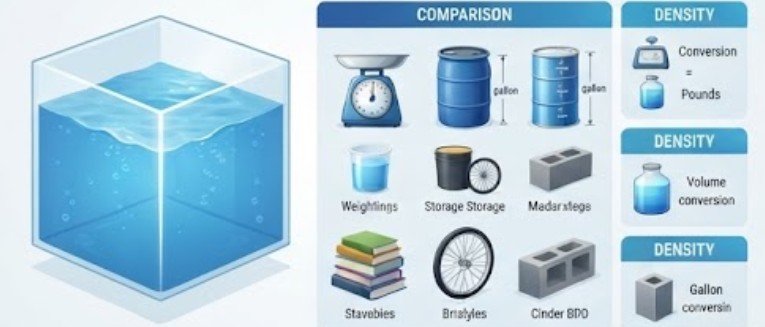
Water expands as it warms and contracts as it cools (until it hits its freezing point). Warmer water molecules move faster and push slightly further apart, making hot water less dense than cold water. A cubic foot of near-boiling water (200°F) weighs about 60.1 pounds—over two pounds lighter than its cold counterpart.
Purity and Salinity
Dissolved minerals add mass without significantly changing total volume. Ocean saltwater contains roughly 3.5% dissolved salts, pushing its weight up to about 64 pounds per cubic foot. If you are managing a saltwater reef tank or calculating boat displacement, that 2% to 3% increase makes a massive difference over large volumes.
Phase Changes (Ice vs. Water)
When water freezes into ice, it expands by roughly 9%. Because the same mass now occupies a larger volume (about 1.09 cubic feet), ice becomes less dense than liquid water, weighing only about 57.2 pounds per cubic foot. This expansion is why ice floats and why uninsulated outdoor pipes burst in winter.
Quick Reference: Water Weight and Volume Data
| Water Type / Condition | Weight per Cubic Foot | Weight per Gallon | Equivalent Gallons |
| Pure Water (39.2°F / 4°C) | 62.42 lbs (28.32 kg) | 8.34 lbs | 7.48 gal |
| Room Temp Water (70°F / 21°C) | 62.30 lbs (28.25 kg) | 8.33 lbs | 7.48 gal |
| Hot Water (140°F / 60°C) | 61.30 lbs (27.80 kg) | 8.20 lbs | 7.48 gal |
| Ocean Saltwater (Standard) | 64.00 lbs (29.03 kg) | 8.55 lbs | 7.48 gal |
| Solid Ice (32°F / 0°C) | 57.20 lbs (25.94 kg) | N/A (Solid) | N/A |
Why Water Density Matters in Daily Life

The weight of water in fish tank impacts real-world projects long before most people realize it. A modest 300-gallon hot tub, for instance, holds roughly 40 cubic feet of liquid. That equates to nearly 2,500 pounds of water alone—not including the weight of the tub or the people sitting inside it.
Placing that much weight on an elevated wooden deck without structural reinforcements can lead to catastrophic failure. Standard residential floors in the US are built to support a uniform live load of around 40 pounds per square foot, according to civil engineering guidelines from institutions like MIT School of Engineering. A simple 55-gallon aquarium exerts a localized load far exceeding those safety limits.
Plumbers, landscape architects, and pool builders constantly run these numbers to prevent soil collapse, pipe failure, and structural sagging.
How to Calculate Water Weight for Home Projects
Calculating total load before starting a DIY project is straightforward. Here is a simple three-step method to find the weight of any water-filled container:

- Find the total cubic volume: Measure the length, width, and depth of rectangular containers in feet, then multiply them together (\text{Length} \times \text{Width} \times \text{Depth} = \text{Cubic Feet}). For round containers, calculate \pi \times r^2 \times \text{depth}.
- Account for total gallons: If you only know the gallon capacity, divide the total gallons by 7.48to get cubic feet.
- Multiply by base density: Multiply your total cubic feet by 62.4to determine the water’s weight in pounds. Always add the weight of the empty container itself to get the final static load.
Common Misconceptions and Limitations
A common mistake beginners make is assuming all liquids weigh the same as water. Gasoline, for example, is much lighter at around 42 pounds per cubic foot, while milk is slightly heavier due to fats and proteins.
Another misconception is that water pressure increases its weight. While water pressure increases with depth due to the weight of the fluid stacked above it, the actual weight of an isolated cubic foot of water remains virtually unchanged because liquids are nearly incompressible.
Frequently Asked Questions
1. How much does a 5 gallon jug of water weigh?
A standard 5-gallon water jug weighs about 41.7 pounds (18.9 kg) for the water alone. When you include the weight of the plastic container, the total weight is around 43 pounds.
2. How much does 1 cubic foot of water weigh in pounds?
One cubic foot of pure water weighs approximately 62.4 pounds at standard room temperature. Cold water at its maximum density weighs slightly more, at 62.42 pounds.
3. Is a gallon of water heavier than a gallon of ice?
Yes, a gallon of liquid water is heavier than a gallon of ice. Water expands when it freezes, making ice less dense. A gallon of liquid water weighs 8.34 pounds, while a gallon of ice weighs roughly 7.64 pounds.
4. How much does 200 lb of water weigh?
Two hundred pounds of water weighs exactly 200 pounds. In terms of volume, 200 pounds of room-temperature water equals roughly 24 gallons or about 3.2 cubic feet.
Summary
Understanding how much a cubic foot of water weighs comes down to respecting the hidden density of everyday liquids. At roughly 62.4 pounds per cubic foot, water is surprisingly heavy, and its weight builds up rapidly as volume increases. Whether you are installing an aquarium, setting up a rain barrel system, or building a back deck, keeping temperature, purity, and total volume in mind will protect your home and keep your projects structurally safe.

Ryan Mitchell
Ryan Mitchell holds a degree in Civil Engineering and spent over a decade working in construction project estimation, where accurate volume and material calculations were part of his daily work — from concrete pours to landscaping material orders. He founded this site to bring that same precision to everyday calculations, helping DIYers, contractors, and students get fast, accurate cubic footage results without the guesswork. Ryan reviews every calculator and formula on this site for accuracy and writes guides based on real-world measurement scenarios he's encountered on job sites.