
A filing cabinet can look deceptively compact until I try to fit one into a moving truck, storage unit, or crowded office corner. That is when drawer count stops being useful and cubic feet becomes the number that really matters.
So, How Many Cubic Feet Is a Filing Cabinet? Depending on its design, a vertical filing cabinet can occupy roughly 5 to 20 cubic feet of exterior space, while wider lateral models may require considerably more room.
The actual space available for documents is much smaller, which is why moving-volume estimates and records-storage figures often seem to contradict each other. In this guide, I’ll break down both measurements so you can quickly estimate the space your cabinet actually needs.
How Many Cubic Feet Does a Standard Filing Cabinet Take Up?
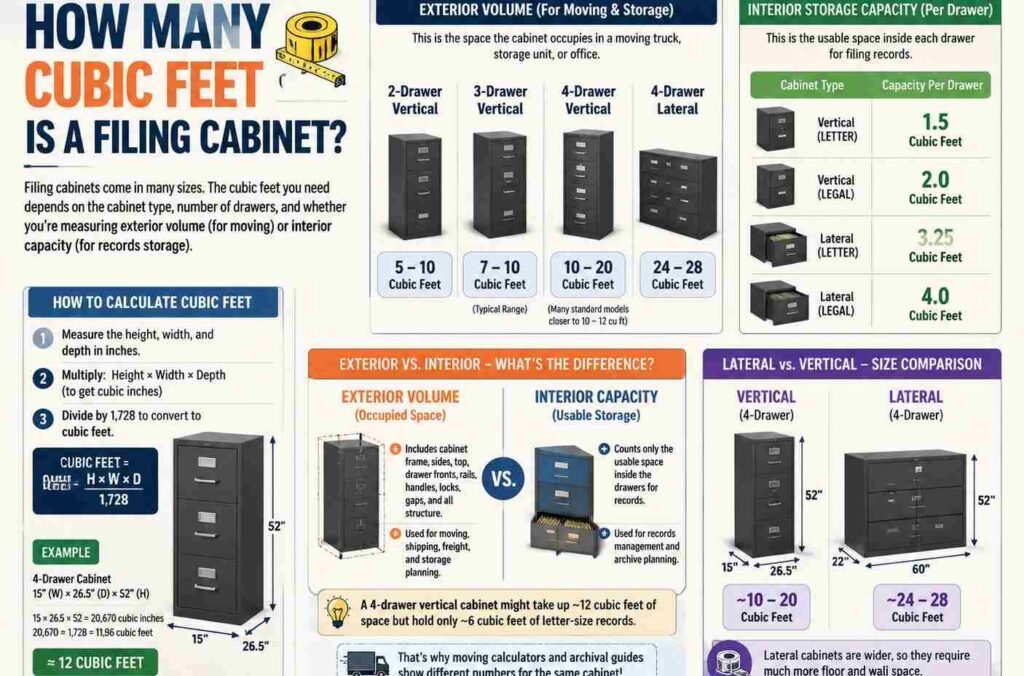
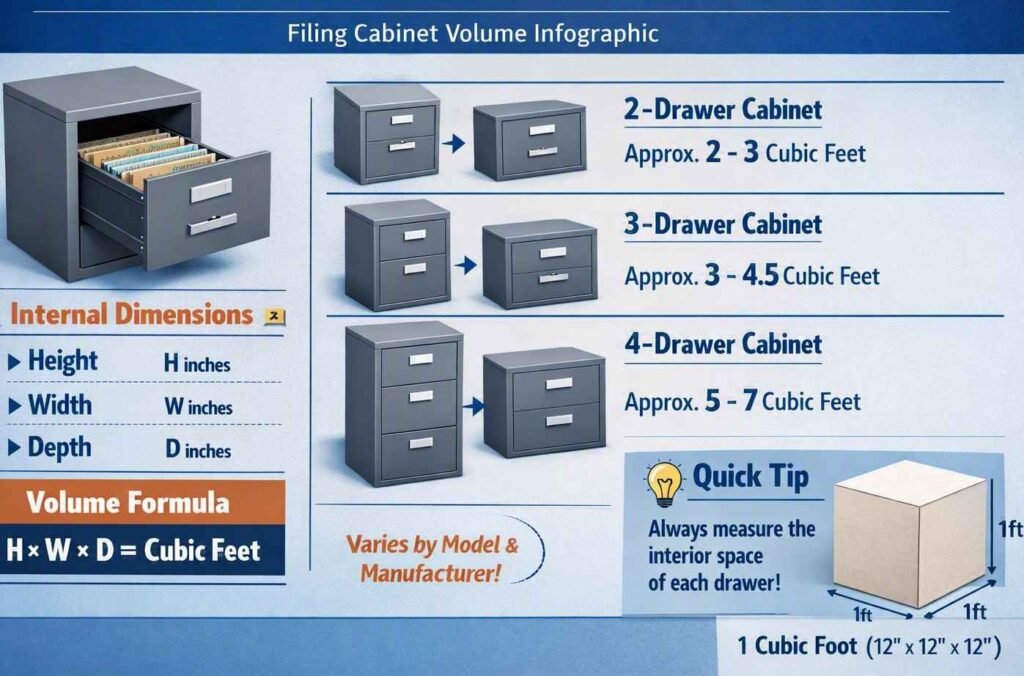
There is no universal filing cabinet volume because manufacturers sell compact two-drawer units, deep commercial cabinets, and wide lateral systems. A two-drawer vertical cabinet may occupy approximately 5 to 10 cubic feet. A four-drawer vertical filing cabinet commonly requires around 10 to 20 cubic feet, while many narrower models measure closer to 10 to 12 cubic feet.
A large four-drawer lateral filing cabinet can occupy about 24 to 28 cubic feet. Its wider body explains why lateral cabinets take considerably more wall and floor space than traditional vertical models. Just as the size of a generator affects how much floor or storage space it needs, filing cabinet dimensions determine the total cubic footage required.
For example, a four-drawer cabinet measuring 15 inches wide, 26.5 inches deep, and 52 inches high has an exterior volume of about 12 cubic feet. That figure is useful for moving, storage, and office planning.
How Much File Storage Capacity Does Each Drawer Hold?

Interior filing cabinet capacity measures the records that fit inside the drawers rather than the complete cabinet shell.
A standard vertical letter-size drawer holds approximately 1.5 cubic feet of records. A vertical legal-size drawer holds about 2 cubic feet. A four-drawer letter-size cabinet can therefore store around 6 cubic feet of records, while a four-drawer legal-size cabinet can hold around 8 cubic feet.
Lateral filing cabinets offer more document storage. A lateral letter-size drawer may hold about 3.25 cubic feet, while a lateral legal-size drawer can hold about 4 cubic feet. These figures help estimate archive space and records-retention needs.
Why Is Exterior Cabinet Volume Higher Than Record Capacity?
I always separate occupied space from usable storage because these measurements answer different questions.
Exterior cubic footage includes the cabinet frame, drawer faces, rails, locks, handles, gaps, and other structural components. Interior capacity only counts usable record space. A similar approach is useful when estimating the cubic-foot size of an air compressor, where the machine’s outside dimensions can differ from the volume of its tank or usable capacity.
That is why a four-drawer vertical cabinet might occupy about 12 cubic feet on a moving truck but hold only about 6 cubic feet of letter-size records.
This explains why moving calculators and archival guides can show different numbers for the same cabinet.
How Do I Calculate Filing Cabinet Cubic Feet?
If I know the exact dimensions, I prefer calculating the volume rather than relying on a generic range.
What Formula Should I Use?
Measure the cabinet’s width, depth, and height in inches. Multiply the three measurements, then divide by 1,728 because one cubic foot contains 1,728 cubic inches.
Width × Depth × Height ÷ 1,728 = cubic feet
For a cabinet measuring 15 × 26.5 × 52 inches:
15 × 26.5 × 52 = 20,670 cubic inches
20,670 ÷ 1,728 = approximately 11.96 cubic feet
I would treat that cabinet as roughly 12 cubic feet for moving and storage purposes. Handles or projections can make the result an estimate rather than an exact usable-space figure.
Is a Lateral Filing Cabinet Bigger Than a Vertical Cabinet?
Usually, yes. A vertical file cabinet is narrow and works well where wall width is limited. A lateral filing cabinet uses wider drawers and can accommodate more records.
A four-drawer lateral cabinet can occupy approximately 24 to 28 cubic feet externally, compared with roughly 10 to 20 cubic feet for many four-drawer vertical cabinets.
Before choosing one, I also check drawer-opening clearance. Cubic footage tells me total volume, but it does not show whether an open drawer will block a walkway, desk, or door.
Which Cubic-Foot Measurement Should I Use for Moving or Records Storage?
For moving, shipping, freight, and self-storage, I use exterior dimensions because the entire cabinet occupies space. I also leave extra room for furniture blankets, handles, irregular shapes, and access paths.
For records management, I use internal drawer capacity. Letter-size and legal-size records have different volume estimates, and lateral drawers usually hold more than vertical drawers.
That distinction makes filing cabinet dimensions easier to compare.
Frequently Asked Questions (FAQs)
1. How Many Cubic Feet Is a Filing Cabinet?
A filing cabinet can occupy roughly 5 to 20 cubic feet depending on its design and drawer count. Smaller vertical models may fall around 6 to 10 cubic feet, while four-drawer vertical cabinets commonly range from about 10 to 20 cubic feet externally.
2. How many cubic feet of files fit in a four-drawer cabinet?
A four-drawer vertical letter-size cabinet holds approximately 6 cubic feet of records. A four-drawer legal-size cabinet holds around 8 cubic feet based on standard per-drawer estimates.
3. How much can a lateral filing cabinet hold?
A lateral letter-size drawer may hold about 3.25 cubic feet of records, while a lateral legal-size drawer may hold around 4 cubic feet. Exact capacity depends on the cabinet configuration.
4. Can I calculate file cabinet volume from its dimensions?
Yes. Multiply the exterior width, depth, and height in inches and divide the total by 1,728. The result is the cabinet’s approximate exterior volume in cubic feet.
Final Thoughts
When I estimate filing cabinet space, I first decide whether I need exterior volume or actual document-storage capacity. For moving and storage planning, outside dimensions matter most. For archives and office records, drawer capacity provides the more useful number.
By separating these measurements and using the cubic-foot formula when exact dimensions are available, I can compare filing cabinet sizes more accurately and choose a cabinet that fits both my space and filing needs.

Ryan Mitchell
Ryan Mitchell holds a degree in Civil Engineering and spent over a decade working in construction project estimation, where accurate volume and material calculations were part of his daily work — from concrete pours to landscaping material orders. He founded this site to bring that same precision to everyday calculations, helping DIYers, contractors, and students get fast, accurate cubic footage results without the guesswork. Ryan reviews every calculator and formula on this site for accuracy and writes guides based on real-world measurement scenarios he's encountered on job sites.