A surprising thing about volume problems is that the missing measurement is often easier to find than it looks. A large coal bin holding 750 cubic feet of material may sound complicated, but with three simple measurements, the answer becomes clear. If a bin when full holds 750 cubic feet of coal, how many feet deep is it, if it is 15 feet long and 10 feet across? The depth is 5 feet.
This type of question teaches an important math skill: working backward from volume to find an unknown dimension. The same idea is used in construction, storage planning, shipping, farming, and engineering whenever people need to understand how much space an object or container can hold.
Understanding the Coal Bin Volume Problem
A bin filled with coal can be treated like a rectangular prism if its length, width, and depth are straight measurements. A rectangular prism follows a simple volume formula:
Volume = Length × Width × Depth
In this example, the total volume is already known:
- Volume = 750 cubic feet
- Length = 15 feet
- Width = 10 feet
- Depth = unknown
The goal is to isolate the missing depth measurement.
Many students struggle with these problems because they see cubic feet and think the calculation requires advanced geometry. In reality, it is a matter of rearranging the formula and using basic division.
The Step-by-Step Calculation to Find the Depth
The first step is finding the area of the bottom surface of the bin.
The bottom is a rectangle, so multiply length by width:
15 feet × 10 feet = 150 square feet
This means the base of the bin covers 150 square feet of floor space.
Next, divide the total volume by the base area:
750 cubic feet ÷ 150 square feet = 5 feet
The missing dimension is the depth.
So, a coal bin that holds 750 cubic feet of coal and measures 15 feet long by 10 feet across must be 5 feet deep.
Why Volume Problems Matter Beyond the Classroom
Students often ask why they need to learn formulas like this. The answer is that volume calculations appear everywhere in real life.
A warehouse manager may calculate how much material fits inside a storage container. The same calculation can help determine the capacity of a plastic container, making it easier to compare storage options and estimate how much usable space is available.
A contractor may estimate concrete requirements for a foundation. Farmers may calculate storage capacity for grain bins. Even homeowners use volume measurements when filling garden beds, pools, or storage spaces.
Understanding cubic measurements helps people make accurate decisions instead of guessing. A small mistake in estimating space can lead to wasted materials, extra costs, or safety problems.
The National Institute of Standards and Technology explains the importance of accurate measurement systems in science, engineering, and everyday applications. Reliable measurements help industries maintain consistency and reduce errors. Learn more about measurement standards from National Institute of Standards and Technology.
Common Mistakes Students Make With Volume Calculations

Although the solution is simple, several mistakes can lead to the wrong answer.
One common error is adding the measurements instead of multiplying them. Volume measures three-dimensional space, so the dimensions must be multiplied.
Another mistake is forgetting the difference between square feet and cubic feet. The bottom area of the bin is measured in square feet because it has two dimensions. The total space inside the bin is measured in cubic feet because it includes length, width, and depth.
A third mistake is dividing too early. Students should first calculate the base area before dividing the total volume.
A quick way to remember the process is:
- Find the floor space of the container.
- Divide the total volume by that floor space.
- The result is the height or depth.
How to Solve Any Similar Storage Bin Problem
The coal bin example is part of a larger group of volume problems. The same method works for boxes, tanks, containers, and rooms.
It also works when estimating the cubic capacity of a tool box, since its internal space can be calculated from its length, width, and height.
Use this process:
Step 1: Identify the known measurements
Write down the volume and the dimensions you already know.
Example:
Volume = 900 cubic feet
Length = 20 feet
Width = 15 feet
Step 2: Calculate the base area
Multiply the two measurements that describe the bottom.
20 × 15 = 300 square feet
Step 3: Find the missing height
Divide:
900 ÷ 300 = 3 feet
The container would be 3 feet deep.
This method works because volume is simply the amount of three-dimensional space inside an object.
Real-World Comparison: How Deep Is 5 Feet?

A depth of 5 feet is easier to understand when compared with familiar objects. It is roughly the height of a tall refrigerator stacked with additional space, or about the height of an average adult lying down vertically.
For a coal storage bin, a 5-foot depth provides enough room to hold a significant amount of fuel while keeping the structure manageable for loading and unloading.
The actual design of coal storage areas can vary depending on factors such as the shape of the bin, the type of coal, and safety requirements. Industrial storage facilities may use sloped floors, reinforced walls, and different layouts that change the usable capacity.
Important Limitations of This Calculation
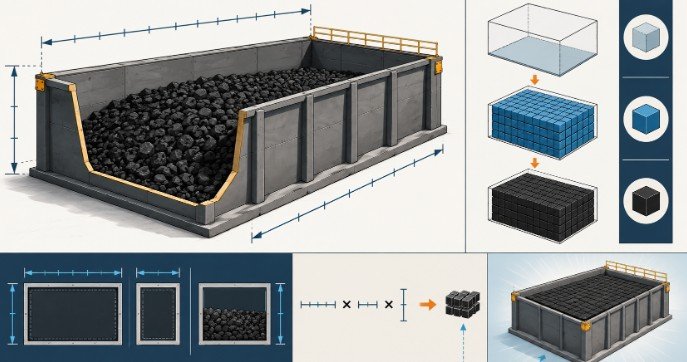
The 5-foot answer assumes the bin is a perfect rectangular prism. Real storage bins are not always shaped this way. Some bins have angled bottoms that help materials move toward an opening. Others may have curved walls or extra space that cannot be filled completely. In those cases, the true usable volume may be different.
The calculation also assumes the entire 750 cubic feet represents open storage space. If the bin has supports, machinery, or unused areas, the actual amount of coal it can hold may be lower.
For school math problems, however, the rectangular prism model is the correct approach. Students who want more practice with measurement concepts can explore educational resources from Khan Academy, which provides free lessons on geometry, volume, and mathematical reasoning.
Frequently Asked Questions
1. How deep is the coal bin in this problem?
The coal bin is 5 feet deep because 750 cubic feet divided by its 150-square-foot base area equals 5 feet.
2. What formula finds the depth of a rectangular bin?
Depth = Volume ÷ (Length × Width).
3. Why is volume measured in cubic feet?
Cubic feet measure three-dimensional space, including length, width, and height or depth.
4. Can this formula work for other containers?
Yes, if the container has a rectangular shape with straight sides.
Final Thoughts
A question like “if a bin when full holds 750 cubic feet of coal, how many feet deep is it, if it is 15 feet long and 10 feet across?” is more than a simple math exercise. It shows how volume connects measurements to real-world decisions. By breaking the problem into smaller steps, anyone can find the missing dimension with confidence. The key lesson is simple: when you know the space something occupies, you can work backward to discover the measurement you need.

Ryan Mitchell
Ryan Mitchell holds a degree in Civil Engineering and spent over a decade working in construction project estimation, where accurate volume and material calculations were part of his daily work — from concrete pours to landscaping material orders. He founded this site to bring that same precision to everyday calculations, helping DIYers, contractors, and students get fast, accurate cubic footage results without the guesswork. Ryan reviews every calculator and formula on this site for accuracy and writes guides based on real-world measurement scenarios he's encountered on job sites.