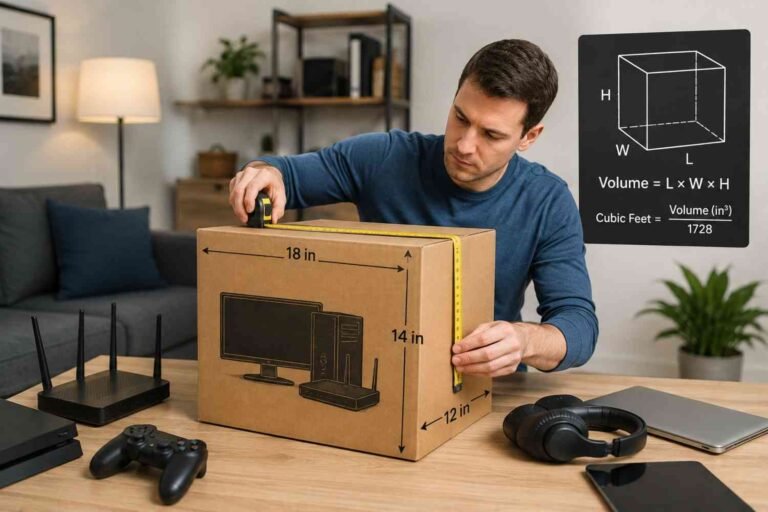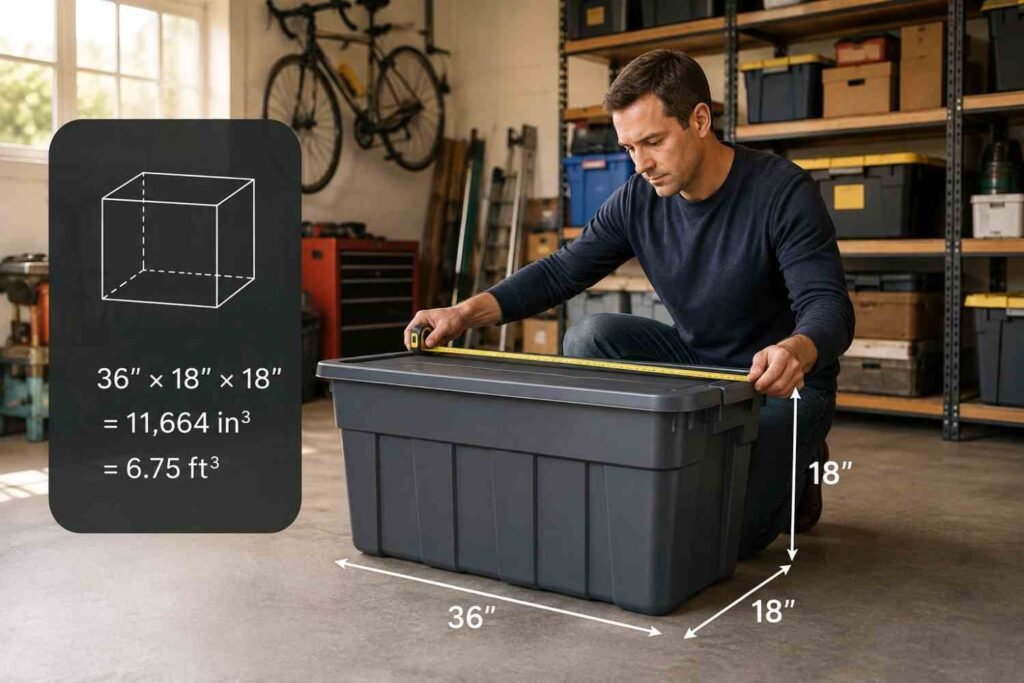
I used to think a storage bin’s gallon label told me almost everything I needed to know. Two containers with similar capacities can have very different shapes, dimensions, and usable space, making cubic feet useful for comparison.
I found the math easier than it sounds. Once the length, width, and height are measured, volume is quick to calculate. The tricky part is knowing which dimensions to use and understanding why the result may not match the capacity printed on the label.
What Cubic Feet Tells You About a Storage Bin
Cubic feet measures three-dimensional space. One cubic foot is a cube measuring 12 inches on every side. It represents space when length, width, and height work together.
For a rectangular storage bin, the formula is simple:
Length × width × height = cubic inches
Then divide that result by 1,728 to convert cubic inches into cubic feet. NIST lists 1,728 cubic inches as exactly one cubic foot. Storage bins are commonly measured in inches, while cubic feet makes larger containers easier to compare.
A bin that looks wide but has little height may hold less than a taller container with a smaller footprint. Cubic feet accounts for all three dimensions.
How to Calculate the Cubic Feet of a Storage Bin
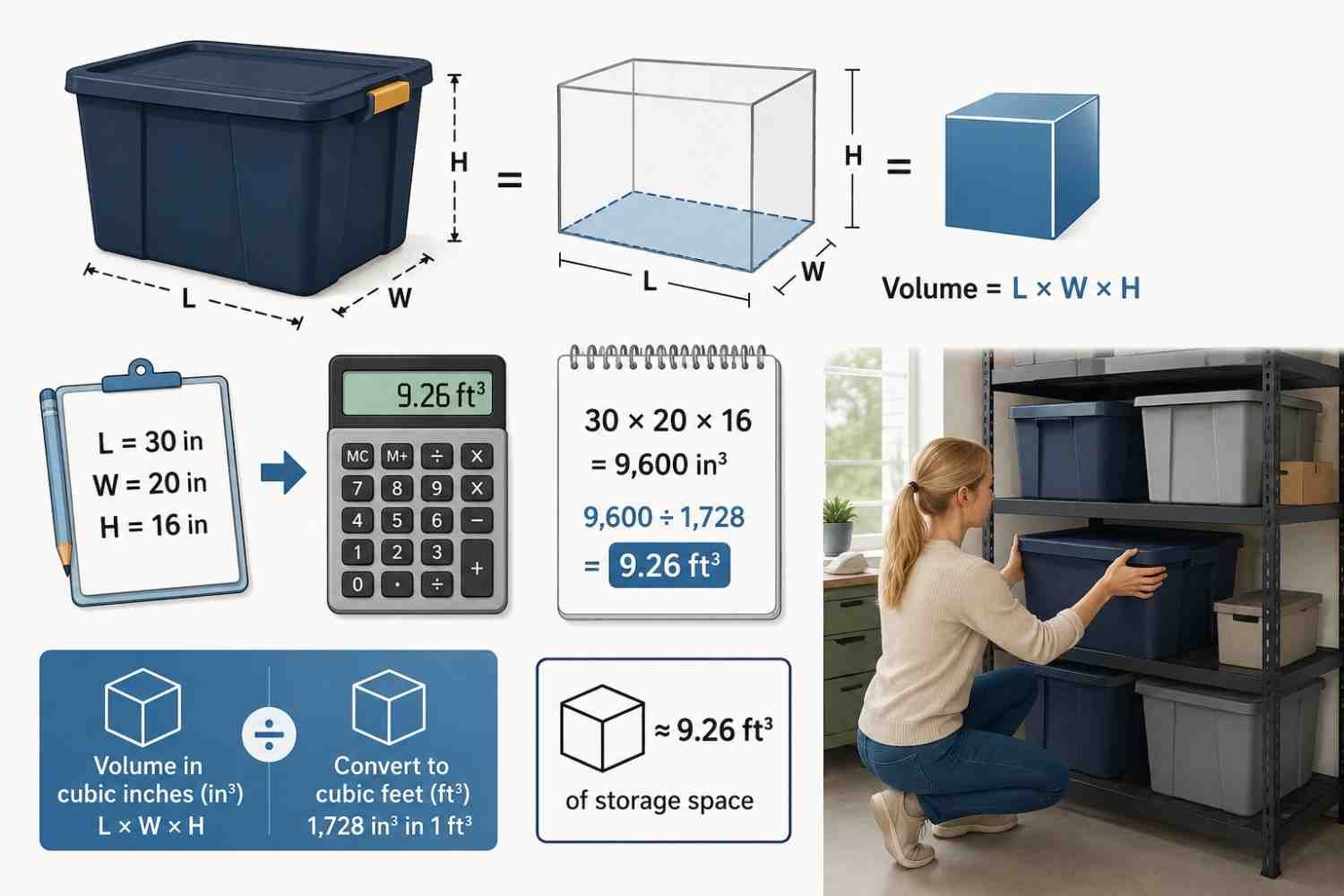
Suppose a rectangular bin measures 24 inches long, 16 inches wide, and 12 inches high. Multiply the measurements:
24 × 16 × 12 = 4,608 cubic inches.
Divide 4,608 by 1,728. The result is about 2.67 cubic feet.
That is the theoretical volume of a box with those dimensions. A real tote may hold less because walls taper, corners round off, or structural features take up room.
If you are measuring a bin yourself, use the interior dimensions when estimating usable storage space. Use exterior dimensions when deciding whether it will fit inside a closet, cabinet, garage shelf, or moving area.
Why the Number on the Label Can Look Different
Storage containers are often sold by gallon capacity, which can make cubic-foot calculations confusing. Gallons describe volume too, but use a different unit. One US gallon equals 231 cubic inches, so roughly 7.48 US gallons equal one cubic foot.
An 18-gallon storage bin therefore works out to about 2.41 cubic feet when converted mathematically. Yet a specific 18-gallon tote can produce a different figure when you multiply its exterior dimensions. That is not necessarily a mistake. Manufacturers can base capacity on interior geometry or the container’s usable design.
A current 18-gallon tote lists exterior dimensions of 23 1/2 by 18 3/8 by 16 1/8 inches and separate interior dimensions. Those measurements produce different volume figures. The distinction matters when estimating what you can pack.
Common Storage Bin Sizes in Cubic Feet
An 18-gallon bin is often around the 1.5 to 2.5 cubic-foot range for practical storage, depending on its shape and which measurements you use. It works well for closets, bedrooms, dorm rooms, and seasonal items.
Large 50-gallon totes are a different category. A current 50-gallon model has exterior dimensions of 40 by 22 1/8 by 18 1/8 inches. Multiplying those dimensions gives about 9.26 cubic feet of exterior geometric volume, while 50 gallons equals about 6.68 cubic feet. That gap shows why calculated volume is not automatically usable capacity.
Shape can matter as much as volume. A broad tote may suit blankets, while a taller bin can use vertical shelf space better.
Cubic Feet vs. Gallons, Quarts, and Boxes
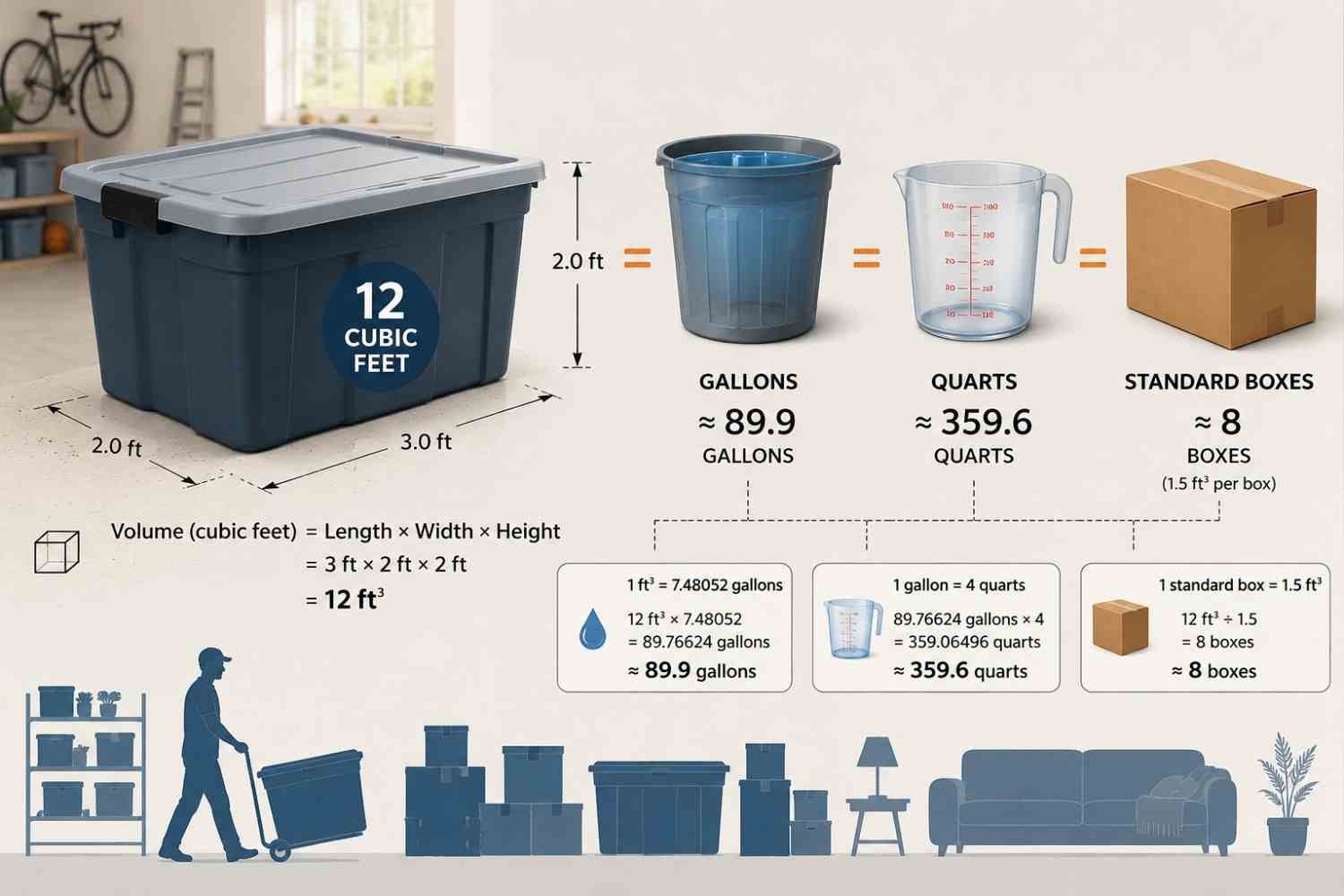
Gallons are convenient when shopping because many totes use that label. Cubic feet helps compare differently shaped containers.
This is also where box measurements become useful. If you are packing items into containers before a move, knowing the bin’s volume can help you compare it with the space available in a larger carton or vehicle. You can use the same basic calculation when learning How Many Cubic Feet Is a Shipping Box, although the box’s interior dimensions are usually more relevant to how much you can pack.
How to Choose a Storage Bin by Volume
Start with the items you plan to store, then consider the location. A huge bin may be difficult to lift, stack, or fit through a doorway.
For clothing and linens, medium or large totes can work well because soft items adapt to the available space. For tools, toys, and seasonal decorations, dimensions may matter more because rigid objects need usable width and height. Check the opening if you plan to store large objects.
Storage-bin capacity also matters when stacking. A bin with a recessed lid and straight sides can use vertical space efficiently, while a heavily tapered design may leave unused gaps between containers.
Before buying, compare interior dimensions, exterior dimensions, gallon capacity, and the available space. That tells you more than the label alone.
FAQs: How Many Cubic Feet Is a Storage Bin? What the Measurements Really Mean
1. How many cubic feet is an 18-gallon storage bin?
An 18-gallon volume converts to about 2.41 cubic feet. Usable space can be lower because bins have walls, tapered sides, lids, and internal features.
2. How many cubic feet is a 50-gallon storage bin?
Fifty US gallons equals about 6.68 cubic feet. Exterior dimensions can produce a larger figure because they include walls and structural space.
3. What is the easiest way to calculate cubic feet?
Multiply length, width, and height in inches, then divide by 1,728. For usable capacity, measure the interior rather than relying only on exterior dimensions.
4. Are cubic feet and gallons the same thing?
No. They measure volume using different units. One cubic foot equals about 7.48 US gallons, while one US gallon equals 231 cubic inches.
Why Measurements Matter More Than Labels
A storage bin’s label gives you a useful starting point, but dimensions tell the fuller story. Cubic feet lets you compare containers using one consistent measurement, while interior measurements reveal how much room you can realistically use. That distinction becomes valuable when storage space is tight and every inch matters.
The best choice is rarely the bin with the biggest number. If you also compare smaller containers, How Many Cubic Feet Is a Gift Box can help put packaging volume into perspective. It is the one whose capacity, shape, opening, and footprint fit both your belongings and your space. Once you understand the math, choosing the right container becomes a simpler decision.

Ryan Mitchell
Ryan Mitchell holds a degree in Civil Engineering and spent over a decade working in construction project estimation, where accurate volume and material calculations were part of his daily work — from concrete pours to landscaping material orders. He founded this site to bring that same precision to everyday calculations, helping DIYers, contractors, and students get fast, accurate cubic footage results without the guesswork. Ryan reviews every calculator and formula on this site for accuracy and writes guides based on real-world measurement scenarios he's encountered on job sites.