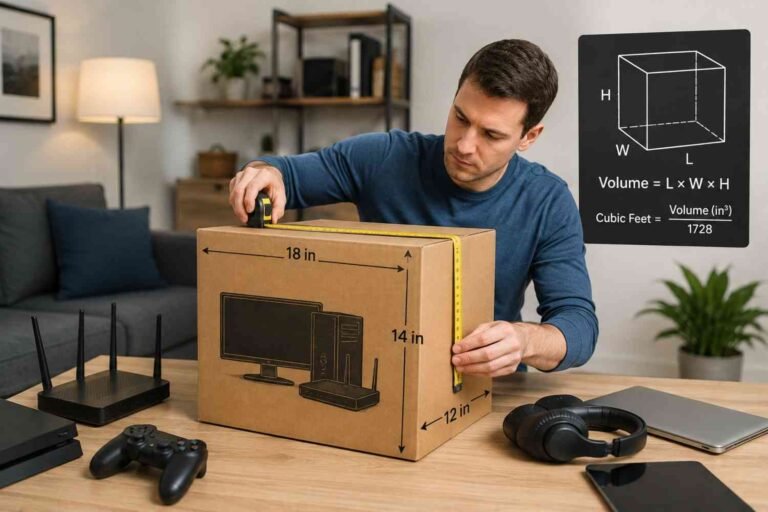
I used to think gift boxes were easy to size because most look compact on a shelf. Then I compared dimensions and realized that two boxes that seem similar can hold very different amounts. A few inches of extra width or height can change the volume quickly.
I also found cubic feet useful when comparing packaging sizes. It gives a consistent way to describe space when one box is square, and another is long and shallow. Once familiar, the calculation helps judge whether a box suits a shirt, candle, gift set, or several smaller items.
How Many Cubic Feet Is a Gift Box?
A typical gift box holds a fraction of a cubic foot rather than a full cubic foot. Small boxes may have only a few hundredths of a cubic foot, while larger boxes can approach or exceed half a cubic foot. There is no universal volume because dimensions vary by the item and packaging style.
For reference, a 5 × 5 × 3-inch box has about 0.043 cubic feet. A 9 × 9 × 3-inch box has about 0.141 cubic feet, while a 12 × 10 × 4-inch box contains about 0.278 cubic feet. A 15 × 15 × 7-inch box reaches about 0.911 cubic feet. These examples show why “small” or “large” tell you little about capacity.
How to Calculate Cubic Feet
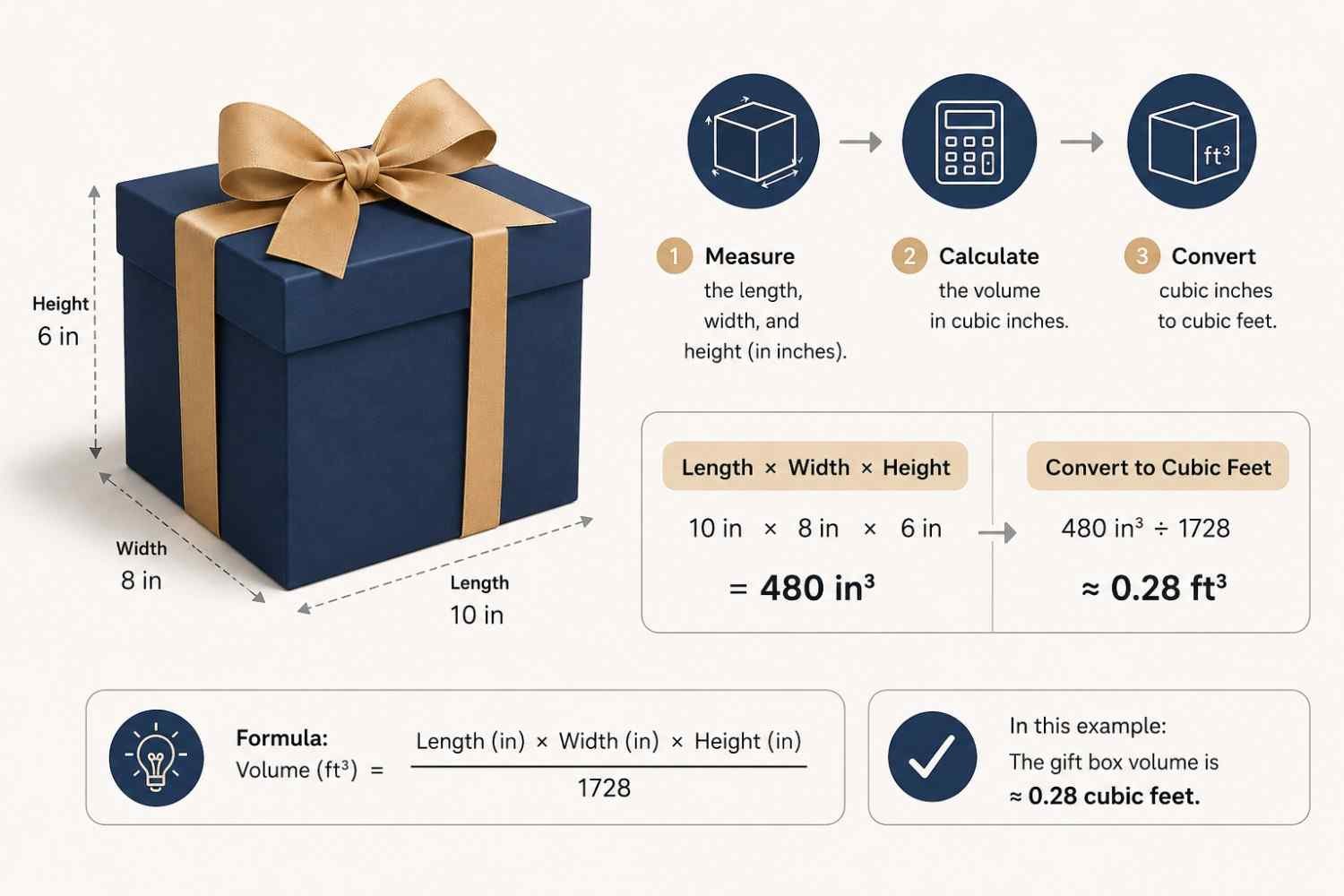
Gift boxes are commonly measured in inches. Multiply length, width, and height to find cubic inches, then divide by 1,728.
The formula is:
Cubic feet = length × width × height ÷ 1,728
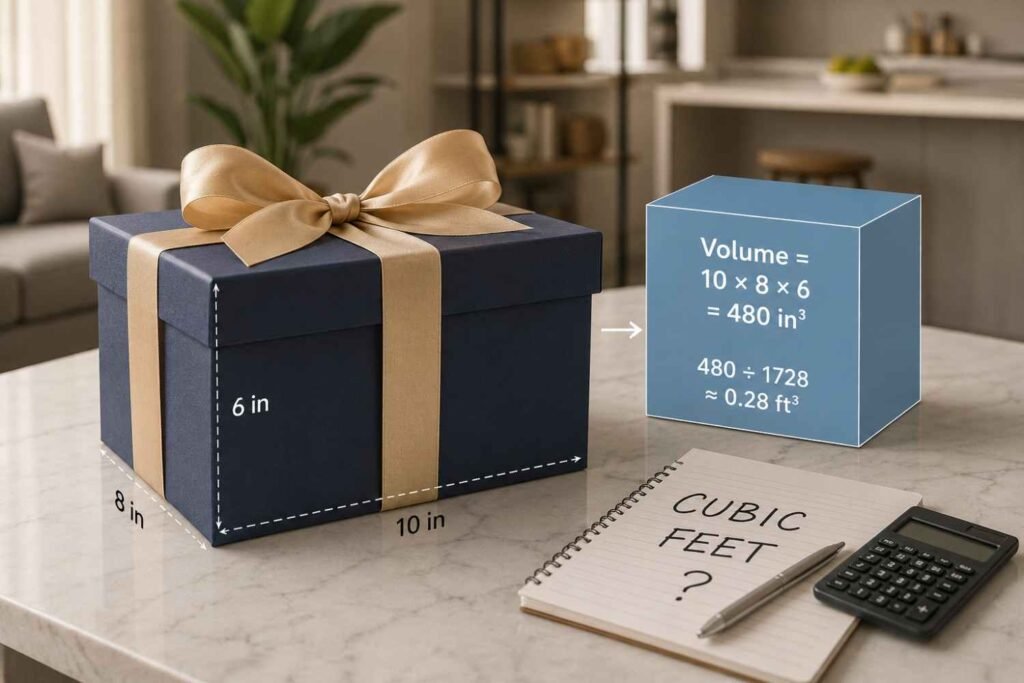
For example, a 10 × 8 × 6-inch box has 480 cubic inches. Dividing 480 by 1,728 gives approximately 0.278 cubic feet.
That describes geometric volume, not usable space. The lid, walls, inserts, tissue paper, and gift shape all affect what actually fits.
A 12 × 12 × 12-inch box equals exactly one cubic foot. Anything smaller will generally contain less, although an unusually long box can still have substantial volume.
Common Gift Box Sizes and What They Hold
Gift boxes come in many shapes. Small boxes around 5 × 5 × 3 inches work well for jewelry, cards, and compact accessories. Medium boxes around 9 × 9 × 3 inches can accommodate candles, books, skincare products, or small gift combinations.
Larger boxes often trade depth for width. A 12 × 10 × 4-inch box can suit apparel, shoes, tablets, or several smaller presents. Boxes around 15 × 15 × 7 inches work better for curated gift sets, hampers, or multiple packaged items.
For comparison:
- 4 × 4 × 1 inches: about 0.009 cubic feet
- 15 × 9.5 × 2 inches: about 0.165 cubic feet
- 14 × 10 × 6 inches: about 0.486 cubic feet
The last example is close to half a cubic foot.
Why the Dimensions Matter More Than the Label
A small, medium, or large label is only a general category. Actual dimensions determine whether the gift fits. A folded shirt may need length and width but little height, while a candle needs less floor space and more depth.
Interior dimensions deserve attention, too. Exterior measurements include box material and construction details. To determine whether a product fits, interior length, width, and height matter most.
Leave some breathing room rather than forcing the gift against the walls. Tissue paper, crinkle filler, ribbons, inserts, and protective wrapping all take up space. A mathematically large box may still be too tight once finishing materials are added.
This is where Cubic Feet Is useful when comparing gift packaging with shipping-oriented box measurements. The same volume calculation applies, but shipping often requires attention to exterior dimensions, while gift presentation focuses more heavily on interior fit.
Choosing the Right Gift Box
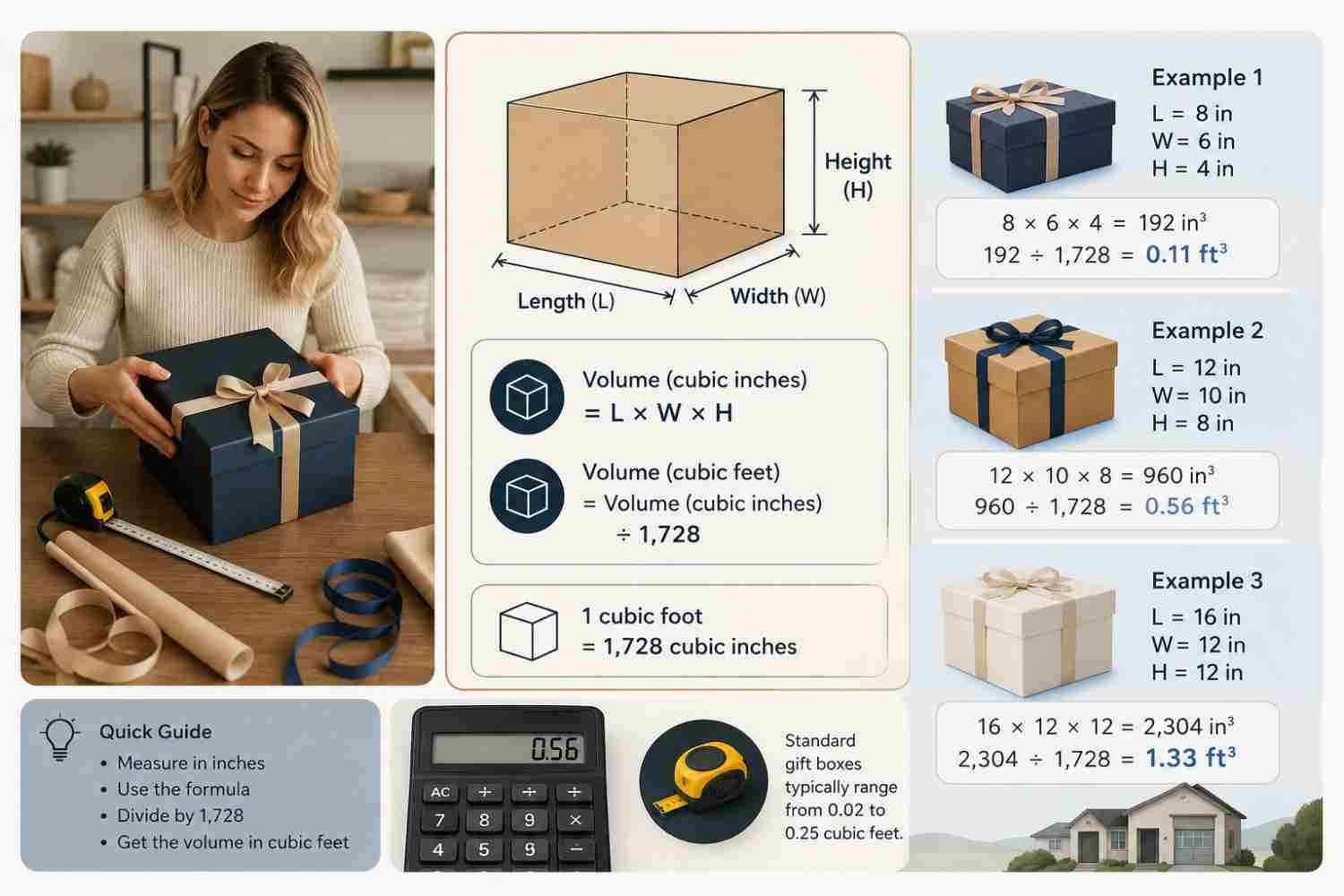
Start with the gift, not the box. Measure its longest, widest, and tallest points, then compare them with the packaging’s interior dimensions. For irregular items, measure the widest practical footprint.
A little extra room improves protection and presentation. Half an inch to an inch of clearance can provide space for tissue or filler. Fragile products may need more room.
A good box should close without crushing the contents. Too much empty space can make a gift look lost and require more filler. The best size is usually the smallest box that provides enough clearance, protection, and balance.
Gift Box Volume vs. Usable Space
Cubic feet describes geometric volume, not usable capacity. Thick walls, fitted inserts, or unusual shapes can reduce practical space compared with the calculated volume.
Two boxes can have nearly identical cubic-foot measurements but suit different gifts. One may be long and shallow for folded apparel; another may be shorter and deeper for a candle, mug, or bottle.
That is why cubic feet should not be the only factor when ordering packaging. Dimensions, shape, closure style, interior construction, and protective material all affect the fit.
When comparing related packaging, how many cubic feet can frame the difference between a gift box and a shipping container. The formula stays the same, but the purpose may differ.
FAQs: How Many Cubic Feet Is a Gift Box? What You Need to Know
1. What is the average cubic feet of a gift box?
Most gift boxes occupy well under one cubic foot. Small and medium boxes commonly fall around 0.02 to 0.30 cubic feet, while larger specialty boxes can exceed half a cubic foot.
2. How do you calculate a gift box’s cubic feet?
Multiply the length, width, and height in inches, then divide the result by 1,728. The answer is the box’s volume in cubic feet.
3. Does a bigger gift box always hold more?
Not necessarily. Two boxes can have similar volume but different shapes. A shallow box may suit clothing, while a deeper box can accommodate candles or taller objects.
4. Should you use interior or exterior dimensions?
Use interior dimensions to determine whether the gift will fit. Exterior dimensions matter more for shipping space, storage, or the packaged box footprint.
Why the Right Size Feels Just Right
The useful number is not always the biggest one. A gift box can have plenty of cubic footage and still be wrong if its proportions do not match the item inside. Good packaging balances capacity with shape, clearance, protection, and presentation. Measuring the gift before choosing a box usually works better than guessing from labels such as small or large.
Once the dimensions are in hand, cubic feet becomes a simple comparison tool. A quick calculation shows how much space a box provides, while its shape and measurements show whether that space is useful.

Ryan Mitchell
Ryan Mitchell holds a degree in Civil Engineering and spent over a decade working in construction project estimation, where accurate volume and material calculations were part of his daily work — from concrete pours to landscaping material orders. He founded this site to bring that same precision to everyday calculations, helping DIYers, contractors, and students get fast, accurate cubic footage results without the guesswork. Ryan reviews every calculator and formula on this site for accuracy and writes guides based on real-world measurement scenarios he's encountered on job sites.