

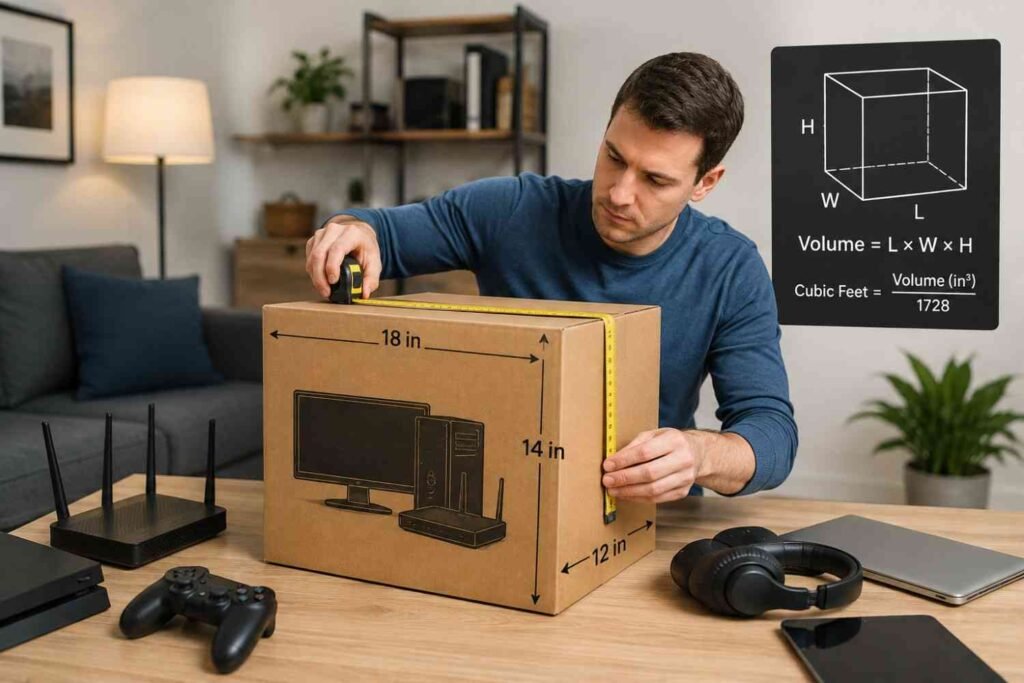
I’ve noticed that “electronics box” sounds more specific than it really is. When packing a console, monitor, speakers, or cables, the box that works for one setup can be completely wrong for another. That made me realize cubic feet is less about a standard box and more about understanding the dimensions in front of you.
I’ve also found that box volume gets confusing when packaging enters the picture. A carton might have a certain outside measurement, yet padding and the shape of the electronics can reduce the space you actually use. Once the basic calculation is clear, figuring out the capacity becomes straightforward.
There Isn’t One Standard Electronics Box Size
There is no universal electronics box size. Small cartons may hold accessories, controllers, cameras, cables, or compact devices, while larger cartons can accommodate monitors, printers, speakers, and home entertainment equipment. Moving boxes and shipping cartons also serve different purposes, so their dimensions vary.
For a quick reference, a box measuring 16 × 12 × 12 inches has a volume of about 1.33 cubic feet. An 18 × 12 × 12-inch box comes to exactly 1.5 cubic feet. Larger cartons can reach 3, 4, 6, or more cubic feet, depending on what they are designed to carry.
That range is why dimensions matter.
How to Calculate Cubic Feet?
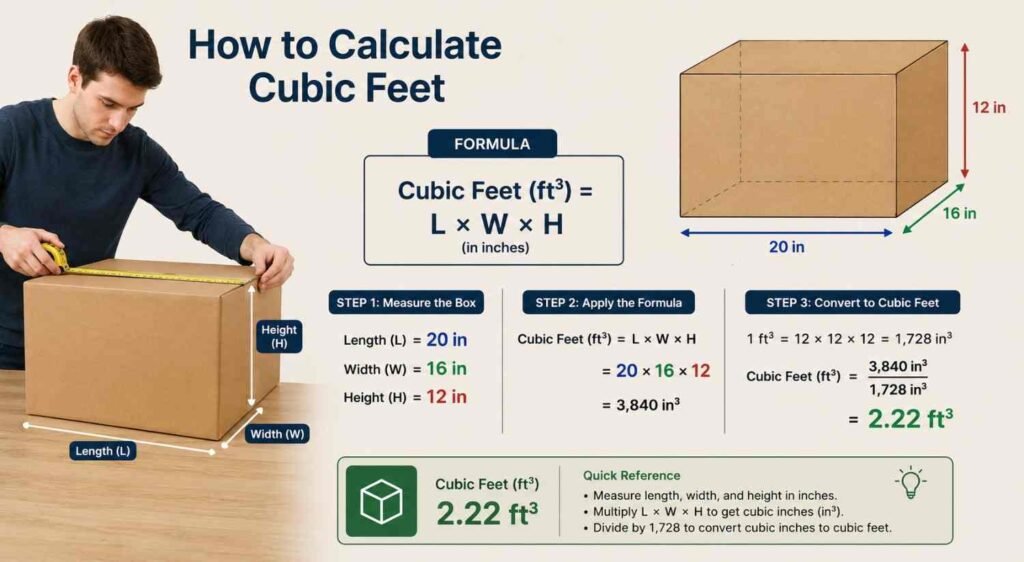
The calculation is simple:
Length × Width × Height ÷ 1,728 = cubic feet
Use the box’s internal dimensions when you want to estimate usable interior volume. Measure all three sides in inches, multiply them together, then divide by 1,728, since one cubic foot contains 1,728 cubic inches.
For example, consider a carton that measures 20 × 20 × 12 inches internally. Multiply 20 by 20 by 12, and you get 4,800 cubic inches. Divide 4,800 by 1,728, and the result is about 2.78 cubic feet.
Using inches is usually faster because manufacturers commonly list carton dimensions that way. Keep the units consistent.
What a 2.8-Cubic-Foot Electronics Box Can Hold
A roughly 2.8-cubic-foot carton can hold a mixed load of electronics. A compact computer, gaming equipment, speakers, accessories, or several smaller devices may fit when arranged carefully.
Volume alone does not tell you whether something will fit. A long component can require more length even with modest volume. A monitor may need clearance around its edges so the screen and casing do not press against cardboard.
Packing technique also affects usable capacity. Bubble wrap, foam corners, air cushions, and other protective materials occupy space. The theoretical cubic-foot capacity should not be treated as the exact amount of electronics you can put inside.
For related household items, How Many Cubic Feet Is a Home Theater System can help put bulky entertainment equipment into perspective. Physical dimensions matter as much as the number itself.
Internal and External Dimensions Are Different
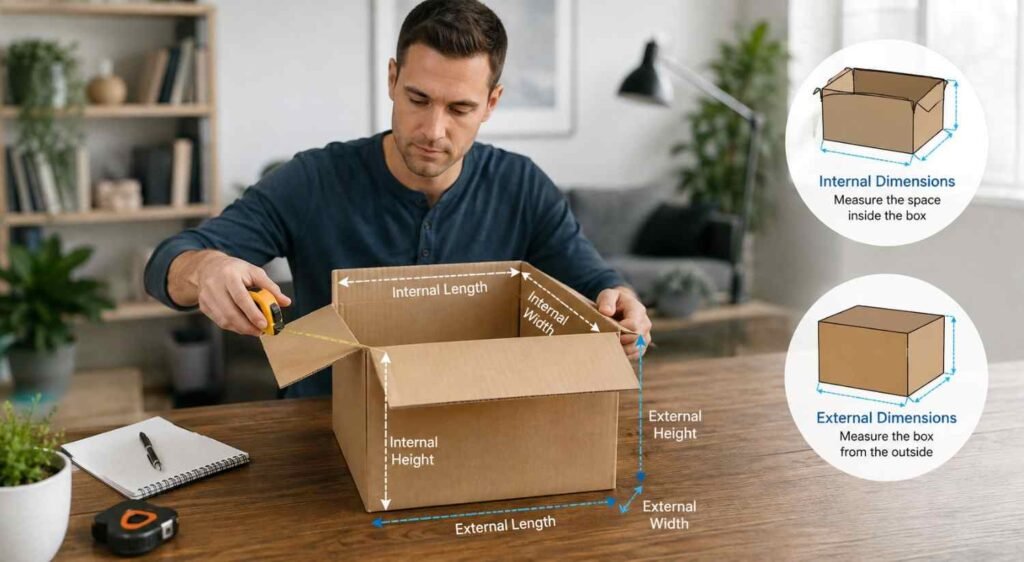
Box measurements can refer to either the inside or outside of a carton. Internal dimensions are more useful when deciding whether a device can fit. External dimensions are more relevant when considering storage space, moving-truck capacity, or shipping requirements.
The difference becomes more noticeable with thicker corrugated cardboard or heavy-duty cartons. A box may provide less interior room if its listed numbers describe the exterior.
Measure the device first and leave clearance for protective material. Do not choose a carton solely because its cubic footage appears large enough. It can have sufficient volume but still have the wrong dimensions.
Does Cubic Footage Affect Shipping Cost?
Box volume and shipping price are related, but they are not the same thing. Carriers can use dimensional weight when a package takes up substantial space relative to its actual weight. A large, lightweight electronics box may therefore be rated differently from a compact box containing something equally light.
For shipping, measure the completed package, including its protective materials. Carriers use length, width, and height for dimensional-weight calculations. UPS and FedEx explain that dimensional weight can affect billable weight when package size is large compared with actual weight.
Right-sizing matters. Extra space may require more cushioning, increase the carton’s footprint, and potentially raise shipping costs. A properly protected package is generally more efficient than an oversized box.
Common Mistakes When Measuring an Electronics Box
A few simple errors can throw off the calculation:
- Mixing inches and feet in the same formula.
- Forgetting to divide cubic inches by 1,728.
- Using external measurements when estimating interior capacity.
- Assuming cubic footage guarantees that a particular device will fit.
- Ignoring space occupied by protective packaging.
Another common mistake is measuring an irregular package incorrectly. For shipping purposes, the completed package is what matters. UPS recommends measuring the package at its longest points, while irregularly shaped packages are measured using their overall theoretical rectangular dimensions.
If you’re also comparing compact gear, How Many Cubic Feet Is a Camera Bag offers a useful reminder that small differences in dimensions can change total capacity quickly. The same principle applies when selecting a carton for electronics.
FAQs: How Many Cubic Feet Is an Electronics Box? Understanding Box Size
1. What is the average size of an electronics box?
Electronics boxes may be around 1 to 1.5 cubic feet, while cartons for larger equipment can reach several cubic feet.
2. How do I calculate box volume in cubic feet?
Multiply the box’s length, width, and height in inches, then divide the result by 1,728. The answer is the box’s cubic-foot volume.
3. Should I use inside or outside box dimensions?
Use internal dimensions when estimating whether electronics will fit. Use external dimensions when planning storage or shipping space.
4. Does a bigger box cost more to ship?
Not automatically, but a larger, lightweight package can have a higher dimensional weight. Carriers may use that figure instead of actual weight when determining billable weight.
Why Accurate Measurements Make Packing Easier
Cubic footage is useful because it turns an ordinary cardboard carton into a measurable amount of space. Instead of guessing whether a box is large enough, you can calculate its capacity, compare it with your equipment, and leave room for protection. That small bit of math can prevent crushed corners, awkward packing, wasted cardboard, and unnecessary shipping space.
The real answer to “How many cubic feet is an electronics box?” is simple: it depends on the box. Measure it, calculate the volume, and judge that space against the equipment and packaging you actually need.

Ryan Mitchell
Ryan Mitchell holds a degree in Civil Engineering and spent over a decade working in construction project estimation, where accurate volume and material calculations were part of his daily work — from concrete pours to landscaping material orders. He founded this site to bring that same precision to everyday calculations, helping DIYers, contractors, and students get fast, accurate cubic footage results without the guesswork. Ryan reviews every calculator and formula on this site for accuracy and writes guides based on real-world measurement scenarios he's encountered on job sites.


