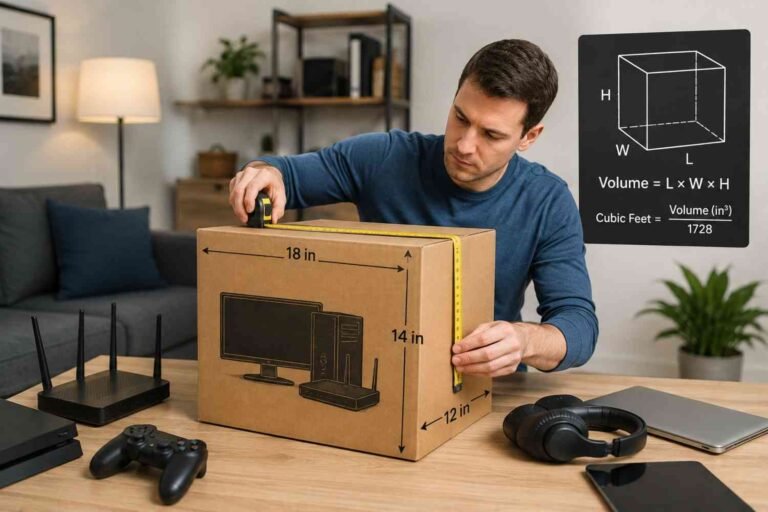
I have packed enough boxes to learn that “large” can be a surprisingly vague label. A box can look enormous, yet usable space feels smaller once blankets and oddly shaped belongings go inside. That is why I look at cubic feet before buying boxes.
I also found that the number alone does not tell the whole story. A large moving box gives you more room than a medium box, but that space suits lightweight household goods. Fill it with dense items, and the box becomes difficult to carry.
How Many Cubic Feet Is a Large Moving Box?
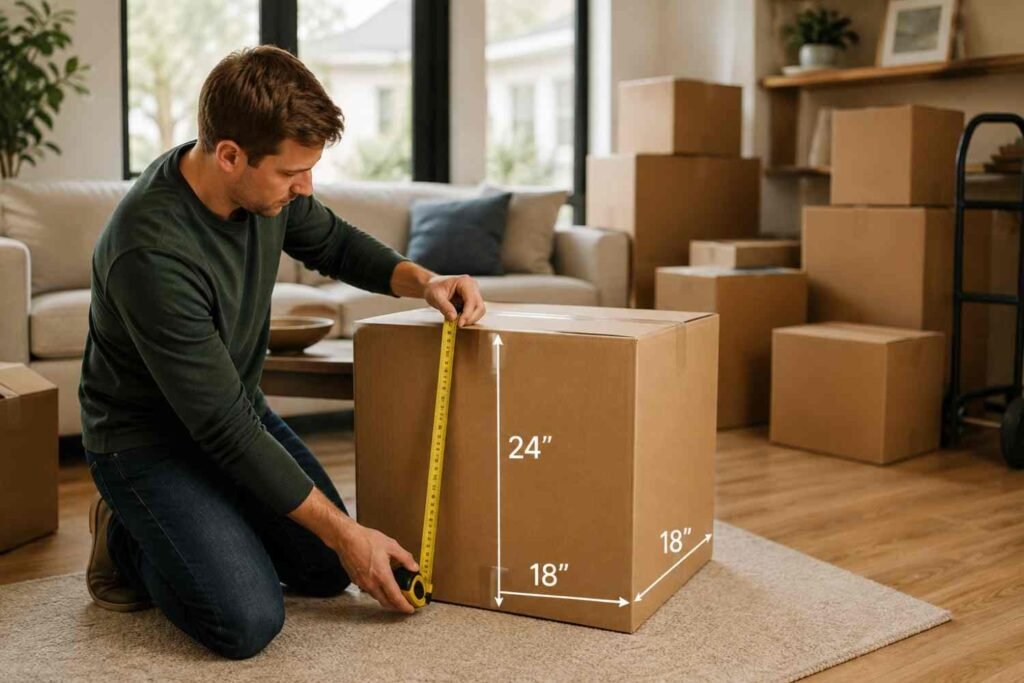
A standard large moving box is about 4.5 cubic feet. A common size is 18 x 18 x 24 inches, which works out to exactly 4.5 cubic feet when converted from cubic inches. That size is widely used for household moves and provides room for bulky belongings without becoming oversized.
There is one catch: “large” is not a universal measurement. Different retailers can sell boxes with different dimensions while still calling them large. Never check the listed capacity rather than relying on the label alone. That distinction matters when comparing boxes from different stores during a real move.
How Do You Calculate a Moving Box’s Cubic Feet?
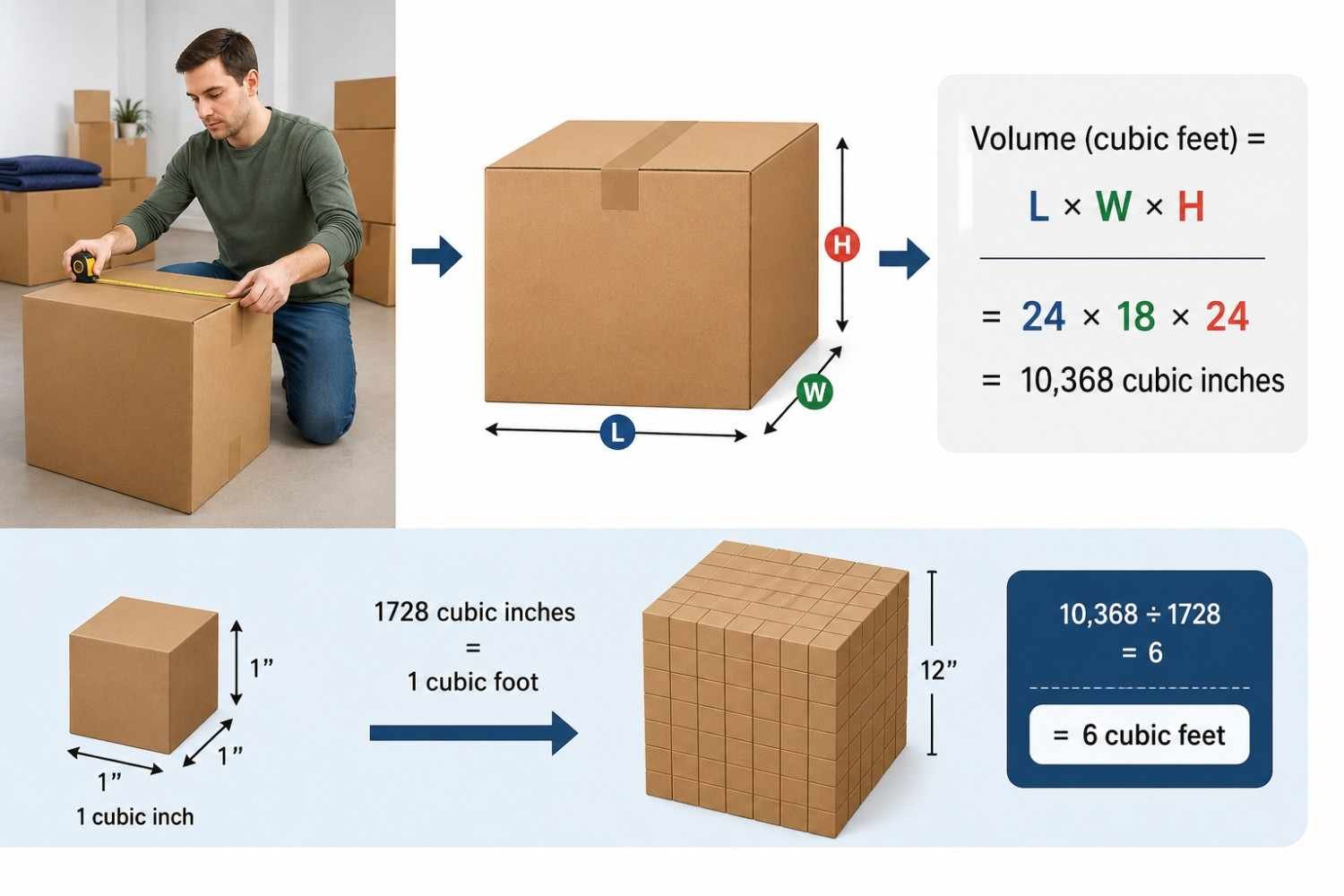
The calculation is:
Length x Width x Height ÷ 1,728 = cubic feet
The 1,728 figure comes from 12 x 12 x 12, since one cubic foot contains 1,728 cubic inches.
For an 18 x 18 x 24-inch box, 7,776 cubic inches divided by 1,728 gives 4.5 cubic feet. This works for almost any rectangular box.
Listed dimensions may be outside measurements, so interior space can be slightly smaller. Packing materials also reduce usable capacity.
What Belongs in a Large Moving Box?
Large boxes work best when the contents are bulky but relatively light. Think comforters, sheets, towels, blankets, pillows, winter coats, lampshades, stuffed animals, clothing, and some small household appliances. These items take up space without creating an unreasonable load.
A packing rule is to let density determine the box size. Books, canned food, tools, dishes, and similar heavy belongings generally belong in smaller boxes. Too many dense objects can make a large box awkward to lift.
A large box can work for a mixed load when heavier pieces stay at the bottom, and lighter items fill the space above. That keeps the load manageable.
Large vs. Medium and Extra-Large Boxes
A typical medium moving box holds about 3 cubic feet, while a large box holds about 4.5 cubic feet. An extra-large box can reach roughly 6 cubic feet. Across dozens of boxes, those differences add up.
If you are comparing small moving box options with larger sizes, think about what you are actually packing rather than choosing based on volume alone. Smaller boxes naturally limit weight. Large boxes make more sense for soft, bulky items.
The jump from large to extra-large deserves caution. More cubic feet can reduce the number of boxes needed, but it also creates more opportunity to overfill one. Books or kitchenware can make an extra-large box difficult to handle.
How Heavy Should a Large Moving Box Be?
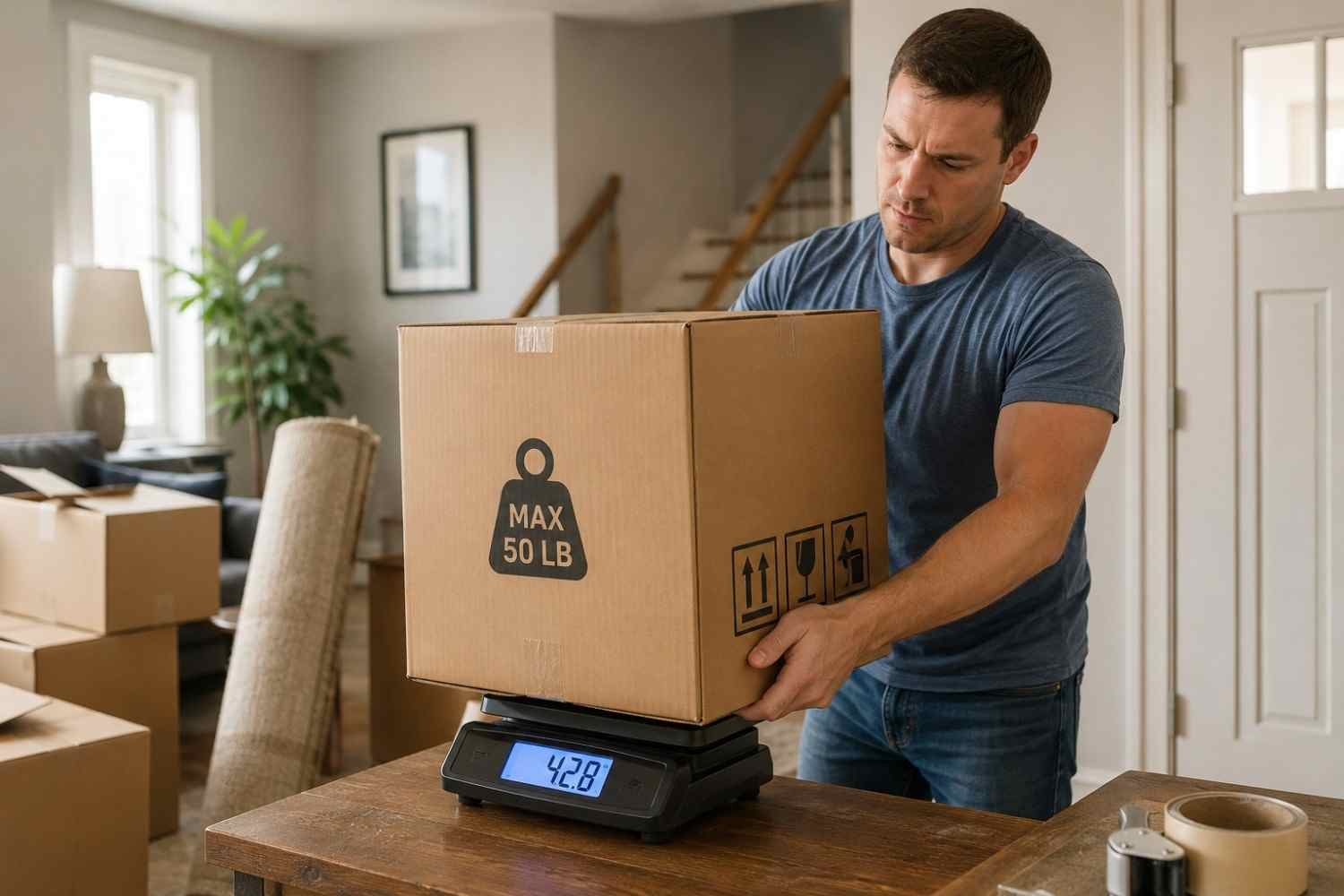
Manufacturers may publish a maximum weight rating, but that number should not be treated as a target. A commonly cited capacity for a standard large box is 65 pounds. In practice, a comfortably liftable box is a better goal than a completely full one.
Think about the entire moving process. Someone has to lift the box, carry it through a doorway, stack it, and bring it into the new home. A box within its rating can still be miserable to handle.
For heavy belongings, choose a smaller box or a heavy-duty design. Stronger cardboard improves durability, but it does not make a heavy box easier to carry.
Tips for Packing Large Boxes Efficiently
Start with a solid bottom and seal it properly. Place heavier pieces toward the bottom and lighter belongings above them. Avoid large empty pockets because contents can shift during handling.
For better results:
- Use towels, clothing, or crumpled packing paper to fill gaps.
- Keep fragile items cushioned and away from the box walls.
- Stop packing when the box becomes difficult to lift comfortably.
- Label the room and include a brief description of the contents.
Keep similar items together. A box filled with bedroom linens is easier to identify and unpack than one containing random belongings from several rooms.
When Is a Large Moving Box the Right Choice?
Choose a large box when the main challenge is volume rather than weight. It suits bedding, linens, clothing, pillows, soft décor, and other lightweight items that occupy plenty of space.
If you are deciding between a large and medium moving box, consider how the finished box will feel in your hands. A medium box may require more containers, but it can be smarter for anything dense. A large box is valuable when it consolidates light belongings without creating an unwieldy load.
The best packing setup is rarely one size. Mixed sizes make better use of space while keeping loads manageable.
FAQs: How Many Cubic Feet Is a Large Moving Box? Choosing the Right Size
1. Is 4.5 cubic feet a large moving box?
Yes. Around 4.5 cubic feet is a common standard for large household moving boxes, although dimensions vary by manufacturer.
2. What are typical large moving box dimensions?
A common size is 18 x 18 x 24 inches. Other large boxes can have different dimensions while offering similar capacity.
3. What should not go in a large moving box?
Avoid very dense items such as books, canned goods, or large quantities of dishes. Their weight can quickly make the box difficult to carry.
4. Is a 4.5-cubic-foot box enough for bedding?
Usually, yes. Comforters, sheets, towels, pillows, blankets, and soft goods are well suited to this amount of space.
Why the Right Box Size Makes Moving Easier
Cubic feet is a useful starting point, but it is only one part of smart packing. Match capacity with the weight, shape, and fragility of what you are moving. A 4.5-cubic-foot box suits blankets but can be impractical for dense goods.
Once each box has a sensible job, packing becomes less about squeezing everything into the fewest containers and more about creating loads that can be moved, stacked, protected, and unpacked easily.
A good box is not the biggest one you can fill. It is the one that makes the next step easier.

Ryan Mitchell
Ryan Mitchell holds a degree in Civil Engineering and spent over a decade working in construction project estimation, where accurate volume and material calculations were part of his daily work — from concrete pours to landscaping material orders. He founded this site to bring that same precision to everyday calculations, helping DIYers, contractors, and students get fast, accurate cubic footage results without the guesswork. Ryan reviews every calculator and formula on this site for accuracy and writes guides based on real-world measurement scenarios he's encountered on job sites.