

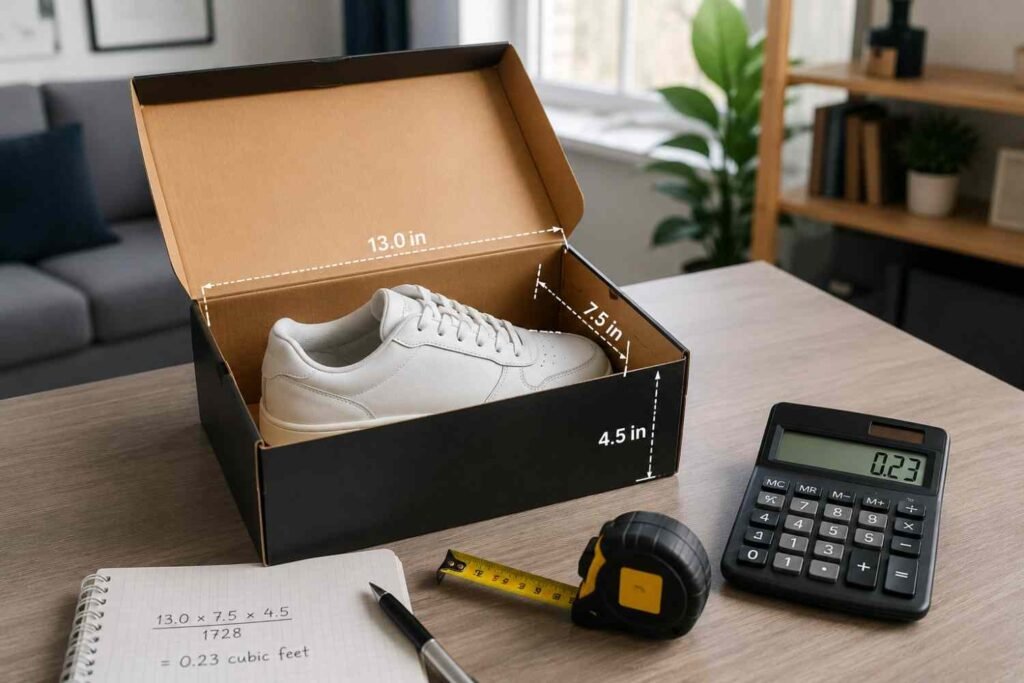
I started paying closer attention to shoe boxes when a closet cleanout turned into a surprisingly large storage problem. Several pairs made the space disappear. That got me wondering how much room one shoe box takes up in cubic feet.
I found that there is no universal shoe box size. Dimensions change with shoe style, size, brand, and packaging. Still, a useful average puts a typical adult shoe box at roughly a quarter to a third of a cubic foot.
How Many Cubic Feet Does a Typical Shoe Box Hold?
A typical adult shoe box holds about 0.25 to 0.33 cubic feet. Common dimensions are roughly 12 to 14 inches long, 7 to 9 inches wide, and 4 to 6 inches high.
One example is a 13 × 7.5 × 4.5-inch box. Multiply those dimensions, and you get 438.75 cubic inches. Since one cubic foot contains 1,728 cubic inches, dividing 438.75 by 1,728 gives about 0.25 cubic feet.
A larger 13 × 8 × 5-inch box contains 520 cubic inches, or about 0.30 cubic feet. A 14 × 8 × 5-inch retail box reaches roughly 0.32 cubic feet.
How to Calculate Shoe Box Volume
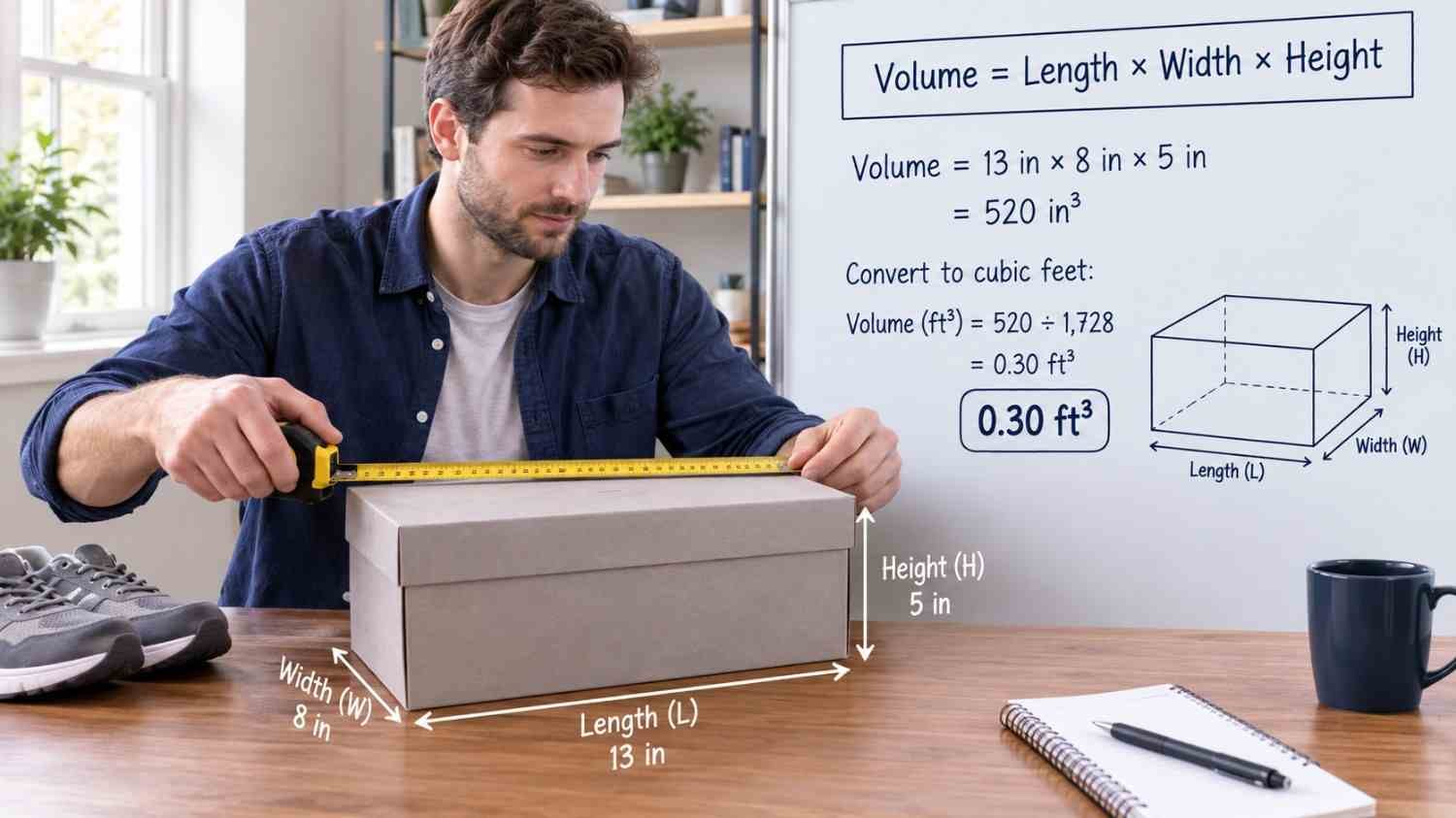
Measure the length, width, and height in inches, multiply the three numbers, then divide by 1,728.
For example, a 13 × 8 × 5-inch box has 520 cubic inches. Divide 520 by 1,728, and the result is approximately 0.30 cubic feet.
This describes geometric volume, not necessarily usable interior space. For storage, interior dimensions are useful when available. For estimating how much room boxes occupy in a truck or storage unit, exterior dimensions matter more because they represent the physical space consumed.
Why Shoe Box Sizes Vary
Shoe boxes are not standardized. A children’s pair may need only a fraction of the space required for large athletic shoes. Women’s footwear can fit in narrower boxes, while men’s shoes, bulky sneakers, and larger sizes often need more length or height.
Boots create another obvious difference. An ankle boot may fit into a conventional box, while tall boots can require substantially more height. Similar differences appear with specialty sneakers, cleats, and shoes with thick soles.
Tissue paper, inserts, lids, labels, and structural tolerances can change the final dimensions. Two boxes holding similar footwear can therefore have noticeably different measurements.
How Much Space Do Several Shoe Boxes Take?
The math becomes more useful when you have a collection. If one box averages 0.30 cubic feet, ten boxes represent about 3 cubic feet of calculated volume. Twenty boxes would be about 6 cubic feet.
Boxes may not stack perfectly, and shelves need clearance. You may also need room to pull individual boxes out.
When comparing that collection with a large moving box, consider both cubic-foot capacity and physical dimensions. A container can have enough theoretical volume but still be awkward if its width or height prevents efficient stacking.
Shoe Boxes for Moving and Storage

Keeping shoes in their original boxes can make a move easier because each pair stays protected and identifiable. It also creates predictable units that can be stacked, labeled, and counted. The tradeoff is that boxed footwear consumes more space than loose shoes arranged carefully inside a larger container.
For estimating cartons, count the pairs, estimate average volume per box, and leave room for walls and unused gaps.
A storage carton can work well for a manageable group of shoe boxes, especially when the footwear is similar in size. Heavier shoes should be distributed rather than packed into one oversized carton, since weight can make a box difficult to lift.
Calculated Volume vs. Usable Space
Cubic feet tell you how much three-dimensional space a box occupies mathematically. They do not tell you how efficiently that space can be used. Shoes have irregular shapes, and the pair contains air gaps that cannot always be eliminated.
The cumulative volume may look precise, but the arrangement determines the actual footprint. Gaps between cartons, shelf supports, wall clearance, and access space all matter.
For planning, treat 0.25 to 0.33 cubic feet as a benchmark, then adjust based on your actual boxes.
Why the Number Is Useful
Measure one representative box, calculate its volume, and multiply that figure by your number of pairs. For a collection going into a medium moving box, that estimate provides a useful starting point.
The result will not predict every packing situation, but it can help with closet capacity, shelving, moving cartons, and storage planning. Even a rough volume estimate is more useful than guessing when you have dozens of pairs.
The Space Adds Up Faster Than Expected
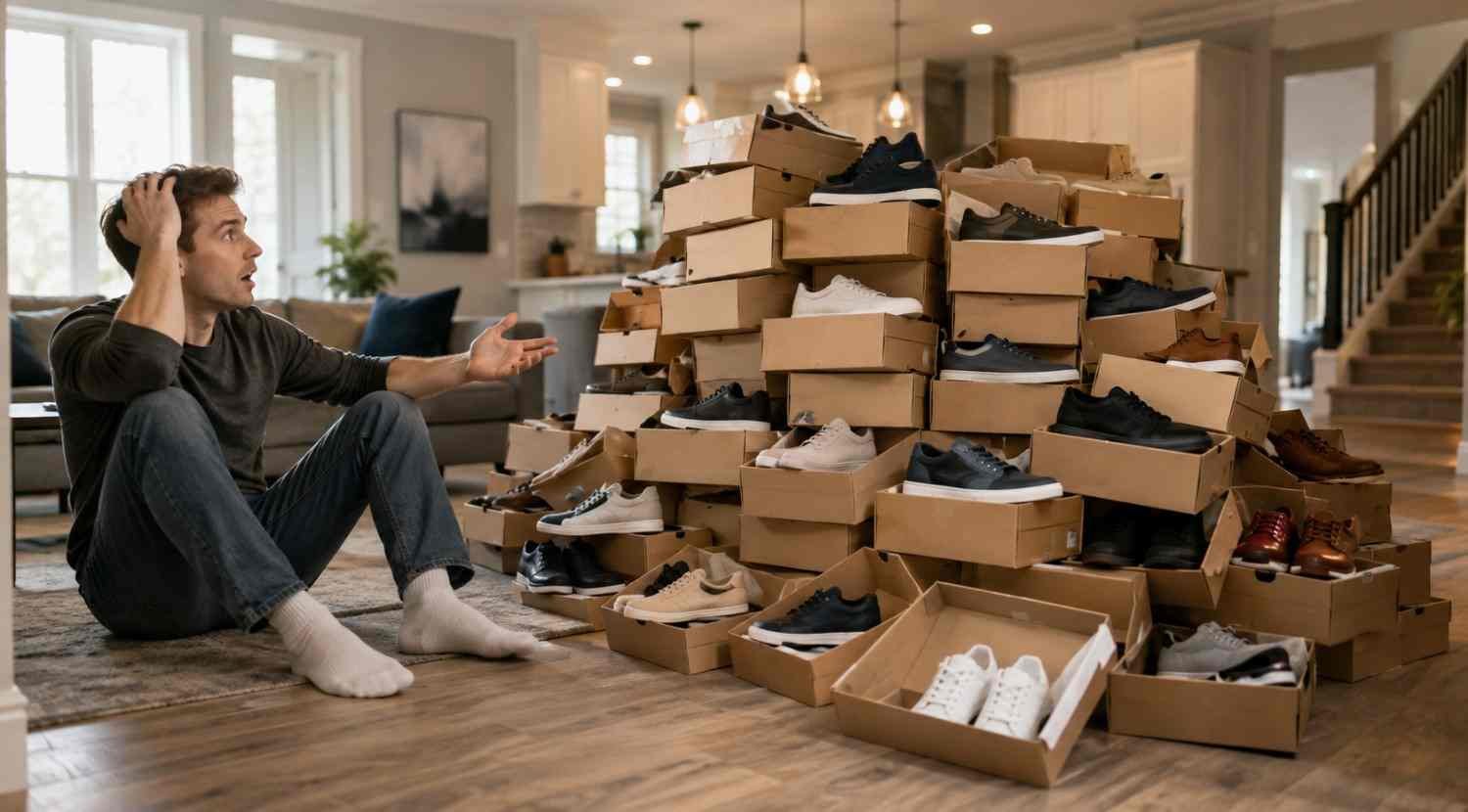
A shoe box looks small when you hold one. Multiply that footprint across a dozen or two dozen pairs, though, and the difference becomes obvious. The cumulative space matters more, especially when every box must remain accessible day to day.
An estimate of around a quarter to a third of a cubic foot gives you enough information to plan without pretending every shoe box is identical. Measure the boxes you actually own when accuracy matters, and let those dimensions guide the final storage decision.
FAQs: How Many Cubic Feet Is a Shoe Box? What the Average Box Holds
1. How many cubic feet is a standard shoe box?
Most adult shoe boxes fall around 0.25 to 0.33 cubic feet, depending on their dimensions. Children’s boxes can be considerably smaller.
2. What is the average shoe box size?
A common adult example is about 13 × 7.5 × 4.5 inches. Larger boxes may measure around 13 × 8 × 5 inches or more.
3. How do you calculate a shoe box’s cubic feet?
Multiply length, width, and height in inches. Then divide the cubic-inch result by 1,728 to convert it to cubic feet.
4. Does shoe size change box volume?
Yes. Larger footwear, bulky sneakers, and boots generally require larger packaging. Brands also use different designs, so shoe size alone does not determine exact volume.
Small Measurements, Useful Decisions
Once shoe boxes are viewed as measurable containers instead of closet clutter, storage planning becomes clearer. The calculation is simple, but it gives context to decisions about shelves, moving cartons, closets, and storage units. A box that occupies only a fraction of a cubic foot can still become a meaningful space commitment when repeated across a collection.
The simplest rule is to measure what you have, calculate the volume, and leave some breathing room. That planning can prevent a large storage headache.

Ryan Mitchell
Ryan Mitchell holds a degree in Civil Engineering and spent over a decade working in construction project estimation, where accurate volume and material calculations were part of his daily work — from concrete pours to landscaping material orders. He founded this site to bring that same precision to everyday calculations, helping DIYers, contractors, and students get fast, accurate cubic footage results without the guesswork. Ryan reviews every calculator and formula on this site for accuracy and writes guides based on real-world measurement scenarios he's encountered on job sites.


