
A microwave that looks massive on your kitchen counter might actually have less usable cooking space than a model that takes up half the footprint.
When you’re shopping on a budget, paying extra for exterior size instead of actual interior capacity is one of the easiest ways to waste money. So, how many cubic feet is a microwave oven, and how do you know which size actually fits your daily cooking routine and your wallet?
Standard household microwave ovens range from 0.5 to 2.2 cubic feet of interior capacity. However, the size on the box doesn’t tell the whole story. Understanding interior volume prevents you from overpaying for capacity you will never use—or buying a cheap unit that can’t even fit a standard dinner plate.
Microwave Sizes at a Glance: The Interior Capacity Breakdown
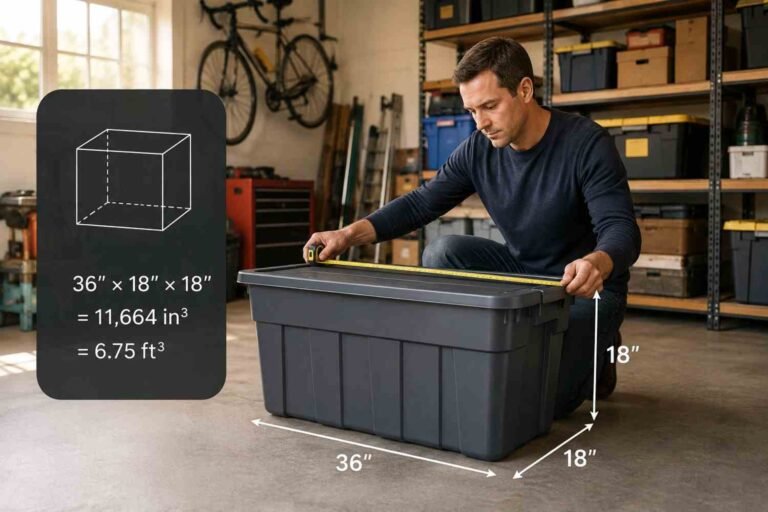
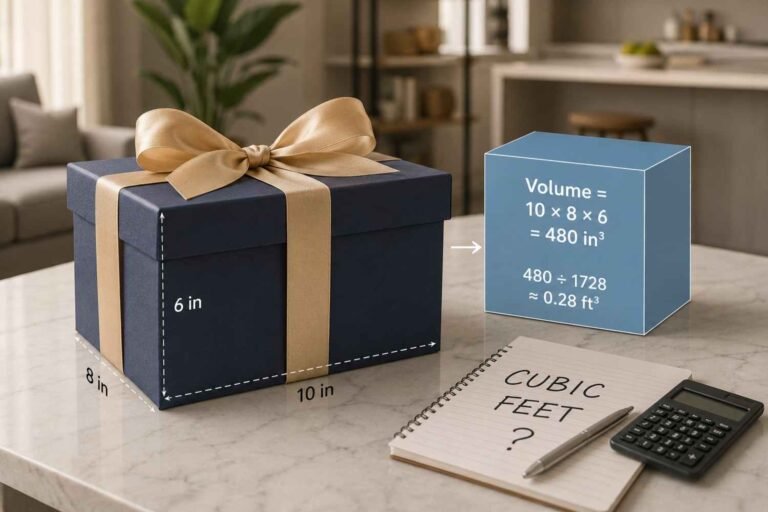
Microwave capacity measures the total three-dimensional space inside the cooking chamber. Manufacturers calculate this by multiplying the interior height, width, and depth in inches, then dividing by 1,728 (the number of cubic inches in a cubic foot).
Interior Volume = (Height × Width × Depth in inches) ÷ 1,728
Knowing this formula helps when you are shopping secondhand or looking at unbranded estate-sale units where the original box and manual are long gone.
| Microwave Size Category | Interior Volume (Cu. Ft.) | Typical Turntable Diameter | Best Suited For | Energy Usage (Watts) |
| Compact / Small | 0.5 – 0.9 | 9.5 – 10.5 inches | Dorms, studio apartments, basic reheating | 600 – 900W |
| Mid-Size / Standard | 1.0 – 1.6 | 11.0 – 13.5 inches | Everyday family cooking, standard dinner plates | 900 – 1,100W |
| Large / Full-Size | 1.7 – 2.2+ | 14.0 – 16.0+ inches | Casserole dishes, large families, built-in/OTR | 1,100 – 1,250W |
Why Interior Cubic Feet Matter for Your Monthly Budget
Buying an appliance isn’t just a one-time purchase. It affects your monthly utility bills and your overall home energy efficiency.
According to data from the U.S. Department of Energy, cooking appliances account for a notable share of household energy use, and larger units naturally pull higher wattage. A 2.2 cubic foot microwave typically consumes 1,200 watts or more, while a 0.7 cubic foot compact model operates around 700 watts.
If your primary goal is simply warming up leftovers, heating coffee, or popping popcorn, buying a full-size 2.0 cubic foot unit means paying double for the initial unit and consuming extra electricity every time you hit start.
However, going too small has its own financial hidden traps. If a cheap 0.5 cubic foot unit cannot accommodate your meal prep containers, you end up reheating meals in smaller batches. That double-cooking routine wastes time and drains electricity, quickly neutralizing any upfront savings.
Choosing the Right Capacity: A Practical Decision Framework
To choose the right size without overspending, match your actual cooking habits against the target capacity ranges below.
Understanding appliance capacity measurements can also help when comparing different kitchen appliances.
Understanding dishwasher capacity also makes it easier to see how manufacturers describe usable space across different kitchen appliances.
Compact / Small (0.5 to 0.9 Cubic Feet)
These units are designed strictly for space savings and tight budgets.
- The Pros: Low price tag, control of electricity pull, fits easily on tiny counters or desk corners.
- The Limitations: Turntables rarely exceed 10 inches. Standard 11-inch dinner plates or wide frozen meal boxes will jam against the walls, preventing the turntable from rotating smoothly.
Mid-Size / Standard (1.0 to 1.6 Cubic Feet)
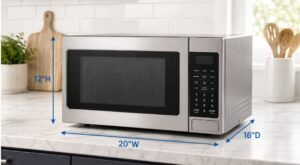
This range represents the sweet spot for budget-conscious individuals and small families.
- The Pros: Fits standard 11-inch to 12-inch dinner plates, medium bowls, and standard glass food storage containers without issue.
- The Limitations: May struggle with long rectangular glassware or large 9×13-inch baking dishes.
Large / Full-Size (1.7 to 2.2+ Cubic Feet)
Full-size microwaves are usually over-the-range (OTR) models or heavy countertop units meant for serious batch cooking.
- The Pros: Comfortably handles 9×13-inch casserole dishes, large serving platters, and tall beverage containers.
- The Limitations: High upfront cost, heavy power consumption, and a massive physical footprint.
If you are expanding your kitchen capabilities on a tight budget, managing cold-storage space is just as vital as cooking space.
Knowing the right chest freezer size can help you plan meal-prep and bulk-food storage just as effectively as choosing a microwave that fits your needs.
The “Plate & Tape” Test: Measure Before You Buy
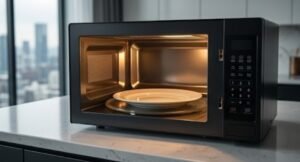
Before spending money, run this 30-second test at home using a standard tape measure and your largest dinner plate.
- Measure Your Largest Plate: Take the diameter of the dish you use most often.
- Add 2 Inches for Clearance: If your plate is 11 inches wide, you need a minimum interior width of 13 inches so the plate can rotate freely without catching on the walls.
- Check the Height: Measure your tallest travel mug or soup bowl. Ensure the microwave interior height offers at least 2 inches of clearance above the rim.
According to consumer safety guidelines from the National Fire Protection Association, overcrowding an appliance or jamming plates against interior walls can lead to uneven heating, thermal stress on glassware, and potential electrical hazards. Giving your food room to turn safely keeps your kitchen running smoothly.
Common Misconceptions About Microwave Capacity
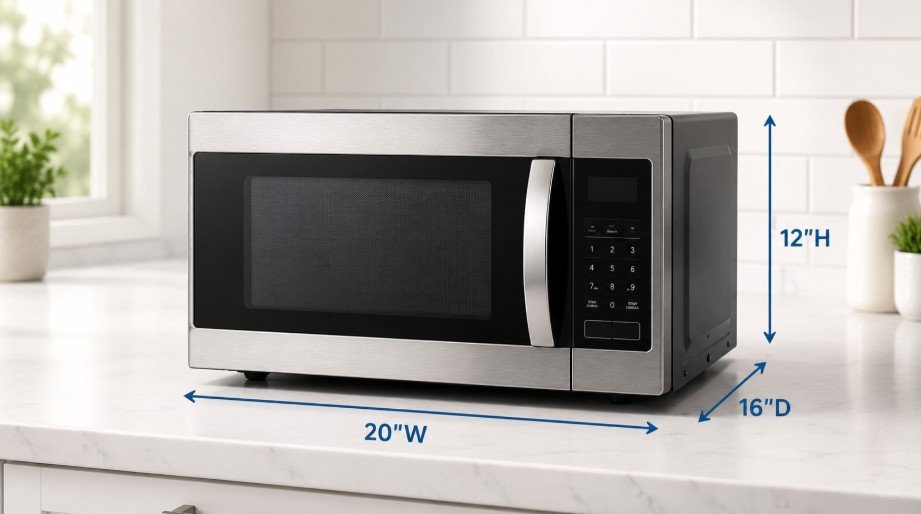
- Misconception 1: Exterior size always equals interior capacity. Insulation, fan placement, and wall thickness vary wildly between brands. Two microwaves with identical exterior dimensions can have vastly different interior usable volumes.
- Misconception 2: Higher cubic footage always cooks faster. Cooking speed depends on wattage, not cubic volume. A 1,000-watt compact microwave will heat food faster than an 800-watt large microwave.
- Misconception 3: You need a huge microwave for meal prepping. Unless you cook entire casseroles inside the microwave, a mid-size 1.1 to 1.3 cubic foot model handles almost all standard food prep containers comfortably.
Frequently Asked Questions
1. Is 1.6 cubic feet a large microwave?
Yes, 1.6 cubic feet is on the upper end of mid-size units. It comfortably fits large dinner plates, 9×13-inch baking dishes, and serves standard families well without taking up massive counter space.
2. Is 2.2 cubic feet a big microwave?
Yes, 2.2 cubic feet is among the largest residential microwaves available. It is considered a full-size unit, best suited for large families, heavy batch cooking, or over-the-range installations.
3. Is 1.1 cubic feet a big microwave?
No, 1.1 cubic feet is a standard mid-size microwave. It is compact enough for small kitchens while still large enough to comfortably fit standard 11-inch dinner plates and everyday food containers.
4. Is 0.9 cu. ft a big microwave?
No, 0.9 cubic feet is considered a small or compact microwave. It works great for dorms, studio apartments, or basic reheating, but may struggle with oversized dinner plates or large dishes.
Choosing the Right Microwave Size for Your Needs
Navigating appliance sizes doesn’t have to break your monthly budget. A standard microwave runs between 0.5 and 2.2 cubic feet, but most budget-focused households thrive right in the 1.0 to 1.4 cubic foot range.
By matching your daily dish sizes to interior dimensions rather than paying for flashy exterior bulk, you protect your savings while keeping your kitchen functional. Measure your plates, check your wattage, and buy only the capacity you truly need.

Ryan Mitchell
Ryan Mitchell holds a degree in Civil Engineering and spent over a decade working in construction project estimation, where accurate volume and material calculations were part of his daily work — from concrete pours to landscaping material orders. He founded this site to bring that same precision to everyday calculations, helping DIYers, contractors, and students get fast, accurate cubic footage results without the guesswork. Ryan reviews every calculator and formula on this site for accuracy and writes guides based on real-world measurement scenarios he's encountered on job sites.