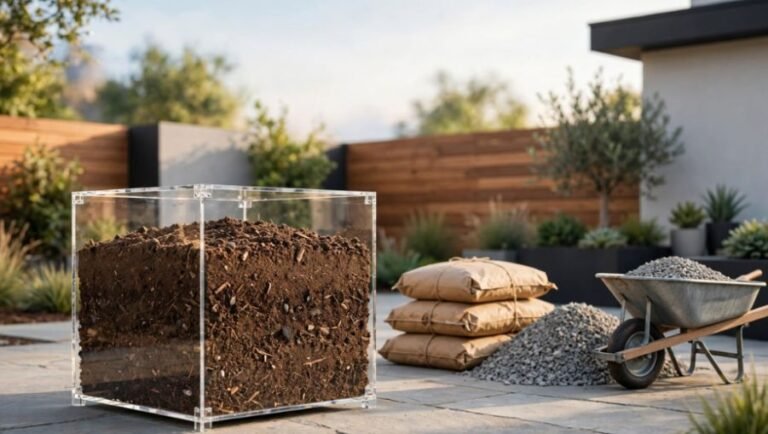

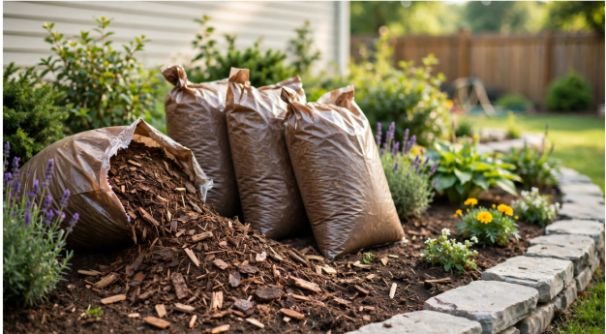
If I need a quick answer to how many cubic feet is a bag of mulch, I start with 2 cubic feet. That is the standard size I expect to see for many bagged wood and colored mulches sold in the US.
But I never buy mulch based on the bag size alone. A 2-cubic-foot bag can cover 12 square feet or only 8 square feet depending on how deeply I spread it. That depth difference can turn a correct-looking estimate into several missing bags.
The Short Answer: Standard Mulch Bag Sizes
When estimating how many cubic feet is a bag of mulch, I usually work with three common retail sizes: 1.5, 2, and 3 cubic feet.
A current Lowe’s specification for Scotts Nature Scapes, for example, lists a 2-cubic-foot bag with 12 square feet of coverage when applied 2 inches deep.
| Bag Size | Coverage at 2 Inches | Coverage at 3 Inches | Equivalent Bags per Cubic Yard |
| 1.5 cu. ft. | 9 sq. ft. | 6 sq. ft. | 18 |
| 2.0 cu. ft. | 12 sq. ft. | 8 sq. ft. | 13.5* |
| 3.0 cu. ft. | 18 sq. ft. | 12 sq. ft. | 9 |
*Thirteen and a half 2-cubic-foot bags mathematically equal 27 cubic feet. Since stores sell whole bags, I would need 14 bags to buy at least one cubic yard.
That half-bag detail sounds minor, but it matters when planning an actual shopping trip.
Mulch Bag Coverage by Depth
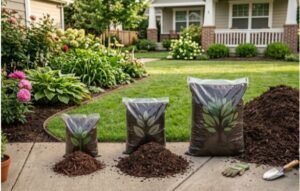
Knowing how many cubic feet is a bag of mulch answers the volume question. It does not answer how much landscape the bag will cover.
Depth controls coverage.
A 2-cubic-foot bag spread 2 inches deep covers approximately 12 square feet. Spread it 3 inches deep, and coverage falls to roughly 8 square feet.
Penn State Extension recommends a settled mulch layer of about 2 to 3 inches in many home plantings. It says this depth can help suppress young weeds and reduce water evaporation while still allowing water penetration.
University of Minnesota Extension gives a broader 2-to-4-inch recommendation for many garden applications and advises keeping mulch clear of stems and trunks.
The Fast Coverage Formula I Use
When a bag does not clearly state its coverage, I use this formula:
Coverage in square feet = bag volume in cubic feet × 12 ÷ mulch depth in inches
For a 2-cubic-foot bag at a 2-inch depth:
2 × 12 ÷ 2 = 12 square feet
At a 3-inch depth:
2 × 12 ÷ 3 = 8 square feet
This reveals something easy to miss when asking how many cubic feet is a bag of mulch: increasing depth from 2 inches to 3 inches reduces the area one bag covers by one-third.
That is the depth-sensitivity rule I find most useful when checking mulch estimates.
Worked Example: A 120-Square-Foot Bed
Suppose I need to mulch a 120-square-foot flower bed at 3 inches deep.
I first convert 3 inches to feet:
3 ÷ 12 = 0.25 feet
Then I calculate the required volume:
120 × 0.25 = 30 cubic feet
If I buy standard 2-cubic-foot bags:
30 ÷ 2 = 15 bags
The project therefore needs exactly 15 two-cubic-foot bags.
I can also convert that amount into cubic yards:
30 ÷ 27 = 1.11 cubic yards
That comparison becomes useful when deciding between bagged mulch and bulk delivery.
How Many Bags of Mulch Equal a Cubic Yard?
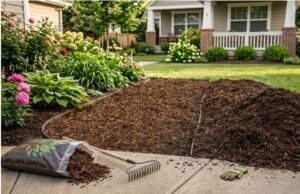
One cubic yard always contains 27 cubic feet.
Once I know how many cubic feet is a bag of mulch, converting bags into yards is simple.
For 1.5-cubic-foot bags, I divide 27 by 1.5 and get 18 bags.
For 3-cubic-foot bags, 27 divided by 3 gives 9 bags.
For standard 2-cubic-foot bags:
27 ÷ 2 = 13.5 bags
The mathematical answer is 13.5, but I cannot normally buy half a sealed bag. For a project that truly requires one cubic yard, I would purchase 14 two-cubic-foot bags.
I use this calculation before comparing bulk and bagged prices. Bulk mulch can make sense for larger beds, while bags can be easier to transport, store, and move through tight yards.
Does Mulch Type Change the Bag Volume?

Mulch type can influence which package sizes are available, but the volume printed on the package remains the measurement I trust.
Traditional shredded hardwood and colored mulch commonly appear in 2-cubic-foot packages. Bark nuggets and specialty products may come in 1.5- or 3-cubic-foot bags.
I also avoid confusing volume with weight.
Two bags can each contain 2 cubic feet yet weigh noticeably different amounts. Moisture, wood species, particle size, and density can change weight without changing the stated cubic volume.
For coverage calculations, I use cubic feet rather than pounds.
How I Avoid Buying Too Much or Too Little
Before buying anything, I measure the bed’s length and width in feet.
For deeper planting areas, checking raised garden bed volume also helps me estimate the total material needed before I start filling the space.
I break irregular landscapes into smaller rectangles, circles, or simple sections and calculate each area separately.
Then I choose my intended depth.
For an existing landscape bed, I also check how much mulch remains. If there are already 2 inches on the ground, automatically adding another 3 inches may create an excessive layer.
University of Minnesota Extension recommends no more than about a 3-inch mulch layer around newly planted trees and shrubs. It warns that overly deep mulch may interfere with water movement, reduce oxygen around roots, and contribute to root problems.
I also keep mulch away from trunks rather than building the familiar “mulch volcano.” Both Minnesota and Penn State Extension advise leaving space around trunks because mulch piled against bark can create moisture and plant-health problems.
That means the smartest answer to how many cubic feet is a bag of mulch is not simply “2 cubic feet.” The right purchase quantity depends on existing mulch, bed area, and target depth.
Related Cubic-Foot Calculations for Yard Projects
The same volume math helps with other home and landscaping projects.
When filling planters or raised beds, I use the same length × width × depth approach to estimate soil volume for garden beds before deciding how many bags to buy.
For container gardening, calculating planter box volume helps me estimate how much soil, compost, or mulch I need before filling the box.
For shed and garage organization, knowing how many cubic feet is a garden tool set can help estimate storage space before adding shelving or cabinets.
I use similar three-dimensional measurements for how many cubic feet is a pressure washer when planning garage storage or vehicle cargo space.
The distinction stays the same: square feet measure surface area, while cubic feet measure volume.
Frequently Asked Questions
1. How many cubic feet are in a standard bag of mulch?
A standard bag commonly contains 2 cubic feet, although 1.5- and 3-cubic-foot bags are also sold.
2. How much area does a 2-cubic-foot bag of mulch cover?
A 2-cubic-foot bag covers about 12 square feet at 2 inches deep or 8 square feet at 3 inches deep.
3. How many 2-cubic-foot bags of mulch make one cubic yard?
One cubic yard equals 27 cubic feet, or 13.5 two-cubic-foot bags mathematically; buy 14 full bags to reach at least one yard.
4. How many cubic feet is a bag of mulch for a 100-square-foot bed?
At 3 inches deep, 100 square feet requires 25 cubic feet, equal to 12.5 two-cubic-foot bags, so I would purchase 13.
Don’t Let One Extra Inch Wreck the Estimate
My answer to how many cubic feet is a bag of mulch starts with the package label, and in many cases that number is 2 cubic feet. But I never stop there.
Depth is what decides how many bags actually reach the other side of the flower bed.
I measure the area, choose the depth, calculate the cubic feet, and only then decide how many bags to put in the cart. That extra minute of math is far easier than staring at a half-mulched yard with an empty bag in my hand.

Ryan Mitchell
Ryan Mitchell holds a degree in Civil Engineering and spent over a decade working in construction project estimation, where accurate volume and material calculations were part of his daily work — from concrete pours to landscaping material orders. He founded this site to bring that same precision to everyday calculations, helping DIYers, contractors, and students get fast, accurate cubic footage results without the guesswork. Ryan reviews every calculator and formula on this site for accuracy and writes guides based on real-world measurement scenarios he's encountered on job sites.