
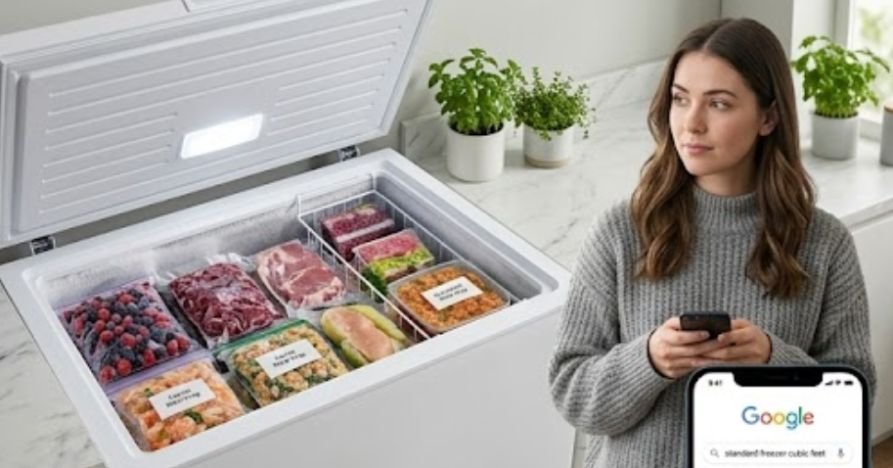
Buying a chest freezer can slash your monthly grocery bill by hundreds of dollars, but getting the wrong size will cost you. A unit that is too large wastes electricity running an empty insulated box, while a tiny model leaves your bulk savings sitting out on the counter.
When people ask, “How many cubic feet is a chest freezer?” the short answer is that residential models range from 3 to 25 cubic feet.
The sweet spot for most budget-conscious households is between 5 and 7 cubic feet. Knowing how that internal volume translates to real meals, grocery bags, and monthly electric costs makes all the difference before spending your hard-earned money.
Decoding Cubic Feet: How Much Food Fits Inside?
Understanding volume ratings can feel abstract when looking at appliance tags. A reliable rule of thumb used by appliance manufacturers is that 1 cubic foot of freezer space holds about 35 pounds of usable food.
However, packaging shape changes that equation drastically. Stacking uniformly flat, vacuum-sealed ground beef bags is far more efficient than storing bulky, odd-sized frozen pizza boxes or whole turkeys.
The Four Main Chest Freezer Sizes and Who They Are For
Chest freezers fall into four distinct size categories. Matching your household size and shopping habits to the right capacity ensures you do not overspend on up-front appliance costs or monthly energy usage.
Comparing standard freezer capacity can also help me decide whether a chest freezer or a traditional upright model better matches my storage needs.”
If you’re also weighing an upright model, see cubic feet is a standard freezer to compare both freezer types side by side.
| Freezer Class | Capacity (Cu. Ft.) | Holds Approx. (Lbs) | Best Fits | Average Annual Energy Cost |
| Compact | 3 – 5 cu. ft. | 105 – 175 lbs | Singles, couples, small apartments | $15 – $25 |
| Small | 5.5 – 9 cu. ft. | 190 – 315 lbs | Families of 2–3, budget meal-preppers | $20 – $35 |
| Medium | 10 – 16 cu. ft. | 350 – 560 lbs | Families of 4–5, partial quarter-cow buyers | $35 – $50 |
| Large | 17 – 25+ cu. ft. | 595 – 875+ lbs | Large families, homesteaders, hunters | $50 – $80+ |
Comparing dishwasher capacity is another useful way to put appliance storage sizes into perspective, especially when deciding how much room different household appliances require.
Compact Chest Freezers (3 to 5 Cubic Feet)
These units take up about as much floor space as a small nightstand. They hold around 3 to 5 grocery bags of food. If you live in an apartment or simply want to stock up on sale items like frozen vegetables and meal-prep containers, a 3.5 to 5 cubic foot model provides adequate space without overwhelming your living area.
Small Chest Freezers (5.5 to 9 Cubic Feet)

This is the most popular category for first-time homebuyers and small families. A 7 cubic foot chest freezer easily accommodates a couple of months of bulk meat purchases, frozen fruits, and batch-cooked soups. It offers enough space for significant savings at wholesale clubs without taking over your entire garage.
Medium Chest Freezers (10 to 16 Cubic Feet)
Suited for growing families or households that buy meat in bulk—such as a quarter cow or a half pig. These units require a dedicated spot in a basement, utility room, or garage. They hold around 10 to 14 full grocery bags of food.
Large Chest Freezers (17 to 25+ Cubic Feet)
Built for serious bulk storers, homesteaders, or large families of six or more. A 20 cubic foot freezer can hold an entire split side of beef along with seasonal garden harvests. However, keeping an underfilled unit of this size cool wastes money, so only choose this tier if you keep it consistently filled.
The Hidden Economics of Chest Freezer Ownership

From a financial standpoint, chest freezers are exceptionally efficient investments. According to consumer data from the U.S. Department of Energy, chest freezers lose less cold air than upright models when opened because cold air settles at the bottom rather than spilling out.
Furthermore, data published by the USDA Food Safety and Inspection Service highlights that keeping food constantly frozen preserves quality and safety indefinitely, allowing you to buy loss-leader grocery sales in bulk without spoilage risk.
Before adding a separate freezer, I can compare my existing refrigerator storage capacity to see whether the extra frozen-food space is actually necessary.”
To maximize your savings, consider these key operational factors:
- Energy Draw: Modern Energy Star-certified chest freezers cost very little to run—often between $20 and $45 a year depending on local utility rates.
- Thermal Mass Efficiency: A full freezer acts as its own cold-storage battery. Thermal mass helps the compressor turn on less frequently, saving electricity. If your freezer is half empty, fill empty milk jugs with water and freeze them to take up empty space.
- Floor Footprint: Remember that an 8 cubic foot unit is not just 8 cubic feet of space inside; thick insulated walls add 3 to 5 inches to every outer edge. Measure your doorways, hallways, and intended floor space before purchasing. If you’re deciding whether your existing fridge-freezer combo already covers your bulk storage needs, checking a standard refrigerator before adding a standalone unit.
The Cardboard Box Test: How to Pick Your Exact Size

Before buying an appliance based on guesswork, perform this simple 3-step physical test at home to determine your exact capacity needs:
- Gather Your Typical Bulk Load: Collect the items you usually buy in bulk or plan to store (e.g., 4 bags of frozen fruit, 10 packs of chicken breast, 5 meal-prep containers).
- Find a Standard Moving Box: A standard medium cardboard box from a hardware store is roughly 1.5 to 2 cubic feet.
- Pack the Box: Pack your items tightly inside the box. If your usual bulk overflow fills 3 medium moving boxes, you are using roughly 4.5 to 6 cubic feet of space. Add 1.5 cubic feet for breathing room and organizing baskets, and you have your target size (around 7 cubic feet).
Common Misconceptions to Avoid
- “Upright freezers hold more food than chest freezers.” False. Upright freezers have shelves and door bins that take up physical volume.
- A 10 cubic foot chest freezer usually accommodates more bulk food than a 10 cubic foot upright model because you utilize the entire open cavity.
- “Freezers run fine in any unheated garage.” Not always. Extreme outdoor temperatures can trick the internal thermostat into turning off or cause the compressor to overwork in summer heat. Check the manufacturer’s ambient temperature limits if placing the unit in an unheated space.
Frequently Asked Questions
1. Is a 7 cu ft chest freezer big?
No, a 7 cubic foot chest freezer is considered a small-to-medium size. It takes up about as much floor space as a small laundry hamper and holds roughly 245 pounds of food, making it ideal for 2 to 4 people.
2. Is there a deep freezer that is 8 cubic feet?
Yes, many major appliance brands produce 8 cubic foot deep freezers. They serve as a popular middle ground, offering ample bulk storage for small families while maintaining a compact footprint for garages or utility rooms.
3. Is a 14 cubic feet freezer big?
Yes, a 14 cubic foot freezer is a medium-to-large appliance. It holds nearly 500 pounds of food—equivalent to about 14 full grocery bags—and is best suited for families of 4 or more or heavy bulk shoppers.
4. Is 16 cubic feet a big freezer?
Yes, 16 cubic feet is a large freezer capacity. It easily stores a quarter-cow, seasonal harvests, and bulk purchases for large households, requiring significant floor space in a garage, basement, or utility area.
Final Takeaway
Chest freezers range from small 3 cubic foot apartment units to massive 25 cubic foot storage chests. For anyone starting out on a tight budget, balancing initial cost against long-term utility is essential. Choosing a 5 to 7 cubic foot unit provides the perfect middle ground: low purchase cost, minimal electricity usage, and enough space to lock in bulk food savings month after month.

Ryan Mitchell
Ryan Mitchell holds a degree in Civil Engineering and spent over a decade working in construction project estimation, where accurate volume and material calculations were part of his daily work — from concrete pours to landscaping material orders. He founded this site to bring that same precision to everyday calculations, helping DIYers, contractors, and students get fast, accurate cubic footage results without the guesswork. Ryan reviews every calculator and formula on this site for accuracy and writes guides based on real-world measurement scenarios he's encountered on job sites.