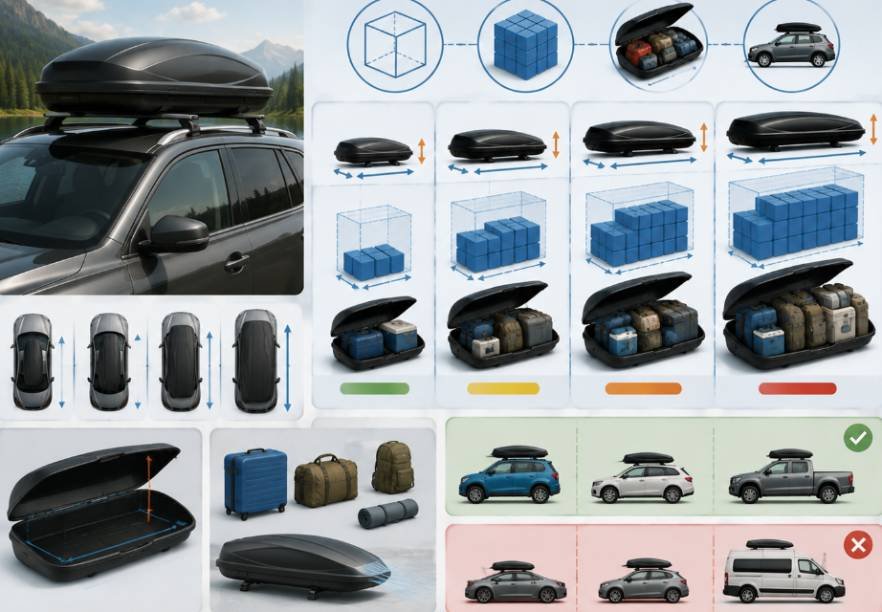
Whenever I prepare for a road trip, I am surprised by how quickly suitcases, camping supplies, and sports equipment consume the available trunk space. A rooftop carrier can solve that problem, but choosing one based on appearance alone often leads to wasted space or an awkward vehicle fit.
If you are wondering How Many Cubic Feet Is a Cargo Box?, most rooftop models provide between 10 and 22 cubic feet of storage, while 14 to 18 cubic feet is the most practical range for families.
What Is the Average Cargo Box Capacity?
A compact roof box generally offers 8 to 12 cubic feet of storage. This size works well for one or two travelers carrying soft bags, boots, outdoor equipment, or a few smaller suitcases. Its narrow shape may also leave enough crossbar space for a bicycle or kayak rack.
Medium models usually provide 13 to 16 cubic feet. They balance capacity and manageable dimensions, making them suitable for couples, small families, weekend travel, and everyday storage. While advanced methods such as lidar estimation of storage capacity can measure irregular interior spaces more precisely, a 14-cubic-foot carrier can often accommodate several duffel bags, compact camping supplies, or a folded stroller, although its exact usefulness depends on its shape.
Large boxes typically hold 17 to 18 cubic feet. This popular family category can carry multiple carry-on suitcases, sleeping bags, tents, and other bulky but relatively light belongings. Extra-large models range from approximately 19 to 22 cubic feet and suit longer vacations or groups carrying substantial outdoor equipment.
What Fits Inside Different Roof Box Sizes?
Cubic footage can feel abstract because belongings rarely form perfect cubes. An 11-cubic-foot sport box may be long enough for skis but too shallow for tall luggage. Meanwhile, a shorter 16-cubic-foot model may accept several suitcases yet be unsuitable for long snowboards.
An 8-to-12-cubic-foot box generally accommodates two small suitcases or several soft bags. A 13-to-16-cubic-foot carrier may hold luggage for two or three people. Models offering 17 to 18 cubic feet are often appropriate for a family’s weekend bags, while a 20-to-22-cubic-foot box provides room for extended-trip gear.
These are estimates rather than packing guarantees. Duffel bags use irregular spaces more efficiently than rigid suitcases, and compressible sleeping bags fit around mounting hardware more easily.
If hard-shell luggage is what you’re packing, my suitcase sizing guide breaks down how “medium” and “large” labels translate into actual cubic feet, which makes it easier to estimate how many will realistically fit.
A cargo box cubic feet calculation can provide a useful capacity estimate, but the box’s shape and internal components still affect how much gear fits. Before choosing a carrier, gather the belongings you commonly transport and measure the longest, widest, and tallest pieces.
Choosing Cargo Capacity by Number of Travelers

For two people, approximately 12 cubic feet is often sufficient for a short trip. Three travelers may benefit from about 15 cubic feet, while four people commonly need around 18 cubic feet. Groups of five may prefer 20 or 21 cubic feet, and six travelers carrying outdoor gear may need 22 cubic feet or an additional storage solution.
Passenger count should remain a starting point rather than a fixed rule. Skiing equipment requires more length, family camping supplies demand height, and a stroller may need a wide opening. Trip duration also matters, but packing style can influence capacity just as much. Travelers using flexible bags may fit considerably more than those relying on hard-shell luggage.
How to Calculate Cargo Box Volume
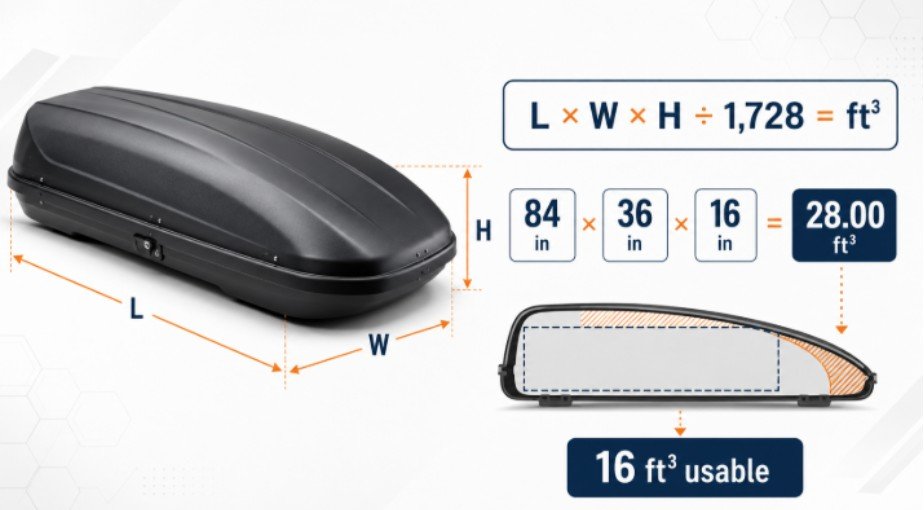
If the manufacturer does not provide capacity, multiply the interior length, width, and height in inches. Divide the result by 1,728 to convert cubic inches into cubic feet.
For example, a rectangular interior measuring 72 inches long, 30 inches wide, and 14 inches high produces 30,240 cubic inches. Dividing that figure by 1,728 gives 17.5 cubic feet.
This result is only an approximation. Rooftop boxes have curved lids, tapered noses, sloping sides, and internal mounting components. Similar to engine mounts and their design considerations, these structural features influence the space available within the product. Treating a cargo box as a perfect rectangular container can therefore overstate its usable capacity.
When capacity is shown in liters, divide the number of liters by 28.3168. A 450-liter carrier therefore provides approximately 15.9 cubic feet. Conversely, multiply cubic feet by 28.3168 to estimate liters.
Advertised Capacity Versus Usable Space
The stated volume represents the space inside a carrier, but it does not reveal how efficiently that space can be packed. Two boxes advertised at 16 cubic feet may perform very differently.
A long, low-profile model is suited to skis, snowboards, fishing rods, and folding equipment. A shorter, taller carrier is generally better for suitcases, duffels, tents, and strollers. Curved walls can create unusable corners, while internal clamps may interfere with flat-bottomed luggage.
Interior dimensions are therefore more valuable than volume alone. Compare the box’s internal length with your longest equipment and examine its opening height before buying. Exterior measurements remain important for determining whether the carrier will fit the vehicle.
Cubic Feet and Weight Capacity Are Not the Same
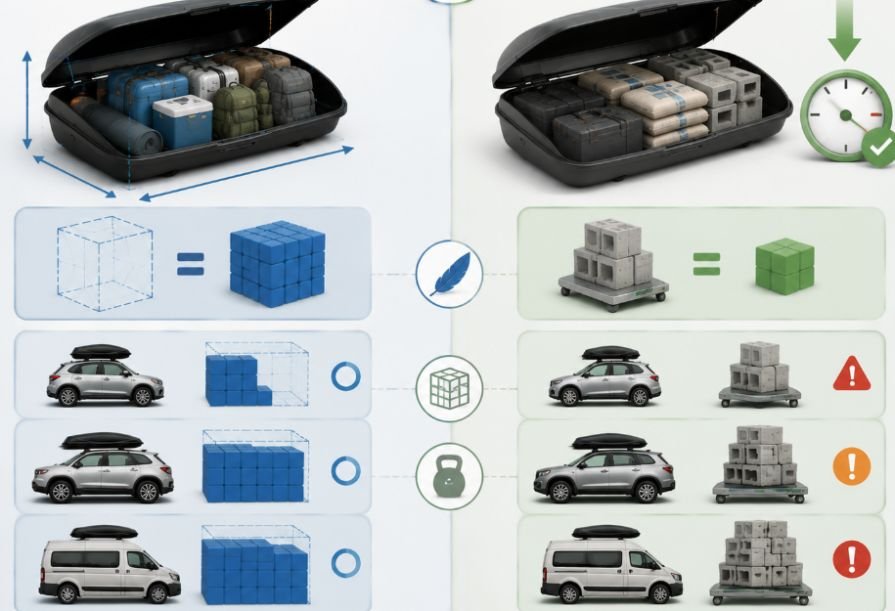
Volume measures available space, whereas weight capacity measures the load a carrier can safely support. A spacious box should not be packed with dense items simply because they fit.
The safe load depends on several limits: the carrier’s maximum capacity, the crossbars’ rating, and the vehicle manufacturer’s dynamic roof-load limit. The lowest rating controls the setup. The total roof load includes the empty cargo box, mounting system, crossbars, and everything packed inside.
Heavy objects are usually better inside the vehicle, positioned low and securely restrained. Roof boxes are most appropriate for bulky, comparatively light items such as clothing, sleeping bags, tents, and sports equipment. Always follow the instructions supplied by the vehicle, rack, and carrier manufacturers.
Will a Cargo Box Fit Your Vehicle?
First, confirm that the mounting clamps support the type, width, and spacing of your crossbars. Some boxes offer adjustable mounting points, but their usable range is limited.
Next, check rear-hatch clearance. A box mounted too far back may prevent the liftgate from opening fully. Careful measurement is essential here, much like when planning to arch a doorway in drywall, where surrounding clearances affect the final fit. Positioning the box too far forward can create visibility, wind, or installation problems.
Measure the vehicle’s total height after installation, especially if you use parking garages, carports, or low-clearance entrances. Remember that a roof box may also increase aerodynamic drag and wind noise. A properly positioned low-profile model usually performs better than a tall or loosely mounted carrier.
Drivers who cannot use a roof-mounted model may consider a hitch-mounted cargo box. A rear carrier is easier to reach and avoids increasing vehicle height, although it adds length and may affect hatch access or parking.
Between trips, that same gear often needs somewhere to sit my garage storage cabinet guide covers cabinet sizes that can hold a roof box, mounting hardware, and other road-trip equipment when it’s not in use.
Frequently Asked Questions
1. How Many Cubic Feet Is a Cargo Box?
Most rooftop cargo boxes hold 10 to 22 cubic feet. Compact versions may start near 8 cubic feet, while family-oriented models commonly provide 14 to 18 cubic feet.
2. Is an 18-Cubic-Foot Roof Box Considered Large?
Yes. An 18-cubic-foot model is generally considered large and can accommodate several suitcases, camping supplies, or winter sports equipment, depending on its dimensions.
3. How Many Suitcases Fit in a Roof Box?
A medium carrier may hold two or three carry-on suitcases, while a large model may accept four or five. Actual capacity depends on suitcase dimensions and the carrier’s shape.
4. Can a Larger Cargo Box Carry More Weight?
Not necessarily. Larger volume provides more room, but the allowable weight is determined by the box, rack, and vehicle roof-load ratings.
Final Thoughts
When I select a cargo box, I treat cubic footage as the beginning of the decision rather than the final answer. A 14-to-18-cubic-foot model meets the needs of many travelers, but internal shape, equipment length, vehicle compatibility, and safe load matter just as much.
Measuring the gear and checking every manufacturer rating before purchasing helps create a safer, quieter, and more useful road-trip setup.

Ryan Mitchell
Ryan Mitchell holds a degree in Civil Engineering and spent over a decade working in construction project estimation, where accurate volume and material calculations were part of his daily work — from concrete pours to landscaping material orders. He founded this site to bring that same precision to everyday calculations, helping DIYers, contractors, and students get fast, accurate cubic footage results without the guesswork. Ryan reviews every calculator and formula on this site for accuracy and writes guides based on real-world measurement scenarios he's encountered on job sites.