

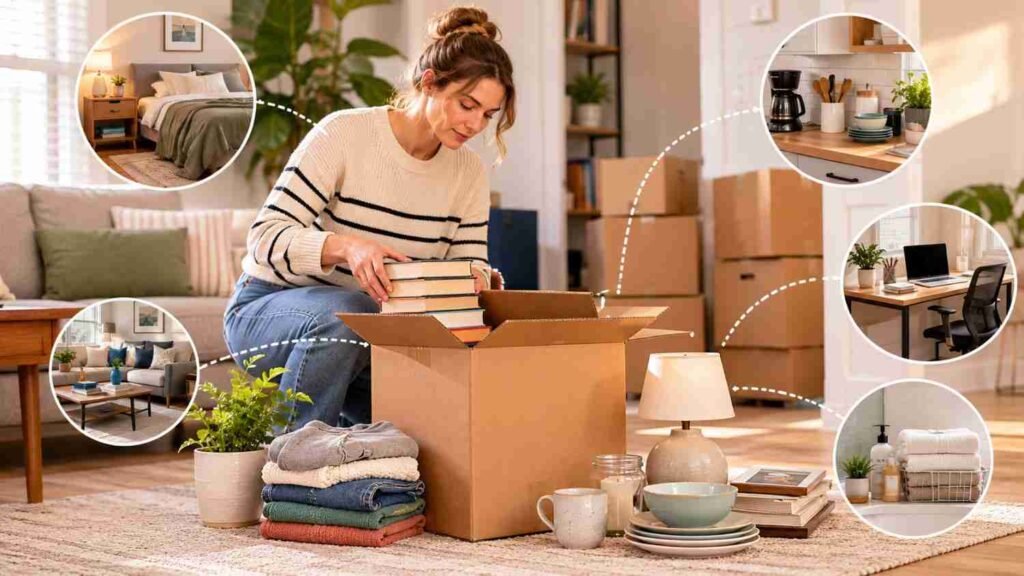
I noticed how quickly moving-box labels become confusing once packing starts. A box marked medium can look different from another medium box. The cubic-foot measurement is more useful than the word medium alone.
I found that the practical answer is simpler than the packaging suggests. A typical medium moving box holds about 3 cubic feet, but its dimensions, construction, and usable space can vary. Knowing that difference makes it easier to choose boxes and estimate moving volume.
The Typical Medium Moving Box Holds About 3 Cubic Feet
For most standard household moving boxes, 3 cubic feet is the number to keep in mind. A common example measures about 18 inches long, 18 inches wide, and 16 inches high. That combination produces roughly 2,992 cubic inches, which converts to just under 3 cubic feet. Many retailers round that capacity to 3 cubic feet.
The label is not a universal standard. Manufacturers can use different dimensions, so checking the listed dimensions and interior volume is smarter than relying on the size label alone.
How to Calculate the Box Volume
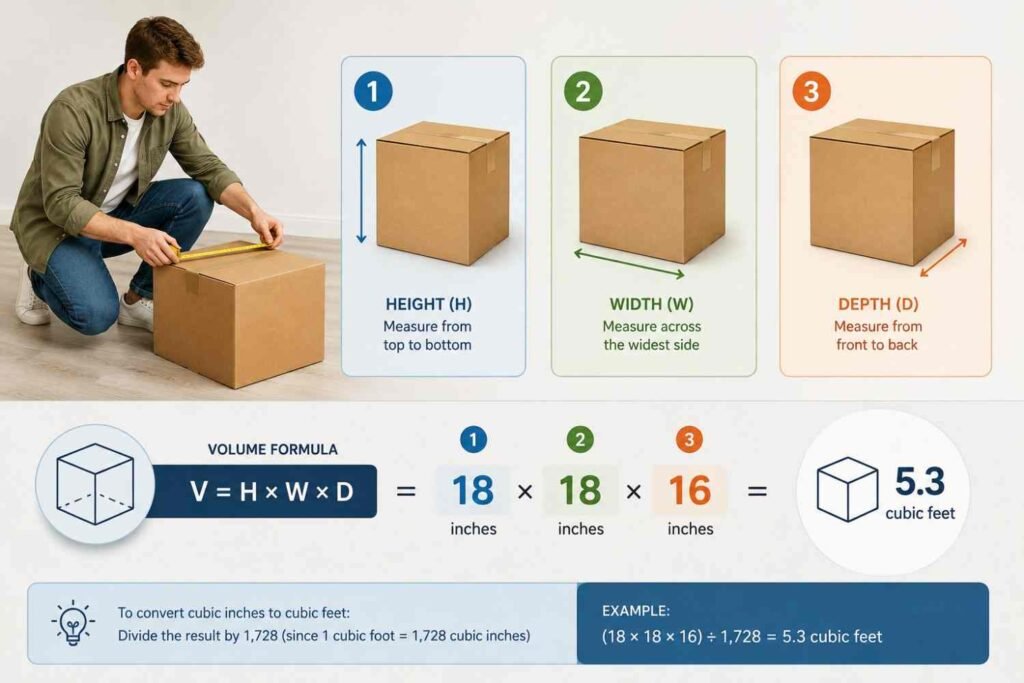
Calculating cubic footage is straightforward. Multiply the box’s length, width, and height in inches, then divide the result by 1,728, because one cubic foot contains 1,728 cubic inches.
For example, an 18-by-18-by-16-inch box contains 5,184 cubic inches. Divide 5,184 by 1,728, and the result is exactly 3 cubic feet. This calculation describes interior volume, not a promise that every inch will be filled.
Real packing leaves gaps around irregular objects and protective material. Usable packing space will therefore feel slightly smaller than the mathematical capacity.
What Fits in a Medium Moving Box?
Medium boxes work well for belongings with some bulk but without excessive density.
In a kitchen, a medium carton can handle pots, pans, food-storage containers, small appliances, and wrapped dishes. Heavier items should be balanced with lighter ones instead of creating one dense layer.
Living rooms offer plenty of candidates, including board games, toys, picture frames, decorations, cables, and shelf items. Bedrooms are another good match for folded clothing, shoes, and accessories.
For an office, think about files, notebooks, desk accessories, electronics, and supplies. Books can work, but a full box of them becomes heavy quickly.
If you are comparing this capacity with a Small Moving Box, remember that smaller cartons can be useful for dense belongings that would become unnecessarily heavy in a medium box. The goal is not simply to maximize volume. It is to create a package that remains manageable from the floor to the moving truck.
Why Weight Matters as Much as Volume
Three cubic feet does not tell you how heavy a full box will be. A carton filled with pillows could remain easy to carry, while the same volume filled with books, tools, or dishes could become difficult.
Box construction matters, too. Standard-duty corrugated boxes suit everyday belongings, while heavy-duty versions offer more support for dense or fragile loads. Treat the stated weight capacity as a limit, not a target.
Put heavier objects near the bottom, distribute weight evenly, and fill gaps with lighter material. Keep the flaps level instead of forcing them closed. If a box feels difficult to lift, repack it.
Medium vs. Other Moving Box Sizes

Small boxes are generally better for dense, heavy belongings such as books, canned goods, and hand tools. Medium boxes provide a middle ground for mixed household items. Large cartons are better suited to bulky, lightweight belongings such as bedding, towels, and oversized clothing.
That distinction can save time. Large boxes filled with heavy items are harder to carry and stack, while tiny cartons waste space for bulky belongings.
How Many Medium Boxes Might You Need?
There is no reliable one-box-per-room formula because homes vary. A bedroom may need a few cartons, while a cookware-heavy kitchen can require more.
A better approach is to estimate by belongings rather than rooms. Look at shelves, drawers, closets, and cabinets, then consider how much will actually be packed. If most possessions are medium-sized and moderately light, 3-cubic-foot cartons can become the main box size, with smaller and larger cartons filling the gaps.
Buying a modest number first can also help. Once several boxes are packed, the remaining volume becomes easier to judge.
Packing a Medium Box Without Wasting Space
Start with a sturdy base and add heavier items first. Wrap breakables individually, then use soft materials to prevent shifting. Leave enough room to close the flaps without compressing the contents.
Think about shape as you pack. Flat objects can create useful layers, while smaller pieces can fill spaces around larger ones. The same principle applies to a cardboard box: efficient packing comes from reducing empty pockets without turning the carton into a solid block of weight.
Label each box on two sides with its room and a short description. That makes unloading easier when identical cartons are stacked together.
FAQs: How Many Cubic Feet Is a Medium Moving Box? A Room-by-Room Look
1. Is a medium moving box usually 3 cubic feet?
Yes. Around 3 cubic feet is a common capacity for standard medium household moving boxes, although dimensions vary by manufacturer.
2. What are typical medium box dimensions?
A common size is about 18 by 18 by 16 inches. Other medium cartons may use slightly different measurements while offering similar capacity.
3. Are medium boxes good for books?
They can be, but a full box of books may become very heavy. Mix books with lighter belongings or use smaller cartons for dense loads.
4. How should medium boxes be packed?
Place heavier items low, distribute weight evenly, cushion fragile belongings, fill unnecessary gaps, and close the flaps without forcing them.
Why the Right Box Size Makes Moving Easier
The most useful thing about cubic footage is that it turns an ordinary cardboard carton into something measurable. Once the capacity is clear, packing decisions become less about guessing and more about matching belongings to the space and strength of each box. A 3-cubic-foot medium box is versatile because it sits between the extremes: roomy enough for everyday household possessions, yet compact enough to remain manageable when packed thoughtfully. That balance makes it a practical foundation for many moves.
The best box is not the one you can fill the most. It is the one you can close, lift, stack, transport, and unpack without creating a problem somewhere else.

Ryan Mitchell
Ryan Mitchell holds a degree in Civil Engineering and spent over a decade working in construction project estimation, where accurate volume and material calculations were part of his daily work — from concrete pours to landscaping material orders. He founded this site to bring that same precision to everyday calculations, helping DIYers, contractors, and students get fast, accurate cubic footage results without the guesswork. Ryan reviews every calculator and formula on this site for accuracy and writes guides based on real-world measurement scenarios he's encountered on job sites.


