


I’ve noticed that “small” moving boxes can be surprisingly confusing. Two boxes may carry the same label while having slightly different dimensions, and that difference changes how much they actually hold. When planning a move, I’ve found that thinking in cubic feet makes the choice much clearer than relying on the word small alone.
I’ve also learned that box capacity is only part of the equation. A small box can be excellent for heavy belongings because it discourages overpacking, while a larger box may be better for lightweight items. Knowing the approximate volume helps you buy enough supplies without ending up with boxes that are awkward to carry.
The Typical Size of a Small Moving Box
A standard small moving box is usually around 1 to 1.5 cubic feet, with 1.5 cubic feet being common for household moves. Capacity depends on the manufacturer and dimensions.
For example, a box measuring 16 by 12 by 12 inches has a volume of 2,304 cubic inches. Divide that by 1,728, the number of cubic inches in one cubic foot, and the result is about 1.33 cubic feet.
Some moving boxes are slightly larger. A box measuring approximately 16 3/8 by 12 5/8 by 12 5/8 inches comes out to about 1.5 cubic feet. Check the listed dimensions because small boxes vary.
How to Calculate Cubic Feet
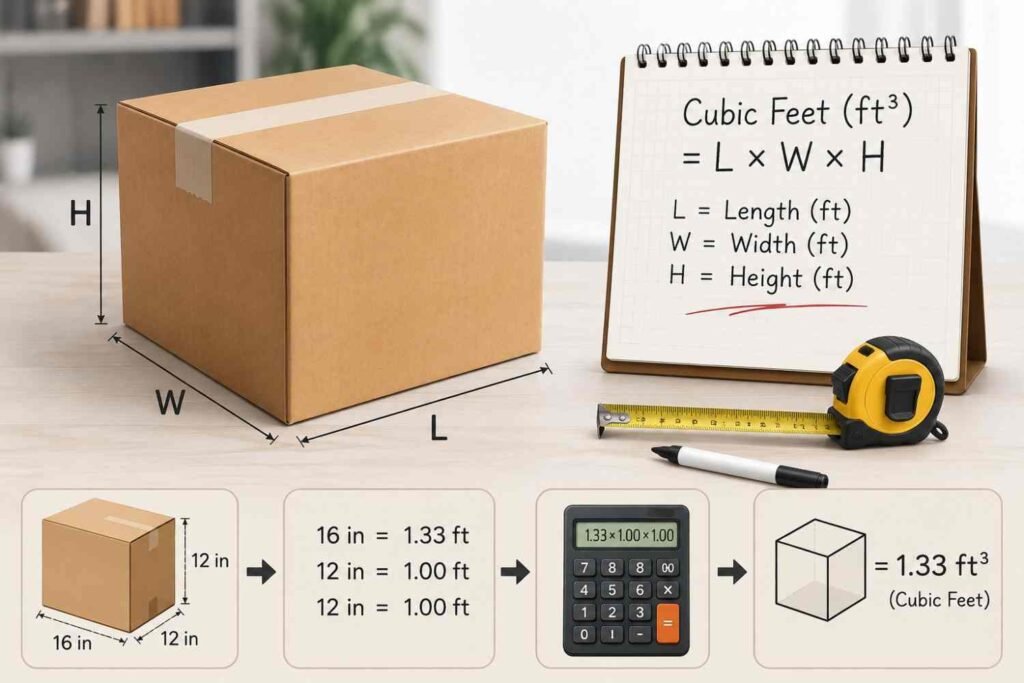
Calculating box volume is straightforward. Multiply the length, width, and height in inches, then divide the result by 1,728.
For a 16 by 12 by 12-inch box:
16 × 12 × 12 = 2,304 cubic inches
2,304 ÷ 1,728 = 1.33 cubic feet
This calculation helps when comparing boxes from different stores. A box that looks slightly bigger can have noticeably more volume. Remember that the published figure represents overall capacity, not necessarily the amount of space you should fill.
What Fits in a Small Moving Box?
Small boxes work particularly well for dense or relatively heavy belongings. Books, magazines, records, photo albums, canned foods, tools, hardware, and small appliances are common choices.
They also work for fragile objects that need wrapping or padding. Glassware, small decorative pieces, and compact kitchen equipment can fit when packed carefully. Leaving room for protective material is smarter than using every available inch.
Weight matters here. A box filled with books can become difficult to lift long before it looks full. Keeping dense items in a compact box makes the load easier to manage and reduces the chance of the bottom giving way. Many small moving boxes are rated for roughly 50 to 65 pounds, but the manufacturer’s stated limit should always take priority.
Small vs. Medium Moving Boxes
The jump from a small box to a medium box can make sense when the contents are bulky but relatively light. Towels, bedding, clothing, pillows, and larger household items generally benefit from additional space.
A small box is usually better when the contents have significant weight. It keeps the load manageable and can make stacking easier in a moving truck or storage unit. Medium boxes offer more capacity, but dense belongings can make them unnecessarily heavy.
The goal is safe lifting, carrying, stacking, and unloading. It also discourages cramming, which can damage belongings, strain box seams, and make unpacking more difficult once everything safely reaches the new home.
How Much Space Do You Really Get?
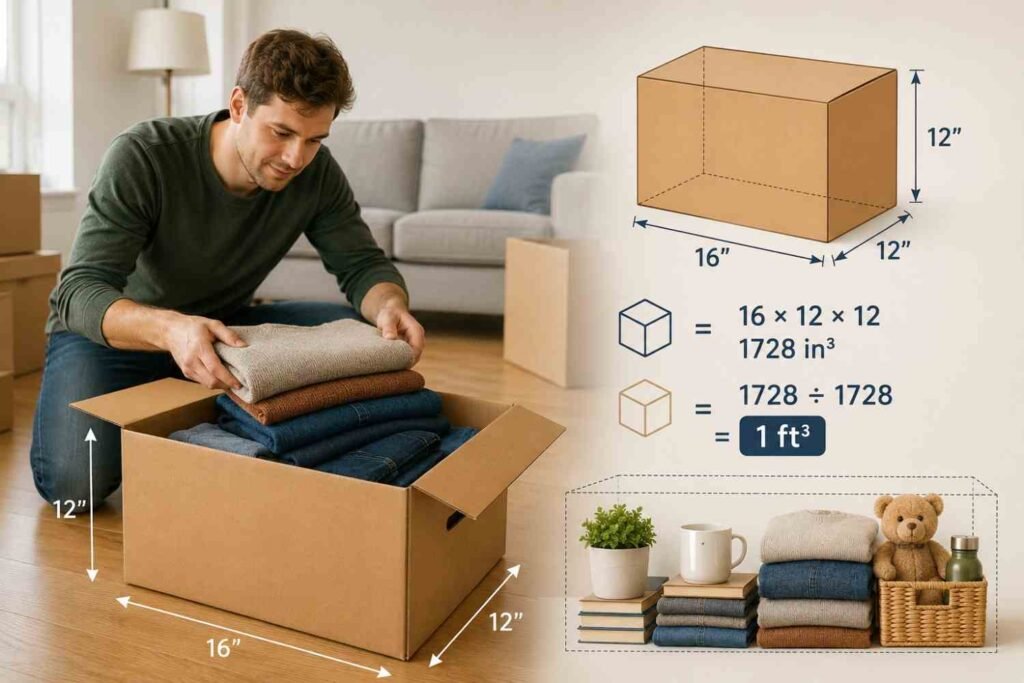
The cubic-foot measurement gives you a useful baseline, but real packing rarely uses every bit of theoretical volume. Boxes contain corners, seams, flaps, and small gaps between oddly shaped belongings. Protective paper, bubble wrap, towels, or other cushioning also takes up space.
A 1.5-cubic-foot box should not be packed until nothing else can fit. Some breathing room protects fragile contents and makes closing the flaps easier.
The same principle applies when comparing an electronics box with a standard small moving box. Electronics often need additional padding, so two boxes with similar advertised capacities may hold different amounts of actual belongings once protection is added.
Choosing the Right Box for Your Move
Start with the items rather than the box label. For books, a small box is usually more practical. For lightweight linens, extra volume can be helpful.
Check the exterior dimensions, interior dimensions when available, and stated weight capacity before buying a large quantity. It is also worth purchasing a few different sizes instead of trying to make one box type work for everything.
For oddly shaped belongings, compare available space with the item’s longest dimensions. A box can have enough cubic feet on paper and still be a poor fit if the opening is too narrow.
Thinking about a cardboard box in terms of both volume and purpose can also prevent wasted supplies. The right box is the one that suits the contents, not necessarily the one with the biggest capacity.
Why Small Boxes Can Make Moving Easier
A small moving box may seem insignificant when compared with the dozens of containers involved in a full household move, but its size serves a practical purpose. Keeping dense belongings contained in manageable packages makes packing, carrying, stacking, and unloading less exhausting. It also creates a more organized system because similar items can stay together without creating oversized loads.
The most useful number to remember is that a typical small moving box holds roughly 1 to 1.5 cubic feet. From there, dimensions and weight capacity tell you whether a particular box is actually suited to your belongings. Planning before packing can save frustration on moving day.
FAQs: How Many Cubic Feet Is a Small Moving Box? What to Expect
1. Is 1.5 cubic feet a small moving box?
Yes. A 1.5-cubic-foot box is a common small moving-box size. Dimensions vary by manufacturer, so check the specifications.
2. What are typical small moving box dimensions?
Common dimensions are around 16 × 12 × 12 inches, although some boxes are slightly larger or smaller. Those differences can change the total cubic-foot capacity.
3. What should go in a small moving box?
Small boxes are especially useful for dense items such as books, records, tools, canned goods, hardware, and compact household items. Avoid making them excessively heavy.
4. How do you calculate a box’s cubic feet?
Multiply the length, width, and height in inches. Then divide the total by 1,728. For example, a 16 × 12 × 12-inch box holds about 1.33 cubic feet.
Why the Right Box Size Makes Moving Simpler
A small moving box may seem insignificant when compared with the dozens of containers involved in a full household move, but its size serves a practical purpose. Keeping dense belongings contained in manageable packages makes packing, carrying, stacking, and unloading less exhausting. It also creates a more organized system because similar items can stay together without creating oversized loads.
The most useful number to remember is that a typical small moving box holds roughly 1 to 1.5 cubic feet. From there, dimensions and weight capacity tell you whether a particular box is actually suited to your belongings. Planning before packing can save frustration on moving day.

Ryan Mitchell
Ryan Mitchell holds a degree in Civil Engineering and spent over a decade working in construction project estimation, where accurate volume and material calculations were part of his daily work — from concrete pours to landscaping material orders. He founded this site to bring that same precision to everyday calculations, helping DIYers, contractors, and students get fast, accurate cubic footage results without the guesswork. Ryan reviews every calculator and formula on this site for accuracy and writes guides based on real-world measurement scenarios he's encountered on job sites.


