
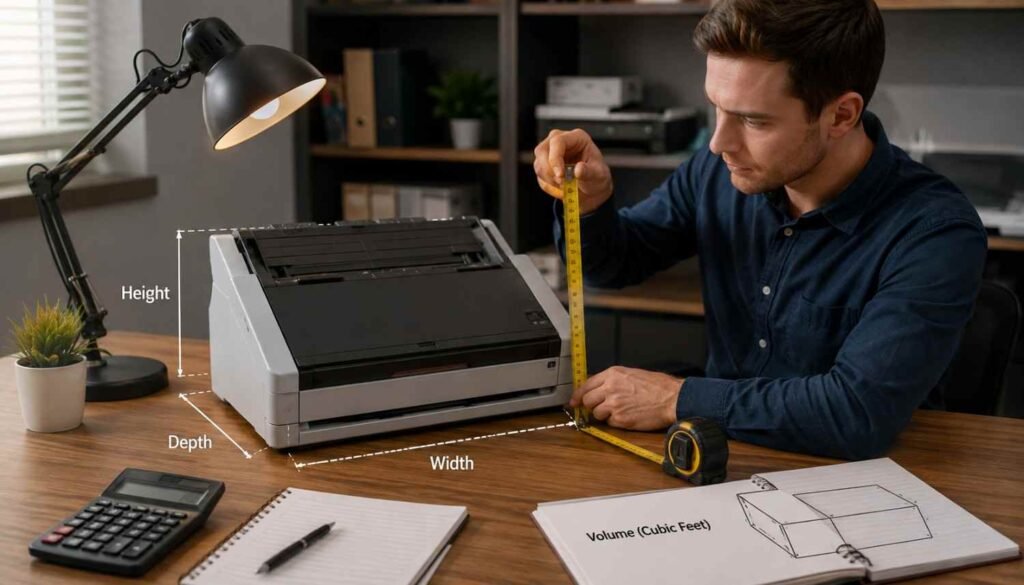
I started looking at scanner size differently when I realized that a device can look small on a desk but still take up more physical space than expected once you account for its full length, width, and height. The same thing happens when planning storage or shipping space. A scanner’s product category alone does not tell you much about its actual volume.
I also found that there is no single number that works for every scanner. A small mobile unit can take up only a few hundredths of a cubic foot, while a standard desktop model can approach half a cubic foot or more. Larger professional machines can take several cubic feet. The easiest way to get an accurate answer is to use the scanner’s actual dimensions and calculate its volume.
How Many Cubic Feet Is a Scanner?
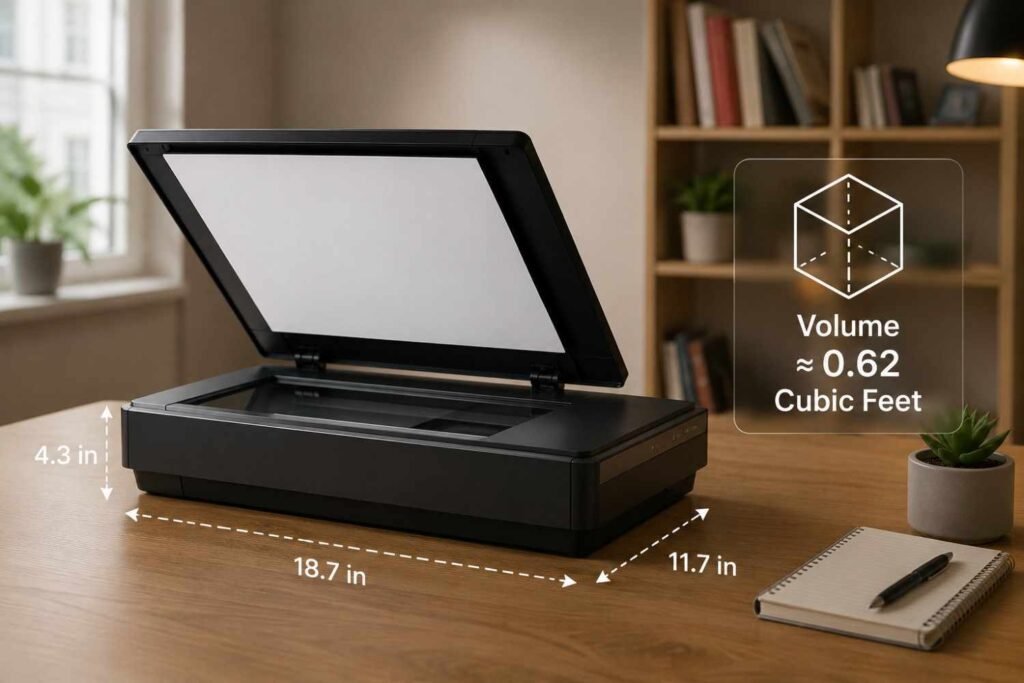
A typical desktop scanner can occupy around 0.4 to 0.8 cubic feet, although the actual number depends heavily on the design. Compact mobile scanners can take up less than 0.05 cubic feet, while larger professional and production models can reach several cubic feet.
For example, a scanner measuring 17 × 12 × 5 inches has a volume of about 0.59 cubic feet. That is close to the 0.6-cubic-foot figure often used as a practical estimate for a standard flatbed scanner.
A small scanner measuring 11 × 3 × 2 inches has a volume of only about 0.04 cubic feet. At the other end of the range, a large professional scanner measuring 27.8 × 19.7 × 13.6 inches works out to about 4.31 cubic feet. Current equipment specifications show just how wide this range can be.
How to Calculate a Scanner’s Cubic Feet
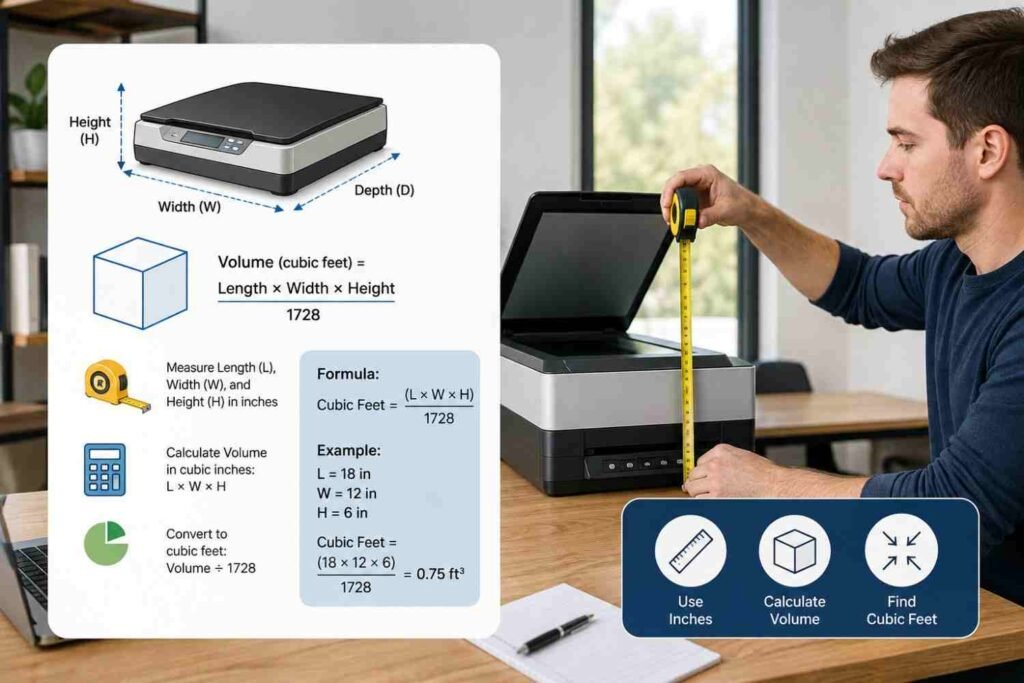
You do not need a special tool to calculate the volume. You only need three measurements: length, width, and height.
If the measurements are in inches, use this formula:
Cubic feet = length × width × height ÷ 1,728
The number 1,728 comes from the fact that one cubic foot contains 12 × 12 × 12, or 1,728, cubic inches.
For example, suppose your scanner measures 17 inches long, 12 inches wide, and 5 inches high:
17 × 12 × 5 = 1,020 cubic inches
1,020 ÷ 1,728 = 0.59 cubic feet
So, that scanner occupies roughly 0.59 cubic feet of physical volume.
If your measurements are already in feet, you can simply multiply the three dimensions together. A scanner measuring 1.5 feet by 1 foot by 0.5 feet would have a volume of 0.75 cubic feet.
Scanner Size Depends on the Type
Scanner dimensions vary because different models are designed for different jobs. A portable scanner built for occasional document capture has very different physical requirements from a high-volume office machine.
Mobile scanners
Mobile scanners are designed to be easy to carry and store. A compact model measuring approximately 11 × 3 × 2 inches would occupy about 0.04 cubic feet.
That is small enough to fit comfortably in a drawer, backpack, or small storage compartment. These scanners can be useful when portability matters more than scanning large batches of documents.
Flatbed scanners
Flatbed scanners usually require more horizontal space because they have a scanning bed and lid. A model measuring about 17 × 12 × 5 inches would occupy approximately 0.59 cubic feet.
The height can also matter more than it first appears. Opening the lid requires additional vertical clearance, especially if the scanner sits underneath a shelf or cabinet.
Desktop document scanners
Office document scanners often use an automatic document feeder, or ADF, which can make them taller than compact models. One current professional desktop model measures 11.6 × 7 × 9.2 inches, producing a volume of about 0.43 cubic feet.
This is a useful reminder that two scanners with similar capabilities can have noticeably different footprints.
Physical Volume Is Not the Same as Working Space
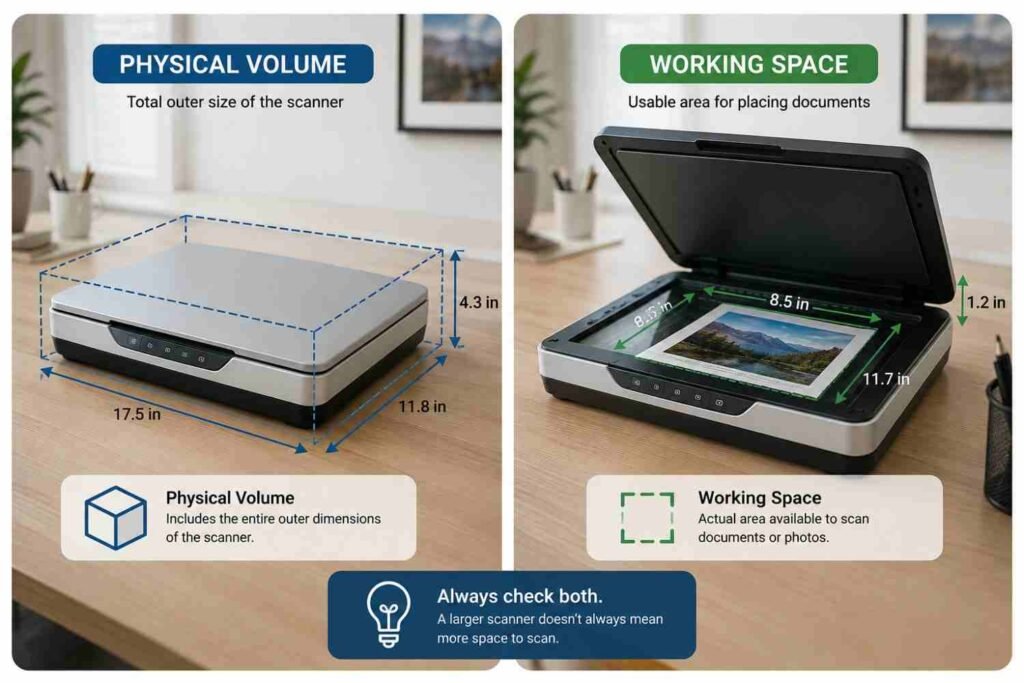
The calculated cubic feet tells you how much three-dimensional space the scanner itself occupies. It does not tell you how much space you should reserve around it.
A scanner may need room for a power cable, USB connection, paper input, output documents, or an ADF tray. Some models also change considerably in size when their trays are opened.
For instance, one current document scanner measures 291 × 267 × 242 mm with its trays closed, but expands to 291 × 600 × 378 mm when the trays are open.
That difference matters if you are measuring a desk, cabinet, shelf, or storage area. The closed dimensions might fit perfectly, while the operating position could be much more restrictive.
How Much Space Should You Leave Around a Scanner?
For everyday desk use, think beyond the scanner’s cubic-foot calculation.
Leave enough room to place documents beside the machine and collect scanned pages without constantly moving it. If the scanner has an automatic feeder, check where documents enter and exit. If it has a flatbed lid, make sure there is enough clearance to open it fully.
This is also where comparisons with related office equipment can be useful. If you are already calculating the volume of a laptop package, the same basic length-by-width-by-height approach works for a laptop box. The important difference is that packaging dimensions measure the container, while scanner dimensions measure the device itself.
When estimating storage or moving space, you may also want to compare the scanner with the volume of a printer. Printers often need more clearance because of paper trays and output areas, even when their basic dimensions appear similar.
What About Large Professional Scanners?
Large production scanners can occupy several cubic feet, particularly when they include large document feeders, floor-standing structures, or additional components.
A professional flatbed scanner listed with dimensions of 27.8 × 19.7 × 13.6 inches has a calculated volume of approximately 4.31 cubic feet.
Some older or specialized production equipment can be even larger. That is why using a blanket figure for “scanner volume” can be misleading. The model’s dimensions are always the better starting point.
Packaging also creates another layer of difference. A shipping carton is normally larger than the scanner itself because it needs protective material and space around the equipment. If you are planning freight or storage, use the carton dimensions rather than the scanner’s dimensions.
A Quick Scanner Volume Reference
Here is a simple way to think about the range:
- Mobile scanner: about 0.04 cubic feet
- Standard desktop or flatbed scanner: around 0.4 to 0.8 cubic feet
- Larger office scanner: roughly 0.8 to 2 cubic feet, depending on design
- Professional production scanner: several cubic feet and potentially more
These are practical ranges rather than fixed standards. The actual number can change substantially from one model to another.
Why Scanner Dimensions Matter More Than a Single Average
Knowing the cubic-foot volume is useful when you need to estimate storage, shipping, moving space, or desk capacity. But the number becomes much more useful when paired with the scanner’s footprint and operating clearance.
A scanner that occupies 0.5 cubic feet could be short and wide, tall and narrow, or somewhere in between. Those shapes require very different spaces even though the mathematical volume is similar.
The safest approach is simple: measure the actual device, calculate the cubic feet, then check how much additional room it needs to operate comfortably.
FAQs: How Many Cubic Feet Is a Scanner? A Quick Guide to Volume and Dimensions
1. How many cubic feet is a standard scanner?
A standard desktop or flatbed scanner often falls around 0.4 to 0.8 cubic feet. A 17 × 12 × 5-inch scanner, for example, is about 0.59 cubic feet.
2. How do I calculate scanner volume?
Multiply the scanner’s length, width, and height in inches, then divide the result by 1,728. This converts cubic inches into cubic feet.
3. Are portable scanners much smaller?
Yes. Compact mobile scanners can occupy less than 0.05 cubic feet. Their smaller size makes them easier to store and transport than traditional flatbed or office scanners.
4. Should I use scanner or box dimensions for shipping?
Use the package dimensions when estimating shipping space. The carton is usually larger than the scanner because it includes protective packaging and extra clearance.
The Right Number Depends on the Scanner You Have
There is no universal cubic-foot measurement for a scanner. A portable unit may occupy almost no noticeable space, while a professional machine can require several cubic feet. The most reliable answer always comes from the actual dimensions of the model you own or plan to buy.
Once you know those three measurements, the calculation is straightforward. More importantly, you can plan the real space the scanner needs, including its trays, cables, lid, and room to work. That makes a simple volume calculation much more useful than an average size estimate.

Ryan Mitchell
Ryan Mitchell holds a degree in Civil Engineering and spent over a decade working in construction project estimation, where accurate volume and material calculations were part of his daily work — from concrete pours to landscaping material orders. He founded this site to bring that same precision to everyday calculations, helping DIYers, contractors, and students get fast, accurate cubic footage results without the guesswork. Ryan reviews every calculator and formula on this site for accuracy and writes guides based on real-world measurement scenarios he's encountered on job sites.