

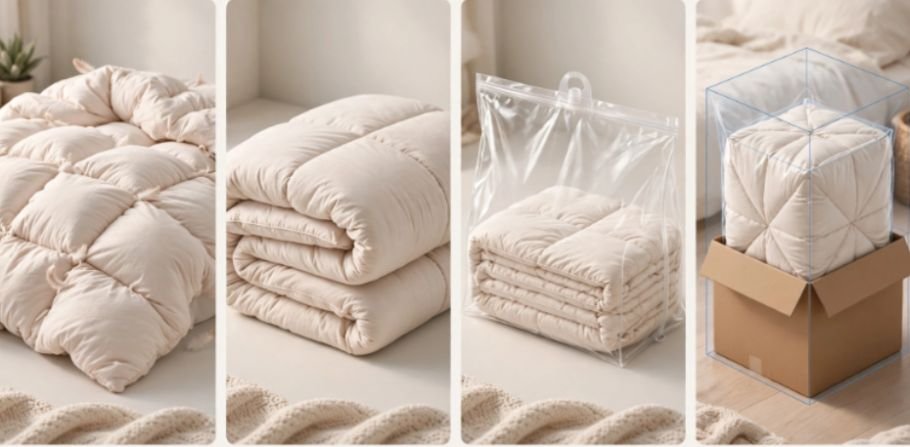
I used to think measuring a comforter was as simple as looking at its bed size and estimating how much room it would take in a closet. That changed when I tried to fit bulky bedding into a storage container. A queen comforter could look manageable when folded, yet take up far more room than expected once it was fluffed back up. The fill, thickness, and way it was folded made a noticeable difference.
I also found that “cubic feet” can mean different things depending on what you are trying to measure. The loose volume of a comforter is very different from the space it takes inside a storage bag, and neither number tells you exactly what washer capacity you need. Once those differences are clear, estimating comforter volume becomes much easier.
So, How Many Cubic Feet Is a Comforter?
There is no single cubic-foot measurement for every comforter because bedding is flexible and compressible. A fluffy comforter can occupy roughly 10 to 15 cubic feet when it is fully lofted and spread loosely. Once folded or packed, the same comforter may occupy closer to 1 to 2.5 cubic feet, depending on its size, fill, thickness, and how tightly it is compressed.
That difference can seem surprising, but it makes sense. A comforter contains a lot of trapped air between its fibers and filling. Folding removes some of that air, while compression removes even more.
For storage purposes, the packed measurement is usually the number that matters. For understanding how bulky the comforter is, its lofted volume gives you a better picture.
What Changes a Comforter’s Volume?
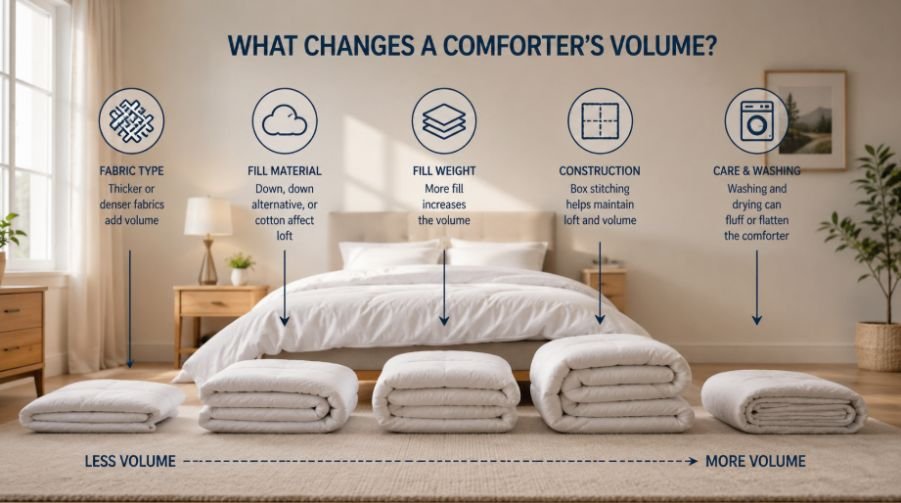
Two comforters with the same bed-size label can require very different amounts of space. The dimensions of standard comforters already vary by manufacturer, with queen comforters commonly measuring around 86 to 90 inches wide and 90 to 100 inches long. King sizes can be considerably larger.
Fill is another major factor. Down comforters can have substantial loft because the filling traps air, while some synthetic comforters may feel denser even when their overall dimensions are similar. Fill power, baffle construction, shell fabric, and thickness all affect how much air remains inside the bedding.
The way you fold it matters, too. A neatly folded comforter with several layers can have a smaller footprint than one folded loosely. Vacuum compression can reduce it even further.
How to Calculate the Cubic Feet Yourself
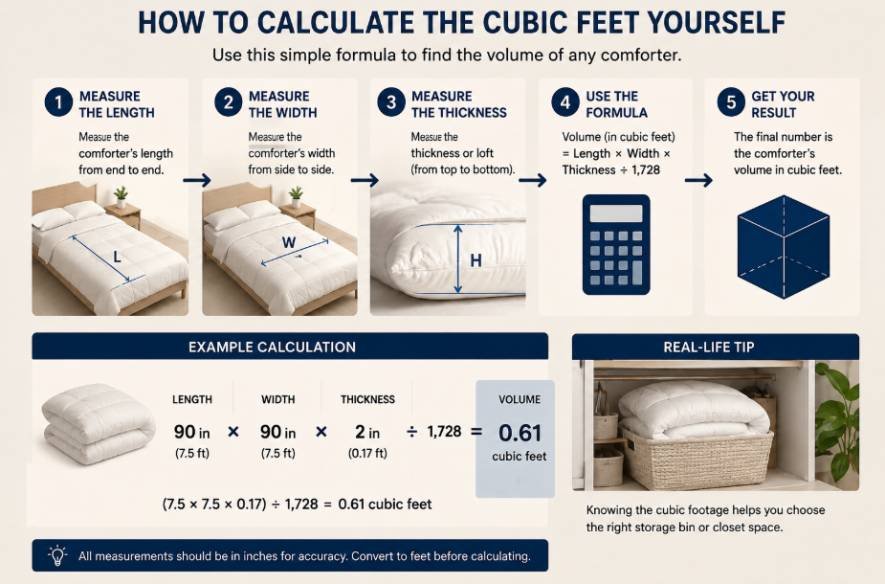
If you want a more useful estimate, measure the comforter after folding it into the shape you intend to store.
Measure:
- Length
- Width
- Height
Keep all three measurements in inches, multiply them together, and divide the result by 1,728.
For example, suppose your folded comforter measures 24 inches long, 18 inches wide, and 8 inches high:
24 × 18 × 8 = 3,456 cubic inches
3,456 ÷ 1,728 = 2 cubic feet
So the folded comforter takes up approximately 2 cubic feet in that packed state.
This is an estimate rather than a permanent measurement. If you fold the same comforter differently tomorrow, the dimensions can change.
Why Fluffy and Packed Volume Are So Different
A comforter is not a rigid box. Its fill expands when it has room and collapses when you press it down.
Think about taking a comforter out of its packaging. It may look surprisingly thin at first, then gradually become thicker as the filling regains its loft. That expansion is exactly why a storage bag that looks large enough for a compressed comforter may not have enough room for it in its natural state.
For regular closet storage, giving the bedding some breathing room is usually more practical than forcing it into the smallest possible container. A breathable storage bag can also be preferable for certain types of bedding, particularly when long-term storage is involved.
How Much Storage Space Should You Allow?
For storage, focus on the dimensions of the container rather than the comforter’s bed size alone.
A folded comforter measuring roughly 2 cubic feet needs a container with slightly more usable capacity than 2 cubic feet. You need room to place the bedding inside without forcing it through the opening or compressing it unnecessarily.
For example, a storage container measuring 24 by 18 by 8 inches has exactly 2 cubic feet of geometric volume. In practice, a comforter with a calculated volume of 2 cubic feet may still be difficult to fit because the container has corners, an opening, and limited flexibility.
For that reason, choosing a container with some extra capacity is usually more practical than matching the numbers exactly.
What Does Comforter Volume Have to Do With Washer Capacity?

This is where cubic-foot measurements often cause confusion.
A washer’s cubic-foot rating describes the approximate internal capacity of the drum. It does not mean that a comforter with 4 cubic feet of packed volume automatically requires a 4-cubic-foot washer.
The comforter needs room to move during the wash. If it is crammed into the drum, water and detergent may not circulate properly, and the filling may not distribute evenly.
For bulky bedding, larger machines are generally more appropriate. Current manufacturer guidance commonly recommends around 4.5 cubic feet or more for king-size comforters, while some guidance recommends 5 cubic feet or more for reliable movement.
A comforter’s thickness and filling still matter, though. If you have to force the bedding into the washer, the machine is probably too small. A commercial washer may be the better option for especially bulky bedding.
Why Dryer Capacity Matters Too
Washing is only half the job. A comforter that fits inside the washer may still need considerable room to dry properly.
A large comforter needs space to tumble so air can circulate through the fabric and filling. Current laundry guidance commonly recommends a dryer around 7 cubic feet or larger for bulky comforters.
If the comforter comes out of the washer extremely wet or remains bunched during drying, it may need a larger commercial dryer.
The Practical Way to Think About Comforter Volume
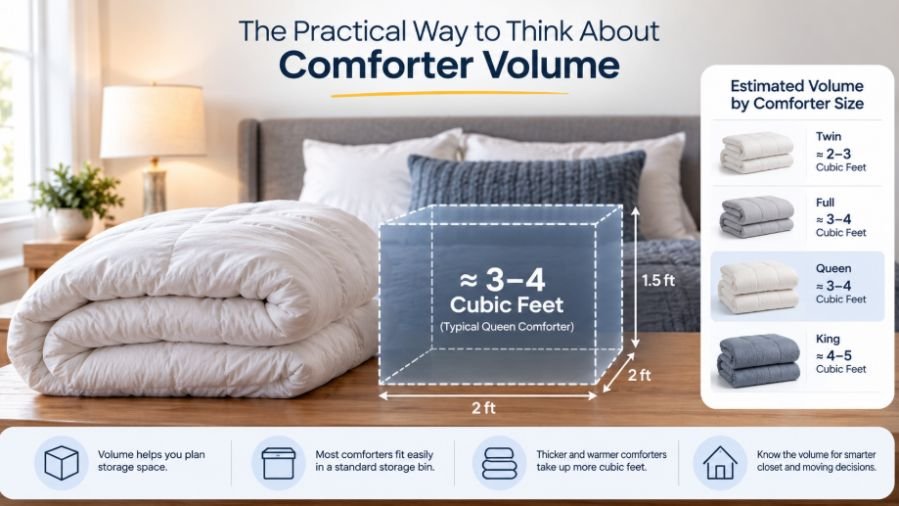
If you only need a rough answer, remember the two states: a fluffy comforter can occupy around 10 to 15 cubic feet, while a folded or compressed one may occupy roughly 1 to 2.5 cubic feet.
If you need an exact estimate for storage, measure the folded comforter and use the cubic-foot formula. If you need to wash it, ignore the packed volume and focus on whether the washer provides enough room for the comforter to move freely.
Frequently Asked Questions
1. How many cubic feet does a queen comforter take up?
A fluffy queen comforter may occupy roughly 10 to 15 cubic feet when fully lofted. Folded storage volume can be much smaller, often around 1 to 2.5 cubic feet depending on thickness and filling.
2. How do I calculate a comforter’s cubic feet?
Measure the folded length, width, and height in inches. Multiply those measurements and divide the result by 1,728 to convert cubic inches into cubic feet.
3. Is a 4.5-cubic-foot washer large enough for a comforter?
A 4.5-cubic-foot washer can handle many bulky comforters, including some king sizes, but the exact fit depends on thickness, filling, and machine design. The comforter should move freely rather than being tightly packed.
4. Does vacuum-sealing change a comforter’s volume?
Yes. Removing trapped air can greatly reduce the space a comforter occupies. The compressed measurement should be treated separately from its normal, lofted volume.
Why the Number Depends on How You Measure
A comforter’s cubic footage is less about one fixed number and more about its physical state. Spread it out and the trapped air creates a surprisingly large volume.
Fold it carefully, and the same bedding becomes much easier to store. Compress it further and the required space drops again. That is why a useful estimate should always say whether the comforter is lofted, folded, or compressed.
For everyday planning, measure the comforter in the form you actually need. Storage calls for packed dimensions, while laundry calls for enough washer and dryer capacity to let the bedding move freely. That small distinction can save a lot of guesswork.

Ryan Mitchell
Ryan Mitchell holds a degree in Civil Engineering and spent over a decade working in construction project estimation, where accurate volume and material calculations were part of his daily work — from concrete pours to landscaping material orders. He founded this site to bring that same precision to everyday calculations, helping DIYers, contractors, and students get fast, accurate cubic footage results without the guesswork. Ryan reviews every calculator and formula on this site for accuracy and writes guides based on real-world measurement scenarios he's encountered on job sites.


