

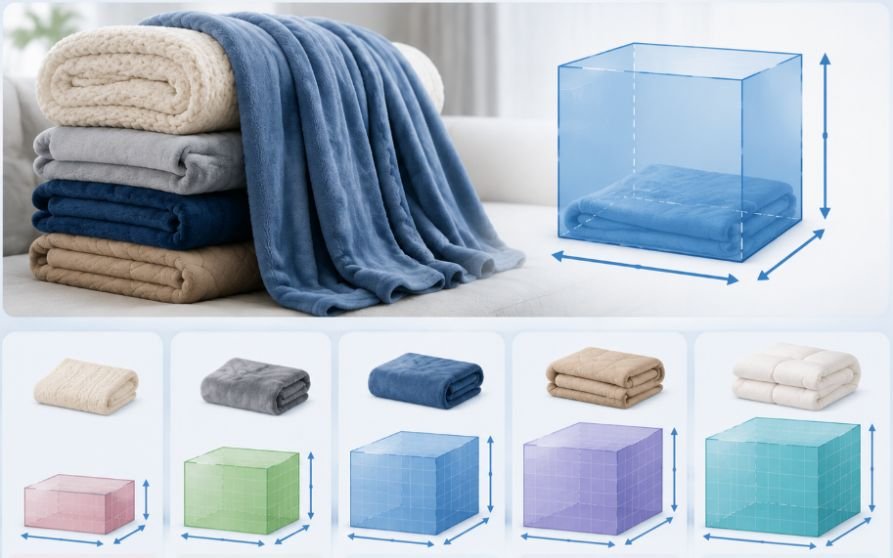
I first realized how awkward blanket volume can be when trying to figure out whether several folded blankets would actually fit inside a storage bin. Blanket labels give you familiar dimensions such as 50 by 60 inches or queen and king sizes, but those numbers describe surface area. They do not tell you how much three-dimensional storage space the blanket will occupy once it is folded.
I found that the useful answer depends less on the size printed on the package and more on how the blanket is packed. As a practical estimate, a neatly folded blanket may occupy roughly 0.21 cubic feet for a small throw and around 1.17 cubic feet for a bulky king-size blanket. Material, thickness, folding, and compression can move those numbers considerably, so cubic feet works best as a storage estimate rather than a universal blanket specification.
So, How Many Cubic Feet Is a Blanket?
For a quick reference, a folded throw blanket may occupy about 0.21 cubic feet, a twin around 0.49 cubic feet, a full or queen around 0.78 cubic feet, and a king around 1.17 cubic feet.
These are reasonable working estimates based on neatly folded dimensions, not standardized industry volumes. Blanket manufacturers generally list length and width rather than cubic feet, and even standard blanket dimensions vary somewhat between products.
That matters because cubic feet measure three-dimensional space. A blanket spread across a bed looks almost two-dimensional because its thickness is small relative to its length and width. For storage purposes, however, what matters is the rectangular space occupied by the folded or packed blanket.
Estimated Cubic Feet by Blanket Size
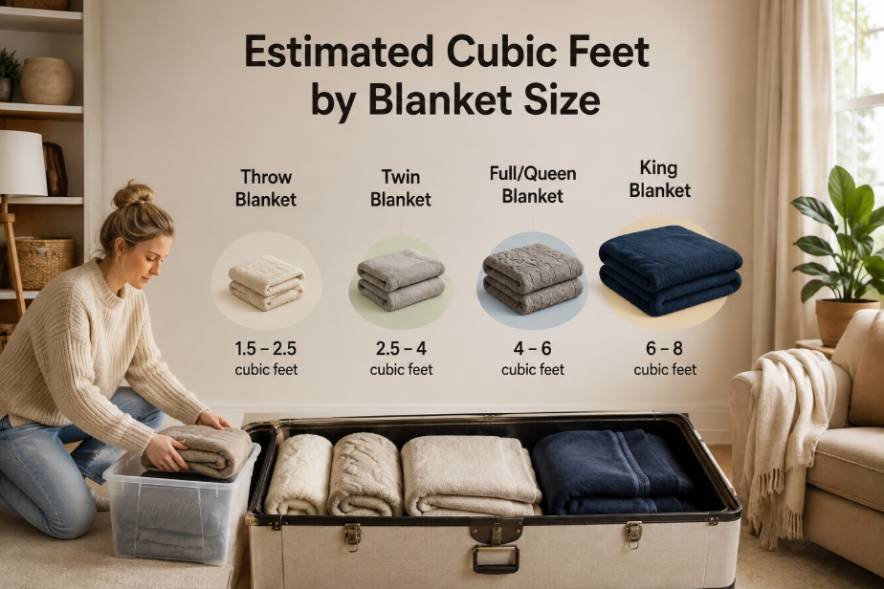
Here is a practical way to visualize common folded blanket volumes:
| Blanket size | Example folded dimensions | Approx. cubic inches | Approx. cubic feet |
| Throw | 12 × 10 × 3 in. | 360 | 0.21 cu. ft. |
| Twin | 14 × 12 × 5 in. | 840 | 0.49 cu. ft. |
| Full/Queen | 16 × 14 × 6 in. | 1,344 | 0.78 cu. ft. |
| King | 18 × 14 × 8 in. | 2,016 | 1.17 cu. ft. |
Treat these figures as examples rather than fixed capacities. A thin cotton queen blanket may fold much flatter than the example, while a plush fleece blanket of similar surface dimensions may occupy considerably more room.
Blanket dimensions themselves are not completely standardized either. A common throw is about 50 by 60 inches, while typical bed blankets can range around 66 by 90 inches for a twin, 90 by 90 inches or more for a queen, and roughly 108 by 90 inches or larger for a king.
How to Calculate Blanket Volume Yourself
If you need an accurate estimate for a particular blanket, measuring the folded blanket is more useful than starting with its unfolded dimensions.
Fold or roll it exactly as you plan to store it. Measure the resulting length, width, and height in inches. Then use:
Length × Width × Height ÷ 1,728 = Cubic Feet
There are 1,728 cubic inches in one cubic foot.
Suppose your folded blanket measures 15 inches long, 12 inches wide, and 6 inches high. Multiplying those dimensions gives 1,080 cubic inches. Divide 1,080 by 1,728, and the blanket occupies an estimated 0.625 cubic foot of bounding storage space.
The calculation becomes especially useful when comparing your blanket with the internal capacity of a moving box, storage tote, closet cubby, or under-bed container.
Why Blanket Material Changes the Answer
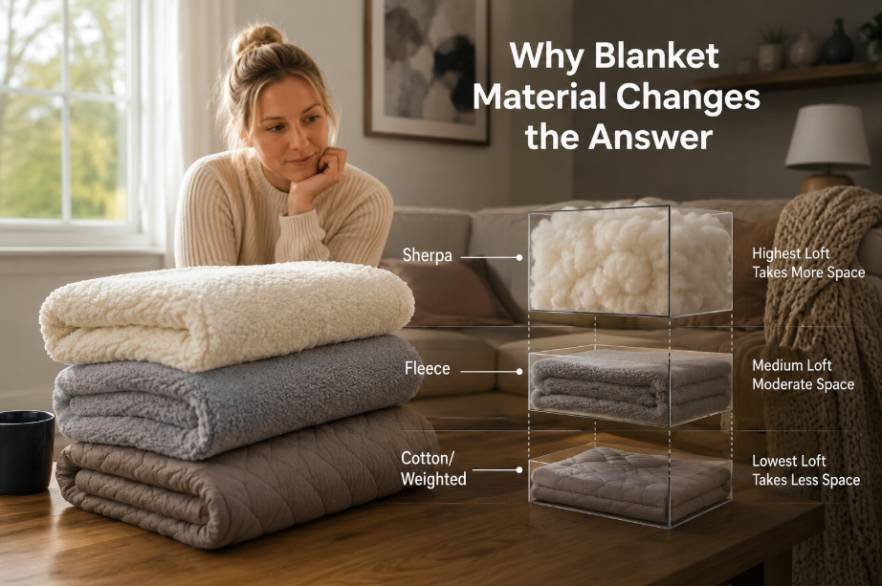
Two blankets with identical length and width can occupy completely different amounts of storage space.
A lightweight cotton blanket has relatively little loft and can usually be folded into a compact stack. Fleece tends to remain bulkier. Wool thickness varies considerably, while down-filled bedding can trap a large amount of air.
Weighted blankets create another situation entirely. They may contain glass beads or other dense filling, so they can be heavy without necessarily being exceptionally bulky. Weight and volume are separate measurements.
Construction matters as well. Quilting, multiple fabric layers, batting, knitted textures, and plush pile can increase the height of the folded stack.
This is why estimating blanket cubic feet solely from twin, queen, or king labeling can produce a misleading result.
This same packing unpredictability applies to soft luggage too; my suitcase sizing guide explains how soft-sided bags can compress or expand beyond their stated dimensions, affecting the amount of space they actually occupy.
Choosing Storage Based on Cubic Feet
Knowing the approximate blanket volume becomes practical when you are deciding what size container to use.
Do not choose a container whose advertised capacity exactly matches your calculation. Real blankets do not form perfect rectangular blocks, and storage bins may taper toward the bottom or lose usable room around handles and lids.
I explore this same difference between exterior dimensions and usable capacity when discussing plastic container storage, which can help when choosing bins for folded linens.
For example, a blanket measuring around 0.8 cubic feet when folded theoretically fits inside a one-cubic-foot space. In practice, leaving additional room makes packing easier and avoids excessive compression.
Clean and fully dry blankets before long-term storage. Depending on the material and environment, breathable fabric bags, under-bed containers, baskets, closet shelves, or sturdy bins can all work. Everyday throws benefit from easy access, while seasonal bedding can be stored farther out of reach.
Measure the Blanket You Actually Own
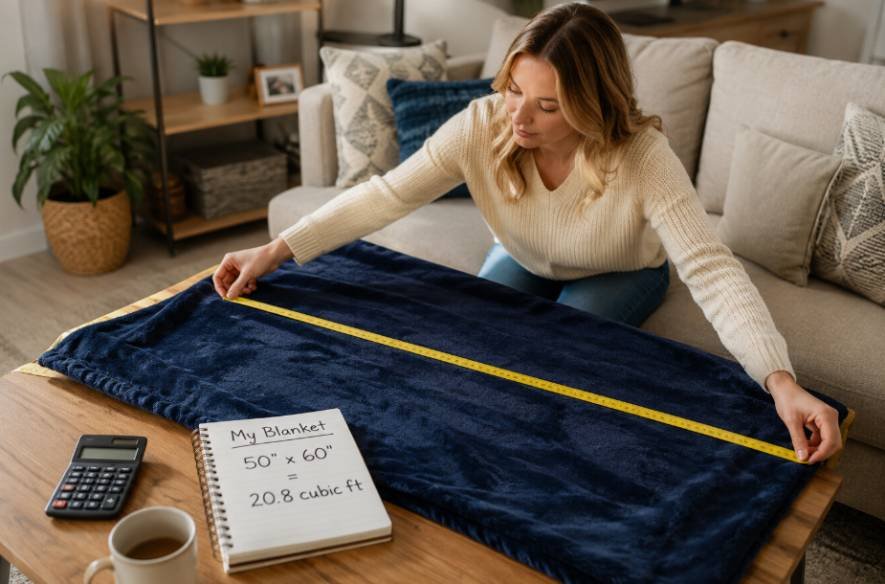
Standard size charts are helpful for estimating length and width, but measuring your own folded blanket produces a much better volume figure.
Manufacturers can use different dimensions for products carrying the same size label. A queen blanket might also be lightweight cotton, thick fleece, wool, or another construction altogether.
Fold it normally, let it settle, and measure the outer dimensions without pressing down excessively. If you plan to compress it during storage, measure it after applying approximately the same compression.
That gives you a realistic number for the space the blanket will actually occupy rather than an abstract calculation based on its bed size.
Frequently Asked Questions
1. How many cubic feet does a throw blanket take up?
A neatly folded 50-by-60-inch throw might occupy around 0.21 cubic feet when folded to approximately 12 by 10 by 3 inches. Thick fleece or knitted throws can require more space.
2. How many cubic feet is a queen blanket?
A folded full/queen blanket can occupy roughly 0.78 cubic feet using an example folded size of 16 by 14 by 6 inches. Actual volume depends heavily on material and compression.
3. How do I calculate cubic feet for my own blanket?
Measure the blanket after folding it. Multiply its length, width, and height in inches, then divide the result by 1,728 to convert cubic inches into cubic feet.
4. Does vacuum packing reduce a blanket’s cubic feet?
Yes, for compressible materials. Vacuum packing removes trapped air and reduces the external storage volume. The reduction varies with fabric and construction, so measure the blanket after compression when planning a specific storage space.
Why the Folded Size Is the Number That Matters
Asking how many cubic feet a blanket occupies sounds like it should have one straightforward answer, but blanket size is only part of the equation.
For rough planning, approximately 0.21 to 1.17 cubic feet covers useful examples from a folded throw through a folded king. Once material, loft, and compression enter the picture, however, measuring the actual folded blanket becomes far more reliable than relying on its size label.
When storage space is tight, measure what goes into the container, not what stretches across the bed.

Ryan Mitchell
Ryan Mitchell holds a degree in Civil Engineering and spent over a decade working in construction project estimation, where accurate volume and material calculations were part of his daily work — from concrete pours to landscaping material orders. He founded this site to bring that same precision to everyday calculations, helping DIYers, contractors, and students get fast, accurate cubic footage results without the guesswork. Ryan reviews every calculator and formula on this site for accuracy and writes guides based on real-world measurement scenarios he's encountered on job sites.


