Did you know that packing a standard moving truck, stocking warehouse shelves, and calculating shipping costs all rely on a simple math concept taught in elementary school? The size of a box isn’t just about how long or tall it looks from the outside; it comes down to total volume. If you have ever wondered how many cubic units is a box that is 3 units high, 3 units wide, and 2 units deep?, the short answer is 18 cubic units.
Calculating volume seems simple when looking at small numbers, but understanding how to measure 3D space is an essential skill. Whether you are prepping for a basic geometry test, organizing a storage container, or starting an e-commerce business, knowing how spatial measurement works keeps you from paying for empty space.
The Math Behind 3D Space: Breaking Down the Formula
When we talk about length or width on a flat sheet of paper, we measure in two dimensions (square units). But the moment an object gains depth, it enters three-dimensional space. To find the total internal capacity—or volume—of any rectangular box, you use a standard geometric formula:
How to Calculate the Volume of a Box
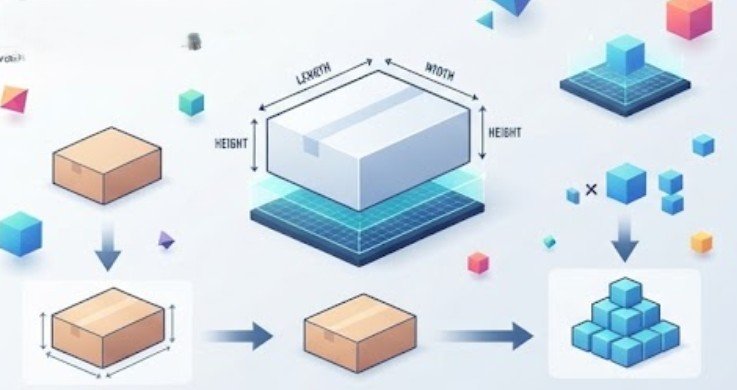
To find the volume (the amount of space inside a box), multiply its three measurements:
Volume = Length × Width × Height
You can multiply these numbers in any order because multiplication gives the same answer no matter the order.
For example:
3 × 3 × 2 = 2 × 3 × 3 = 18
Now, for this box:
- Height = 3 units
- Width = 3 units
- Depth = 2 units
So:
Volume = 3 × 3 × 2
Volume = 18 cubic units
Simple Example
Imagine the box is made of small toy blocks.
- The bottom layer is 3 blocks wide and 2 blocks deep.
- So, one layer contains:
3 × 2 = 6 blocks
The box is 3 blocks high, so you stack 3 layers of these blocks:
6 blocks × 3 layers = 18 blocks
Therefore, the box can hold 18 cubic units of space.
Real-World Applications: Why Volume Matters Outside the Classroom
Calculating volume isn’t just an abstract exercise for math homework. The National Institute of Standards and Technology (NIST) relies on standardized volume units to establish unified trade guidelines across global supply chains. In everyday life, spatial capacity dictates practical decisions every single day. Here are a few ways understanding cubic volume impacts daily life:
- E-Commerce and Shipping Costs: Major shipping carriers like USPS, FedEx, and UPS use “dimensional weight” pricing. If you ship a light item in an unnecessarily large box, you get charged based on the box’s cubic volume rather than its actual weight.
- Home Organization and Moving: Knowing about a scanner that fits inside a storage unit or moving truck prevents you from renting a vehicle that is too small for your furniture.
- Home Improvement Projects: Pouring concrete for a patio, filling a raised garden bed with soil, or buying an air conditioner sized for a room all require calculating cubic volume.
3D vs. 2D Measurement: Quick Comparison
It is easy for beginners to mix up perimeter, area, and volume. Here is a quick breakdown to keep the definitions clear:
| Measurement Type | Dimensions Covered | Example Formula | Output Units | Real-World Use Case |
| Perimeter | 1D (Distance around an edge) | \text{Side} + \text{Side} + \text{Side} + \text{Side} | Linear units (in, ft, cm) | Fencing off a yard |
| Area | 2D (Flat surface space) | \text{Length} \times \text{Width} | Square units (\text{in}^2, \text{ft}^2, \text{cm}^2) | Buying carpet for a floor |
| Volume | 3D (Total internal capacity) | \text{Length} \times \text{Width} \times \text{Height} | Cubic units (\text{in}^3, \text{ft}^3, \text{cm}^3) | Filling a box or tank |
Common Misconceptions When Calculating Cubic Volume
Even though the math relies on basic multiplication, beginners often hit a few common snags.

1. Mixing Up Measurement Units
You cannot multiply inches by feet and get an accurate answer. If a box is 3 feet high, 3 feet wide, and 24 inches deep, you must convert the 24 inches into 2 feet before multiplying. Otherwise, your math will tell you the box holds 216 cubic feet instead of the correct 18 cubic feet!
2. Confusing Cubic Volume with Liquid Capacity
Cubic units measure solid 3D space, while fluid ounces, liters, or gallons measure liquid capacity. However, they are directly connected. For instance, according to standard conversion factors managed by educational and metric resources like standard measurement tables, one cubic centimeter is exactly equal to one milliliter.
3. Forgetting the “Cubic” Label
Writing your answer as “18 units” or “18 square units” is technically incorrect. Linear units measure distance, square units measure flat area, and cubic units measure three-dimensional capacity. Always label 3D space in cubic units (e.g., \text{ft}^3, \text{cm}^3, or cubic units).
A Quick Step-by-Step Method to Calculate Any Box
If you are facing a volume problem on a test or in real life, follow this 4-step checklist to get the right answer every single time:
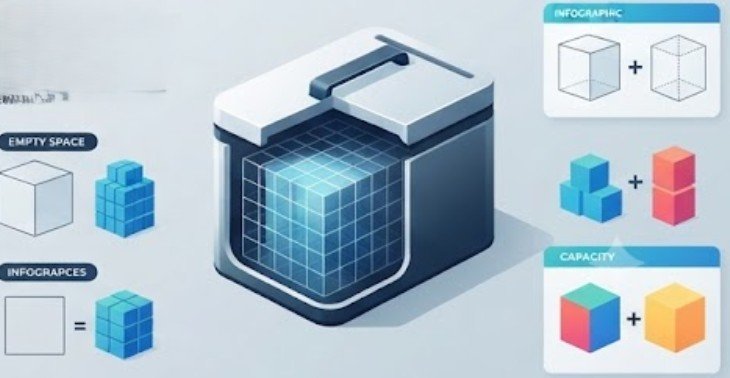
- Identify the three core dimensions: Locate the box’s length, width, and height/depth.
- Standardize your units: Make sure all three measurements use the exact same unit (convert everything to inches, feet, or meters first).“For example, when measuring a plastic container, convert its length, width, and height into the same unit before multiplying them. This makes it easier to compare container sizes accurately and estimate how much storage space each one requires.”
- Multiply all three numbers together: Calculate \text{Length} \times \text{Width} \times \text{Height}.
- Label your answer properly: Append “cubic units” or write the unit with an exponent of 3 (like \text{ft}^3).
Frequently Asked Questions
1. How do you convert cubic inches to cubic feet?
Divide the total volume in cubic inches by 1,728 to convert it into cubic feet. This is because: 1 cubic foot = 12 inches × 12 inches × 12 inches = 1,728 cubic inches So the conversion formula is: Volume in cubic feet = Volume in cubic inches ÷ 1,728
2. Does the order of height, width, and depth matter?
No. Multiplication works the same regardless of order. Multiplying height by width by depth yields the exact same numerical volume as multiplying depth by length by height.
3. What is the difference between volume and capacity?
Volume is the total 3D space an object occupies, while capacity refers to how much liquid or solid material a container can hold inside. For thin-walled boxes, they are essentially identical.
Understanding how 3D space works comes down to one core habit: visualizing objects in layers rather than flat surfaces. Once you picture that initial layer of 6 blocks stacked 3 levels high, finding an answer of 18 cubic units becomes second nature. Whether you are packing up your home, designing a product, or studying for a test, keeping this simple multiplication formula in your back pocket ensures you will always know precisely how much space you have to work with.

Ryan Mitchell
Ryan Mitchell holds a degree in Civil Engineering and spent over a decade working in construction project estimation, where accurate volume and material calculations were part of his daily work — from concrete pours to landscaping material orders. He founded this site to bring that same precision to everyday calculations, helping DIYers, contractors, and students get fast, accurate cubic footage results without the guesswork. Ryan reviews every calculator and formula on this site for accuracy and writes guides based on real-world measurement scenarios he's encountered on job sites.