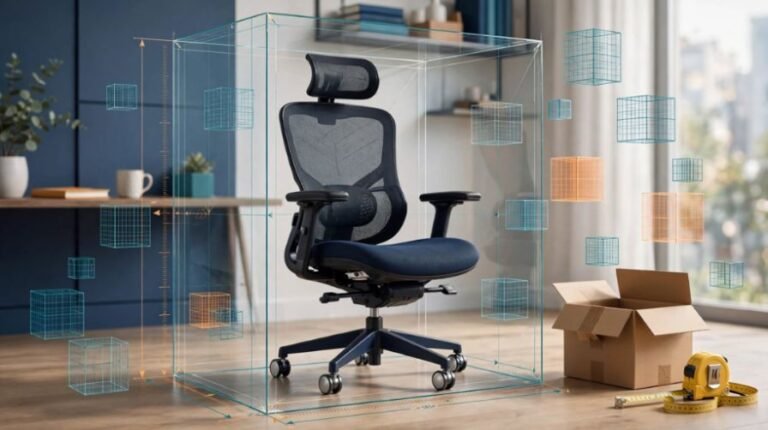
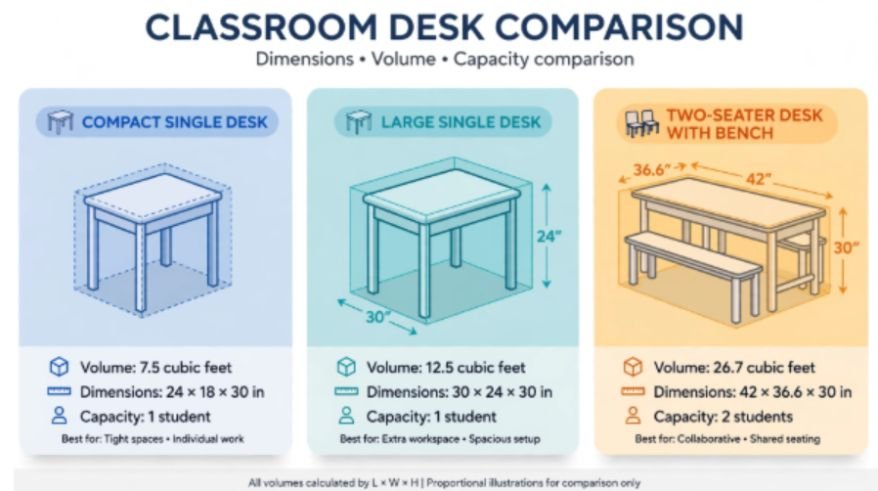
A standard single-student classroom desk usually occupies 7.5 to 12.5 cubic feet when measured as a rectangular unit. Larger two-seater models can require about 26.7 cubic feet.
When someone asks me, how many cubic feet is a classroom desk?, I first check the desk style. A compact writing desk, adjustable student desk, and attached bench model cannot share one reliable estimate. Their frames, shelves, seats, and dimensions vary too much.
The Quick Answer
Most classroom desks fall within these general ranges:
| Desk type | Typical outside dimensions | Approximate volume |
| Compact single desk | 24 × 18 × 30 inches | 7.5 cubic feet |
| Large single desk | 30 × 24 × 30 inches | 12.5 cubic feet |
| Two-seater desk and bench | 42 × 36.6 × 30 inches | 26.7 cubic feet |
These figures represent the desk’s outside storage envelope. They include the empty space between its legs and beneath its writing surface.
Published dimension guides place many child desks around 24–30 inches wide and 18–20 inches deep. Classroom tables commonly stand approximately 28–30 inches high.
Classroom Desk Cubic Feet by Type
The answer changes according to the furniture’s design and intended age group.
| Classroom furniture | Estimated cubic-foot range | Main factor affecting size |
| Elementary student desk | 5.5–8.5 | Lower or adjustable height |
| Standard single desk | 7.5–12.5 | Desktop width and depth |
| Chair-desk combination | 10–16 | Attached seat and frame |
| Collaborative student table | 12–22 | Wider working surface |
| Two-seater desk with bench | 22–30 | Attached seating and shelf |
| Teacher’s desk | 25–45 | Drawers, pedestal, and depth |
These are planning ranges, not universal furniture standards. Measure the actual item before booking storage or selecting a moving vehicle.
How to Calculate Classroom Desk Volume
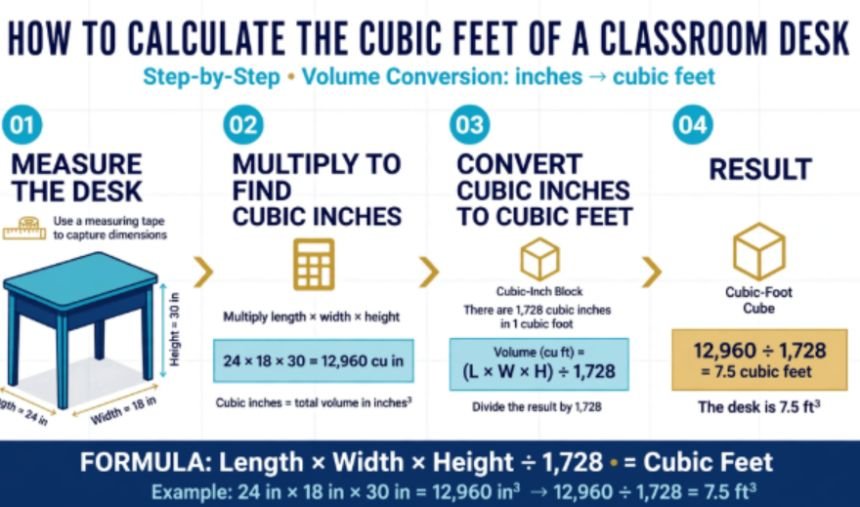
Use the desk’s maximum outside dimensions:
Cubic feet=Length in inches×Width in inches×Height in inches1,728\text{Cubic feet}= \frac{\text{Length in inches}\times\text{Width in inches}\times\text{Height in inches}}{1,728}
The divisor is 1,728 because one cubic foot contains 12×12×1212 \times 12 \times 12, or 1,728 cubic inches. This conversion method is also used in standard cubic-foot calculations.
The same measurement method can be applied to other office and classroom equipment. For example, if you are planning a workspace move, you can also estimate the space occupied by a desktop printer before loading or storing it.
Measure the Maximum Outside Dimensions
Measure from the desk’s outermost points, not only across the writing surface. Include any projecting feet, book baskets, hooks, backrests, or attached seats.
Keep the tape measure straight and record:
- The longest horizontal measurement
- The widest front-to-back measurement
- The highest point from floor to top
Round each dimension up to the next whole inch for moving estimates. That small allowance covers measurement errors and protective wrapping.
Convert Cubic Inches to Cubic Feet
Multiply the three measurements before dividing by 1,728. Do not divide ordinary inches by 1,728 separately.
If the measurements are already in feet, use:
Volume=Length×Width×Height\text{Volume}=\text{Length}\times\text{Width}\times\text{Height}
For example, a desk measuring 2 feet long, 1.5 feet deep, and 2.5 feet high occupies 7.5 cubic feet.
Worked Classroom Desk Volume Examples
Suppose I measure a standard student desk at 24 inches long, 18 inches deep, and 30 inches high:
24×18×30=12,960 cubic inches24\times18\times30=12,960\text{ cubic inches} 12,960÷1,728=7.5 cubic feet12,960\div1,728=7.5\text{ cubic feet}
A larger 30-by-24-by-30-inch desk produces:
30×24×30÷1,728=12.5 cubic feet30\times24\times30\div1,728=12.5\text{ cubic feet}
For a two-seater unit measuring 42 by 36.6 by 30 inches:
42×36.6×30÷1,728=26.6942\times36.6\times30\div1,728=26.69
I would round that result to 26.7 cubic feet, or 27 cubic feet when reserving moving space.
Why the Calculated and Packed Volumes Differ
A cubic-foot calculation gives a dependable starting point, but desks rarely pack like sealed boxes.
Open Space Still Counts
A desk may contain little solid material, yet its legs create an occupied rectangular area. Movers care about this storage envelope because another object may not fit safely inside it.
For this reason, how many cubic feet is a classroom desk? usually refers to occupied moving space, not the volume of its wood, plastic, or steel.
Nesting and Disassembly Reduce Space
Stackable desks can use substantially less space than their separate calculations suggest. Removable legs and folding frames may reduce the packed height further.
Here is my practical planning adjustment:
| Packing condition | Suggested estimate |
| Fully assembled and separate | Use 100% of calculated volume |
| Closely nested | Use roughly 65–80% |
| Legs removed and tops stacked | Use roughly 35–55% |
| Wrapped or individually boxed | Add about 5–15% |
These percentages are original planning allowances rather than fixed industry standards. Test-stack two desks before applying a reduction to the whole inventory.
Estimating Space for Multiple Student Desks
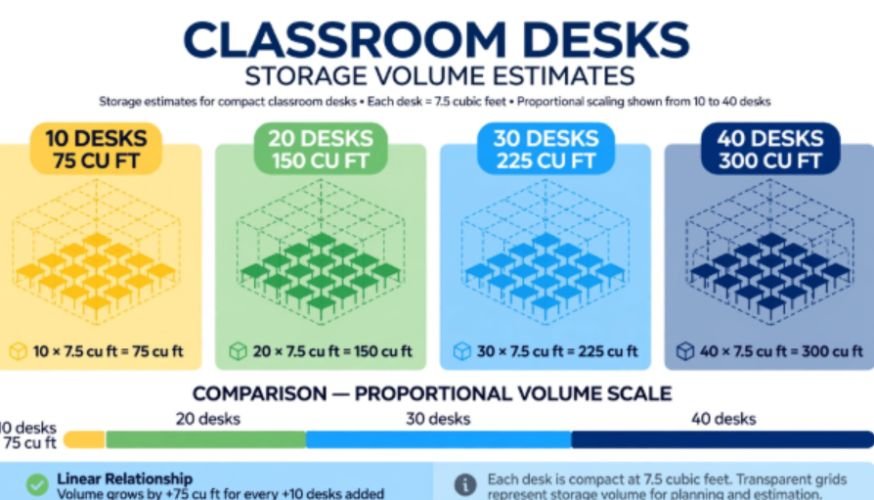
Multiply one desk’s volume by the number of identical units:
Total volume=Volume per desk×Number of desks\text{Total volume}=\text{Volume per desk}\times\text{Number of desks}
Twenty compact desks at 7.5 cubic feet each require a maximum of:
7.5×20=150 cubic feet7.5\times20=150\text{ cubic feet}
If the desks nest efficiently and use 70% of that envelope, the revised estimate becomes:
150×0.70=105 cubic feet150\times0.70=105\text{ cubic feet}
Add protective materials, chairs, cartons, and loading gaps separately. I prefer a 10% buffer when desks cannot be test-loaded beforehand.
When planning a larger classroom move, it is also useful to account for the shelving and equipment used to organize supplies. You can estimate the occupied space of a commercial storage rack separately so the total moving or storage requirement is more accurate.
| Number of desks | At 7.5 cu. ft. each | At 12.5 cu. ft. each |
| 10 | 75 cu. ft. | 125 cu. ft. |
| 20 | 150 cu. ft. | 250 cu. ft. |
| 30 | 225 cu. ft. | 375 cu. ft. |
| 40 | 300 cu. ft. | 500 cu. ft. |
Classroom Layout Volume Versus Moving Volume
Cubic feet helps with storage and transportation. It does not show how much classroom floor area students need.
A 24-by-18-inch desk has a desktop footprint of only three square feet. However, its usable classroom footprint must include the chair, student movement, and circulation space.
Furniture size should also suit the student’s body dimensions. A systematic review found frequent mismatches between school furniture and student measurements, reinforcing the value of age-appropriate sizing.
Use square feet for room layouts and cubic feet for storage or moving capacity.
Frequently Asked Questions
1. How many cubic feet is a classroom desk with an attached chair?
Most chair-desk combinations occupy approximately 10–16 cubic feet, although the attached seat can increase the outside depth.
2. How much space do 30 classroom desks need?
Thirty compact 7.5-cubic-foot desks occupy up to 225 cubic feet before nesting or disassembly.
3. Should desk legs be included in the measurement?
Yes. Measure the desk’s maximum outside length, width, and height while the legs remain attached.
4. Can I calculate classroom desk volume from square feet?
Only if you also know the height; multiply the floor footprint in square feet by the desk’s height in feet.
Final Bell: Measure Once, Move Smarter
When I need a fast estimate, I use 7.5 to 12.5 cubic feet per single classroom desk. I then measure any attached-seat or collaborative model separately.
The best answer to how many cubic feet is a classroom desk? comes from its outermost dimensions. Multiply them, divide by 1,728, and add a modest packing buffer. For a large move, test-stack two desks first. That five-minute check can prevent paying for unnecessary truck or storage space.

Ryan Mitchell
Ryan Mitchell holds a degree in Civil Engineering and spent over a decade working in construction project estimation, where accurate volume and material calculations were part of his daily work — from concrete pours to landscaping material orders. He founded this site to bring that same precision to everyday calculations, helping DIYers, contractors, and students get fast, accurate cubic footage results without the guesswork. Ryan reviews every calculator and formula on this site for accuracy and writes guides based on real-world measurement scenarios he's encountered on job sites.