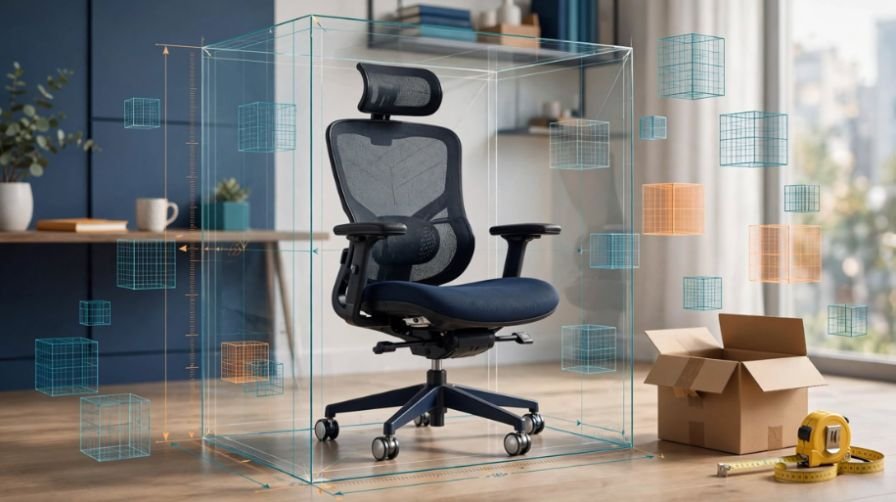
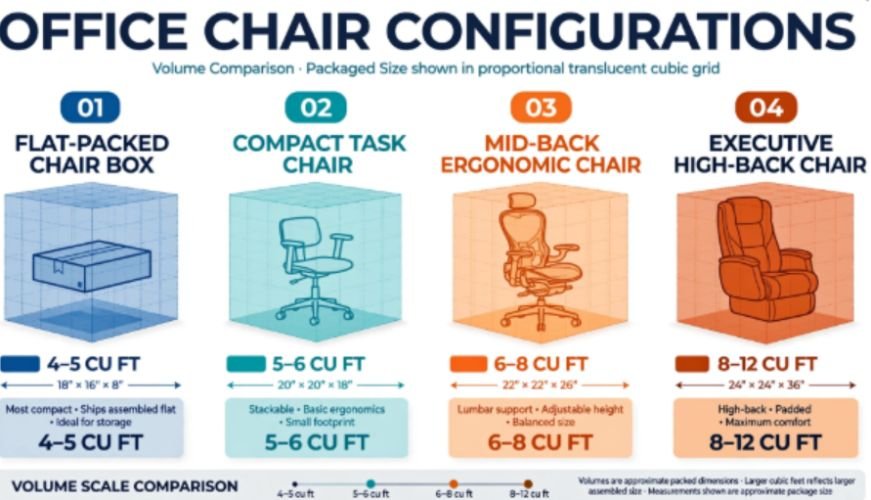
When I estimate how many cubic feet is an office chair, I first ask whether it will be boxed, assembled, or partly disassembled. A packaged chair may need only 4–5 cubic feet. However, an assembled chair’s outer dimensions can enclose 12–20 cubic feet.
The difference matters when pricing shipping, booking storage, or planning a move.
The Quick Answer
Most office chairs receive a practical moving allowance of 5–8 cubic feet. Large executive or gaming-style chairs may receive 8–12 cubic feet. These figures account for the chair’s irregular form and its usable share of a tightly packed load.
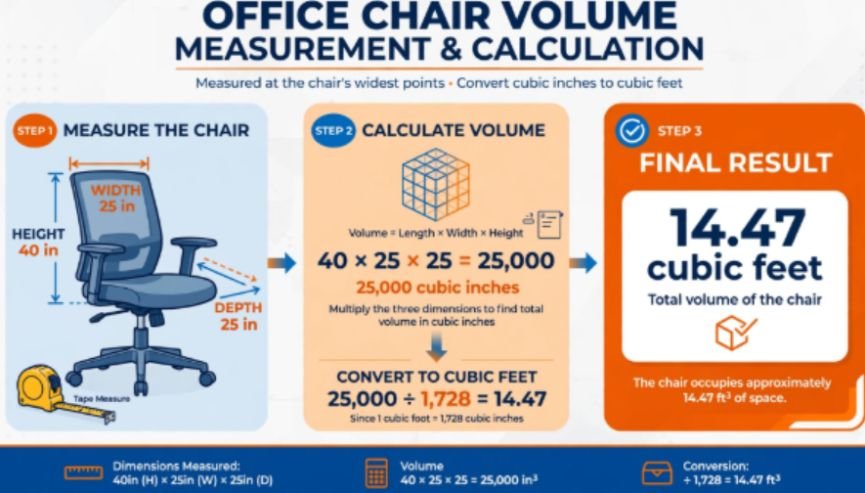
A fully assembled chair can have a much larger rectangular footprint. For example, a chair measuring 40 inches high, 25 inches wide, and 25 inches deep encloses 14.47 cubic feet. Much of that envelope is empty air beneath and around the seat.
| Chair configuration | Typical planning estimate |
| Flat-packed chair in its box | 4–5 cu. ft. |
| Basic task chair | 5–6 cu. ft. |
| Mid-back ergonomic chair | 6–8 cu. ft. |
| Executive or gaming chair | 8–12 cu. ft. |
| Assembled outer envelope | 12–20+ cu. ft. |
These are planning ranges, not universal product specifications. Measure the actual chair when space or cost is tight.
Office Chair Volume by Type
The answer to how many cubic feet is an office chair changes with the backrest, base, arms, and packaging.
| Chair type | Example outer dimensions | Bounding-box volume |
| Compact task chair | 36″ × 22″ × 22″ | 10.08 cu. ft. |
| Standard office chair | 40″ × 25″ × 25″ | 14.47 cu. ft. |
| High-back chair | 46″ × 27″ × 28″ | 20.13 cu. ft. |
| Boxed chair | 25″ × 13″ × 23″ | 4.33 cu. ft. |
Chair designs vary because good seating must support different users and working positions. OSHA’s office-chair guidance recommends an adjustable backrest, suitable seat dimensions, arm support, and a stable five-leg base. These features can increase the chair’s measured envelope.
Why Office Chair Volume Estimates Differ
I use three separate measurements because one figure cannot answer every planning question.
Bounding-Box Volume
Bounding-box volume treats the chair as if a rectangular container surrounds its widest points. This method includes the open area below the seat and between the base legs.
It gives the safest estimate for:
- Doorway and elevator clearance
- An isolated storage position
- Protective crating
- An assembled chair placed in a vehicle
The EPA uses overall dimensions when estimating the volume of fully assembled office furniture. That supports the bounding-box method for conservative space planning.
Practical Moving Volume
Movers can place cartons around the chair base or invert one chair over another. Therefore, its effective share of a moving truck may be lower than its rectangular envelope.
This explains why a 14.47-cubic-foot chair may receive a moving allowance near 6–8 cubic feet. Do not reduce the figure unless the loading arrangement makes that space usable.
For a complete office relocation, calculate the size of an office desk separately by measuring its length, width, and height, then account for any drawers, attached components, or protective packaging that may increase its overall moving volume.
Packaged Shipping Volume
Manufacturers often remove the backrest, casters, gas lift, and armrests. The parts then fit into a compact carton. Packaging protects those parts but adds cardboard, foam, and air gaps.
The EPA notes that packaging can increase estimated volume by about 10% in its waste-planning model. Actual increases vary with the item and packing method. Include both pieces in a furniture moving package.
How to Calculate Office Chair Cubic Feet
Measure the chair’s maximum height, width, and depth in inches. Include protruding armrests, wheels, adjustment handles, and the furthest base points.
Use this formula:
Cubic feet = length × width × height ÷ 1,728
The divisor is 1,728 because one cubic foot contains 12 × 12 × 12 cubic inches.
Worked Example
Suppose I measure an assembled mid-back chair at:
- Height: 40 inches
- Width: 25 inches
- Depth: 25 inches
The calculation is:
40 × 25 × 25 = 25,000 cubic inches
25,000 ÷ 1,728 = 14.47 cubic feet
My original insight is to record a second figure beside that result: the packing-adjusted volume. If careful loading makes 45% of the envelope usable for small cartons, the chair’s effective allocation becomes about 7.96 cubic feet:
14.47 × 0.55 = 7.96 cubic feet
That adjustment is useful for moving estimates. It is not appropriate for parcel shipping or a chair stored alone.
Measuring an Office Chair for Moving
Set the chair upright on a level floor. Lower the seat and backrest where possible. Turn the casters inward, then measure the widest remaining points.
Measure depth from the front edge to the furthest rear projection. Do not measure only the seat pan. High-back chairs may extend well behind the base when reclined.
Add 1–2 inches to each dimension when using blankets or padding. For tight spaces, also measure doors, hallways, elevator openings, and vehicle cargo access.
Calculating Space for Several Office Chairs
Do not always multiply one assembled bounding box by the chair count. Identical chairs may nest, stack, or travel with their seats facing opposite directions.
| Loading method | Suggested planning approach |
| Chairs stored separately | Use full bounding-box volume |
| Chairs packed with small cartons | Use 55%–70% of each envelope |
| Chairs partly disassembled | Measure the resulting bundles |
| Stackable guest chairs | Measure the complete stack |
| Mixed executive chairs | Allow 8–12 cu. ft. per chair |
For ten standard chairs, a simple moving estimate may range from 60 to 80 cubic feet. Ten isolated bounding boxes could exceed 140 cubic feet.
How Disassembly Changes the Required Space
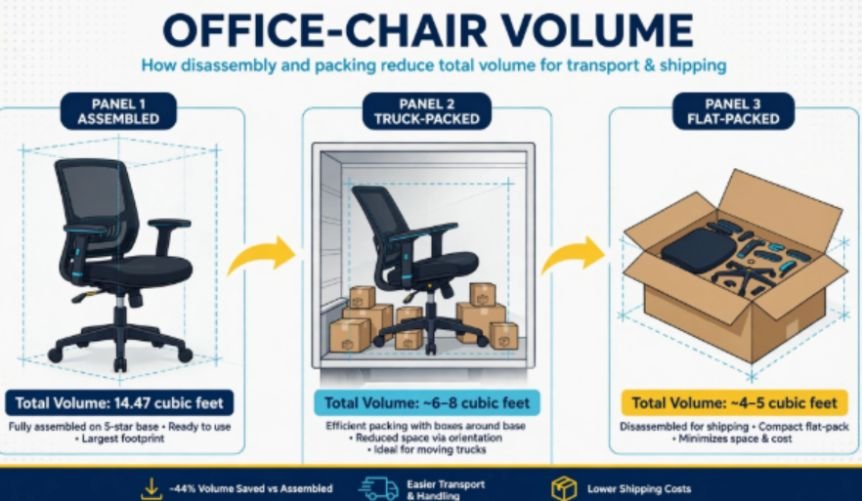
Removing the backrest usually creates the greatest reduction. Detachable arms and bases provide further savings. Place hardware in labeled bags and protect the gas cylinder from impacts.
I photograph each chair before disassembly. The images preserve adjustment positions and make reassembly faster.
Never force a press-fit gas cylinder apart without the correct method. If a component will not release safely, leave it assembled and measure the larger bundle.
Shipping an Office Chair
For parcel shipping, use the final carton dimensions—not the assembled chair’s practical moving allowance. Both FedEx and UPS calculate dimensional weight from package length, width, and height. FedEx generally applies a divisor of 139 for qualifying U.S. shipments. UPS states that its divisor can vary by rate type.
A 25″ × 13″ × 23″ carton contains 4.33 cubic feet. Its FedEx-style dimensional weight would be:
25 × 13 × 23 ÷ 139 = 53.78 pounds
The carrier may therefore bill it as 54 pounds even when the chair weighs less.
Frequently Asked Questions
1. How many cubic feet is an office chair when boxed?
A standard flat-packed chair commonly occupies about 4–5 cubic feet, although large models need more space.
2. How much moving-truck space should I allow per office chair?
Allow about 5–8 cubic feet for a standard chair and 8–12 cubic feet for a bulky executive chair.
3. Should I calculate empty space under an assembled chair?
Include it for clearance and isolated storage, but reduce it only when other packed items can safely use that space.
4. Can removing the backrest reduce chair volume?
Yes. Removing the backrest, arms, or base can turn an awkward chair into several compact, easier-to-pack bundles.
The Final Roll: Measure Before You Move
When I calculate how many cubic feet is an office chair, I never rely on one generic number. I use the carton for shipping, the outer envelope for clearance, and a realistic allocation for truck loading.
Measure the widest points, divide the cubic-inch total by 1,728, and label the result by purpose. That small step keeps a rolling chair from rolling straight through your moving budget.

Ryan Mitchell
Ryan Mitchell holds a degree in Civil Engineering and spent over a decade working in construction project estimation, where accurate volume and material calculations were part of his daily work — from concrete pours to landscaping material orders. He founded this site to bring that same precision to everyday calculations, helping DIYers, contractors, and students get fast, accurate cubic footage results without the guesswork. Ryan reviews every calculator and formula on this site for accuracy and writes guides based on real-world measurement scenarios he's encountered on job sites.