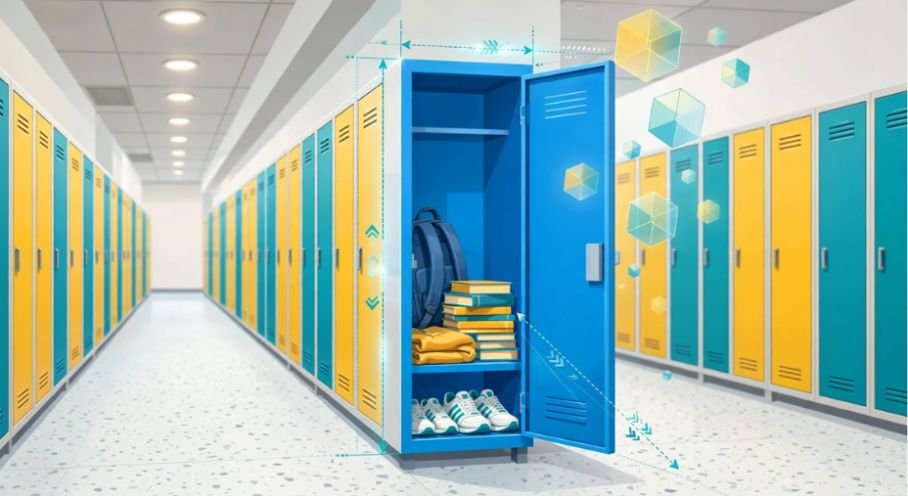
How many cubic feet is a school locker when measured accurately? Most individual compartments hold about 2.5 to 7.5 cubic feet by exterior dimensions. Small multi-tier compartments can fall below 2 cubic feet, while wide, full-height models may exceed 9 cubic feet.
When I estimate locker capacity, I separate exterior volume from usable storage. Shelves, hooks, walls, hinges, and the lock assembly reduce the space available for books or bags.
The Short Answer
A standard 12-inch-wide, 12-inch-deep school locker measures about 5 cubic feet at 60 inches tall. A 72-inch model measures 6 cubic feet.
A common 12-by-15-by-72-inch locker occupies 7.5 cubic feet. Dividing that cabinet into two equal compartments creates two spaces of about 3.75 cubic feet each.
This is why a blanket range of 1.5 to 4 cubic feet can be misleading. It describes many smaller compartments, but not every full-height locker.
School Locker Volume by Size
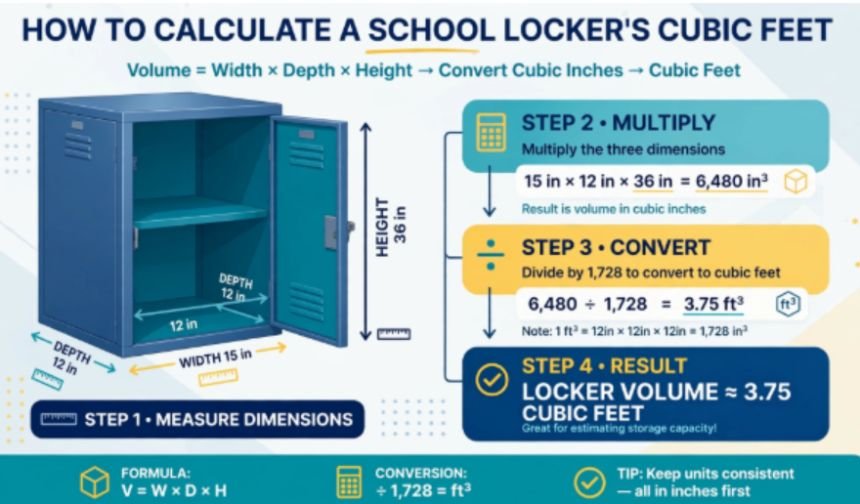
The following figures represent rectangular exterior volume. Product dimensions differ among schools and manufacturers.
| Locker configuration | Dimensions in inches | Calculated volume |
| Small compartment | 12 × 12 × 24 | 2.00 cu. ft. |
| Half-tier | 12 × 12 × 30 | 2.50 cu. ft. |
| Half-tier, deeper | 12 × 15 × 36 | 3.75 cu. ft. |
| Full-size, 60 inches high | 12 × 12 × 60 | 5.00 cu. ft. |
| Full-size, 72 inches high | 12 × 12 × 72 | 6.00 cu. ft. |
| Full-size, deeper | 12 × 15 × 72 | 7.50 cu. ft. |
| Wide full-size | 15 × 15 × 72 | 9.38 cu. ft. |
ASI Storage identifies 12 by 12 by 60 inches as a common single-tier size. It also notes that school lockers commonly measure 60 to 72 inches tall. A listed single-tier school model measuring 12 by 15 by 72 inches confirms that deeper configurations are also sold.
Half-tier locker capacity
A half-tier compartment usually occupies 2.5 to 3.75 cubic feet when its dimensions range from 12 by 12 by 30 inches to 12 by 15 by 36 inches.
These lockers suit books, lunch bags, folded jackets, and smaller backpacks. However, a shelf or projecting lock case may limit how items can be arranged.
Full-size locker capacity
A conventional full-height unit commonly occupies 5 to 7.5 cubic feet. Wider and deeper models can approach 9.4 cubic feet.
This capacity works better for coats, sports bags, backpacks, and tall objects. The narrow door may still prevent a bulky item from entering, even when its total volume seems suitable.
How to Calculate School Locker Cubic Feet
Use this formula when all three measurements are in inches:
Cubic feet=width×depth×height1,728\text{Cubic feet}= \frac{\text{width}\times\text{depth}\times\text{height}}{1,728}
NIST confirms that one cubic foot equals exactly 1,728 cubic inches.
Measure the locker’s width from side to side, depth from front to back, and height from bottom to top. Use interior measurements when you need storage capacity. Use exterior measurements for transport or floor planning.
Worked locker-volume example
Suppose I measure a locker at 12 inches wide, 15 inches deep, and 72 inches high:
12×15×72=12,960 cubic inches12\times15\times72=12,960\text{ cubic inches} 12,960÷1,728=7.5 cubic feet12,960\div1,728=7.5\text{ cubic feet}
Therefore, its exterior rectangular volume is 7.5 cubic feet. A bank of six identical lockers would occupy approximately 45 cubic feet before adding packaging or clearance.
This worked distinction is the article’s original practical insight: the same locker requires two answers depending on the task.
Exterior Volume Versus Usable Storage
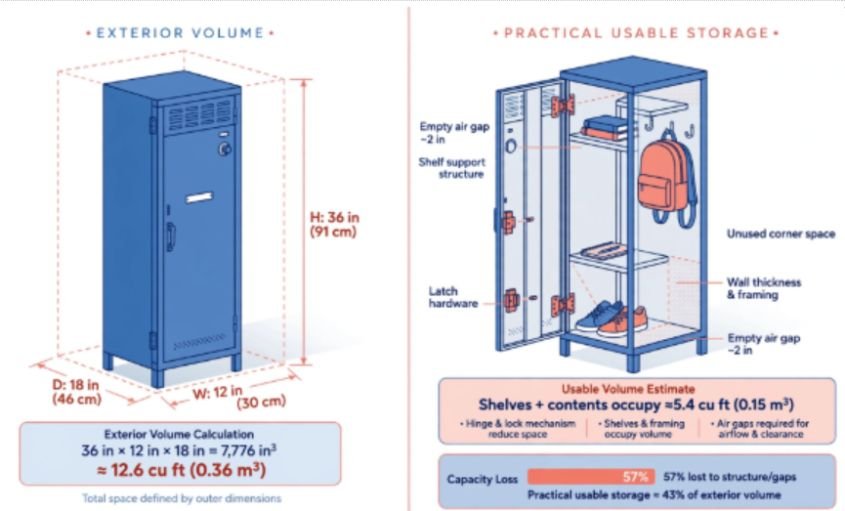
The answer to how many cubic feet is a school locker changes according to what you measure.
| Measurement type | Best use | What it includes |
| Exterior volume | Moving and room planning | Entire cabinet envelope |
| Interior volume | General storage estimates | Space behind the door |
| Practical capacity | Packing personal items | Clear, accessible space |
Usable capacity is always lower than exterior volume. Metal panels have thickness, while hooks and locking hardware occupy space. Shelves divide the interior and may stop large objects from using the full height.
For realistic packing, I first calculate the internal volume. I then reserve roughly 10% to 20% for irregular shapes and access. That allowance is a planning estimate, not a universal manufacturer specification.
For comparison, storage bin size can also help when estimating how much space smaller containers require for organizing books, supplies, and other belongings.
For example, 80% of a 7.5-cubic-foot interior is 6 cubic feet. That figure better represents convenient everyday use than a tightly packed theoretical maximum.
What Fits Inside a Typical School Locker?
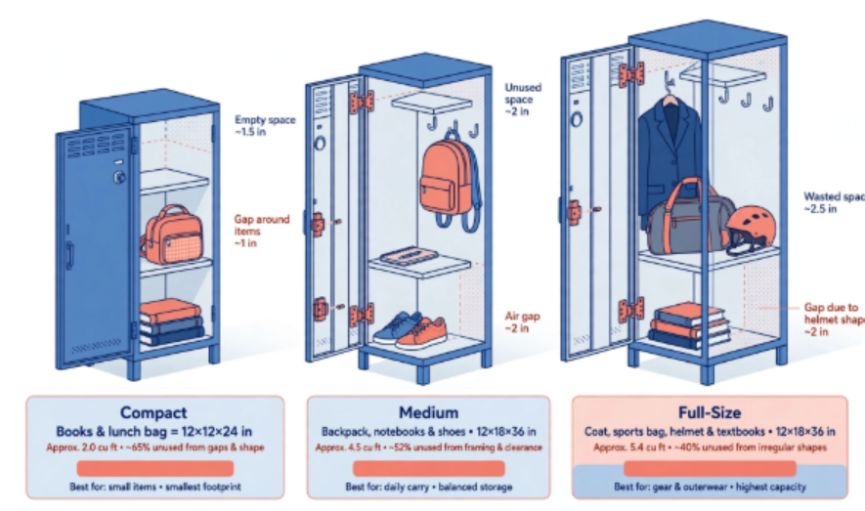
Volume alone does not determine whether an object fits. The item must pass through the door and fit within each interior dimension.
A 3-cubic-foot backpack will not enter a locker if its rigid width exceeds the door opening. A flexible coat uses space differently because it can fold or compress. Books pack efficiently, but shoes and helmets leave empty gaps around their curved surfaces.
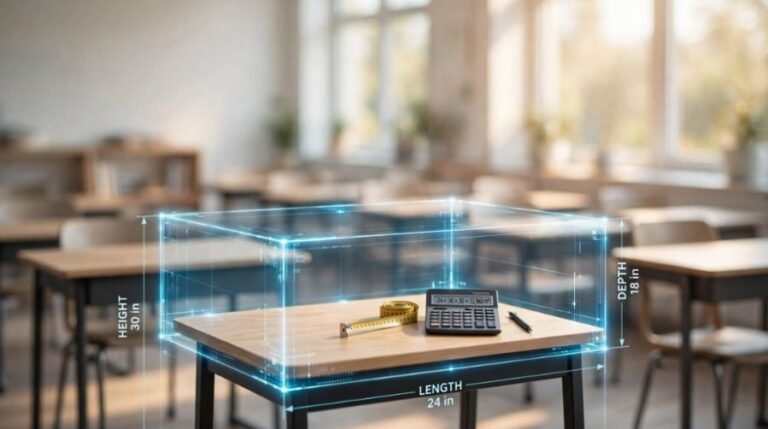
When comparing other school furniture, use the same rectangular-prism method for a classroom desk. Larger workplace items, such as a conference table, may require separate measurements for removable components.
Measuring Lockers for Moving or Space Planning
For storage capacity, measure the clear interior. Avoid counting the thickness of the door, frame, or surrounding cabinet.
For moving, measure the complete locker bank rather than multiplying one opening’s dimensions. Shared side panels mean the result may differ slightly. Include legs, sloped tops, trim, and protruding handles.
Do not confuse cubic feet with square feet. Cubic feet measure three-dimensional volume. Square feet measure the floor or wall area occupied by the locker.
Packaging and Storage Size
When organizing or packing smaller items, understanding gift box size can help you select suitable containers and estimate the space needed for storage.
Accessibility and Locker Capacity
Capacity is not the only factor when schools specify lockers. The 2010 ADA Standards require at least 5%—and no fewer than one—of each locker type to meet the applicable accessibility requirements. The guidance recognizes full-size, half-size, and sports-equipment lockers as different types.
An accessible locker may position shelves, hooks, and controls within required reach ranges. That arrangement can change practical storage even when the cabinet has the same exterior dimensions.
Reference links
| Reference | Information used |
| NIST Handbook 44 | Cubic-inch conversion |
| ADA Design Standards | Accessible locker requirements |
| ASI Storage Solutions | Common locker dimensions |
| Salsbury Industries | Available locker tiers |
Frequently Asked Questions
1. How many cubic feet is a standard high school locker?
A 12-by-12-by-60-inch locker measures 5 cubic feet, while a 12-by-15-by-72-inch model measures 7.5 cubic feet.
2. How many cubic feet is a half-size school locker?
A 12-by-12-by-30-inch half-tier locker occupies approximately 2.5 cubic feet.
3. How do I calculate locker capacity in cubic feet?
Multiply the interior width, depth, and height in inches, then divide the result by 1,728.
4. Is locker volume the same as usable storage space?
No. Shelves, walls, hardware, door clearance, and awkward item shapes reduce usable storage.
Shut the Door on Guesswork
I would not assign one fixed capacity to every school locker. A sensible general range is 2.5 to 7.5 cubic feet, although smaller compartments and wider lockers fall outside it.
For the most accurate answer, measure the clear interior and use the formula above. If you are planning a move, measure the full exterior instead. One tape measure settles the question faster than any average.

Ryan Mitchell
Ryan Mitchell holds a degree in Civil Engineering and spent over a decade working in construction project estimation, where accurate volume and material calculations were part of his daily work — from concrete pours to landscaping material orders. He founded this site to bring that same precision to everyday calculations, helping DIYers, contractors, and students get fast, accurate cubic footage results without the guesswork. Ryan reviews every calculator and formula on this site for accuracy and writes guides based on real-world measurement scenarios he's encountered on job sites.