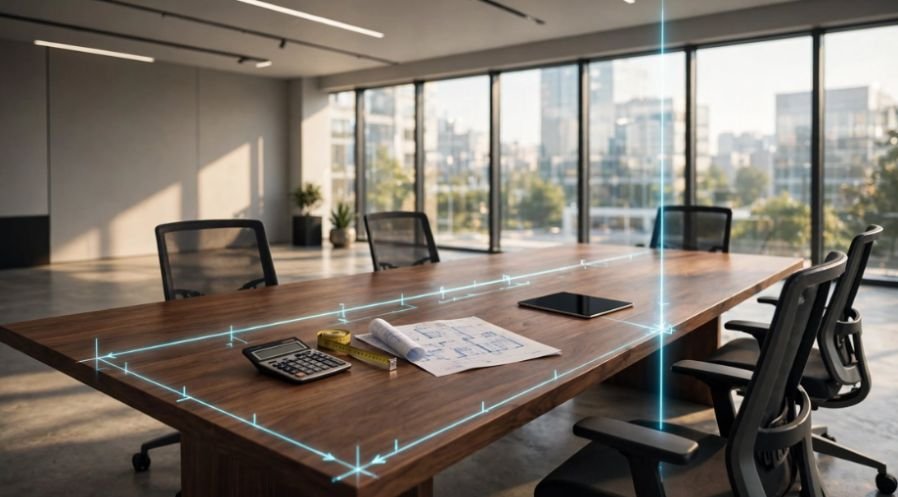
A typical conference table occupies about 45 to 200 cubic feet when measured as an assembled rectangular box. When clients ask me how many cubic feet is a conference table, I first ask what the figure will be used for. Room planning, storage, and freight estimates require different measurements.
Most seated models stand about 28.5 to 30 inches high. Length and width create the biggest differences. A compact six-foot table may occupy 45 cubic feet, while a 16-foot boardroom model can reach 200 cubic feet.
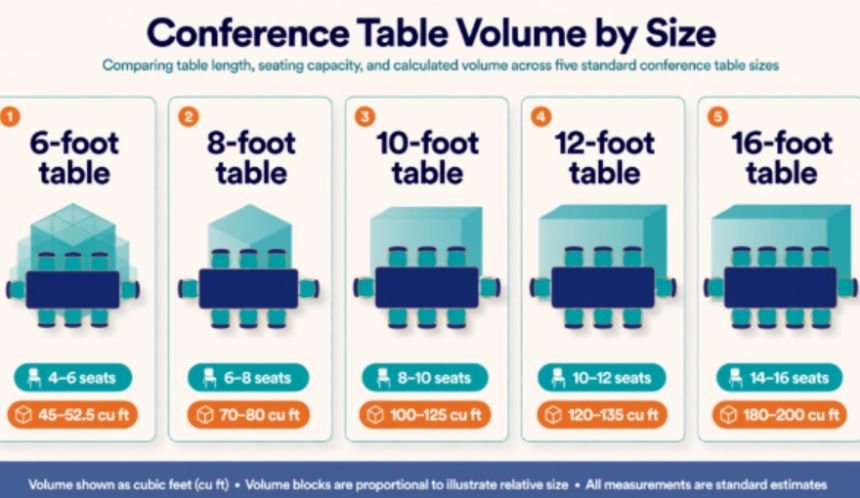
Quick Answer: Conference Table Volume by Size
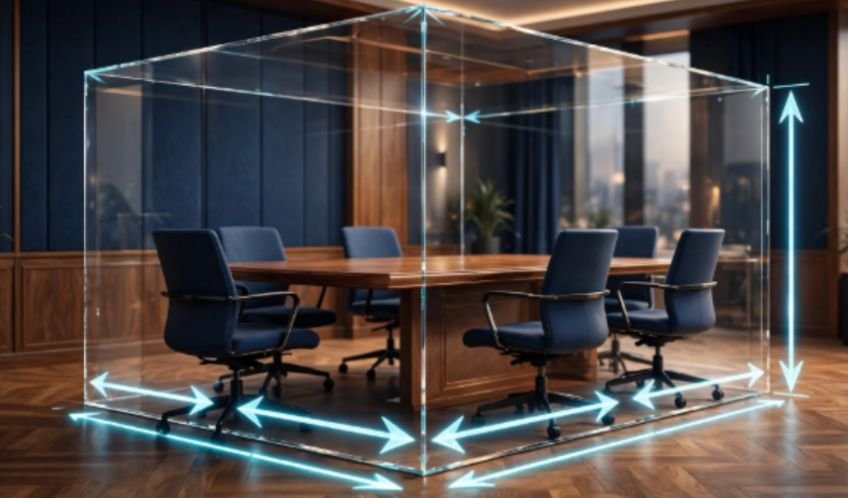
I calculated the estimates below with a 30-inch, or 2.5-foot, height. They represent each table’s outer rectangular space, not the amount of wood or metal in it.
| Common table size | Typical seats | Calculation | Assembled volume |
| 6 ft × 3–3.5 ft | 4–6 | 6 × 3–3.5 × 2.5 | 45–52.5 cu ft |
| 8 ft × 3.5–4 ft | 6–8 | 8 × 3.5–4 × 2.5 | 70–80 cu ft |
| 10 ft × 4–5 ft | 8–10 | 10 × 4–5 × 2.5 | 100–125 cu ft |
| 12 ft × 4–4.5 ft | 10–12 | 12 × 4–4.5 × 2.5 | 120–135 cu ft |
| 16 ft × 4.5–5 ft | 14–16 | 16 × 4.5–5 × 2.5 | 180–200 cu ft |
These corrected figures matter. For example, 6 × 3 × 2.5 equals 45, not 15. That simple arithmetic check prevents a major shortfall when booking storage or moving capacity.
Herman Miller lists seated Headway tables at 28.5 inches high, 60–240 inches long, and 36–54 inches deep. Real products therefore vary beyond simplified labels.
How to Calculate Conference Table Cubic Feet
Use this formula for a rectangular table:
Cubic feet = length in feet × width in feet × height in feet
Measure in Feet
Measure the table at its longest and widest points. Include projecting bases, power modules, and thick edge profiles when they extend past the top. Convert every inch measurement before multiplying:
Feet = inches ÷ 12
NIST defines 1 foot as exactly 0.3048 meter. For US furniture calculations, dividing inches by 12 is the fastest conversion.
Worked Example
Suppose I measure a table at 120 inches long, 48 inches wide, and 30 inches high. The converted dimensions are 10 feet × 4 feet × 2.5 feet.
10 × 4 × 2.5 = 100 cubic feet
This example answers how many cubic feet is a conference table measuring 10 feet long: about 100 cubic feet at four feet wide. A five-foot-wide version occupies 125 cubic feet.
Why the Number Changes by Measuring Purpose
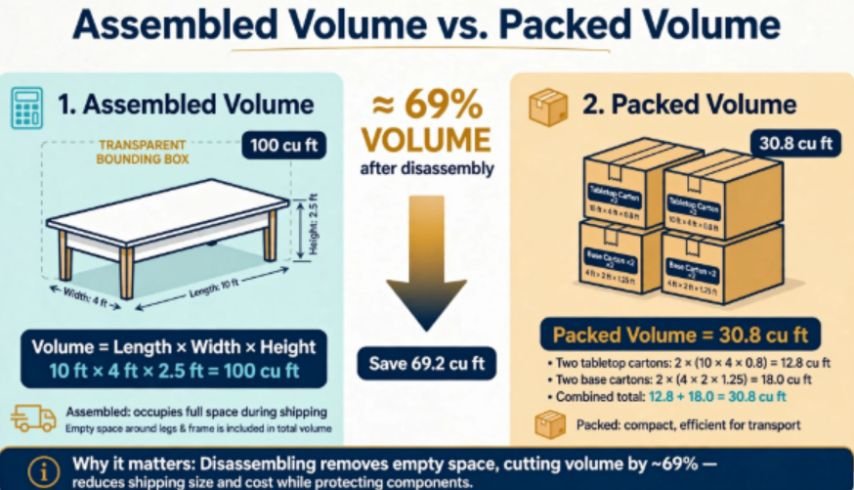
Assembled Spatial Volume
The formula measures a bounding box, including open air beneath the top. It works for layouts, storage, elevator checks, and rough moving comparisons. It does not measure the volume of the table’s solid material.
Moving and Freight Volume
Movers need packed dimensions. Remove detachable bases, protect each component, measure every carton, and add their volumes.
For example, imagine a disassembled 10-foot table packed into two top cartons measuring 60 × 50 × 6 inches and two base cartons measuring 30 × 24 × 12 inches. Dividing each carton result by 1,728 converts cubic inches to cubic feet:
| Package | Quantity | Volume calculation | Total volume |
| Top carton | 2 | 60 × 50 × 6 ÷ 1,728 | 20.8 cu ft |
| Base carton | 2 | 30 × 24 × 12 ÷ 1,728 | 10 cu ft |
| Combined shipment | 4 | — | 30.8 cu ft |
For office moves, smaller equipment should also be measured separately rather than estimated from the overall furniture volume. A desktop computer can take up additional packed space once the monitor, tower, accessories, and protective packaging are included.
That shipment occupies about 31 cubic feet versus the table’s 100-cubic-foot assembled box. Always use final packed measurements for a quote.
Conference Table Size, Seating, and Room Fit
Cubic footage does not prove a table will fit comfortably. I treat the table, seating, and circulation as separate layers. Calculate its floor footprint, then add the pulled-out depth of an office chair on each occupied side. Check doors, cabinets, and screens for collisions.
Use the same bounding-box method when estimating the space required for an office chair, especially when planning seating, circulation, and overall room capacity.
The US Access Board sets accessible dining and work surfaces at 28–34 inches high. Its guidance also covers clear floor, knee, and turning space. Check applicable ADA standards and local rules.
OSHA also recommends adequate leg clearance and layouts that reduce awkward reaching. Blocked knee space and poorly placed technology reduce usability.
Shape Adjustments for Round and Oval Conference Tables
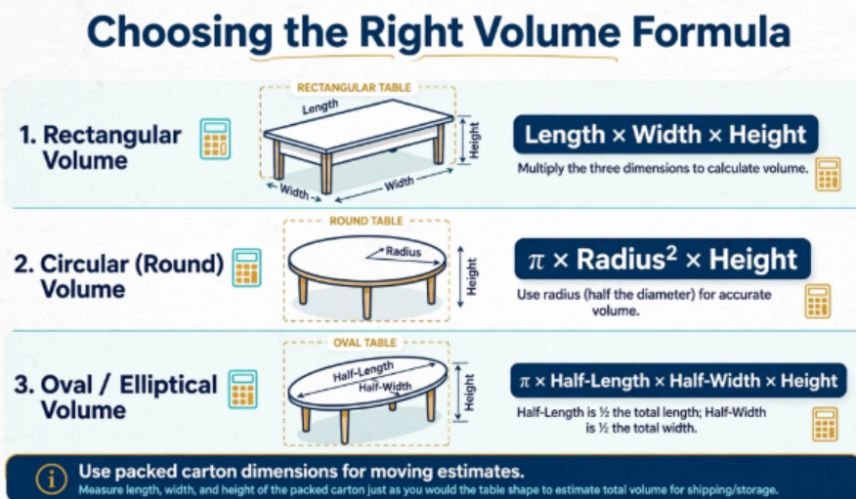
For a round table, calculate the cylindrical envelope:
Volume = π × radius² × height
A five-foot-diameter table at 2.5 feet high has a 49.1-cubic-foot cylindrical envelope. A rectangular box gives 62.5 cubic feet, so the cylinder is tighter.
For an oval table, use the elliptical-cylinder formula:
Volume = π × half-length × half-width × height
Use the rectangular box when a mover, warehouse, or elevator plan needs conservative clearance. Use it for boat-shaped tops unless the carrier accepts a detailed model.
Common Conference Table Measurement Mistakes
The mistake I see most is mixing feet and inches. Other errors include using top thickness as table height, ignoring wide bases, and confusing assembled with shipping volume.
Do not estimate seating from volume alone. Bases, shape, chair width, power boxes, and accessibility affect capacity. Manufacturer drawings beat generic labels.
Authoritative References
| Source | What it supports |
| NIST unit-conversion guidance | US customary and metric length conversion |
| US Access Board ADA guidance | Clear floor, knee, toe, and turning space |
| OSHA desk and work-surface guidance | Leg clearance and ergonomic work-surface planning |
| Herman Miller conference-table specifications | Real conference-table height, width, and depth ranges |
Frequently Asked Questions
1. How many cubic feet is a 6-foot conference table?
A 6 × 3 × 2.5-foot model occupies about 45 cubic feet as an assembled bounding box.
2. How many cubic feet is a 10-person conference table?
A typical 10-foot model occupies roughly 100–125 cubic feet, depending on whether it is four or five feet wide.
3. How do I calculate a conference table for moving?
Measure each protected carton after disassembly, calculate its cubic feet, and add all carton volumes.
4. Does table shape affect cubic footage?
Yes; round and oval formulas give tighter estimates, while a rectangular bounding box provides safer clearance.
The Final Measure: Make the Table Earn Its Space
When I answer how many cubic feet is a conference table, my practical range is 45–200 cubic feet for common six- to 16-foot seated models. Yet that number only starts the decision. I use assembled volume for space planning, packed volume for moving, and a full room layout for comfort.
Measure the longest, widest, and highest points twice. Then photograph the base and record whether it detaches. That five-minute check can prevent an undersized truck, a blocked doorway, or a boardroom that feels like a furniture puzzle.

Ryan Mitchell
Ryan Mitchell holds a degree in Civil Engineering and spent over a decade working in construction project estimation, where accurate volume and material calculations were part of his daily work — from concrete pours to landscaping material orders. He founded this site to bring that same precision to everyday calculations, helping DIYers, contractors, and students get fast, accurate cubic footage results without the guesswork. Ryan reviews every calculator and formula on this site for accuracy and writes guides based on real-world measurement scenarios he's encountered on job sites.