When I first looked at How Many Cubic Feet Is a Car Engine?, I expected one standard measurement. The answer turned out to be more nuanced because “engine volume” can describe either internal displacement or the exterior space occupied by the complete assembly.
Most passenger-car engines have a displacement of approximately 0.035 to 0.220 cubic feet. However, their physical dimensions can occupy several cubic feet under the bonnet.
Quick Answer: Average Car Engine Volume
A typical passenger-car engine has between 1.0 and 6.2 litres of displacement. Converted into cubic feet, that equals approximately 0.035 to 0.219 cubic feet.
Common examples include:
- A 1.0-litre engine equals approximately 0.035 cubic feet.
- A 1.5-litre engine equals approximately 0.053 cubic feet.
- A 2.0-litre engine equals approximately 0.071 cubic feet.
- A 3.0-litre engine equals approximately 0.106 cubic feet.
- A 4.0-litre engine equals approximately 0.141 cubic feet.
- A 5.0-litre engine equals approximately 0.177 cubic feet.
- A 6.2-litre engine equals approximately 0.219 cubic feet.
These values describe displacement, not the exterior dimensions of the engine block, cylinder head, intake system, belts, turbocharger, or other attached components.
What Does Car Engine Volume Actually Mean?
Engine volume usually refers to displacement. This is the combined volume swept by every piston as it moves between the highest and lowest points inside its cylinder.
Manufacturers normally express displacement in litres or cubic centimetres. A 2.0-litre engine, for example, has a displacement of approximately 2,000 cubic centimetres. Older engines and some performance models may use cubic inches instead.
Engine displacement does not tell you how much room the complete engine occupies. It is an internal measurement based on cylinder geometry.
Displacement Versus Physical Size
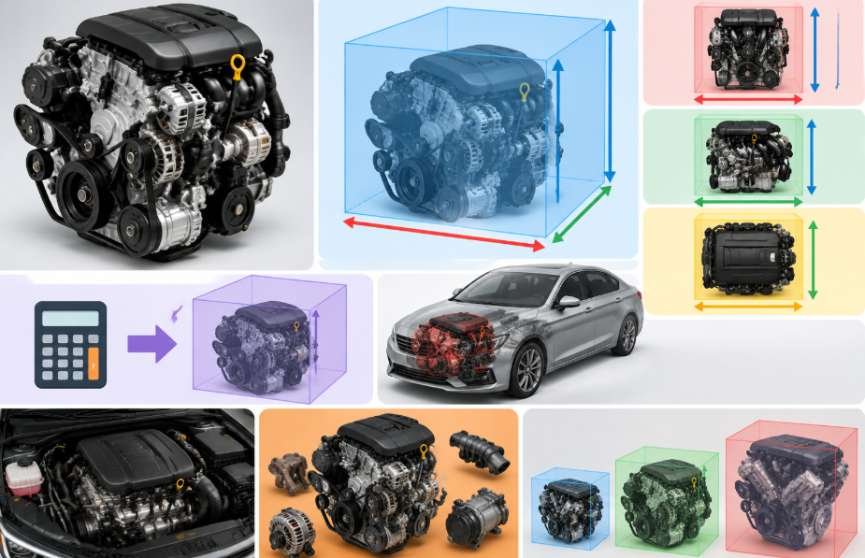
The difference between displacement and exterior volume is essential. A 2.0-litre engine contains only about 0.071 cubic feet of swept cylinder volume, but the complete assembly may occupy several cubic feet.
Components such as the cylinder block, cooling system, intake manifold, exhaust manifold and accessories increase its exterior dimensions. Turbocharged petrol engines may require additional space for turbochargers, intercoolers and connecting pipes.
Therefore, displacement cannot be used alone to select a crate, shelf, storage area or shipping container.
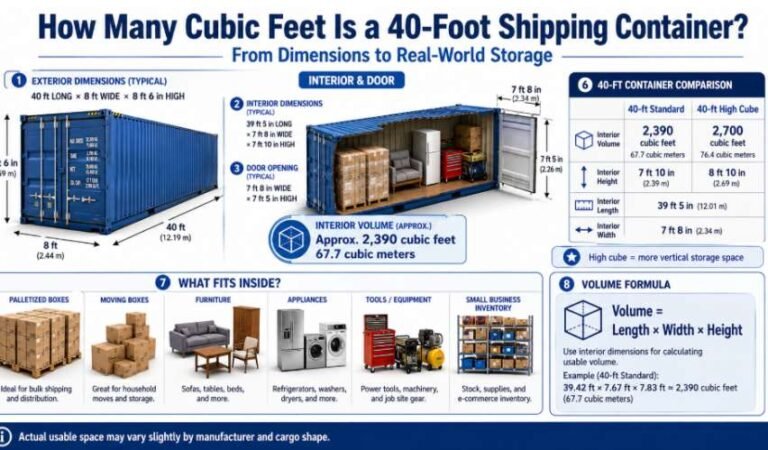
For larger vehicle storage planning, comparing minivan cargo space can also provide a useful reference when estimating available room for transportation.
How to Convert Litres to Cubic Feet
One litre equals approximately 0.0353147 cubic feet. The conversion formula is:
Cubic feet = litres × 0.0353147
For a 2.5-litre engine:
2.5 × 0.0353147 = 0.0883 cubic feet
For a 4.0-litre engine:
4.0 × 0.0353147 = 0.1413 cubic feet
This is the quickest method when the engine specification is already shown in litres.
Converting Cubic Centimetres
One cubic foot contains approximately 28,316.85 cubic centimetres. Use this formula:
Cubic feet = cubic centimetres ÷ 28,316.85
A 1,500 cc engine produces the following result:
1,500 ÷ 28,316.85 = 0.053 cubic feet
A 3,500 cc engine equals approximately 0.124 cubic feet.
Converting Cubic Inches
One cubic foot contains exactly 1,728 cubic inches. Use this formula:
Cubic feet = cubic inches ÷ 1,728
A classic 350-cubic-inch engine has approximately 0.203 cubic feet of displacement. A 440-cubic-inch engine has approximately 0.255 cubic feet.
How Engine Displacement Is Calculated
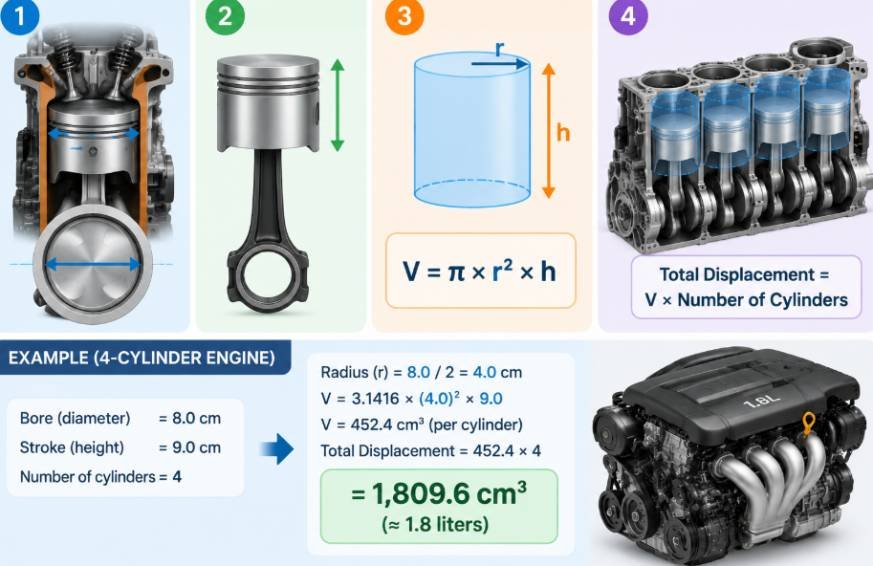
Engine displacement depends on cylinder bore, piston stroke and cylinder count. Bore is the internal diameter of a cylinder, while stroke is the distance travelled by its piston.
The formula is:
Displacement = (π ÷ 4) × bore² × stroke × number of cylinders
All measurements must use the same unit. If bore and stroke are measured in centimetres, the answer will be in cubic centimetres. If they are measured in inches, the result will be in cubic inches.
This calculation explains why two four-cylinder engines can have different capacities. One may have a wider bore, a longer stroke, or both.
Does a Larger Engine Always Produce More Power?
A larger displacement generally allows an engine to draw in and burn more air and fuel during each cycle. This can support greater torque and power, but displacement is not the only deciding factor.
Turbocharging, compression ratio, fuel delivery, valve timing, engine speed and electronic management also influence performance. A modern turbocharged 2.0-litre engine can produce more power than an older naturally aspirated engine with substantially greater displacement.
Cylinder count also does not provide a reliable volume measurement by itself. Four-cylinder, six-cylinder and eight-cylinder engines are available in several capacities.
How to Measure an Engine for Storage or Shipping
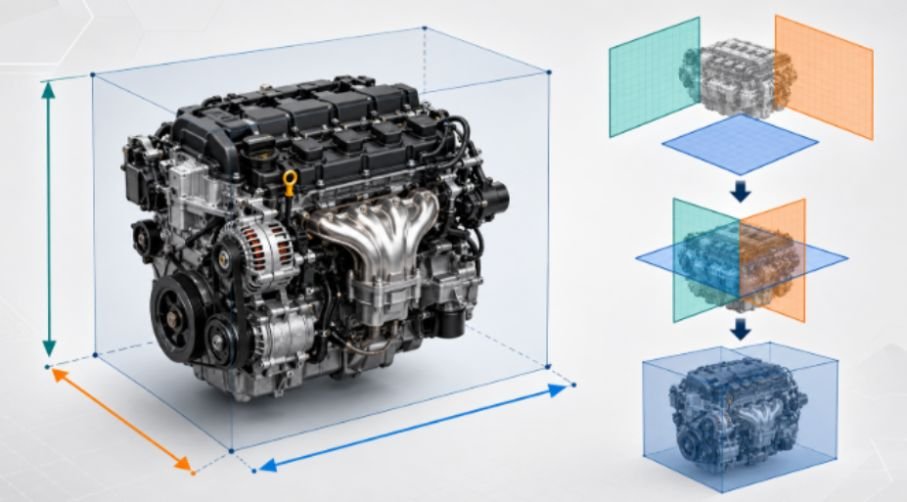
For storage and transport, measure the complete engine’s maximum exterior length, width and height. Include attached components that will remain in place during handling.
Use this formula:
Cubic feet = length in inches × width in inches × height in inches ÷ 1,728
Suppose an assembled engine measures 32 inches long, 28 inches wide and 30 inches high:
32 × 28 × 30 = 26,880 cubic inches
26,880 ÷ 1,728 = 15.56 cubic feet
This figure represents a rectangular bounding volume. The engine itself does not fill every part of that space, but the measurement is useful when choosing a crate or storage location. Allow additional clearance for padding, supports and safe handling.
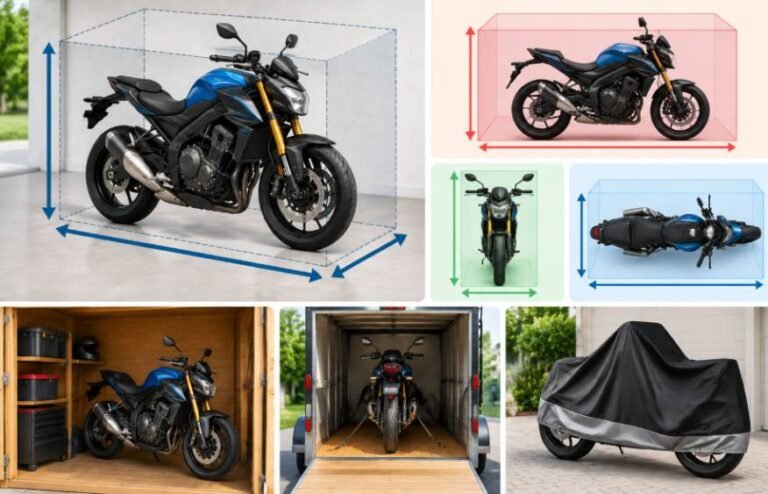
For other vehicle-related storage estimates, you can also compare the motorcycle size when planning transport, storage, or available space.
Frequently Asked Questions
1. How Many Cubic Feet Is a Car Engine?
Most passenger-car engines have approximately 0.035 to 0.220 cubic feet of displacement. The complete physical assembly can occupy several cubic feet, depending on its design and attached equipment.
2. How many cubic feet is a 2.0-litre engine?
A 2.0-litre engine has approximately 0.0706 cubic feet of displacement. This figure does not represent its exterior physical volume.
3. How many cubic feet is a 350-cubic-inch engine?
Divide 350 by 1,728. The result is approximately 0.2025 cubic feet of displacement.
4. Can displacement determine shipping-box size?
No. Displacement measures swept cylinder volume. Measure the assembled engine’s exterior length, width and height when selecting packaging.
Final Thoughts
I find the easiest approach is to identify what “volume” means before calculating anything. Use displacement when comparing engine capacity, and use exterior measurements when arranging shipping or storage. Most car-engine displacements remain well below one cubic foot, even though complete assemblies occupy much more space.
With the correct unit and formula, converting litres, cubic centimetres or cubic inches into cubic feet takes only a few seconds.

Ryan Mitchell
Ryan Mitchell holds a degree in Civil Engineering and spent over a decade working in construction project estimation, where accurate volume and material calculations were part of his daily work — from concrete pours to landscaping material orders. He founded this site to bring that same precision to everyday calculations, helping DIYers, contractors, and students get fast, accurate cubic footage results without the guesswork. Ryan reviews every calculator and formula on this site for accuracy and writes guides based on real-world measurement scenarios he's encountered on job sites.