

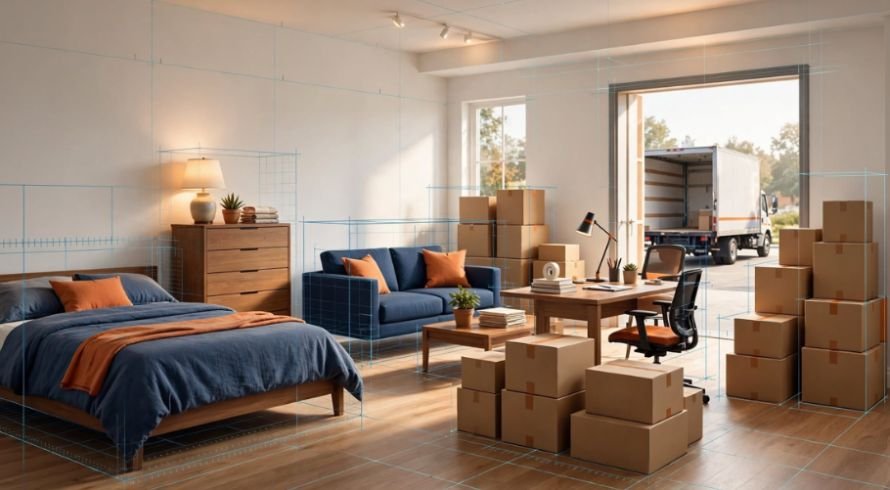
A typical furnished room needs about 150 to 200 cubic feet of packed space. Bulky living rooms often need 300 to 400 cubic feet. When people ask how many cubic feet is an entire room of furniture, I start with the room type, then adjust for boxes, oversized pieces, and packing efficiency.
That estimate describes the load inside a truck or storage unit. It does not describe the empty room’s full interior volume.
The Quick Answer for One Furnished Room
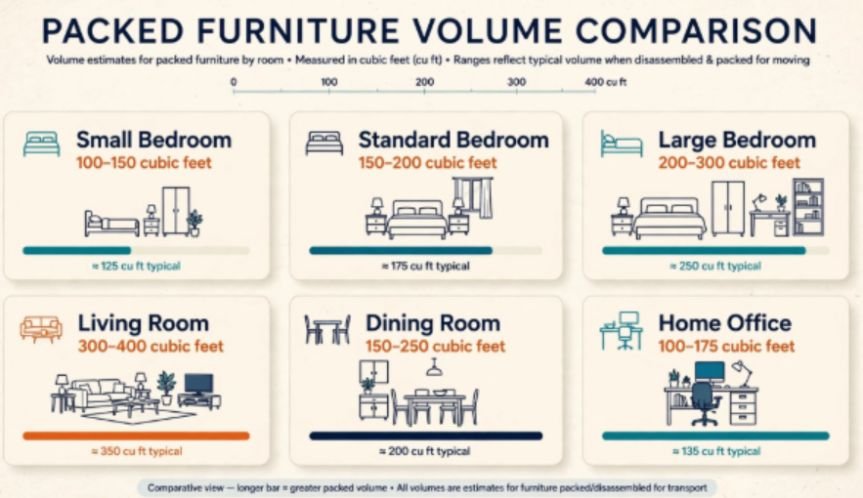
For planning purposes, I use 150 to 200 cubic feet for a standard bedroom or lightly furnished room. A dense bedroom may exceed 250 cubic feet. A living room with a sectional, recliners, and an entertainment center can reach 400 cubic feet.
These figures are estimates, not guarantees. Furniture shape matters as much as floor area. A disassembled bed packs tightly. A curved sofa creates unusable gaps.
Furniture Volume Estimates by Room Type
The following ranges provide a practical starting point for US moves and storage bookings.
| Room type | Typical contents | Estimated packed volume |
| Small bedroom | Twin bed, dresser, nightstand, 8–10 boxes | 100–150 cu. ft. |
| Standard bedroom | Queen bed, dresser, two nightstands, 10–15 boxes | 150–200 cu. ft. |
| Large bedroom | King bed, wardrobes, dresser, 15–20 boxes | 200–300 cu. ft. |
| Living room | Sofa, chairs, tables, TV unit, 10–15 boxes | 300–400 cu. ft. |
| Dining room | Table, chairs, cabinet, packed dishes | 150–250 cu. ft. |
| Home office | Desk, chair, shelves, files, electronics | 100–175 cu. ft. |
These ranges answer how many cubic feet is an entire room of furniture more reliably than one universal number. Minimal rooms may fall below them. Oversized or antique furniture can push the total higher.
Packed Furniture Volume Is Not Room Volume
A 12-by-12-foot room with an 8-foot ceiling contains 1,152 cubic feet of interior space. Its furniture might occupy only 150 to 250 cubic feet after packing.
This distinction prevents a costly mistake. Do not multiply the room’s length, width, and ceiling height when sizing a moving truck. That formula measures the room itself, including empty air.
One cubic foot equals about 0.0283 cubic meters, according to the National Institute of Standards and Technology. For furniture, calculate the outer dimensions of each packed item instead.
How to Calculate the Cubic Feet of Room Furniture
Measure Each Large Item
Measure every piece at its widest packed dimensions. Convert inches to feet by dividing each measurement by 12. Then use:
Length × width × height = cubic feet
A packed dresser measuring 60 by 20 by 36 inches occupies about 25 cubic feet:
5 × 1.67 × 3 = 25.05 cubic feet
Repeat this calculation for beds, sofas, cabinets, and tables. If you are estimating a furniture moving package, group pieces by room before adding the totals.
When estimating smaller furniture pieces, checking the office chair size can also help you account for its footprint and packing space within the overall furniture load.
Add Boxes and a Loading Allowance
Boxes are easier to estimate because their dimensions are regular. Home Depot lists common medium moving boxes at roughly 3 cubic feet and large boxes at about 4.5 cubic feet in its moving-box guide.
Multiply the box capacity by the number of boxes. Then add 10% to 15% for blankets, padding, uneven shapes, and loading gaps. I use 15% when the room contains fragile or awkward furniture.
Worked Example: A Typical Bedroom
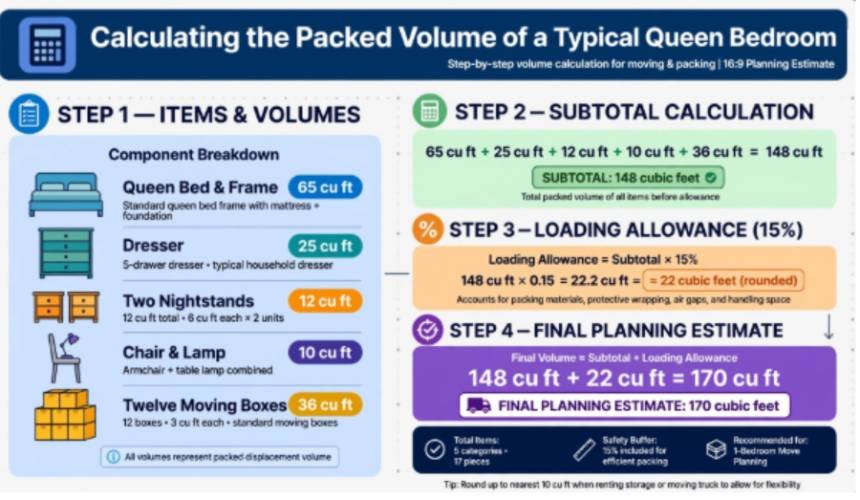
Here is my item-based estimate for a queen bedroom:
| Packed item | Estimated volume |
| Queen mattress and frame components | 65 cu. ft. |
| Dresser | 25 cu. ft. |
| Two nightstands | 12 cu. ft. |
| Chair and lamp | 10 cu. ft. |
| Twelve medium boxes at 3 cu. ft. each | 36 cu. ft. |
| Subtotal | 148 cu. ft. |
| 15% loading allowance | 22 cu. ft. |
| Planning total | 170 cu. ft. |
The result sits inside the 150-to-200-cubic-foot rule. The added allowance is the useful part. A perfect geometric total rarely reflects a real truck load.
Choosing Storage or Moving Capacity
Do not reserve space that exactly matches your calculation. A small margin protects furniture and makes unloading easier.
U-Haul lists its cargo van at about 245 cubic feet and its 10-foot truck at 402 cubic feet in its truck-size comparison. A cargo van may handle one compact bedroom. A 10-foot truck gives more room for a large bedroom or a modest living room.
Storage recommendations also depend on stacking. The PODS storage size guide notes that actual capacity changes with furniture size, packing efficiency, and space needed to protect fragile belongings.
How Packing Changes the Final Number
Three choices can reduce the required capacity. Remove detachable legs, stand mattresses vertically when permitted, and fill safe hollow spaces with light items. Never place heavy boxes inside weak furniture.
Poor stacking has the opposite effect. Assembled bed frames, loose cushions, and empty drawers waste space. Protective wrapping also adds volume, so never omit it from an estimate.
For how many cubic feet is an entire room of furniture, use 150 to 200 cubic feet as the baseline. Then increase it for sectionals, wardrobes, exercise machines, large desks, or many packed boxes.
Frequently Asked Questions
1. How many cubic feet is an entire room of furniture for moving?
Plan for 150–200 cubic feet for a typical room and 300–400 cubic feet for a furnished living room.
2. How many cubic feet does a bedroom set take?
A standard packed bedroom set usually needs 150–200 cubic feet, including a moderate number of boxes.
3. Will one room of furniture fit in a cargo van?
Often yes for a compact bedroom, but bulky sofas or excess boxes may require a small moving truck.
4. Should I add extra space to my furniture estimate?
Yes. Add 10%–15% for padding, irregular shapes, loading gaps, and measurement error.
The Final Tape-Measure Reality Check
I would book from the item total, not the room’s square footage. Start with the 150-to-200-cubic-foot benchmark, measure bulky pieces, add every box, and include a 15% buffer. That quick check turns how many cubic feet is an entire room of furniture from a vague guess into a usable moving number.

Ryan Mitchell
Ryan Mitchell holds a degree in Civil Engineering and spent over a decade working in construction project estimation, where accurate volume and material calculations were part of his daily work — from concrete pours to landscaping material orders. He founded this site to bring that same precision to everyday calculations, helping DIYers, contractors, and students get fast, accurate cubic footage results without the guesswork. Ryan reviews every calculator and formula on this site for accuracy and writes guides based on real-world measurement scenarios he's encountered on job sites.


