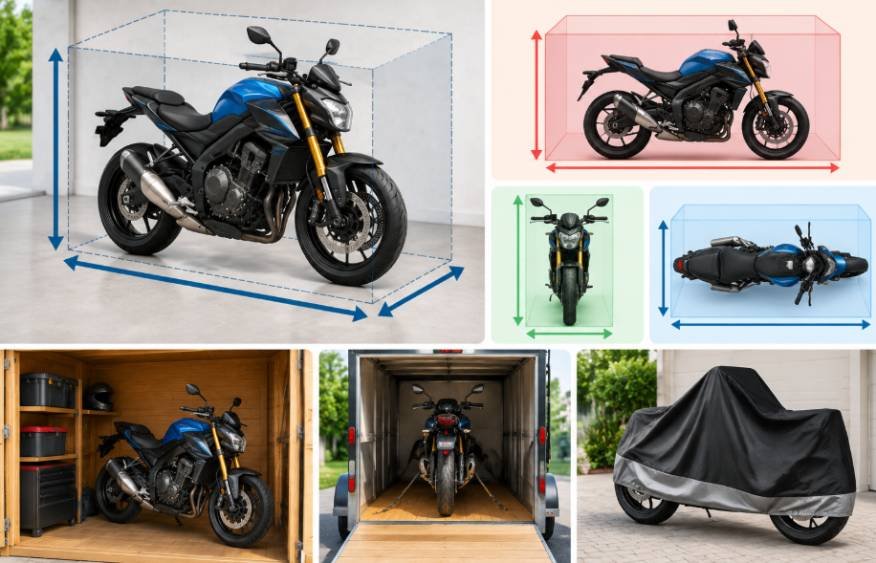
When I began researching How Many Cubic Feet Is a Motorcycle?, I found that the answer depends on the motorcycle’s overall dimensions and how its volume is measured. Most motorcycles occupy approximately 50 to 140 cubic feet when their maximum length, width, and height form an imaginary rectangular enclosure. Standard motorcycles generally fall between 60 and 90 cubic feet, while large touring models may require more than 120 cubic feet.
This figure represents the space surrounding the motorcycle, not its precise solid volume. Empty areas between the wheels, beneath the frame, and around the engine are included in the calculation. Even so, this method provides the most useful estimate for storage, trailers, crates, and freight planning.
Average Motorcycle Volume by Type
Motorcycle dimensions vary substantially between categories. A lightweight scooter can be several feet shorter than a touring model fitted with panniers, a windscreen, and a top case.
A compact scooter measuring 70 inches long, 28 inches wide, and 44 inches high occupies about 50 cubic feet. A small commuter motorcycle measuring 78 by 30 by 42 inches occupies approximately 57 cubic feet.
Sport bikes commonly measure around 82 inches long, 29 inches wide, and 45 inches high. Treating those dimensions as a rectangular space produces a volume of about 62 cubic feet. Standard and naked motorcycles are often slightly wider because of their handlebars, placing many models between 60 and 75 cubic feet.
Dirt bikes and dual-sport motorcycles can occupy 70 to 90 cubic feet. Their narrow frames reduce width, but their suspension, handlebars, and ground clearance make them relatively tall.
Cruisers frequently require 85 to 105 cubic feet because of their longer frames and wider handlebars. Adventure motorcycles may occupy 90 to 115 cubic feet, while large touring bikes can reach 120 to 140 cubic feet or more.
How to Calculate a Motorcycle’s Cubic Feet
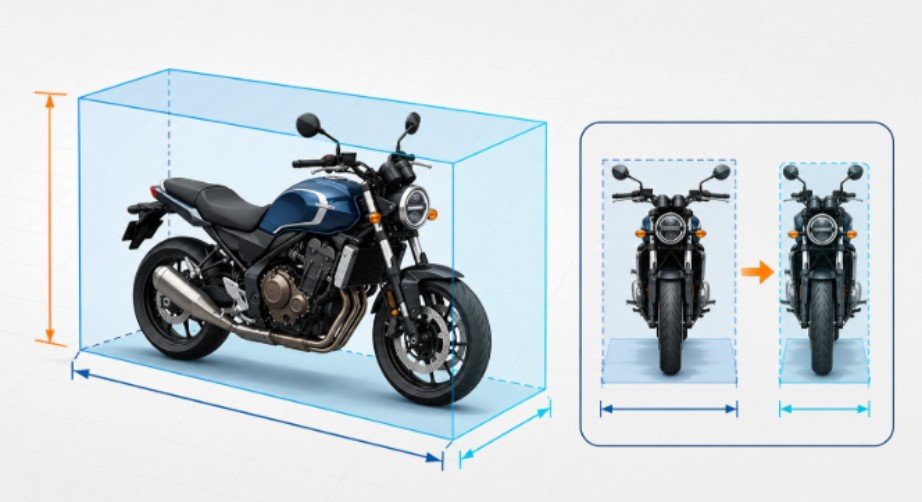
Use the standard rectangular-volume formula:
Cubic feet = length × width × height
All measurements must use the same unit. If the dimensions are recorded in inches, multiply them together and divide the result by 1,728. There are 1,728 cubic inches in one cubic foot.
Measure the Overall Length
Measure from the frontmost point of the tire or fender to the motorcycle’s rearmost point. Include any top case, luggage rack, extended fender, or license-plate bracket that will remain attached.
Do not use wheelbase as the overall length. Wheelbase only measures the distance between the centers of the front and rear wheels, leaving out the portions extending beyond them.
Find the Widest Point
Measure across the widest fixed components. Depending on the motorcycle, these may be the handlebars, mirrors, engine guards, or saddlebags.
Keep the handlebars in the position they will occupy during storage or transportation. If mirrors or panniers will be removed, measure the motorcycle after removing them. Otherwise, include them in the calculation.
Measure the Maximum Height
Measure from the floor to the motorcycle’s highest point. The windscreen, mirrors, or handlebars may determine this measurement.
If the motorcycle will sit on a pallet, include the pallet’s height. When it will be enclosed inside a shipping crate, measure the outside of the completed crate rather than the motorcycle alone.
Example Motorcycle Volume Calculation
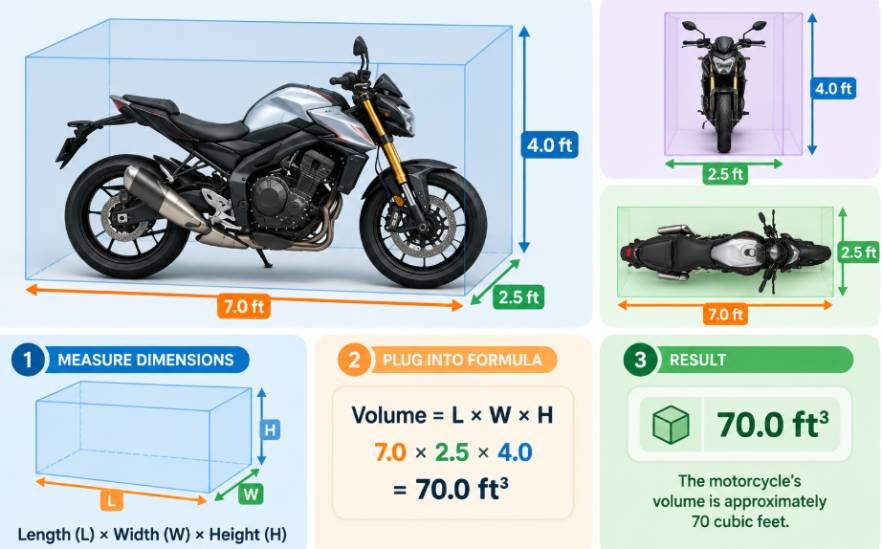
Suppose a standard motorcycle measures 84 inches long, 31 inches wide, and 44 inches high.
First, multiply the dimensions:
84 × 31 × 44 = 114,576 cubic inches
Next, convert cubic inches into cubic feet:
114,576 ÷ 1,728 = 66.3 cubic feet
The motorcycle occupies a rectangular envelope of approximately 66 cubic feet. Extra clearance may still be required for safe handling, protective padding, wheel chocks, or tie-down equipment.
Bounding-Box Volume Versus Actual Volume
A motorcycle is an irregularly shaped object. Multiplying its maximum dimensions calculates its bounding-box volume, meaning the smallest theoretical rectangular enclosure that can surround it.
This measurement includes considerable empty space. Therefore, a result of 66 cubic feet does not mean the motorcycle contains 66 cubic feet of metal, rubber, fuel, and plastic.
Bounding-box volume remains valuable because storage and transportation providers need to know how much usable space the motorcycle prevents them from allocating elsewhere. It also provides a consistent way to compare models with different shapes.
Storage and Garage Space Requirements
Cubic volume is only one part of choosing a storage area. Floor space, entrance width, ceiling height, and maneuvering room are equally important.
A standard motorcycle may have a floor footprint of approximately 3 feet by 7 feet. However, an enclosure matching those exact measurements would not provide enough room for the kickstand or safe access.
Allow clearance around the handlebars and sides of the bike. Check the doorway before selecting a shed, garage space, or storage unit. A room may provide sufficient total volume while having an entrance that is too narrow for mirrors or saddlebags.
For larger vehicle storage comparisons, understanding SUV cargo area can also help when estimating available enclosed volume.
Crated Motorcycle Shipping Volume
Shipping companies typically calculate freight volume from the exterior dimensions of the finished crate. Timber framing, cushioning, tie-down points, and pallets increase the shipment’s size.
When planning vehicle transport, comparing pickup truck dimensions can also help estimate how much cargo space a larger vehicle requires.
For example, a crate measuring 96 inches long, 44 inches wide, and 54 inches high occupies 132 cubic feet:
96 × 44 × 54 ÷ 1,728 = 132 cubic feet
The finished shipment can therefore require almost twice the space calculated for an uncrated standard motorcycle. Freight quotes should use the final packed dimensions and total shipment weight to reduce the risk of additional charges.
What Can Change the Calculation?
Accessories are a major source of measurement differences. Saddlebags, engine guards, and custom handlebars increase width. Windscreens and mirrors increase height, while top cases and rear racks may add both height and length.
Handlebar position can also change the surrounding dimensions. Turning the bars may shorten the motorcycle slightly while making it wider. Suspension compression during transportation could reduce height, although this should only be considered when the approved shipping method allows it.
Measure the motorcycle in the precise configuration in which it will be stored or transported. Adding a modest clearance allowance provides a safer and more practical estimate.
Frequently Asked Questions
1. How Many Cubic Feet Is a Motorcycle?
A typical motorcycle occupies approximately 50 to 140 cubic feet when calculated using its maximum exterior dimensions. Most standard and sport motorcycles fall between 60 and 90 cubic feet, while large touring models may exceed 120 cubic feet.
2. Is engine displacement the same as exterior volume?
No. Engine displacement, such as 600cc or 1,000cc, measures the swept volume inside the engine cylinders. It does not indicate the motorcycle’s overall size or storage-space requirement.
3. Should mirrors and luggage be included?
Include every accessory that will remain fitted. Mirrors, saddlebags, windscreens, top cases, and engine guards can significantly change the maximum exterior dimensions.
4. Should I calculate the motorcycle or its crate?
Use the motorcycle’s dimensions for basic garage or trailer planning. For a freight quote, use the completed crate or pallet’s outside dimensions because the carrier charges according to the packed shipment.
Final Thoughts
From my calculations, 60 to 90 cubic feet is a reasonable estimate for an ordinary motorcycle. Compact scooters may occupy around 50 cubic feet, whereas fully equipped touring machines can exceed 140 cubic feet.
I recommend measuring the individual bike rather than depending entirely on category averages. Using the longest, widest, and highest points—and including packaging when appropriate—will produce the most dependable result.

Ryan Mitchell
Ryan Mitchell holds a degree in Civil Engineering and spent over a decade working in construction project estimation, where accurate volume and material calculations were part of his daily work — from concrete pours to landscaping material orders. He founded this site to bring that same precision to everyday calculations, helping DIYers, contractors, and students get fast, accurate cubic footage results without the guesswork. Ryan reviews every calculator and formula on this site for accuracy and writes guides based on real-world measurement scenarios he's encountered on job sites.