The moment I open an SUV’s rear hatch, I can usually tell whether it is built for my lifestyle or just looks spacious from the outside. A vehicle may appear large, but the real question is whether it can handle my luggage for a cross-country road trip, a weekend camping trip, a family’s worth of groceries, or a few bulky purchases from a home improvement store.
That is why understanding How Many Cubic Feet Is an SUV Cargo Area matters before choosing the right vehicle.
SUV cargo space is measured in cubic feet, but the number alone does not always tell the full story. A compact SUV may offer enough room for everyday errands, while a three-row or full-size SUV can provide enough capacity for moving boxes, sports equipment, and large household items.
In the US market, cargo areas can range from around 15 cubic feet in smaller SUVs to more than 145 cubic feet in extended models with the rear seats folded.
In this guide, I will break down SUV cargo capacity by vehicle size, explain how manufacturers measure storage volume, and show what different cubic-foot ratings actually mean in real-world situations. This makes it easier to compare SUV trunk space and choose a vehicle that fits the way I travel, work, and live.
What Is the Average SUV Cargo Space in Cubic Feet?
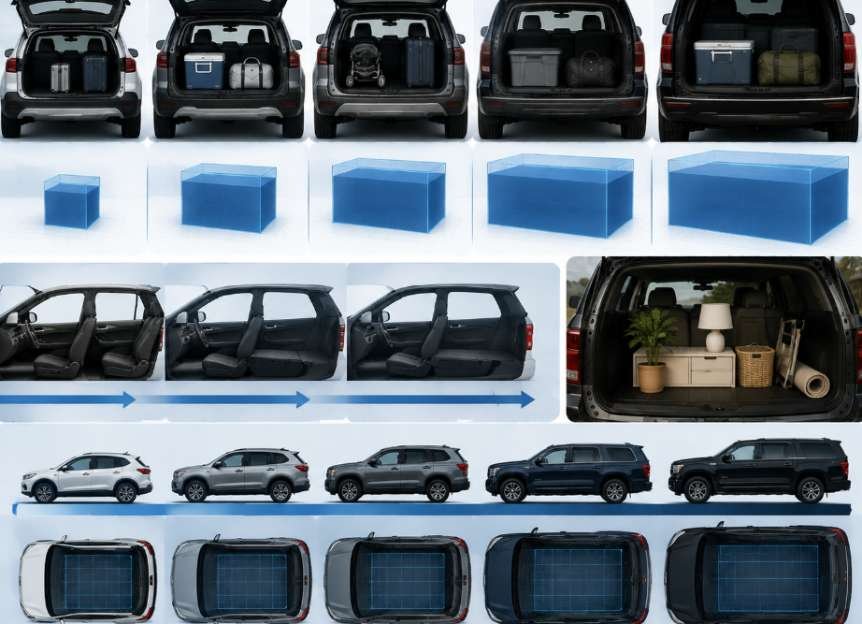
Most SUVs fall into four major categories:
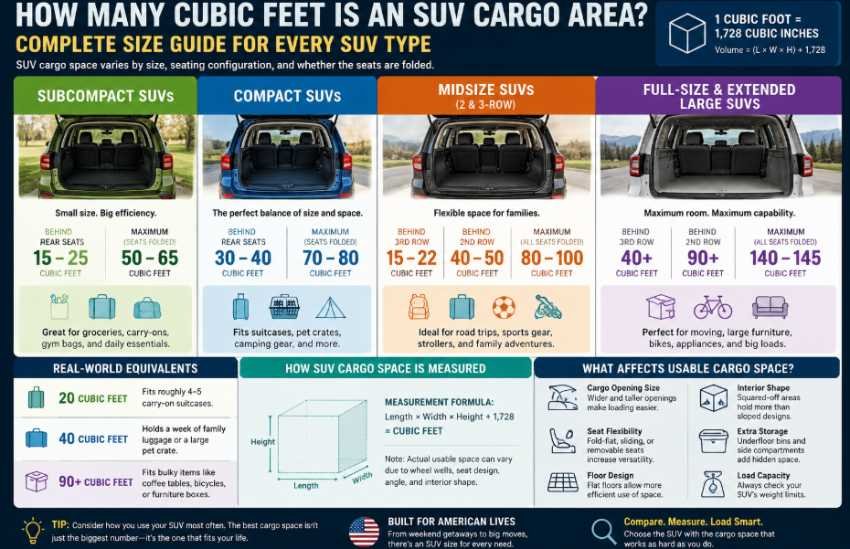
Subcompact SUVs: 15 to 25 Cubic Feet
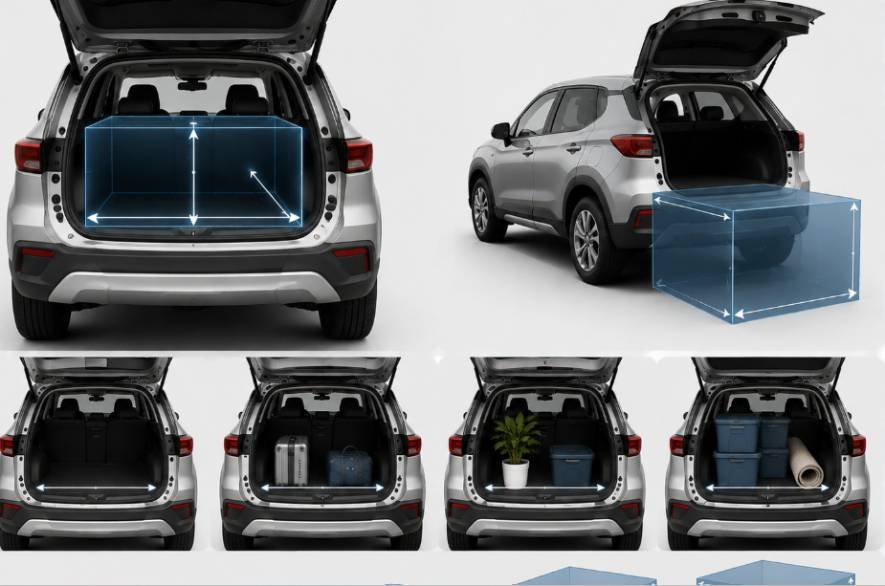
Subcompact SUVs are the smallest SUV category and are popular among drivers who want higher seating positions without a large vehicle footprint.
Behind the rear seats, these SUVs usually provide around 15 to 25 cubic feet of cargo space. When the rear seats are folded, total cargo volume commonly increases to approximately 50 to 65 cubic feet.
This amount of space is suitable for:
- Grocery shopping
- Carry-on luggage
- Gym equipment
- Small outdoor gear
These vehicles are practical for daily commuting but may feel limited for large families or frequent hauling.
Compact SUVs: 30 to 40 Cubic Feet
Compact SUVs are among the most popular vehicles in the US because they offer a balance between fuel efficiency, passenger comfort, and storage.
Models in this category typically provide about 30 to 40 cubic feet behind the second row. With the seats folded down, maximum cargo volume often reaches 70 to 80 cubic feet.
This space can usually handle:
- Multiple suitcases
- Camping supplies
- Pet crates
- Storage containers
- Home improvement purchases
Compact SUVs are often the ideal choice for families who need flexible storage without moving into a larger vehicle.
Midsize SUVs: 15 to 50 Cubic Feet Depending on Seating
Midsize SUVs can vary significantly because many models offer two-row and three-row configurations.
A three-row midsize SUV may provide only about 15 to 22 cubic feet behind the third row because the additional seating reduces available storage space.
However, folding the third row can increase cargo capacity to around 40 to 50 cubic feet. Folding both rear rows can expand the available space to approximately 80 to 100 cubic feet.
This makes midsize SUVs popular for:
- Family vacations
- School activities
- Road trips
- Sports equipment
- Larger household items
Full-Size SUVs: 40 to 145 Cubic Feet
Full-size SUVs offer the largest SUV storage volume available for American drivers. These vehicles are designed for families who need maximum passenger and cargo flexibility.
Many full-size SUVs provide more than 40 cubic feet behind the third row and can exceed 120 cubic feet with seats folded.
Extended models provide even more room. For example, the Chevrolet Suburban and GMC Yukon XL can offer around 41.5 cubic feet behind the third row, approximately 93 cubic feet behind the second row, and about 144.5 cubic feet with rear seats folded.
These vehicles are ideal for:
- Large families
- Long-distance travel
- Moving furniture
- Carrying bulky equipment
How Do I Calculate SUV Cargo Space?
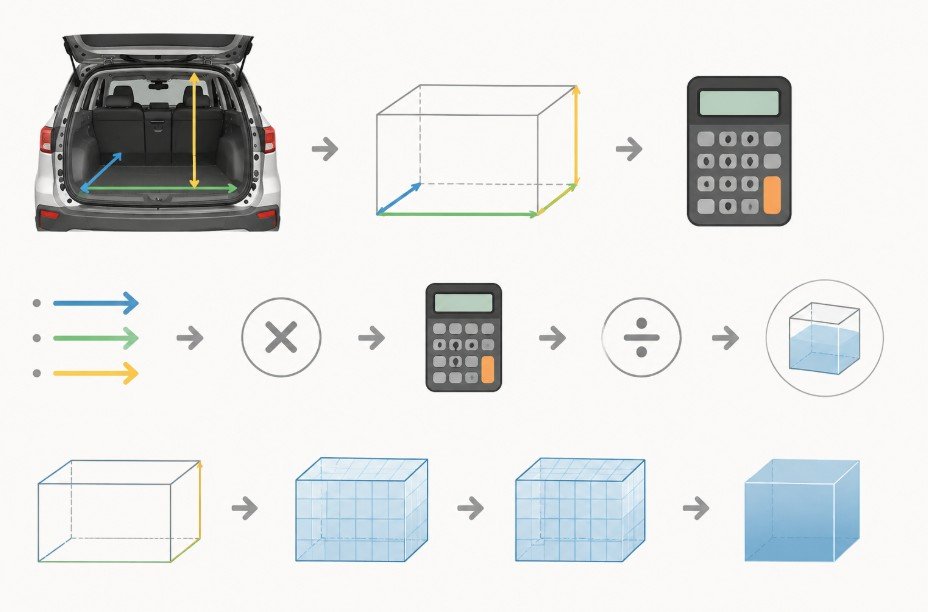
I can estimate an SUV cargo area by measuring the usable length, width, and height of the storage area.
The basic formula is:
Length × Width × Height ÷ 1,728 = Cubic Feet
For example, if an SUV cargo area measures:
- 45 inches long
- 40 inches wide
- 30 inches high
The calculation would be:
45 × 40 × 30 = 54,000 cubic inches
54,000 ÷ 1,728 = approximately 31.25 cubic feet.
The 1,728 figure used here is the standard cubic feet conversion factor, as maintained by the National Institute of Standards and Technology.
However, SUV interiors are rarely perfect rectangles. Wheel wells, sloped roofs, seat angles, and hidden storage compartments can reduce usable space.
That is why advertised cargo volume and real-world storage capacity are not always identical.
Why Is Advertised SUV Cargo Volume Different From Usable Space?
When I compare SUV cargo areas, I look beyond the cubic-foot number because the shape of the space matters.
Manufacturers usually measure cargo volume based on specific industry testing methods. These measurements often represent maximum available space, especially when rear seats are folded.
Real-world usability depends on:
- Cargo opening height and width
- Floor design
- Seat folding system
- Interior height
- Storage compartments
- Shape of the rear area
For example, two SUVs may have similar cargo volume ratings, but the one with a wider and taller cargo opening may be much easier to load.
How Much Can Actually Fit Inside an SUV?
Cubic feet are useful for comparisons, but most drivers want to know what they can carry.
A 20-cubic-foot cargo area can generally hold several grocery bags, a few carry-on suitcases, or everyday personal items.
A 40-cubic-foot SUV cargo area can handle family vacation luggage, larger pet crates, camping equipment, and multiple storage bins.
A vehicle with more than 90 cubic feet of cargo space can carry much larger items, including bicycles, flat-packed furniture, large coolers, and moving boxes.
If you’re weighing two specific models against each other, our cargo volume comparison tool breaks down exactly how much luggage, gear, or boxes each one can realistically hold.
Which SUV Cargo Size Is Right for Me?
When choosing an SUV, I consider how I use the vehicle most often.
A subcompact SUV works well for drivers who mainly need everyday transportation with occasional storage needs.
A compact SUV is a good middle ground for couples and small families who need additional room for travel, shopping, and outdoor activities.
A midsize SUV is better for families who need extra seating and flexible cargo options.
A full-size SUV is the best choice for drivers who regularly transport large loads, travel with many passengers, or need maximum storage capacity.
The right SUV is not always the one with the biggest cargo number. It is the one that provides enough practical space for my daily needs.
For a broader look at other factors beyond cargo space price, fuel economy, safety ratings our SUV buying guide tells everything about what else to weigh before deciding.
Frequently Asked Questions
1. How many cubic feet is a typical SUV cargo area?
A typical SUV cargo area ranges from about 15 to 40 cubic feet behind the seats. Larger SUVs can exceed 100 cubic feet when rear seats are folded.
2. Does folding SUV seats increase cargo capacity?
Yes. Folding the second and third rows can significantly increase maximum cargo volume by creating a larger open storage area.
3. Which SUV has the most cargo space?
Large extended SUVs generally offer the most cargo room. The Chevrolet Suburban and GMC Yukon XL are among the leaders, with maximum cargo volumes around 144.5 cubic feet.
4. How do I measure my SUV cargo area?
Measure the usable length, width, and height of the cargo area, multiply the measurements, and divide by 1,728 to convert cubic inches into cubic feet.
Final Thoughts
After comparing SUV categories, I have learned that cargo space is about more than a single measurement. The listed cubic feet number gives me a starting point, but the vehicle’s shape, seating arrangement, and loading convenience determine how useful the space actually is.
Whether I need room for groceries, luggage, camping gear, or moving supplies, understanding How Many Cubic Feet Is an SUV Cargo Area helps me make a smarter vehicle choice. By comparing SUV classes and considering real-world storage needs, I can find the right balance between passenger comfort and cargo flexibility.

Ryan Mitchell
Ryan Mitchell holds a degree in Civil Engineering and spent over a decade working in construction project estimation, where accurate volume and material calculations were part of his daily work — from concrete pours to landscaping material orders. He founded this site to bring that same precision to everyday calculations, helping DIYers, contractors, and students get fast, accurate cubic footage results without the guesswork. Ryan reviews every calculator and formula on this site for accuracy and writes guides based on real-world measurement scenarios he's encountered on job sites.