

At first glance, a tool box looks easy to size—until you try to fit power tools, socket sets, chargers, and bulky accessories inside it. That is where How Many Cubic Feet Is a Tool Box? becomes more than a simple measurement question.
A compact handheld box may offer well under 1 cubic foot of space, while a professional rolling cabinet can exceed 40 cubic feet. I find that knowing the actual cubic-foot capacity makes it much easier to compare tool boxes, avoid buying one that is too cramped, and choose storage that truly matches the way I work.
How Many Cubic Feet Is a Tool Box?
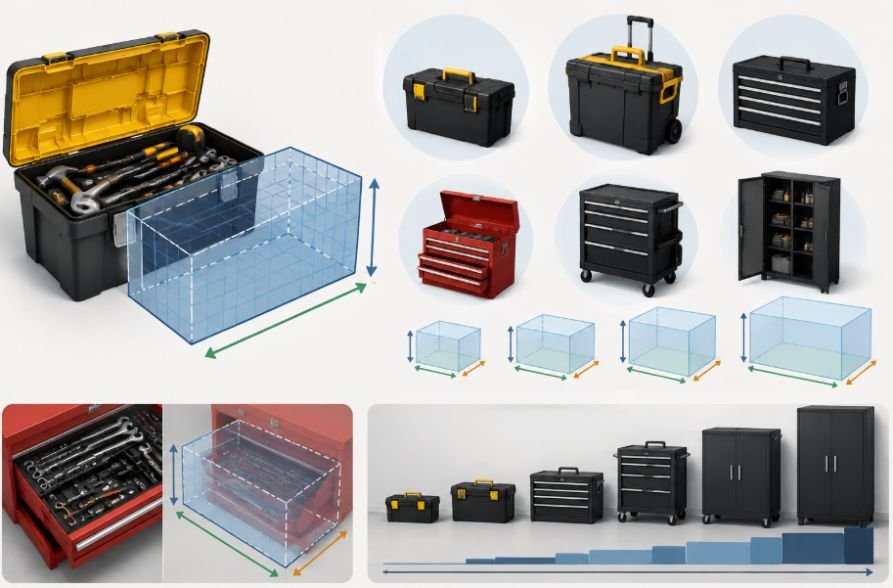
When I need to estimate How Many Cubic Feet Is a Tool Box, I start with the type and internal dimensions. Tool box storage capacity can range from about 0.3 cubic feet for a compact handheld box to more than 40 cubic feet for a large industrial rolling cabinet.
Portable boxes often hold 0.3 to 1.5 cubic feet, modular boxes about 1.5 to 3.5 cubic feet per unit, truck bed boxes roughly 6 to 15 cubic feet, and rolling tool chests about 10 to 45 cubic feet or more.
What Is the Average Tool Box Capacity in Cubic Feet?
There is no universal standard because tool storage products serve different jobs. As a practical guide, portable boxes commonly measure 0.3 to 1.5 cubic feet. Modular storage units often provide 1.5 to 3.5 cubic feet each. Truck tool box capacity generally runs from 6 to 15 cubic feet, while professional rolling cabinets can exceed 30 to 45 cubic feet.
Trays, drawers, handles, hinges, wall thickness, and structural supports reduce usable storage space.
How Do You Calculate Tool Box Cubic Feet?
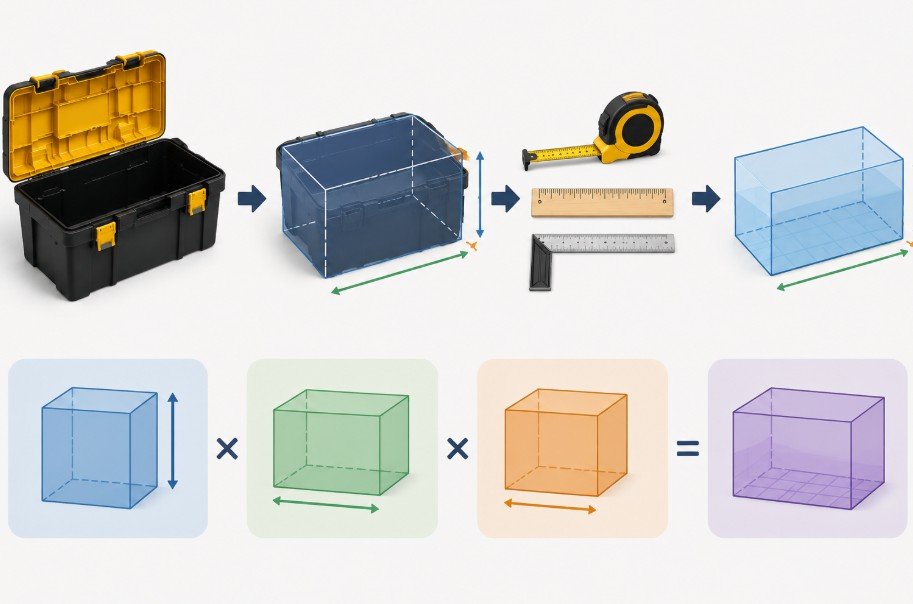
If the dimensions are in inches, use:
Length × Width × Height ÷ 1,728 = cubic feet
There are 1,728 cubic inches in one cubic foot. A rectangular box measuring 36 × 18 × 18 inches has 11,664 cubic inches of volume. Divide that by 1,728, and the estimated volume is 6.75 cubic feet.
The same length × width × height ÷ 1,728 method applies to any rigid storage container I break it down further in my plastic container size guide for bins and totes that use the same boxy shape.
Should You Measure the Inside or Outside?
Use interior dimensions when you want usable toolbox capacity. Use exterior dimensions when you need to know whether the box will fit in a pickup bed, garage, workshop, van, trailer, or shelf.
Exterior volume shows how much physical space the box occupies. Interior volume shows how much equipment you can actually store.
How Many Cubic Feet Does a Portable or Modular Tool Box Hold?
A conventional handheld plastic or metal tool box usually provides about 0.3 to 1.5 cubic feet. Larger contractor-style models can hold cordless drills, batteries, chargers, sockets, and accessories.
Modular systems often provide about 1.5 to 3.5 cubic feet for a larger individual box, while shallow organizers hold less. If capacity is listed in cubic inches, divide by 1,728. If it is listed in liters, divide by approximately 28.3 to estimate cubic feet.
How Many Cubic Feet Does a Truck Tool Box Hold?
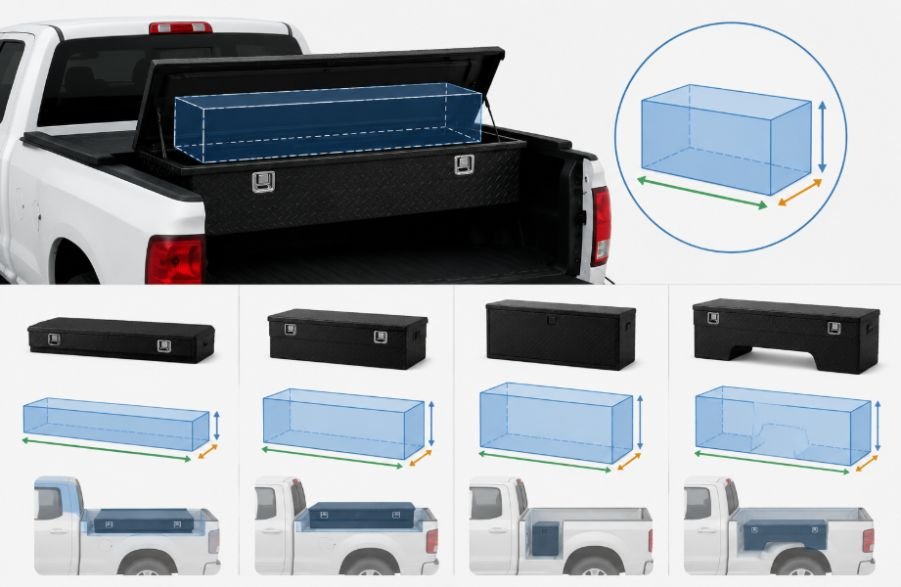
Most truck bed tool boxes offer approximately 6 to 15 cubic feet. Mid-size and top-mount boxes sit near the lower end, while full-size crossover and chest-style models may reach 10 to 15 cubic feet.
For a US pickup, I also check bed width, rail height, box depth, mounting clearance, and tonneau-cover compatibility. A deeper box adds volume but can reduce cargo space, so truck toolbox dimensions matter just as much as advertised capacity.
How Much Storage Does a Rolling Tool Chest Offer?
Rolling tool chests cover the widest capacity range. Standard home-garage cabinets may provide about 10 to 18 cubic feet, while large professional or industrial multi-drawer workstations can reach 30 to 45 cubic feet or more.
The internal layout also affects usefulness. Shallow drawers make sockets and wrenches easier to organize, while deeper drawers work better for power tools, chargers, and larger automotive equipment.
When comparing different storage units, I use a storage space calculator tool to estimate available space and compare storage capacity.
Why Is Usable Tool Box Capacity Smaller Than Exterior Volume?
A tool box is rarely a perfect empty rectangle. Walls, drawer slides, trays, dividers, locks, hinges, handles, framing, and mounting hardware all consume space. Truck boxes may also have sloped sides or irregular lower sections.
That is why I treat exterior cubic footage as an occupied-space estimate rather than guaranteed usable capacity. If storage volume matters most, internal toolbox dimensions provide the more useful measurement.
Is Cubic-Foot Capacity the Same as Weight Capacity?
No. Cubic feet measures volume, while weight capacity tells you how much load the box or drawer can safely support.
Heavy sockets, wrenches, power tools, batteries, and automotive equipment can reach the load limit before the storage compartment appears full. For heavy-duty tool storage, I compare both cubic-foot capacity and the manufacturer’s load rating.
What Size Tool Box Do You Need?
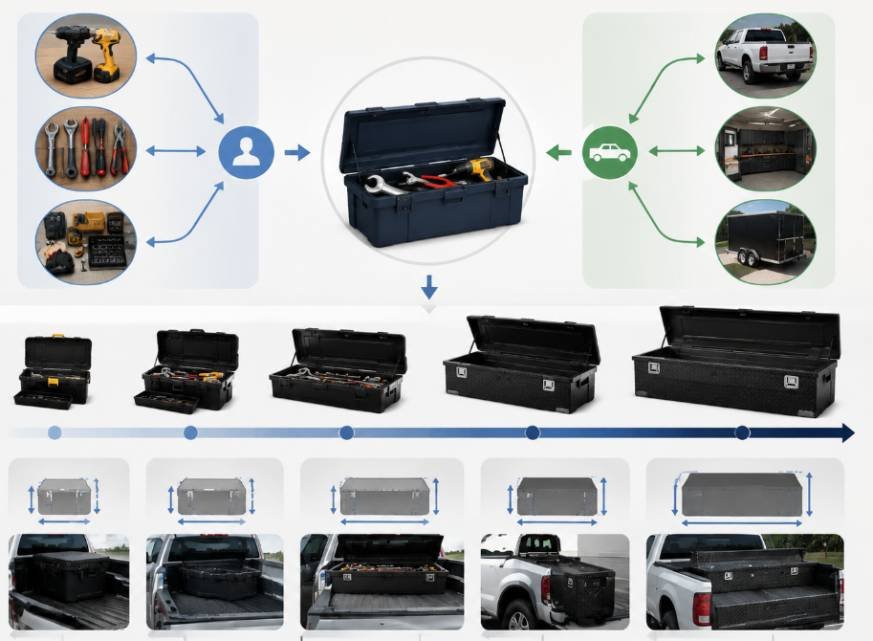
For home repairs, a compact portable tool box may be enough. Contractors carrying drills, batteries, cords, hand tools, and fasteners generally need more room.
Pickup owners may find 6 to 10 cubic feet suitable for everyday tools, while tradespeople carrying bulky equipment may prefer 10 to 15 cubic feet.
When garage storage runs out entirely, my storage locker size guide can help you figure out whether a small unit is enough for overflow tools and seasonal equipment.
A mechanic working primarily in a garage may benefit more from a rolling cabinet with multiple drawers than from one large open chest.
The right size depends on usable storage space, portability, organization, tool weight, and where the box will be used.
Frequently Asked Questions
1. How Many Cubic Feet Is a Tool Box?
A tool box can range from about 0.3 cubic feet for a small handheld unit to 45 cubic feet or more for a large industrial cabinet. Portable boxes commonly hold 0.3 to 1.5 cubic feet, while truck boxes often provide 6 to 15 cubic feet.
2. How do I convert cubic inches to cubic feet?
Divide cubic inches by 1,728. For example, 3,456 cubic inches equals 2 cubic feet.
3. How do I calculate usable tool box capacity?
Measure the internal length, width, and height. Multiply those measurements together and divide by 1,728 when the dimensions are in inches. Interior measurements give a more accurate estimate of usable tool storage capacity.
4. Is a bigger toolbox always better?
Not always. Larger tool storage takes up more garage, workshop, trailer, or truck-bed space. Drawer layout, load capacity, portability, accessibility, and the size of your actual tools can matter as much as total cubic footage.
Final Thoughts
When I compare toolbox sizes, I look beyond labels such as small, medium, or heavy-duty. Portable boxes, modular storage systems, pickup chests, and industrial rolling cabinets can have dramatically different capacities.
The most reliable approach is to calculate interior volume for actual storage and exterior volume for fitment. Once I combine those measurements with drawer layout, load rating, portability, and the tools I actually use, choosing the right toolbox becomes much easier.

Ryan Mitchell
Ryan Mitchell holds a degree in Civil Engineering and spent over a decade working in construction project estimation, where accurate volume and material calculations were part of his daily work — from concrete pours to landscaping material orders. He founded this site to bring that same precision to everyday calculations, helping DIYers, contractors, and students get fast, accurate cubic footage results without the guesswork. Ryan reviews every calculator and formula on this site for accuracy and writes guides based on real-world measurement scenarios he's encountered on job sites.