
Plastic storage bins are everywhere in US homes, garages, basements, dorm rooms, and moving trucks, but their sizing can be confusing. Manufacturers often label plastic totes in gallons or quarts, while moving companies, storage facilities, and warehouse planners frequently use cubic feet.
A question I see often is How Many Cubic Feet Is a Plastic Container? The answer depends on size, but many common household storage totes fall roughly between 0.5 and 7.0 cubic feet.
For quick reference, a 12-quart bin is about 0.40 cubic feet, a 27-gallon tote is about 3.61 cubic feet, a 30-gallon tote is about 4.01 cubic feet, and a 50-gallon container is about 6.68 cubic feet.
What Are Common Plastic Container Sizes in Cubic Feet?
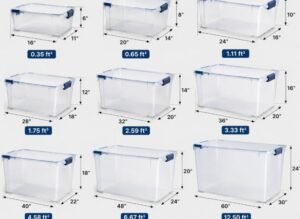
There is no universal plastic container size. Small bins for shoes, cables, or electronics may hold less than one cubic foot, while large garage totes and wheeled trunks can exceed six cubic feet.
| Plastic container size | Approximate cubic feet | Typical use |
| 12 quarts / 3 gallons | 0.40 ft³ | Shoes and small items |
| 5 gallons | 0.67 ft³ | Tools and supplies |
| 10 gallons | 1.34 ft³ | Household storage |
| 15 gallons | 2.01 ft³ | Clothing and linens |
| 18 gallons | 2.41 ft³ | General storage |
| 20 gallons | 2.67 ft³ | Seasonal items |
| 27 gallons | 3.61 ft³ | Garage or moving tote |
| 30 gallons | 4.01 ft³ | Large storage |
| 40 gallons | 5.35 ft³ | Bulky items |
| 50 gallons | 6.68 ft³ | Extra-large trunk |
| 55 gallons | 7.35 ft³ | Utility storage |
These figures are volume conversions, not guaranteed exterior dimensions. Two plastic storage totes with the same gallon rating can have different shapes, wall thicknesses, handles, lids, and footprints.
How Do I Calculate Cubic Feet From Gallons?
For US gallons, I use:
Cubic feet = gallons ÷ 7.48
A 27-gallon tote gives:
27 ÷ 7.48 = approximately 3.61 cubic feet
You can also multiply gallons by about 0.1337. This conversion is useful when a manufacturer lists plastic storage tote capacity in gallons but you need cubic footage for moving, shelving, shipping, or storage planning.
How Do I Convert Quarts to Cubic Feet?
Smaller storage bins are often sold in quarts. I convert them with:
Cubic feet = quarts ÷ 29.92
For a 12-quart plastic bin:
12 ÷ 29.92 = approximately 0.40 cubic feet
This makes it easier to compare small storage bin volume with larger containers measured in gallons or cubic feet.
How Do I Calculate Cubic Feet From Container Dimensions?
If the label does not give a useful capacity, I measure the container.
When dimensions are in feet:
Length × Width × Height = cubic feet
When they are in inches:
Length × Width × Height ÷ 1,728 = cubic feet
For example, a rectangular tote measuring 24 × 18 × 16 inches contains a box volume of:
24 × 18 × 16 = 6,912 cubic inches
6,912 ÷ 1,728 = 4 cubic feet
That formula provides a practical estimate for a rectangular plastic container.
Should I Measure the Inside or Outside of a Plastic Container?
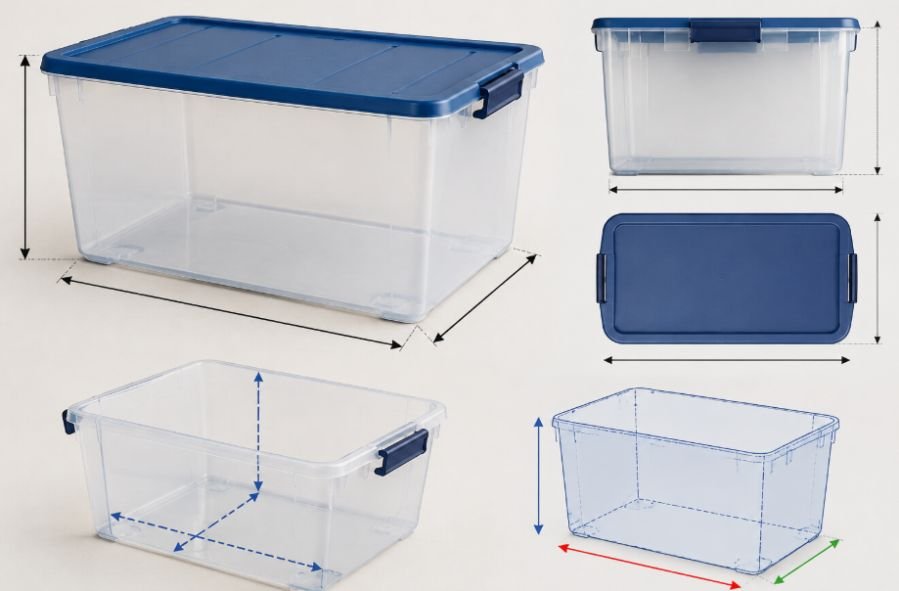
I use interior dimensions when I want to estimate usable storage capacity. This tells me approximately how much clothing, equipment, supplies, or other material can fit inside.
I use exterior dimensions when I need to know how much space the tote occupies on a shelf, under a bed, in an SUV, inside a moving truck, or in a self-storage unit.
That is why the advice to always use interior measurements needs one qualification. Interior dimensions are best for capacity; exterior dimensions are best for space planning.
Why Does a Plastic Tote’s Actual Capacity Differ From Its Dimensions?
Plastic containers are rarely perfect boxes. Many taper toward the bottom so they can nest when empty. Rounded corners, thick rims, recessed lids, molded handles, wheels, and reinforced walls can also reduce usable interior volume. Multiplying maximum exterior dimensions can therefore overstate what actually fits inside.
Similarly, a gallon rating describes capacity, not necessarily the total cube the tote occupies. When I need a quick estimate, I use a cubic feet calculation tool to determine the approximate volume. When fit matters, I check the exact interior or exterior measurements for the job.
Cubic Feet vs. Gallons: Which Should I Use?
Both measure volume, but they serve different practical purposes. Gallons and quarts are common for plastic bins, buckets, and trash cans in the United States. Cubic feet are more useful for shelving, moving trucks, warehouse space, freight, and storage units.
One cubic foot equals approximately 7.48 US gallons. Converting containers to the same unit makes size comparisons much easier.
How Do I Choose the Right Plastic Storage Container?

I first decide whether I care more about capacity or fit. For blankets, clothes, holiday decorations, sports gear, or household supplies, internal storage capacity usually matters most. For a specific closet, vehicle, garage rack, or shelf, exterior dimensions are more important.
If you’re fitting bins into kitchen storage specifically, check the kitchen cabinet’s available space first so your tote dimensions match the shelf space more accurately.
I also avoid assuming that every 27-gallon or 30-gallon tote has identical dimensions. Manufacturers use different shapes and designs, so checking the listed length, width, and height can prevent an expensive sizing mistake.
Frequently Asked Questions
1. How Many Cubic Feet Is a Plastic Container?
It depends on the size. Many household plastic storage bins are roughly 0.5 to 7.0 cubic feet, although containers outside that range are common. Use the gallon or quart capacity, or measure the dimensions, for a more precise result.
2. How many cubic feet is a 27-gallon plastic tote?
A 27-gallon tote equals approximately 3.61 cubic feet by volume. Its exterior cube may be larger because of its lid, rim, handles, and tapered walls.
3. How many cubic feet is a 30-gallon plastic tote?
A 30-gallon container equals approximately 4.01 cubic feet. If you need to determine whether it fits a specific space, use the manufacturer’s exterior dimensions.
4. How many gallons are in one cubic foot?
One cubic foot equals approximately 7.48 US gallons. Multiply cubic feet by 7.48 when converting cubic feet to gallons.
Final Takeaway
I find plastic container cubic-foot calculations easiest when I match the method to the information available. I divide gallons by 7.48, divide quarts by 29.92, or multiply dimensions in inches and divide by 1,728. Understanding basic weights and measures also makes it easier to convert between different volume units accurately.
The most important detail is knowing whether you need usable capacity or occupied space. Interior measurements tell you what can fit inside the container, while exterior measurements help with garages, shelves, vehicles, moving trucks, warehouses, and storage units. With that distinction in mind, comparing plastic container sizes becomes simple and much more accurate.

Ryan Mitchell
Ryan Mitchell holds a degree in Civil Engineering and spent over a decade working in construction project estimation, where accurate volume and material calculations were part of his daily work — from concrete pours to landscaping material orders. He founded this site to bring that same precision to everyday calculations, helping DIYers, contractors, and students get fast, accurate cubic footage results without the guesswork. Ryan reviews every calculator and formula on this site for accuracy and writes guides based on real-world measurement scenarios he's encountered on job sites.