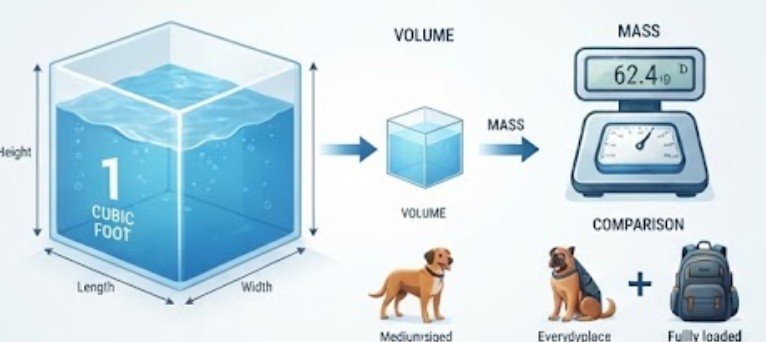

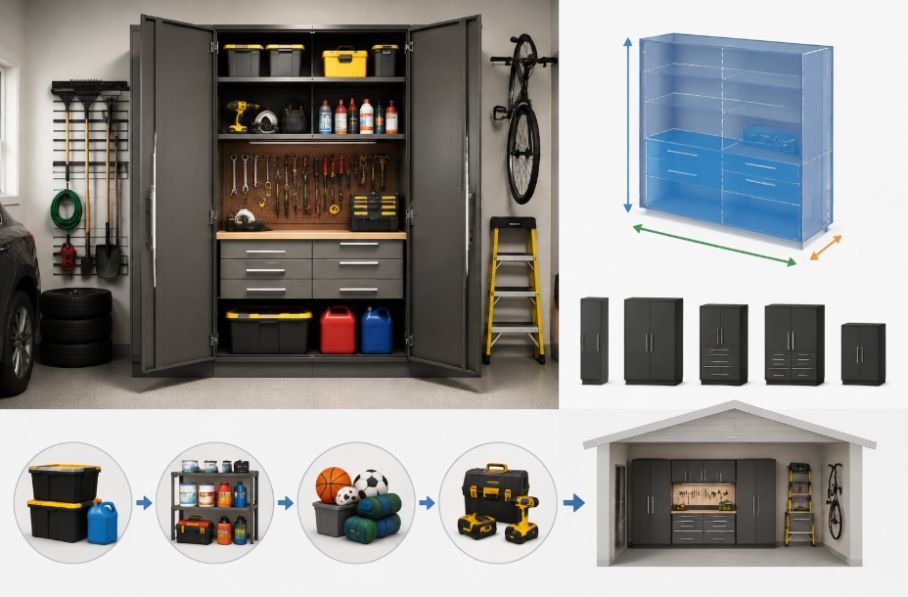
A garage cabinet can look enormous on the showroom floor and still hold far less than I expect once shelves, doors, and framing enter the equation. That is why I prefer to judge storage by actual volume instead of appearance alone. So, How Many Cubic Feet Is a Garage Storage Cabinet?
A typical full-size freestanding model offers around 27 cubic feet of exterior volume, while compact wall-mounted cabinets may provide only 4 to 6 cubic feet, and oversized heavy-duty units can reach 40 to 50 cubic feet or more.
Knowing that range helps me compare cabinet sizes realistically, plan around my vehicle and workspace, and avoid paying for storage that does not actually fit the way I use my garage.
What Is the Average Garage Storage Cabinet Capacity?
For a typical US garage, a full-height freestanding garage cabinet often falls in the mid-20s to low-30s cubic feet when calculated from outside dimensions. A 36 × 18 × 72-inch cabinet equals 27 cubic feet, making it a useful benchmark for a standard tall model. Current tested cabinets include multiple freestanding models around this 72 × 36 × 18-inch size.
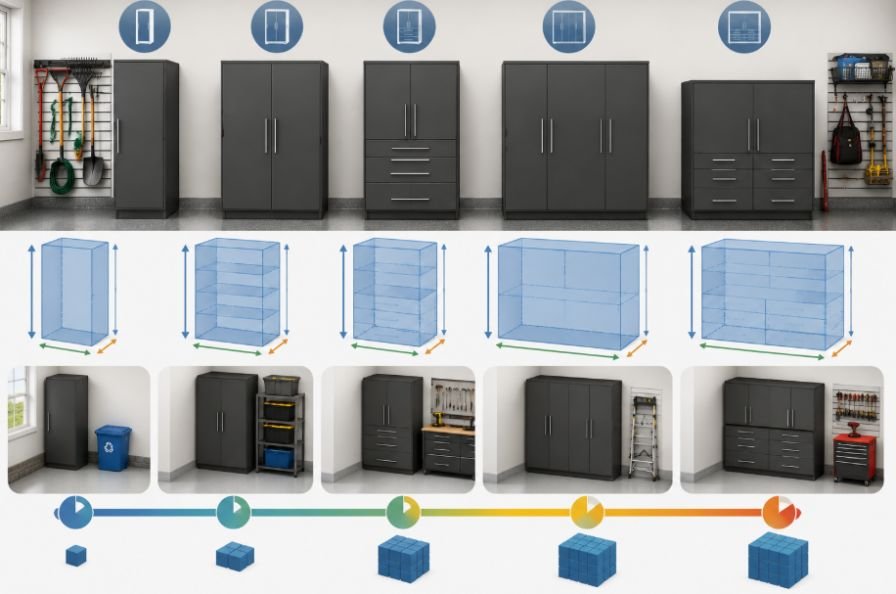
Garage cabinet capacity changes quickly with width, depth, and height. A narrow tall cabinet may occupy around 18 cubic feet, while deeper or wider heavy-duty units can exceed 40 cubic feet. The best garage storage cabinet size therefore depends on both available garage space and what I need to store.
Garage Cabinet Cubic Feet by Common Size
| Garage cabinet type | Example dimensions | Approx. exterior volume |
| Wall-mounted cabinet | 30 × 12 × 30 in. | 6.25 cu. ft. |
| Base or half-height cabinet | 30 × 20 × 36 in. | 12.5 cu. ft. |
| Narrow tall cabinet | 24 × 18 × 72 in. | 18 cu. ft. |
| Standard tall cabinet | 36 × 18 × 72 in. | 27 cu. ft. |
| Mega tall/deep cabinet | 40 × 20 × 80 in. | 37 cu. ft. |
| Deep tall cabinet | 36 × 24 × 84 in. | 42 cu. ft. |
These figures represent mathematical exterior volume rather than guaranteed interior capacity.
How Do I Calculate Garage Cabinet Cubic Feet?
When garage cabinet dimensions are listed in inches, I use this cubic feet calculation:
Width × Depth × Height ÷ 1,728 = cubic feet
There are 1,728 cubic inches in one cubic foot. For a 36 × 18 × 72-inch freestanding garage cabinet, the calculation is 46,656 ÷ 1,728, which equals 27 cubic feet.
If the measurements are already in feet, I simply multiply width × depth × height.
How Much Space Do Different Garage Cabinet Types Provide?
How Large Is a Standard Tall Garage Cabinet?
A standard tall garage cabinet often measures around 24 to 48 inches wide and about 72 inches high. Cabinet systems commonly use widths such as 24, 36, and 48 inches.
A 36 × 18 × 72-inch model provides 27 cubic feet of exterior volume and works well for power tools, automotive supplies, sports gear, and storage containers.
How Much Capacity Does a Base Garage Cabinet Have?
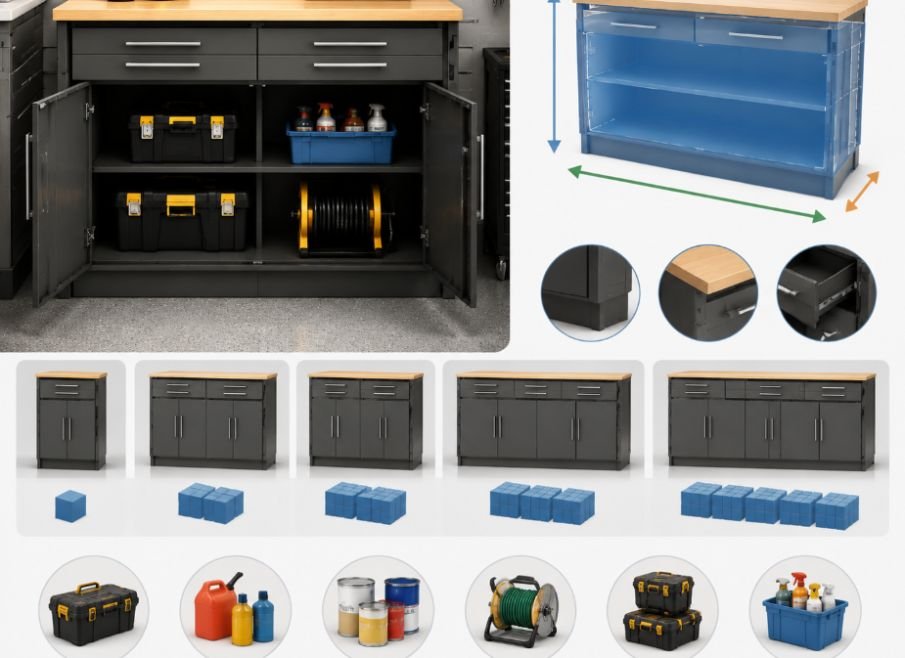
Base or half-height cabinets sit on the floor and may double as support for a workbench. A 30 × 20 × 36-inch model occupies about 12.5 cubic feet.
Their lower profile makes them useful when I want both garage storage space and a practical work surface. Many standard base cabinet systems use a depth around 24 inches.
How Much Space Does a Wall-Mounted Cabinet Offer?
Wall-mounted cabinets keep the floor clear and typically use shallower wall cabinet dimensions. A 30 × 12 × 30-inch model is about 6.25 cubic feet.
A 12-inch garage cabinet depth is commonly used for upper cabinets because it reduces how far the cabinet projects over a work area.
How Large Are Mega Tall and Deep Cabinets?
A 40 × 20 × 80-inch cabinet occupies about 37 cubic feet, while a 36 × 24 × 84-inch cabinet reaches 42 cubic feet. Extra-wide heavy-duty configurations can approach or exceed 48 cubic feet depending on their exact dimensions.
These larger cabinets make sense when I need room for oversized power tools, automotive equipment, large storage totes, or seasonal items.
Is Exterior Volume the Same as Usable Storage Capacity?
No. Exterior cabinet cubic feet tells me how much room the cabinet occupies in the garage. Usable storage capacity tells me how much space I can actually fill.
Steel panels, resin walls, door frames, hinges, shelf tracks, drawers, locks, and structural braces reduce cabinet interior dimensions. I use exterior measurements for layout planning and interior measurements when checking whether tool cases, bins, or equipment will fit.
This same interior-vs-exterior gap shows up in smaller storage furniture too I break it down in my filing cabinet size guide for anyone weighing a cabinet against other garage or office storage.
Two cabinets with similar storage cabinet volume can therefore feel very different once I open the doors.
Is an 18-Inch or 24-Inch Deep Garage Cabinet Better?
An 18-inch deep garage cabinet works well when vehicle clearance and walking space matter. It stores many common tools without extending too far into the garage.
A 24-inch deep garage cabinet provides more room for bulky tools, bins, and automotive supplies. Before choosing one, I measure the parked vehicle, cabinet door swing, garage-door tracks, outlets, workbench, and walkway.
I also use a cubic feet of an item tool to estimate how much usable space the cabinet provides.
More volume does not help if the cabinet makes the garage harder to use.
Does More Cubic Feet Mean a Better Garage Cabinet?
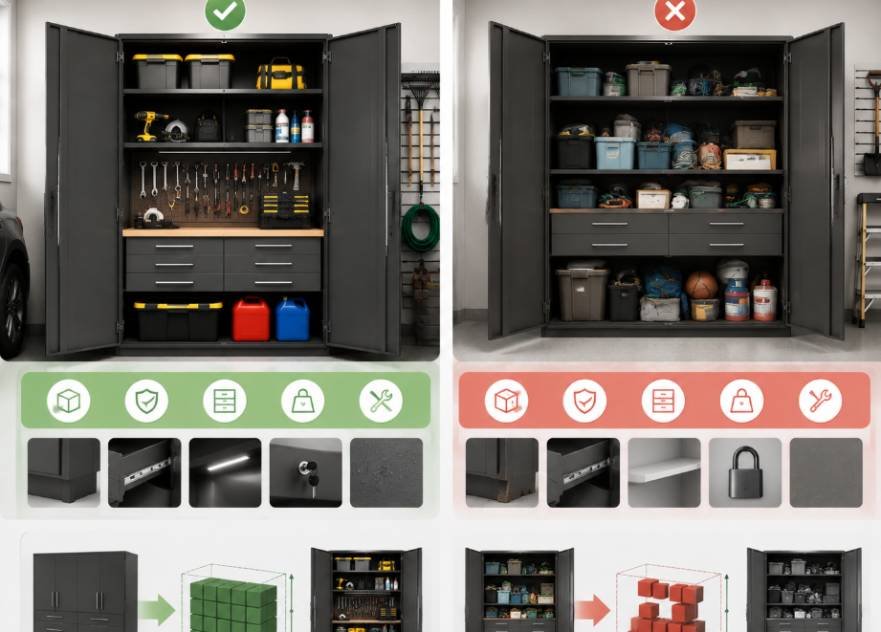
Not always. I also compare shelf configuration, weight capacity, material, door style, locks, and installation requirements.
Steel cabinets are often well suited to heavier equipment, while resin or plastic cabinets can be lighter and resistant to rust. Wall-mounted models save floor space, while freestanding garage cabinet designs offer flexible placement. Current testing guides also emphasize material, storage layout, weight capacity, and installation rather than cabinet size alone.
The best choice depends on what I plan to store and how much clearance I have. When even a large cabinet cannot absorb seasonal overflow, my storage locker size guide walks through whether a small off-site unit makes more sense than squeezing everything into the garage.
Frequently Asked Questions
1. How Many Cubic Feet Is a Garage Storage Cabinet?
A typical full-size freestanding cabinet is around 27 cubic feet when it measures approximately 36 × 18 × 72 inches. Compact wall cabinets may be around 4 to 6 cubic feet, while large tall or deep models may reach 35 to 50 cubic feet or more.
2. What Are Standard Garage Cabinet Dimensions?
Common cabinet widths include roughly 24, 36, and 48 inches. Wall cabinets are often around 12 inches deep, while base cabinets may be around 24 inches deep. Tall garage cabinet size varies by manufacturer, so I always check exact specifications before buying.
3. How Many Cubic Feet Is a 36 × 18 × 72 Cabinet?
It is exactly 27 cubic feet. I multiply 36 × 18 × 72 to get 46,656 cubic inches, then divide by 1,728.
4. Should I Use Interior or Exterior Cabinet Dimensions?
I use exterior dimensions for garage placement and clearance. I use interior dimensions to estimate real storage capacity and determine whether specific tools, bins, or equipment will fit.
Final Takeaway
When I choose a garage storage cabinet, I start with cubic footage but also check usable interior space, shelf layout, garage cabinet depth, weight capacity, and clearance. Around 27 cubic feet is a useful benchmark for a full-size freestanding model, while smaller wall cabinets may offer only a few cubic feet and larger heavy-duty cabinets can exceed 40 cubic feet.
For me, calculating the volume first and then checking the interior layout is the most reliable approach. It helps me choose a cabinet that not only looks spacious on paper but also works efficiently in a real American garage.

Ryan Mitchell
Ryan Mitchell holds a degree in Civil Engineering and spent over a decade working in construction project estimation, where accurate volume and material calculations were part of his daily work — from concrete pours to landscaping material orders. He founded this site to bring that same precision to everyday calculations, helping DIYers, contractors, and students get fast, accurate cubic footage results without the guesswork. Ryan reviews every calculator and formula on this site for accuracy and writes guides based on real-world measurement scenarios he's encountered on job sites.