
I have stored garden tools in bins, totes, cases, and crowded garage corners, and packaging changes the answer fast. If you are asking how many cubic feet is a garden tool set, a typical hand-held kit occupies about 0.08 to 0.52 cubic feet. Sets with full-size rakes, hoes, or shovels may need roughly 3 to 4 cubic feet of practical storage envelope.
That range exists because soft totes, rigid cases, and long-handled bundles use space differently.
How Many Cubic Feet Is a Garden Tool Set on Average?
For most hand-tool kits, how many cubic feet is a garden tool set depends on the outside dimensions of the packed set. Small 3- to 5-piece kits sit near 0.08 cubic feet. Standard 8- to 10-piece kits often reach 0.19 cubic feet. Large molded cases can approach 0.52 cubic feet.
| Garden tool set | Typical packed dimensions | Approx. volume |
| Small 3–5 piece kit | 31 × 11 × 6.5 cm | 0.08 cu. ft. |
| Standard 8–10 piece kit | 32 × 17.5 × 9.5 cm | 0.19 cu. ft. |
| 10+ piece hard-case kit | 44.2 × 9.5 × 35 cm | 0.52 cu. ft. |
| Long-handled tool bundle | Varies | 3–4 cu. ft. envelope |
These are planning figures, not perfect capacity limits. Handles, latches, and access space can increase the room required.
Garden Tool Set Cubic Feet by Kit Size
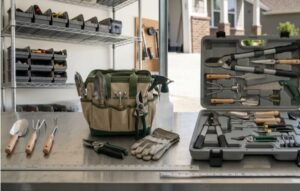
Small 3- to 5-Piece Hand Tool Sets
A basic set may include a trowel, cultivator, and weeder. A packed size of 31 × 11 × 6.5 centimeters equals about 2,216.5 cubic centimeters, or 0.078 cubic feet.
Rounded for practical storage planning, that is about 0.08 cubic feet. A kit this small can usually fit on a garage shelf, beneath a potting bench, or inside a compact gardening tote.
Standard 8- to 10-Piece Garden Tool Kits
Add pruning shears, gloves, a spray bottle, transplanter, and tote, and the package grows. A 32 × 17.5 × 9.5 centimeter package equals approximately 0.188 cubic feet.
For this category, how many cubic feet is a garden tool set is best answered with a benchmark of about 0.19 cubic feet. Soft totes can compress slightly, although upright handles may require more vertical clearance than the calculated volume suggests.
Large Sets in Hard Cases
Rigid molded cases take more shelf space because the shell cannot collapse around the tools. A case measuring 44.2 × 9.5 × 35 centimeters occupies approximately 0.519 cubic feet.
I would round that figure to 0.52 cubic feet. I would also leave enough room to grip the handle and open any external latches.
How to Calculate Garden Tool Set Volume in Cubic Feet
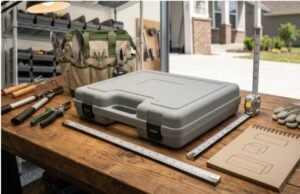
You only need three measurements: the outside length, width, and height of the packed tool set.
When Dimensions Are in Inches
Use this formula:
Cubic feet = (Length × Width × Height in inches) ÷ 1,728
NIST lists one cubic foot as exactly 1,728 cubic inches, making this the correct U.S. customary conversion.
Suppose a garden tool case measures 16 inches long, 8 inches wide, and 6 inches high.
16 × 8 × 6 = 768 cubic inches
768 ÷ 1,728 = 0.44 cubic feet
That example shows why how many cubic feet is a garden tool set cannot be estimated reliably from the number of tools alone. Two 10-piece kits can occupy very different volumes if one uses a compact tote and the other uses a molded case.
When Dimensions Are in Centimeters
Multiply length × width × height to find cubic centimeters. Then divide by approximately 28,316.85.
Using the small kit:
31 × 11 × 6.5 = 2,216.5 cm³
2,216.5 ÷ 28,316.85 = 0.078 ft³
For U.S. storage planning, I find it easier to calculate the metric volume first and convert the final answer into cubic feet.
Package Volume vs. Real Storage Space
This is where my method differs from a basic volume calculation. Package volume measures a tight rectangular box. Practical storage volume describes the envelope needed to store and retrieve the tools comfortably.
A 0.19-cubic-foot tote may require more vertical clearance because its handles stand upright. A 0.52-cubic-foot hard case can need extra depth for a molded grip or latches. Loose tools may occupy even more room because they do not stack into a perfect rectangle.
It’s the same gap between package volume and real footprint I run into when sizing the actual floor space a portable generator needs, where the printed capacity rarely matches the clearance it takes in practice.
For loose or oddly shaped kits, how many cubic feet is a garden tool set still depends on the grouped outer dimensions. For everyday storage, I leave some clearance rather than filling a shelf to its mathematical limit. That is a useful planning heuristic, not an official measurement standard.
How Much Space Do Long-Handled Garden Tools Need?
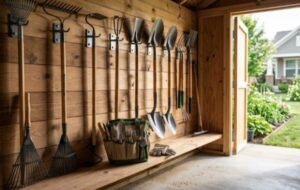
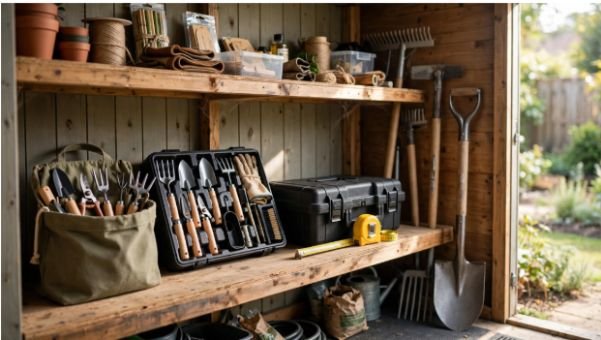
Once a set includes full-size shovels, rakes, hoes, or cultivators, how many cubic feet is a garden tool set becomes more of a storage-envelope question.
A tightly grouped set may require roughly 3 to 4 cubic feet of practical standing space. The exact amount depends on handle length, head width, and how closely the tools overlap.
Wall-mounted hooks can reduce floor use because several handles can occupy the same vertical zone.
This distinction is reflected in purpose-built outdoor storage. Suncast describes its tall vertical storage products as suitable for long-handled tools and garden supplies. It’s the same handle-and-clearance problem I run into when checking whether a pressure washer’s handle will fit under a shelf. One current 22-cubic-foot vertical shed has interior dimensions of about 27 inches wide, 20.25 inches deep, and 69 inches high.
That does not mean a few garden tools need a 22-cubic-foot shed. It demonstrates why height and door access can matter more than raw cubic-foot capacity when storing long tools.
Choosing the Right Storage Space for Garden Equipment
I choose garden-tool storage by shape first and cubic feet second. Short hand tools work well in bins, totes, drawers, and shelves. Hard cases need a rectangular opening large enough for easy removal. Long-handled tools are usually better stored upright or on wall hooks.
Before buying a storage cabinet, deck box, or shed, pack the tools exactly as you intend to store them. Measure the widest outer points and calculate the resulting cubic feet.
This gives a more useful answer to how many cubic feet is a garden tool set than relying on the number of pieces printed on the package. It also prevents a common mistake: buying storage with enough total volume but the wrong dimensions.
FAQs
1. How many cubic feet is a garden tool set with 10 pieces?
Most 8- to 10-piece hand-tool kits occupy about 0.19 cubic feet, while larger rigid cases can reach about 0.52 cubic feet.
2. How much space does a small garden tool kit need?
A compact 3- to 5-piece hand-tool set may need only about 0.08 cubic feet when tightly packed.
3. Do long-handled garden tools need more storage space?
Yes. Grouped rakes, hoes, and shovels may require roughly 3 to 4 cubic feet of practical standing storage space.
4. Should I measure the tools or the storage case?
Measure the outside of the packed case or tote for shelf and shipping calculations; treat loose tools as one grouped storage envelope.
Your Shed Does Not Need a Math Degree
When someone asks me how many cubic feet is a garden tool set, I first decide whether the goal is shipping volume or usable storage. Most hand-held kits fall around 0.08 to 0.52 cubic feet, while long-handled sets need more practical clearance.
My next move is simple: measure the packed outer dimensions, calculate the cubic feet, and leave enough room to grab the tools without wrestling the shelf.
A few measurements now can save you from buying a storage box that looks spacious on paper but turns into a game of garden-tool Tetris.

Ryan Mitchell
Ryan Mitchell holds a degree in Civil Engineering and spent over a decade working in construction project estimation, where accurate volume and material calculations were part of his daily work — from concrete pours to landscaping material orders. He founded this site to bring that same precision to everyday calculations, helping DIYers, contractors, and students get fast, accurate cubic footage results without the guesswork. Ryan reviews every calculator and formula on this site for accuracy and writes guides based on real-world measurement scenarios he's encountered on job sites.