When I first tried to determine How Many Cubic Feet Is a Pallet?, I discovered that the common one-number answers can be misleading. A pallet’s cubic footage depends on its length, width, and total loaded height. An empty wooden pallet may occupy approximately 5 to 7 cubic feet, while a loaded shipping pallet can use 40 to 80 cubic feet or more.
For the standard 48-by-40-inch pallet commonly used by American warehouses, retailers, manufacturers, and freight carriers, a total height of 48 inches produces 53.33 cubic feet. That is the most helpful starting point, but you must measure your actual shipment to obtain an accurate number.
What Is the Cubic Footage of a Standard Pallet?
The standard Grocery Manufacturers Association, or GMA, pallet has a 48-by-40-inch footprint. Its surface occupies approximately 13.33 square feet. However, that footprint alone cannot reveal its cubic footage because volume requires a third measurement: height.
An empty wooden pallet is generally around 4.5 to 6 inches tall. A 48-by-40-inch pallet measuring 6 inches high occupies approximately 6.67 cubic feet. If it is only 4.5 inches high, its bounding volume is 5 cubic feet.
Loaded pallets are significantly larger. A 48-by-40-inch shipment with a total height of 24 inches occupies 26.67 cubic feet. At 36 inches, it occupies 40 cubic feet. At 48 inches, the volume reaches 53.33 cubic feet. A 60-inch-tall pallet uses 66.67 cubic feet, while a 72-inch shipment reaches 80 cubic feet.
These figures describe the rectangular space occupied by the palletized shipment, not the internal capacity of the wooden pallet.
How Do You Calculate Pallet Cubic Feet?
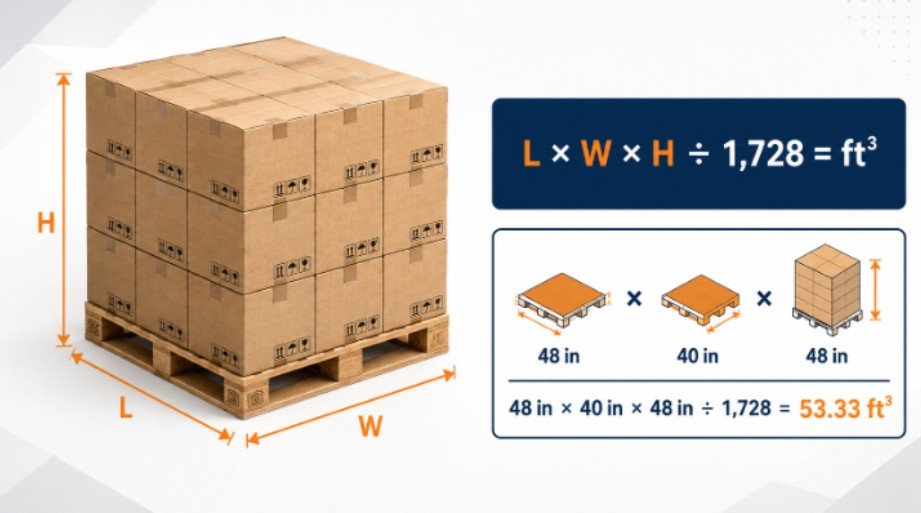
When your measurements are in inches, use this formula:
Cubic feet = Length × Width × Height ÷ 1,728
The number 1,728 represents the cubic inches contained in one cubic foot. For a standard pallet measuring 48 inches long, 40 inches wide, and 48 inches high, the calculation is:
48 × 40 × 48 = 92,160 cubic inches
92,160 ÷ 1,728 = 53.33 cubic feet
If your measurements are already in feet, simply multiply length by width by height. A standard pallet footprint is 4 feet by approximately 3.33 feet. If the shipment is 4 feet high, the calculation becomes:
4 × 3.33 × 4 = approximately 53.3 cubic feet
Always use the shipment’s maximum outside dimensions rather than relying on its advertised or planned measurements.
Does Pallet Height Include the Wooden Pallet?
For freight calculations, the height should normally include the wooden pallet and everything placed on it. Measure from the floor to the highest point of the completed shipment.
This distinction prevents a common mistake. Suppose the cartons rise 48 inches above a 6-inch pallet. The total shipment height is 54 inches, not 48 inches. Its volume would be:
48 × 40 × 54 ÷ 1,728 = 60 cubic feet
If you incorrectly enter 48 inches, you report only 53.33 cubic feet. That difference can affect a freight quote, warehouse estimate, or carrier inspection.
The same principle applies to protective cones, braces, corner boards, irregular products, and other materials extending above the load.
How Should You Measure a Loaded Shipping Pallet?

Measure the finished shipment after stacking, wrapping, and securing it. Begin with the longest point from front to back, followed by the widest point from side to side. Measure the height from the floor to the shipment’s highest point.
Include stretch wrap, straps, crates, braces, corner protectors, and merchandise that extends beyond the pallet.
This same rule measuring the completed, packed shape rather than the container alone is also how I approach smaller shipments in my plastic container size guide, where lids, handles, and stacked contents change the real footprint.
If a carton overhangs the pallet, use the carton’s outside edge instead of the original 48-by-40-inch footprint.
Many freight systems require dimensions to be rounded up to the next whole inch. A shipment measuring 48 by 40 by 50.2 inches may therefore be entered as 48 by 40 by 51 inches. Never round down simply to reduce the reported volume, as the carrier may remeasure the freight and adjust the bill.
Overhang also increases the risk of tears, punctures, compression damage, and inefficient trailer loading. Whenever possible, stack cartons edge-to-edge without allowing them to extend beyond the deck boards.
Do Other Pallet Sizes Have Different Volumes?
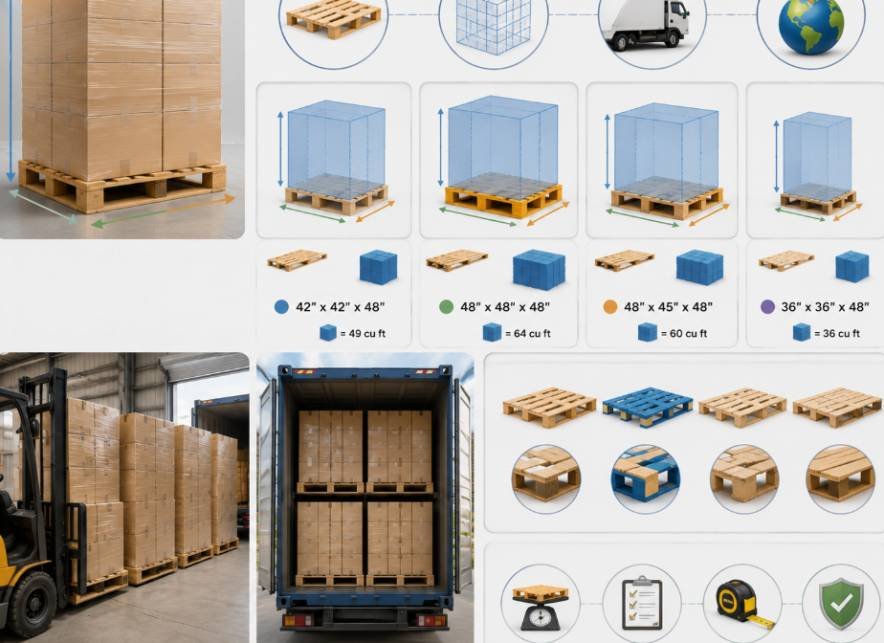
Although 48 by 40 inches is the most familiar American pallet footprint, several industries use different sizes. Telecommunications and paint shipments may use 42-by-42-inch pallets, while drum shipments often use 48-by-48-inch platforms. Automotive operations may use 48-by-45-inch pallets, and some beverage shipments use 36-by-36-inch units.
At a total height of 48 inches, a 42-by-42-inch pallet occupies 49 cubic feet. A 48-by-48-inch pallet occupies 64 cubic feet, a 48-by-45-inch pallet uses 60 cubic feet, and a 36-by-36-inch pallet occupies 36 cubic feet. An online cubic feet shipping calculator can quickly verify these figures and calculate the volume of pallets with different dimensions.
Never assume that every pallet follows the GMA standard. Measure the actual footprint before booking transportation or calculating warehouse space.
Why Does Pallet Cubic Footage Matter?
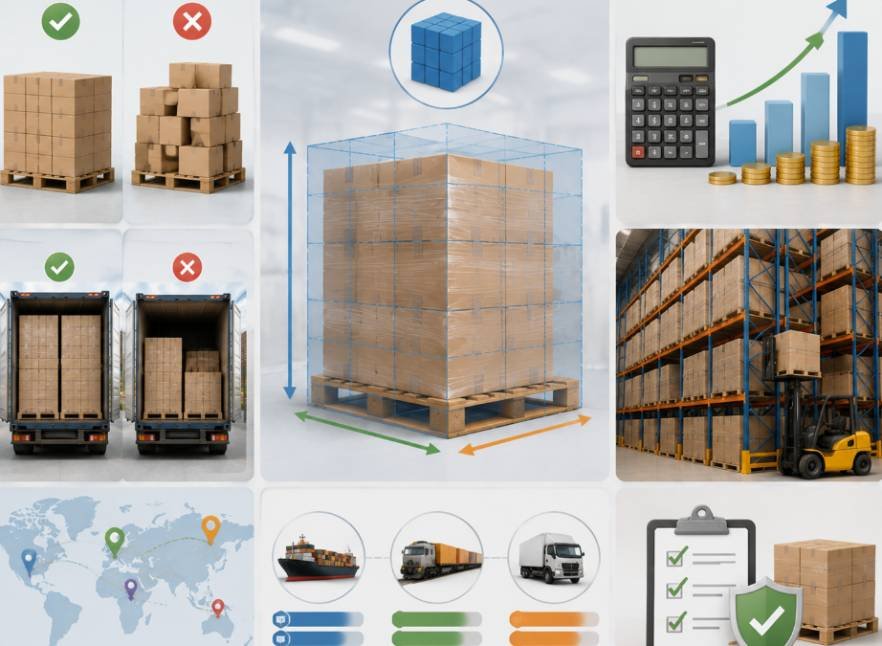
Cubic footage shows how much physical space freight occupies inside a warehouse, trailer, or distribution center. It helps businesses estimate storage requirements, plan rack capacity, compare fulfillment options, and decide how efficiently products fit on a pallet.
The same volume-first approach applies to smaller-scale storage planning I use it in my storage locker size guide when figuring out how many boxes or pallets a rented unit can realistically hold.
Carriers may also use volume alongside weight to calculate freight density:
Density = Shipment weight ÷ Cubic feet
For example, a 500-pound pallet occupying 66.67 cubic feet has a density of 7.5 pounds per cubic foot. Density can influence freight classification and pricing, particularly for large, lightweight shipments that consume considerable trailer space.
Cubic footage is not the same as load capacity. Volume measures space, while pallet capacity describes the weight the platform can support. Capacity varies according to pallet material, construction, condition, weight distribution, and whether the load is resting on a floor, moving on forks, or stored in a rack.
Frequently Asked Questions
1. How Many Cubic Feet Is a Pallet?
An empty 48-by-40-inch pallet generally occupies approximately 5 to 7 cubic feet, depending on its height. A loaded pallet measuring 48 by 40 by 48 inches occupies 53.33 cubic feet. Use the complete outside dimensions for an accurate result.
2. How many cubic feet is a 48-by-40-by-60-inch pallet?
Multiply 48 by 40 by 60 and divide the result by 1,728. The loaded pallet occupies approximately 66.67 cubic feet.
3. Do I include pallet overhang in the calculation?
Yes. Measure the longest, widest, and highest points of the completed shipment. Include cartons, wrapping, braces, cones, and any other material extending beyond the pallet.
4. How do I calculate the volume of several pallets?
Calculate each pallet separately and add the results. If all pallets have identical dimensions, calculate one pallet’s cubic footage and multiply it by the total number of pallets.
Final Takeaway
I would never assign one universal cubic-foot figure to every pallet. The most reliable approach is to measure the completed load and apply the length-times-width-times-height formula. For quick planning, remember that a standard 48-by-40-inch pallet at 48 inches tall occupies 53.33 cubic feet.
Accurate measurements help prevent revised freight bills, warehouse miscalculations, loading problems, and avoidable product damage. Including the pallet, packaging, overhang, and highest point gives you a figure that reflects the space your shipment genuinely occupies.

Ryan Mitchell
Ryan Mitchell holds a degree in Civil Engineering and spent over a decade working in construction project estimation, where accurate volume and material calculations were part of his daily work — from concrete pours to landscaping material orders. He founded this site to bring that same precision to everyday calculations, helping DIYers, contractors, and students get fast, accurate cubic footage results without the guesswork. Ryan reviews every calculator and formula on this site for accuracy and writes guides based on real-world measurement scenarios he's encountered on job sites.