

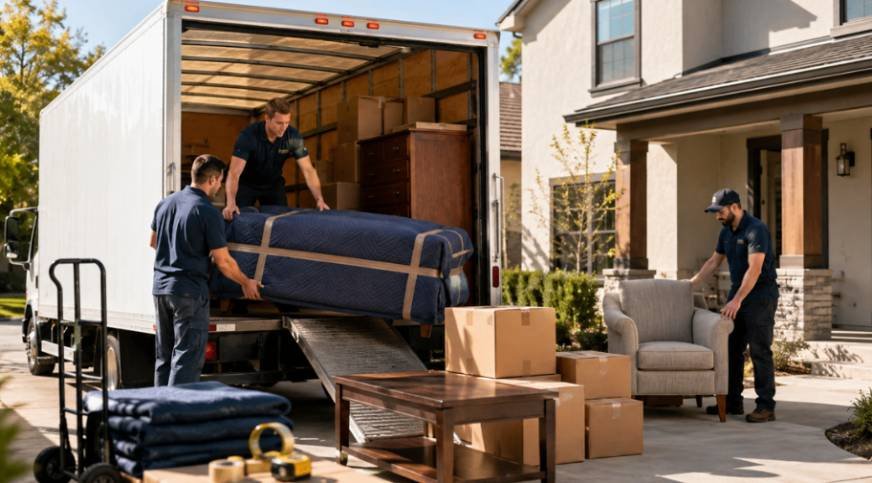
I once estimated a furniture load from room count alone and nearly booked too little space. If you are asking how many cubic feet is a furniture moving package, the honest answer is that no universal package size exists. A small set may occupy 80 cubic feet, while a furnished room can require about 100–150 cubic feet of truck space.
The reliable method is simple: measure every item, include cartons, then allow for padding and unusable gaps.
The Short Answer
A basic furniture package containing a sofa, chair, coffee table, dresser, and several boxes often needs roughly 100–180 cubic feet of loaded space. A full room usually needs around 100–150 cubic feet, while several furnished rooms may require 400 cubic feet or more.
These are planning ranges, not guarantees. Extra Space Storage also uses a rule of thumb of 100–150 cubic feet per fully furnished room. Your actual total depends on dimensions, disassembly, box count, and packing skill.
Furniture Moving Package Cubic Feet Estimates
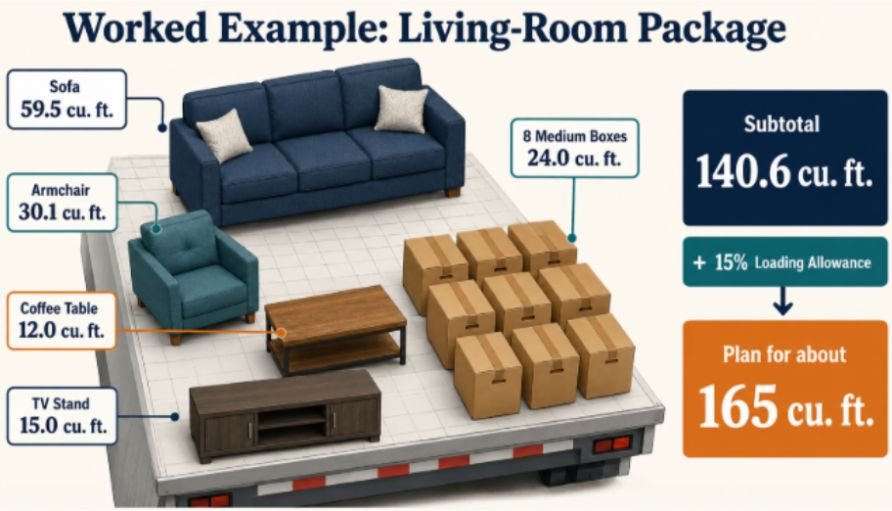
When people ask how many cubic feet is a furniture moving package, they may mean one furniture set or an entire household load. The distinction matters.
| Package or item | Practical planning range |
| Sofa | 35–60 cu. ft. |
| Armchair or recliner | 15–30 cu. ft. |
| Queen mattress and frame | 35–55 cu. ft. |
| Dresser | 20–40 cu. ft. |
| Dining table with chairs | 40–80 cu. ft. |
| Basic living-room package | 100–180 cu. ft. |
| One furnished room | 100–150 cu. ft. |
Furniture estimates vary because movers cannot always use every inch around curved arms, legs, and fragile surfaces. By comparison, cartons stack efficiently. The Home Depot lists common moving boxes at about 1.5 cubic feet for small, 3 cubic feet for medium, and 4.5 cubic feet for large.
How to Calculate Furniture Moving Volume
Measure Each Item
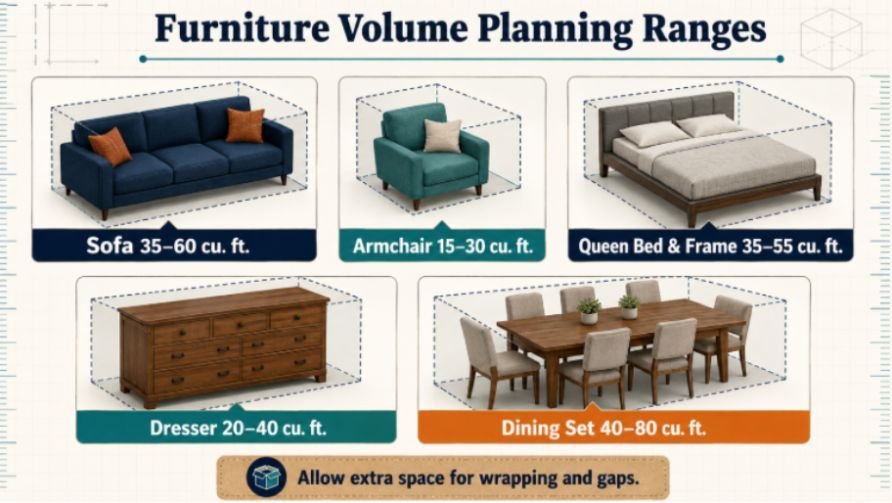
Measure the greatest length, width, and height of each wrapped item. Convert inches to feet by dividing each measurement by 12. Then use:
Length × width × height = cubic feet
For measurements in inches, use:
Length × width × height ÷ 1,728 = cubic feet
A sofa measuring 84 × 36 × 34 inches has a geometric volume of 59.5 cubic feet. That figure describes its outer rectangular envelope. It does not mean the sofa contains that much solid material.
Use the same process for unusually bulky objects. The measuring logic used for a refrigerator box or a generator also applies to wrapped furniture.
The same measuring logic used for large moving boxes also applies to wrapped furniture. For a more detailed example of calculating box capacity, see large moving box volume calculations before estimating your total moving load.
Add Boxes and a Loading Allowance
Add every item’s cubic feet, then include cartons. I add 15% for moving blankets, tie-down access, irregular shapes, and imperfect stacking. Use 20% for fragile antiques or rigid, fully assembled pieces. Skilled loading and disassembled furniture may need only 10%.
This allowance is an original planning method, not a carrier rule. It answers how many cubic feet is a furniture moving package more realistically than raw multiplication alone.
Worked Example for a Living-Room Package
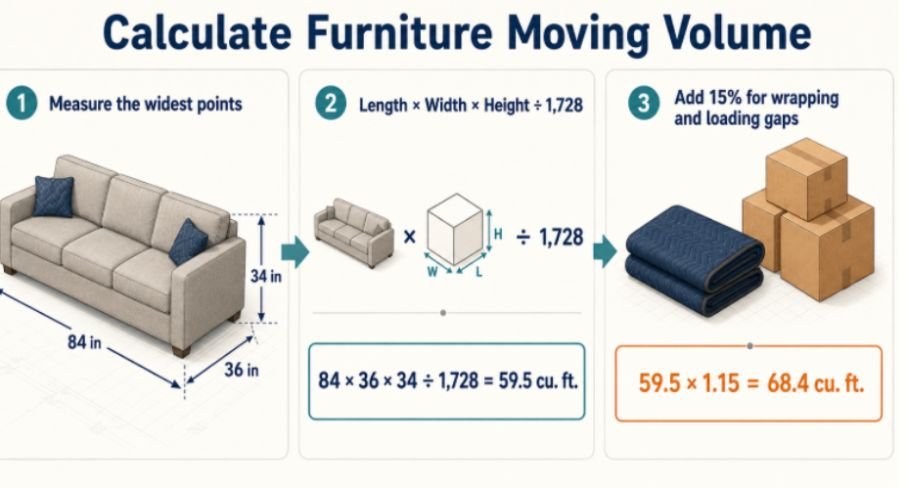
Suppose a move includes one sofa, an armchair, a coffee table, a TV stand, and eight medium boxes.
| Component | Calculated volume |
| Sofa: 84 × 36 × 34 in. | 59.5 cu. ft. |
| Armchair: 38 × 36 × 38 in. | 30.1 cu. ft. |
| Coffee table: 48 × 24 × 18 in. | 12.0 cu. ft. |
| TV stand: 60 × 18 × 24 in. | 15.0 cu. ft. |
| Eight medium boxes at 3 cu. ft. | 24.0 cu. ft. |
| Geometric subtotal | 140.6 cu. ft. |
| Plus 15% loading allowance | 161.7 cu. ft. |
I would plan for about 165 cubic feet, not 141. Rounding up gives the loader working room and lowers the risk of leaving an item behind.
Match the Load to a Truck or Container
After calculating how many cubic feet is a furniture moving package, compare the result with usable cargo volume and the opening dimensions. A sofa may fit by volume yet fail to pass through a narrow door.
| Moving option | Published cargo volume | Useful reference point |
| U-Haul cargo van | 246 cu. ft. | Small furniture package |
| U-Haul 10-foot truck | 402 cu. ft. | Studio or one-bedroom load |
| U-Haul 15-foot truck | 764 cu. ft. | Larger apartment load |
| U-Pack ReloCube | 308 cu. ft. | About one room of belongings |
U-Haul publishes truck volumes and interior dimensions, while U-Pack states that one ReloCube provides 308 cubic feet. Treat advertised volume as a ceiling. Wheel wells, tie rails, loading order, and weight limits can reduce practical capacity.
For electronics that need separate protection during a move, reviewing electronics box capacity can help you estimate the space required for televisions, monitors, speakers, and other equipment before loading the truck.
What Changes the Final Volume?
Disassembly has the greatest impact. Removing table legs and bed frames creates flatter pieces and fewer voids. Nesting chairs may also help, but never force fragile furniture together.
Protective materials add volume. Blankets add little thickness, yet wrapped glass, artwork, and antiques need separation. Sofas with deep arms also waste more rectangular space than stackable cartons.
Inventory changes matter too. Closets, garages, patios, and attics are easy to overlook. Count them before answering how many cubic feet is a furniture moving package for a whole-home move.
Finally, check weight as well as volume. Books, tools, and dense appliances may reach a vehicle’s payload limit before filling its cargo area.
Frequently Asked Questions
1. How many cubic feet is a furniture moving package for one room?
Allow about 100–150 cubic feet for an average furnished room, then adjust for bulky pieces and boxes.
2. How much space does a sofa need in a moving truck?
Many sofas occupy roughly 35–60 cubic feet by outer dimensions, but wrapping and shape affect loaded space.
3. Should I add extra cubic feet for packing materials?
Yes. Add 10–20%, with 15% serving as a sensible starting allowance for most household furniture.
4. Can room count replace an inventory calculation?
Room count gives a quick estimate, but measured dimensions produce a safer truck or container choice.
Pack Smart, Not by Guesswork
When I need to determine how many cubic feet is a furniture moving package, I measure first and use room count only as a cross-check. List every item, calculate its rectangular volume, add box capacity, and apply a realistic loading allowance. Then confirm door dimensions and weight limits before booking. Ten careful minutes with a tape measure can prevent an expensive second trip.

Ryan Mitchell
Ryan Mitchell holds a degree in Civil Engineering and spent over a decade working in construction project estimation, where accurate volume and material calculations were part of his daily work — from concrete pours to landscaping material orders. He founded this site to bring that same precision to everyday calculations, helping DIYers, contractors, and students get fast, accurate cubic footage results without the guesswork. Ryan reviews every calculator and formula on this site for accuracy and writes guides based on real-world measurement scenarios he's encountered on job sites.


