

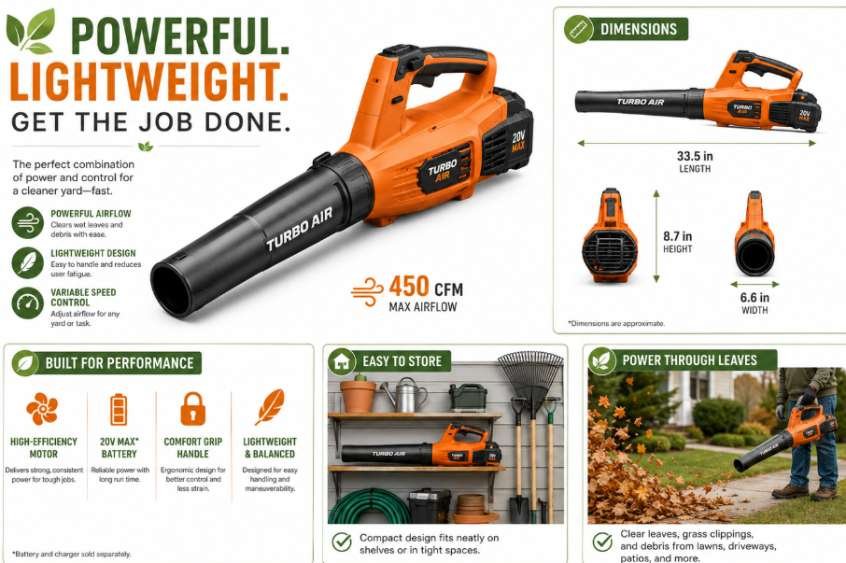
I used to assume that every leaf blower required roughly the same amount of storage space. However, a compact handheld model and a professional backpack blower differ considerably in their dimensions. If you are wondering How Many Cubic Feet Is a Leaf Blower?, the typical answer is approximately 0.7 to 2.5 cubic feet for a handheld unit and 2.5 to 5 cubic feet for a backpack model.
These figures represent the rectangular space surrounding the equipment, not the amount of solid material inside it. The exact measurement depends on the blower’s body, tube, battery, engine, collection bag and whether its detachable parts are installed.
Average Leaf Blower Volume by Type
Leaf blowers come in several configurations. Each design has different storage, packaging and transportation requirements. Measuring the actual product is always more accurate than relying on a general estimate, but standard ranges provide a useful starting point.
Handheld Leaf Blowers
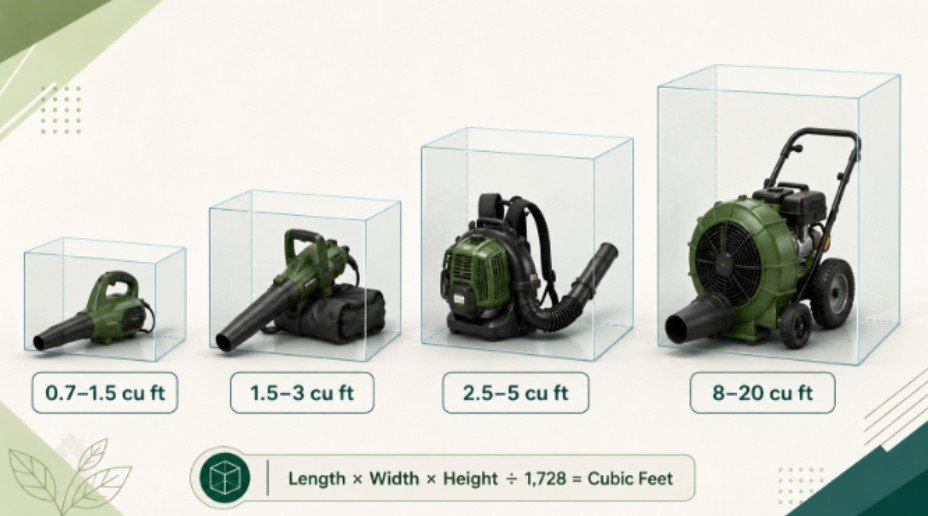
A compact handheld blower generally occupies between 0.7 and 1.5 cubic feet when packaged. Lightweight electric and battery-operated models usually sit at the lower end of that range.
A larger handheld machine with a wide motor housing, high-capacity battery or long nozzle may occupy between 1.5 and 2.5 cubic feet. Removing the blower tube can significantly reduce its storage footprint.
Backpack Leaf Blowers
Backpack models have larger motors, fuel tanks, frames and harness systems. A packaged backpack blower commonly occupies around 2.5 to 5 cubic feet.
An assembled model may require additional horizontal space because of its flexible hose and rigid blower tube. Hanging the tube vertically or disconnecting it from the main housing can make the equipment easier to store.
Leaf Blower Vacuums
Blower-vacuum combinations are generally bulkier than simple handheld machines. The motor housing may resemble a standard blower, but the collection bag, vacuum tube and additional attachments increase the total storage requirement.
A boxed blower-vacuum commonly occupies around 1.5 to 3 cubic feet. Its assembled footprint can be larger when the collection bag is expanded, although an empty fabric bag can normally be folded.
Wheeled Leaf Blowers
Wheeled units are designed for large gardens, grounds and commercial work. Their engines, wheels, frames and wide discharge openings make them considerably larger than handheld equipment.
A wheeled blower can require approximately 8 to 20 cubic feet of storage space. The actual figure depends on the engine size, handle position and whether the handle folds for storage.
Similar outdoor equipment can also require careful space planning, especially when considering the volume of a raised garden bed for storage, landscaping or material calculations.
How to Calculate the Cubic Feet of a Leaf Blower
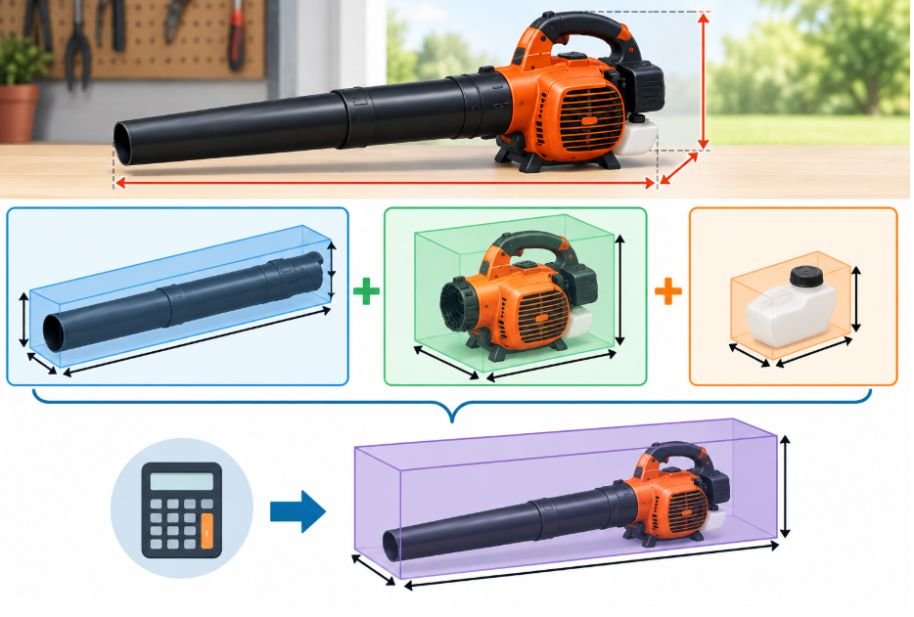
To calculate volume, measure the machine’s maximum length, width and height. Include any parts that will remain attached while it is stored. If the measurements are in inches, use this formula:
Cubic feet = length × width × height ÷ 1,728
The number 1,728 is used because one cubic foot contains 1,728 cubic inches. Keep all three measurements in the same unit before performing the calculation.
For equipment with an irregular shape, imagine placing it inside the smallest rectangular box that can hold it. Measure that imaginary box. This method calculates the blower’s storage footprint rather than its precise physical displacement.
Leaf Blower Volume Calculation Example
Suppose a packaged handheld blower measures 18 inches long, 8 inches wide and 11 inches high. Multiply the dimensions:
18 × 8 × 11 = 1,584 cubic inches
Next, divide the result by 1,728:
1,584 ÷ 1,728 = 0.92 cubic feet
The package therefore occupies approximately 0.92 cubic feet.
Now consider a larger blower-vacuum package measuring 22 inches long, 11 inches wide and 15 inches high:
22 × 11 × 15 = 3,630 cubic inches
3,630 ÷ 1,728 = 2.10 cubic feet
This larger package requires slightly more than two cubic feet of space.
Packaged Size Versus Assembled Size
Product dimensions can be misleading unless they clearly specify whether they refer to the package or the assembled machine. Manufacturers often detach the nozzle, battery, hose or collection bag to reduce the shipping carton’s size.
A blower with a package volume below one cubic foot could occupy more than 1.5 cubic feet after assembly. Its long tube creates the biggest difference, even though the tube itself contains mostly empty space.
Use package dimensions when estimating shipping cartons, warehouse capacity or delivery costs. Use assembled dimensions when planning a garage shelf, garden shed, wall rack or vehicle cargo area.
Physical Volume Is Different From CFM
The phrase “cubic feet” is also associated with airflow. Leaf blower specifications commonly display CFM, which means cubic feet per minute. It measures how much air passes through the blower’s nozzle during one minute.
CFM does not reveal the physical size of the machine. A model rated at 500 CFM moves up to 500 cubic feet of air per minute under the manufacturer’s specified testing conditions. It does not occupy 500 cubic feet of storage space.
MPH measures airspeed rather than air volume. Higher CFM helps move a broad pile of light material, while higher MPH can help loosen wet leaves or stubborn debris. Effective performance normally depends on a suitable balance between both measurements.
What Is a Suitable CFM Rating?
For patios, walkways and small areas with dry leaves, approximately 200 to 400 CFM may be sufficient. General garden cleanup often benefits from a rating between 400 and 700 CFM.
Large areas, dense piles and wet debris may require 700 CFM or more. Buyers should also consider runtime, weight, noise, airspeed and blowing force. Selecting the highest number available can lead to unnecessary cost, weight and energy use.
Factors That Change a Leaf Blower’s Storage Volume
The power source has a noticeable effect on equipment size. Corded electric blowers can be compact because they do not carry a fuel tank or large battery. Battery models require room for a removable power pack, while petrol-powered equipment needs an engine and fuel system.
Nozzle design also matters. A detachable multi-section tube is easier to store than a fixed tube. Backpack frames, padded straps, vacuum bags and extra attachments further increase the space needed.
For practical storage, allow some clearance around the calculated volume. Extra room prevents damage, makes the blower easier to remove and provides space for chargers, batteries, extension cords, fuel containers or safety equipment.
The same approach can be applied when planning storage for the size of a lawn mower, where its overall dimensions and handle position can significantly affect the space required in a shed, garage or vehicle.
Frequently Asked Questions
1. How Many Cubic Feet Is a Leaf Blower?
A handheld model usually occupies around 0.7 to 2.5 cubic feet, while a backpack blower commonly needs approximately 2.5 to 5 cubic feet. Wheeled models may require 8 to 20 cubic feet.
2. Should I measure the blower with its tube attached?
Measure it with the tube attached when planning assembled storage. Remove the tube before measuring if that is how the equipment will normally be stored or transported.
3. Is CFM the same as the blower’s physical volume?
No. Physical volume describes the space occupied by the equipment. CFM describes the volume of air that the blower moves in one minute.
4. How much extra storage space should I allow?
Allow approximately 10% to 20% beyond the calculated bounding-box volume. More clearance may be necessary if batteries, chargers, attachments or maintenance supplies will be stored beside the blower.
Final Thoughts
I find that the most reliable approach is to measure the specific blower rather than depend entirely on an average. Handheld units are usually compact, backpack models require more room and wheeled machines need a dedicated storage area. Separating physical cubic feet from airflow CFM also prevents a common and potentially costly misunderstanding.
Measure the maximum length, width and height, divide cubic inches by 1,728 and account for detachable components. That simple process provides a practical estimate for storage, packaging, shipping or transportation.

Ryan Mitchell
Ryan Mitchell holds a degree in Civil Engineering and spent over a decade working in construction project estimation, where accurate volume and material calculations were part of his daily work — from concrete pours to landscaping material orders. He founded this site to bring that same precision to everyday calculations, helping DIYers, contractors, and students get fast, accurate cubic footage results without the guesswork. Ryan reviews every calculator and formula on this site for accuracy and writes guides based on real-world measurement scenarios he's encountered on job sites.


