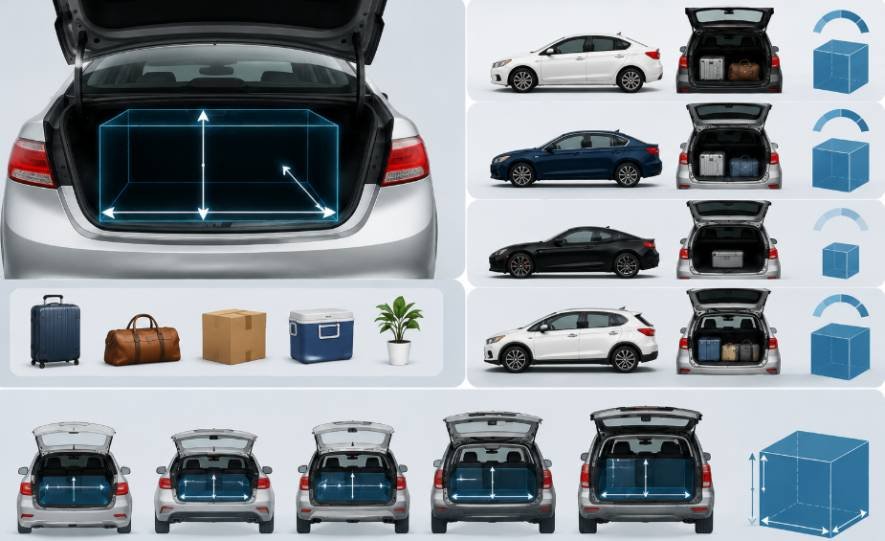
A trunk can look surprisingly large when I first see a vehicle parked at a dealership, but the real test begins when I start loading it. A couple of suitcases, grocery bags, sports equipment, or everyday essentials can quickly reveal whether the available space is actually practical.
That is why How Many Cubic Feet Is a Car Trunk? is an important question for anyone comparing vehicles. Cargo capacity affects everything from weekend trips and family errands to daily convenience. In the US, most sedan trunks provide around 10 to 18 cubic feet of space, while hatchbacks, SUVs, and minivans can offer much larger and more flexible storage areas.
In this guide, I’ll explain average trunk sizes by vehicle type, how automakers calculate cargo volume, what different cubic-foot measurements mean in real situations, and why usable space matters just as much as the number listed in a vehicle’s specifications.
Average Car Trunk Size by Vehicle Type
Car manufacturers measure cargo capacity differently depending on the vehicle design. A traditional sedan has a separate enclosed trunk, while SUVs and hatchbacks usually have an open cargo area that uses vertical space.
The modern car trunk storage compartment evolved from the detachable travel trunks once strapped to the rear of early automobiles.
| Vehicle Type | Average Cargo Volume | What It Can Typically Hold |
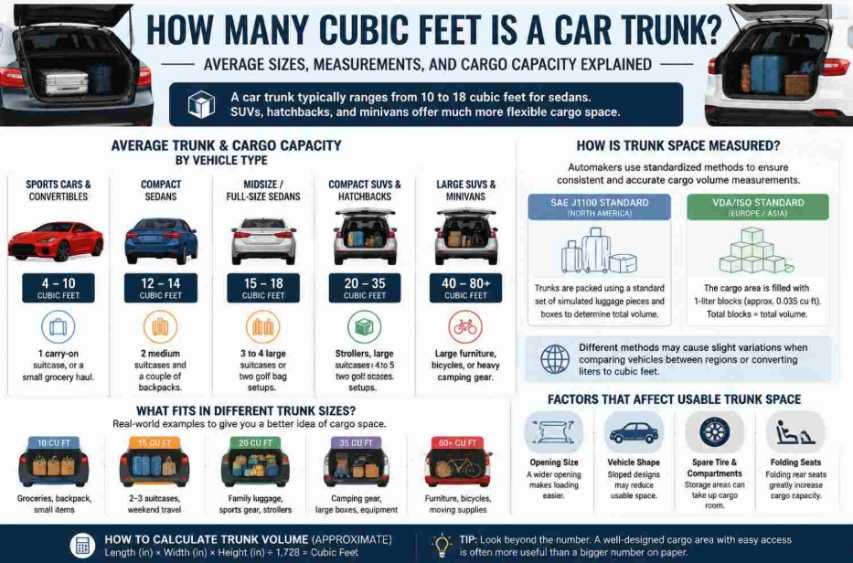
| Sports cars and convertibles | 4–10 cubic feet | Small bags, groceries, one carry-on suitcase |
| Compact sedans | 12–14 cubic feet | Two medium suitcases, backpacks, daily items |
| Midsize and full-size sedans | 15–18 cubic feet | Several suitcases, golf bags, family travel items |
| Hatchbacks and compact SUVs | 20–35 cubic feet | Strollers, boxes, camping supplies |
| Large SUVs and minivans | 40–80+ cubic feet | Bicycles, furniture pieces, large equipment |
For most American drivers, a compact or midsize sedan provides enough trunk space for normal commuting, shopping, and occasional travel. However, families, outdoor enthusiasts, and frequent travelers often prefer SUVs because they provide additional height and flexible seating configurations.
How Is Car Trunk Space Measured?
Many people assume manufacturers simply measure the length, width, and height of a trunk and multiply those numbers together. While that basic calculation works for simple rectangular spaces, real vehicle cargo areas are much more complicated.
A basic cubic feet calculation is:
Length × Width × Height ÷ 1,728 = cubic feet
The 1,728 figure used here is the standard cubic feet conversion factor, as maintained by the National Institute of Standards and Technology.
This formula works when measurements are taken in inches. However, car trunks include irregular shapes such as wheel wells, curved panels, sloping rear windows, and storage compartments. Because of these challenges, automakers rely on standardized testing procedures instead of only using a measuring tape.
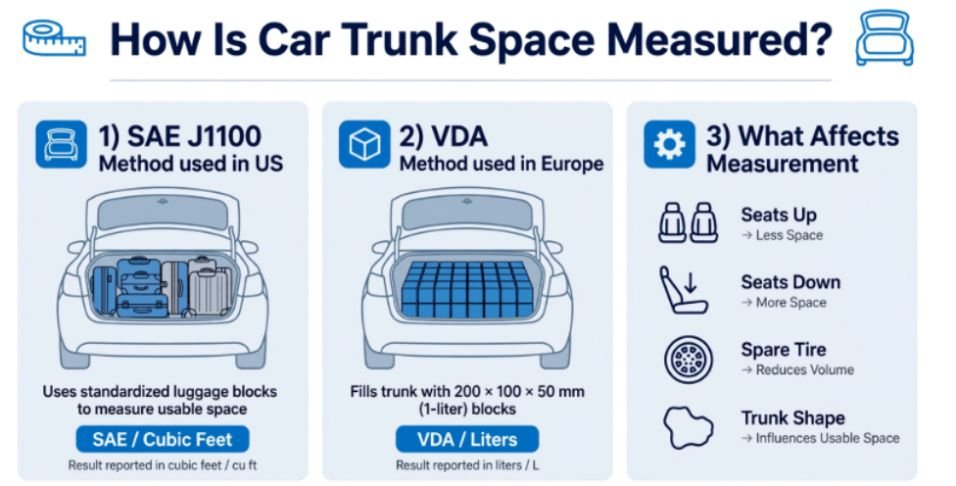
In North America, many manufacturers use the SAE J1100 standard for vehicle dimensions and cargo measurements. For enclosed trunks found in sedans and coupes, the measurement process uses standardized simulated luggage pieces to estimate usable cargo volume.
Open cargo areas in SUVs, hatchbacks, and minivans are measured differently because they can extend into the passenger compartment.
Why Do Cargo Measurements Differ Between Cars?
When I compare two vehicles with similar cargo numbers, I do not assume they will feel identical. The measurement method and vehicle design can create major differences.
For example, a sedan may have 16 cubic feet of trunk volume, but a hatchback with the same number may feel more spacious because it offers greater height and a larger opening.
International vehicles may also use different measurement systems. The VDA method commonly measures luggage capacity by filling the cargo area with standardized one-liter blocks. This approach focuses on realistic usable space rather than simply measuring empty air.
Because SAE and VDA methods are not identical, converting measurements between liters and cubic feet may not always provide a perfect comparison between vehicles.
Independent testers take a different approach how Consumer Reports measures cargo room relies on fitting an actual expanding box into the space rather than relying on manufacturer-reported figures alone.
How Much Can Fit Inside a 15 Cubic Foot Trunk?
A trunk’s cubic footage gives me a general idea of capacity, but what actually fits depends on the shape and layout.
A 15 cubic foot sedan trunk can usually handle:
- Multiple grocery bags
- Two or three medium suitcases
- Backpacks and personal items
- Small sports equipment
- Emergency roadside supplies
However, if I regularly carry family equipment, camping supplies, bicycles, or oversized purchases, I would consider an SUV or hatchback because the additional height and foldable seating create more usable cargo space.
Car Trunk Space vs SUV Cargo Volume: Which Offers More?
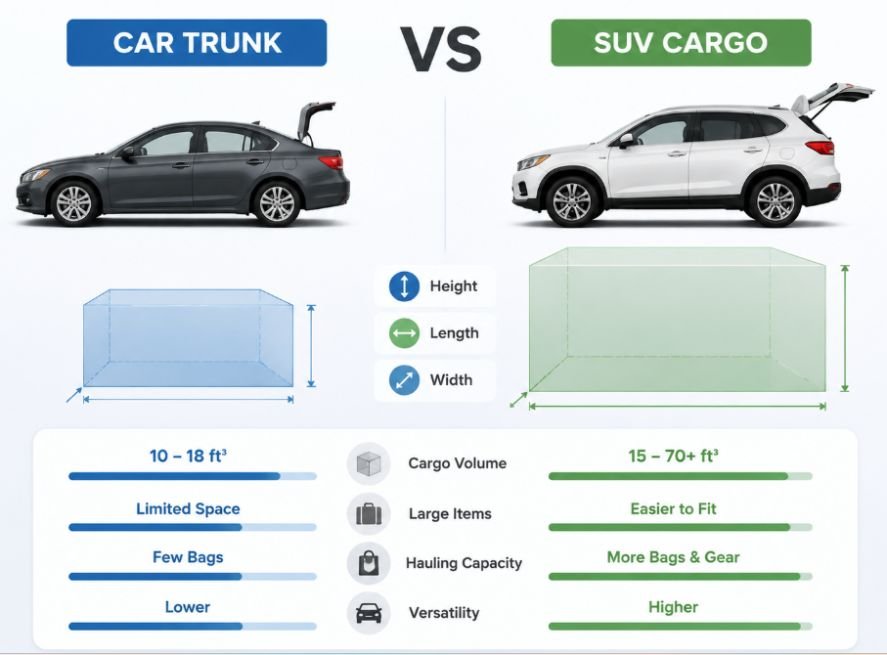
Sedans and SUVs serve different storage needs.
A sedan trunk provides:
- A secure enclosed storage area
- Protection from weather
- Hidden cargo storage
- Good efficiency for everyday driving
An SUV cargo area provides:
- More vertical storage
- Larger loading openings
- Foldable rear seats
- Better flexibility for bulky items
What Factors Affect Usable Trunk Space?
The listed cargo volume is important, but several design features determine how useful the space actually is.
A wide trunk opening makes loading large items easier. A deep but narrow trunk may have a similar cubic-foot rating but be harder to use.
Vehicle design also matters. Sloped rear designs, hybrid battery placement, spare tire compartments, and suspension components can reduce available storage.
Foldable rear seats can dramatically increase cargo capacity. This is why hatchbacks and SUVs often feel much larger than their official numbers suggest.
How Many Cubic Feet Do I Need in a Car Trunk?
The right amount of cargo space depends on how I use my vehicle.
For daily commuting and occasional shopping, 10 to 14 cubic feet may be enough.
For families, frequent travelers, or people carrying sports equipment, 15 to 20 cubic feet provides more flexibility.
For camping, moving supplies, large purchases, or outdoor hobbies, an SUV, a family hauling minivan with fold-flat seating, or crossover is usually the better choice.
The most useful measurement is not always the biggest number. A well-designed cargo area with easy access can outperform a larger but awkward space.
Frequently Asked Questions
1. How many cubic feet is a car trunk on average?
Most sedan trunks in the United States range from about 10 to 18 cubic feet. Larger vehicles such as SUVs and minivans can provide significantly more cargo capacity.
2. Is 10 cubic feet enough trunk space?
A 10 cubic foot trunk can handle basic daily needs such as groceries, backpacks, and small luggage. It may feel limited for families or frequent travelers.
3. How do manufacturers measure trunk volume?
Manufacturers use standardized methods such as SAE J1100 and other industry measurement systems. These methods account for irregular cargo areas and help estimate usable storage capacity.
4. Do SUVs have more cargo space than sedans?
Most SUVs provide more flexible cargo space because they offer greater height, larger openings, and foldable rear seats.
Final Thoughts
When I evaluate a vehicle, I look beyond the number on the specification sheet. Cargo capacity affects everyday convenience, from carrying groceries to packing for a cross-country trip.
A typical sedan offers around 10 to 18 cubic feet of trunk space, but the best choice depends on my lifestyle and storage needs.
By understanding measurement methods, vehicle categories, and real-world usability, I can choose a vehicle that provides the right balance of comfort, performance, and practicality. I also use a vehicle cargo volume tool to compare storage capacity between different vehicle types.

Ryan Mitchell
Ryan Mitchell holds a degree in Civil Engineering and spent over a decade working in construction project estimation, where accurate volume and material calculations were part of his daily work — from concrete pours to landscaping material orders. He founded this site to bring that same precision to everyday calculations, helping DIYers, contractors, and students get fast, accurate cubic footage results without the guesswork. Ryan reviews every calculator and formula on this site for accuracy and writes guides based on real-world measurement scenarios he's encountered on job sites.