

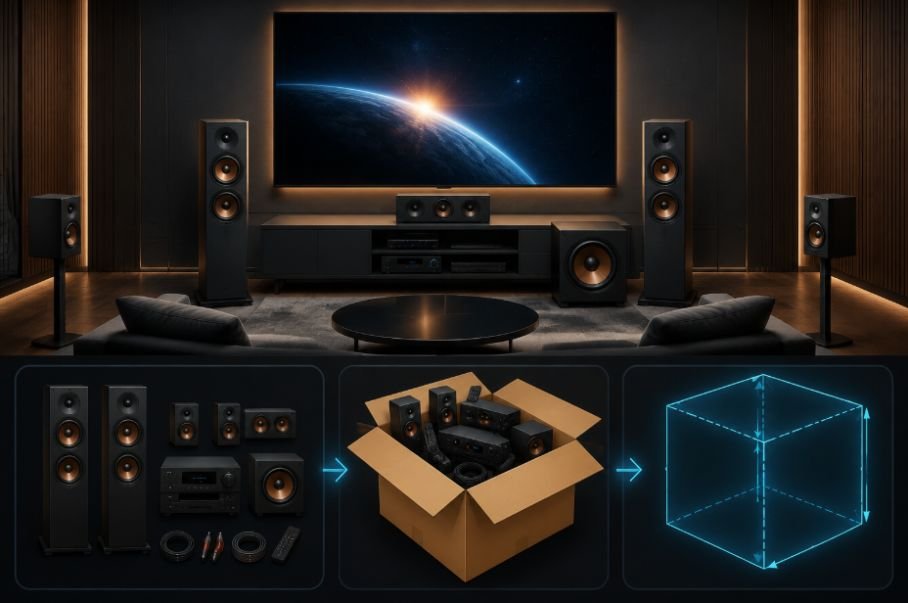
I used to think asking about the cubic feet of a home theater system meant measuring the equipment itself and adding everything together. Once I looked more closely at how home theaters are actually planned, I realized the more useful number is usually the volume of the room. The speakers, receiver, subwoofer, display, and other components have their own physical dimensions, but the room determines how that equipment behaves once everything is playing together.
I also found that room volume can make a simple setup question surprisingly complicated. Two rooms can have similar floor areas but different ceiling heights, giving them different cubic footage and different acoustic characteristics. That is why calculating the room’s volume is a better starting point than trying to assign one fixed cubic-foot measurement to an entire home theater system.
A Home Theater System Does Not Have One Fixed Cubic-Foot Size
There is no standard answer such as “a home theater system is 1,500 cubic feet.” The equipment itself does not have a single cubic-foot classification.
Instead, cubic feet are mainly useful when describing the space where the system operates. Room volume helps determine how much air the speakers need to energize, how low frequencies behave, how much acoustic treatment may be useful, and what type of system makes sense for the space.
A compact 5.1 setup in a bedroom and a large Dolby Atmos installation in a dedicated basement theater are both home theater systems, but their equipment and room requirements can be dramatically different.
Room size is also one factor used when matching a system to a listening environment. Some established certification categories divide home theater applications by room volume, while other planning approaches consider floor area, seating distance, speaker placement, and ceiling height together.
How to Calculate the Cubic Feet of Your Room
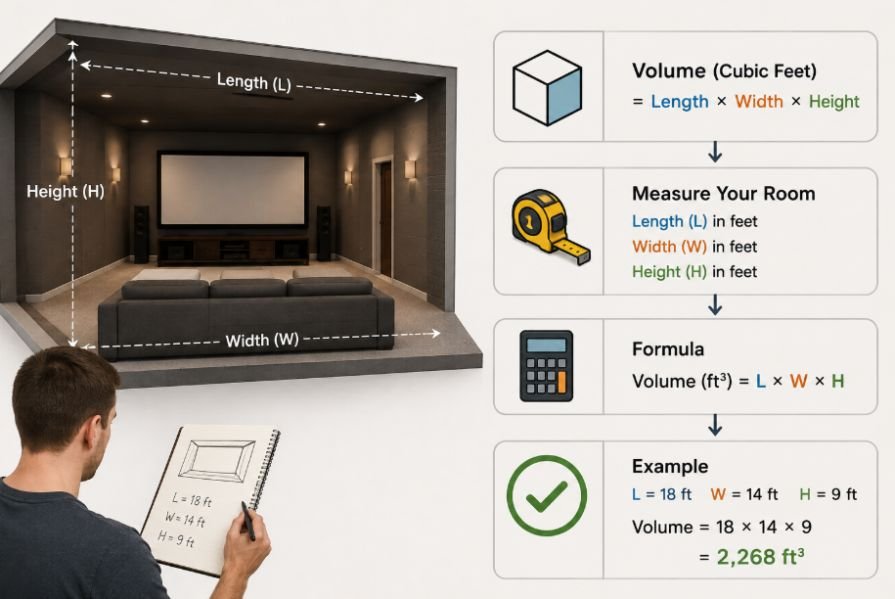
Calculating room volume is straightforward. Measure the room’s length, width, and ceiling height in feet, then multiply those three numbers.
Length × Width × Height = Room Volume
For example, a room measuring 12 feet long, 16 feet wide, and 9 feet high has:
12 × 16 × 9 = 1,728 cubic feet
A smaller 10 × 12 × 8-foot room has 960 cubic feet. A 15 × 20 × 9-foot room has 2,700 cubic feet.
This calculation gives you the total enclosed volume, not the amount of space available for equipment. Furniture, wall treatments, built-in cabinetry, and other features still affect how the room is used.
If the room has an unusual shape, divide it into simpler rectangular sections, calculate each section separately, and add the results.
What Does Equipment Volume Look Like?
Individual home theater components can also be described by their physical volume, but this is a different measurement.
For a rectangular speaker, receiver, or console, multiply its width, height, and depth in inches. Then divide the result by 1,728 to convert cubic inches into cubic feet.
For example, equipment measuring 20 inches wide, 10 inches high, and 15 inches deep occupies approximately 1.74 cubic feet based on its external dimensions.
That calculation is useful when planning shelves, cabinets, storage, or shipping space. It does not tell you how much room the component needs to operate properly.
Speakers are a good example. If you are comparing speaker enclosure volume, the enclosure’s external volume is only part of the story. Internal cabinet volume, driver design, porting, and acoustic tuning can all affect performance. A larger cabinet does not automatically mean a better speaker.
The Subwoofer Can Change the Space You Need
A subwoofer deserves special consideration because it can have a larger physical footprint than many other audio components.
Its placement also matters. You may have enough room to physically fit a subwoofer beside a cabinet, but that does not necessarily make that position acoustically ideal. Low-frequency sound interacts strongly with room boundaries, creating areas where bass can become unusually strong or weak.
This is why room volume should not be treated as a simple equipment-sizing formula. A 1,700-cubic-foot room is not automatically going to sound the same as another 1,700-cubic-foot room.
The dimensions and proportions matter, as does the listening position.
How Much Room Volume Is Suitable?
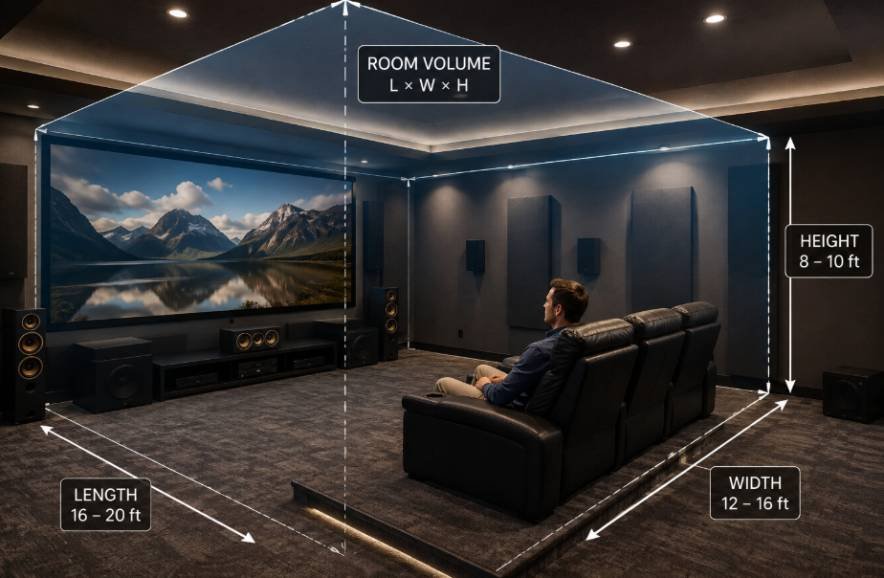
There is no universal minimum cubic-foot requirement for every home theater. Different systems are designed for different environments.
As a practical framework, smaller rooms under roughly 1,500 cubic feet can work well with compact surround systems when the speaker placement and listening distance are appropriate. THX currently lists its compact category for rooms up to 1,000 cubic feet and its Select category for spaces up to 2,000 cubic feet. Larger certified categories extend to 3,000 cubic feet and beyond.
A room between roughly 1,500 and 3,000 cubic feet gives you more flexibility for a dedicated setup. A 12 × 20 × 8-foot room, for example, contains 1,920 cubic feet.
Larger rooms can accommodate greater listening distances, additional seating, and more powerful multi-channel systems, but bigger is not automatically better. The system still needs to match the room.
Why Room Volume Matters for Sound
Room volume influences how sound behaves after it leaves the speakers.
Low frequencies are especially sensitive to the room. Reflections from walls, ceilings, and floors interact with the direct sound, creating peaks and dips in bass response. Room shape and dimensions can therefore matter just as much as the total cubic footage.
Dolby’s home theater guidance also points out that there is no single perfect layout and recommends adapting speaker placement and acoustic treatment to the specific space. It provides different power recommendations based on room floor area, reinforcing the broader point that equipment should be matched to the environment rather than chosen in isolation.
A well-planned smaller room can therefore outperform a poorly planned larger one.
Leave Space Around Your Equipment
Calculating the physical volume of your equipment is useful, but do not design a cabinet or entertainment center around those numbers alone.
An AV receiver, for example, needs adequate ventilation. Cables need room behind components, and you may need access to connections later. Speakers may also need clearance from walls depending on their design.
The same applies when adding other entertainment hardware. If you are assessing gaming console dimensions, its physical volume is relatively easy to calculate, but the real planning question is whether you have enough shelf space, airflow, cable clearance, and access around it.
This becomes more important when several devices share one cabinet. A streaming box, game console, receiver, disc player, and power equipment can quickly turn a tidy setup into a cramped one.
Match the System to the Room
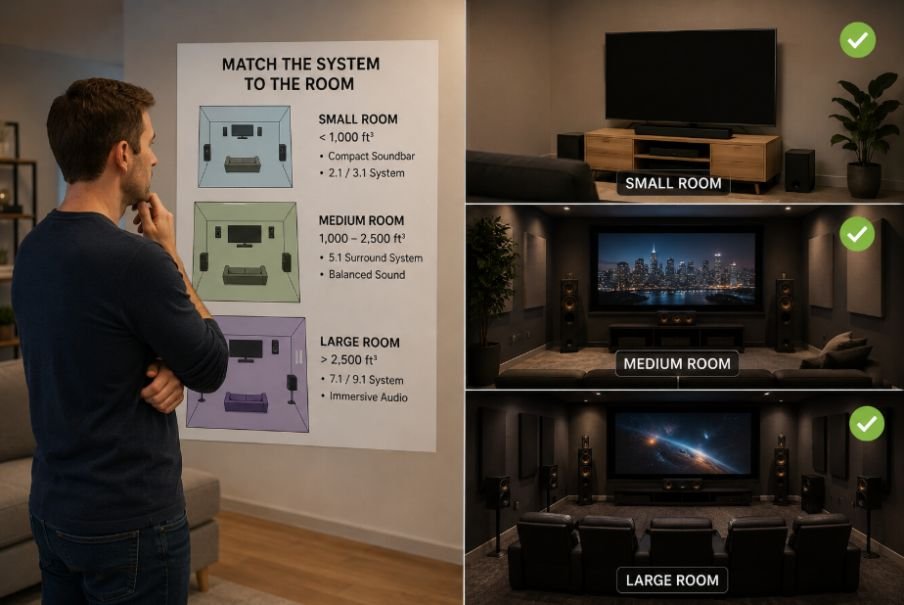
The room should influence the type of home theater you build.
A compact living room may be better suited to a soundbar or smaller 5.1 setup. A medium-sized dedicated room can provide enough space for separate front, center, and surround speakers. A larger room may benefit from additional channels, more capable amplification, or multiple subwoofers.
The listening distance matters too. THX’s current room-size recommendations pair different system categories with approximate viewing distances, ranging from compact spaces at around 8 feet to larger systems intended for substantially greater distances.
Speaker placement should also remain practical. Adding more speakers does not automatically improve immersion if the room cannot accommodate their recommended positions.
A Simple Way to Plan Your Home Theater
Before buying equipment, measure the room and write down three numbers: length, width, and ceiling height. Multiply them to get the cubic footage.
Then map the listening position, screen location, speaker locations, and equipment storage. Think about where cables will run and whether the receiver and other electronics will have enough ventilation.
After that, choose equipment that fits the room rather than choosing equipment first and trying to make the room work around it.
That approach gives you a more realistic picture of both the physical space and the acoustic environment.
Frequently Asked Questions
1. How many cubic feet is a typical home theater room?
There is no single typical size. A compact room may be under 1,000 cubic feet, while dedicated theaters can exceed 3,000 cubic feet. The system should match the available space.
2. How do I calculate home theater room volume?
Multiply the room’s length by its width and ceiling height, with all measurements taken in feet. The result is the room’s cubic footage.
3. Does a larger room need more powerful speakers?
Usually, a larger space can require more output to achieve the desired listening level, but speaker sensitivity, amplifier capability, seating distance, and room acoustics also matter.
4. Is room volume more important than floor area?
Both provide useful information. Volume accounts for ceiling height, while floor area helps with speaker placement, seating, and viewing distance. Neither measurement should be considered alone.
Why the Room Is Part of the System
The most useful way to think about cubic feet is not as a measurement of the home theater equipment itself, but as a description of the environment in which that equipment has to perform.
A room’s volume, proportions, listening distance, surfaces, and layout all influence the final experience. Once those factors are understood, choosing speakers, amplification, a subwoofer, and other components becomes much easier.
You do not need the biggest room or the most powerful equipment. You need a setup that makes sense for the space you actually have.

Ryan Mitchell
Ryan Mitchell holds a degree in Civil Engineering and spent over a decade working in construction project estimation, where accurate volume and material calculations were part of his daily work — from concrete pours to landscaping material orders. He founded this site to bring that same precision to everyday calculations, helping DIYers, contractors, and students get fast, accurate cubic footage results without the guesswork. Ryan reviews every calculator and formula on this site for accuracy and writes guides based on real-world measurement scenarios he's encountered on job sites.


