

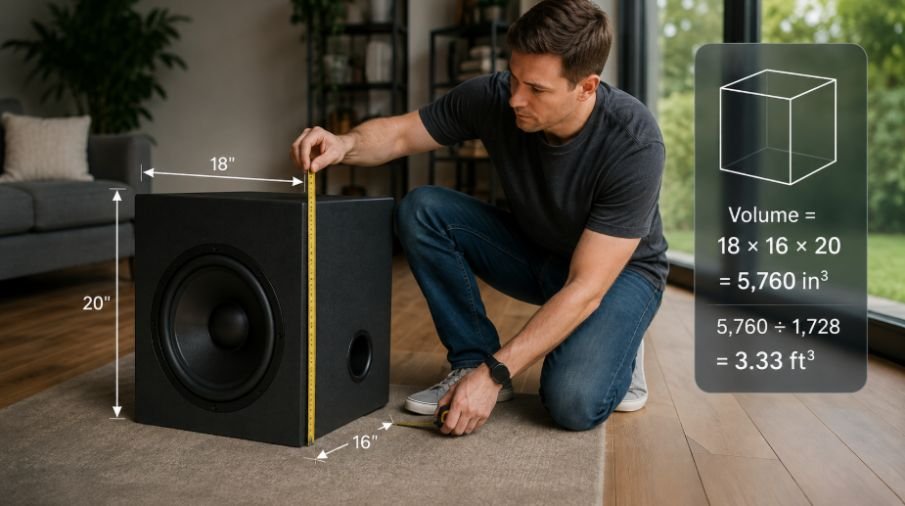
I used to think measuring a speaker was as simple as checking its height, width, and depth and calling it done. Once I looked into speaker enclosures more closely, I realized there is a catch: the outside of a cabinet and the airspace inside it are two different measurements. That distinction matters a lot when you are trying to figure out the actual volume of a speaker box.
I also found that the question “how many cubic feet is a speaker?” does not have one universal answer. A small bookshelf speaker, a floor-standing cabinet, and a subwoofer can occupy very different amounts of space. If you are measuring for storage, transportation, or an enclosure project, the right calculation depends on exactly what you want to know.
There Is No Standard Cubic-Foot Size for a Speaker
A speaker does not have a fixed cubic-foot volume simply because it has a certain driver size. Cabinet dimensions vary by design, manufacturer, enclosure type, and intended use.
A compact bookshelf speaker might occupy only a fraction of a cubic foot externally, while a large floor-standing cabinet can take up several cubic feet. Subwoofer enclosures can be even larger, particularly when they need substantial internal airspace for a specific driver and enclosure design.
That is why the most useful approach is to calculate the volume of the particular speaker or cabinet you are measuring.
There is also an important distinction between physical cabinet volume and acoustic enclosure volume. If you only need to know how much room a speaker occupies in a closet, vehicle, or storage area, external dimensions are what matter. If you are designing or evaluating an enclosure, internal volume becomes much more important.
How Do You Calculate a Speaker’s Volume in Cubic Feet?
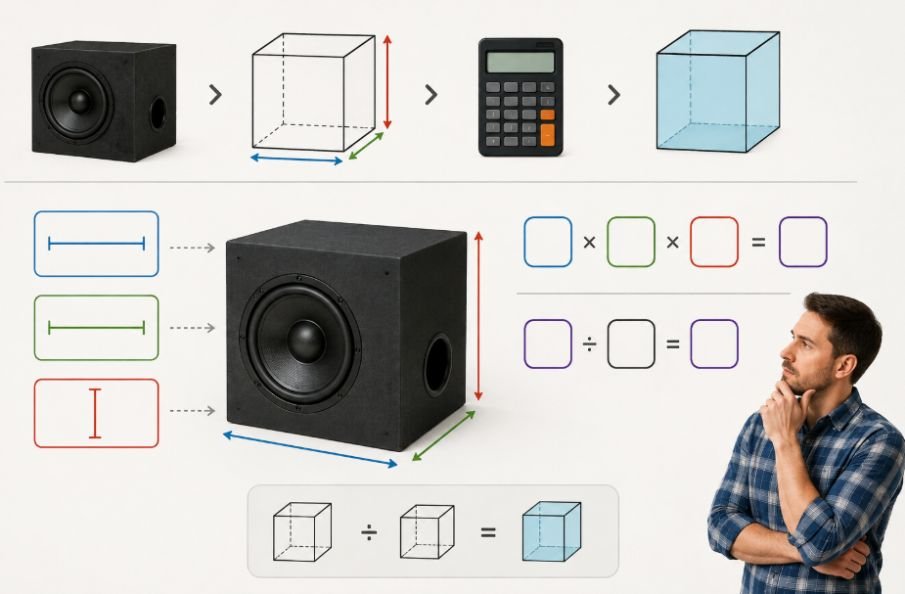
For a rectangular speaker cabinet, the basic calculation is straightforward:
Height × Width × Depth ÷ 1,728 = cubic feet
The dimensions need to be measured in inches for this formula. Multiplying the three measurements gives you cubic inches, and dividing by 1,728 converts that result into cubic feet because a cubic foot contains 12 × 12 × 12, or 1,728, cubic inches.
For example, suppose the inside of a speaker cabinet measures 12 inches high, 10 inches wide, and 8 inches deep.
12 × 10 × 8 = 960 cubic inches.
Then:
960 ÷ 1,728 = 0.56 cubic feet.
So the gross internal volume would be about 0.56 cubic feet.
Use Internal Measurements When You Need Enclosure Volume
This is where many quick calculations go wrong. If you are trying to determine the airspace inside a speaker box, outside measurements are not enough because the cabinet walls take up some of that space.
For example, a box measuring 16 × 12 × 10 inches on the outside will have a smaller internal volume if it uses thick MDF or another cabinet material. You need to account for the wall thickness on each side before multiplying the dimensions.
The difference can become meaningful when a manufacturer specifies a particular enclosure volume. A cabinet that looks large from the outside may have considerably less usable airspace than expected once the panels are accounted for.
This distinction is also useful when comparing the physical size of electronics. For example, scanner dimensions and volume can be estimated from the device’s external measurements, which is different from calculating the internal air volume of a speaker enclosure.
Gross Volume and Net Volume Are Not the Same
If you are only measuring an empty box, the calculation above gives you its gross internal volume. But a working speaker enclosure contains components that occupy some of that space.
The speaker driver itself takes up room inside the cabinet. A port takes up additional space, as can internal bracing, divider panels, and other structures. Those amounts need to be deducted when determining the net internal airspace available to the driver.
For example, imagine your calculated gross internal volume is 1.50 cubic feet. If the driver occupies 0.06 cubic feet and internal components account for another 0.10 cubic feet, the usable net volume would be approximately 1.34 cubic feet.
That number can be much more useful than the gross figure when you are building a custom enclosure.
Why the Net Volume Matters for Speaker Performance
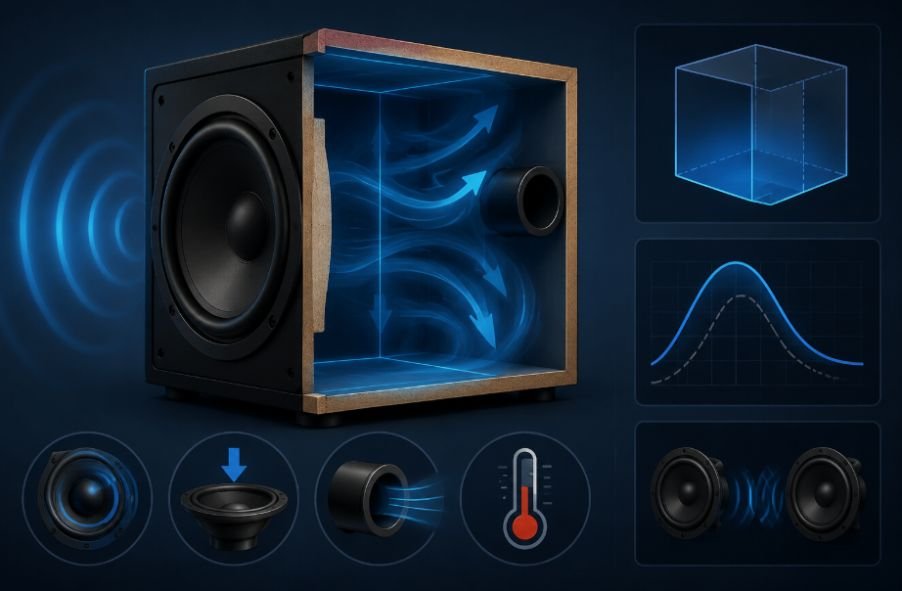
Speaker enclosure volume is not just a measurement for storage or woodworking. It can influence how a driver behaves.
In a sealed enclosure, the air trapped behind the driver acts as part of the system’s acoustic behavior. In a vented enclosure, the port and cabinet volume work together to create a tuned system. Changing the enclosure volume or port dimensions can therefore change the resulting bass response and tuning.
This is why copying the outside dimensions of an enclosure does not necessarily reproduce its acoustic design. Two cabinets can have similar external dimensions while producing different internal volumes because of wall thickness, bracing, dividers, or other construction details.
If you are replacing a cabinet or designing one from scratch, the manufacturer’s recommended enclosure volume is generally a better starting point than simply matching the visible dimensions.
What If the Speaker Box Has an Unusual Shape?
The simple height × width × depth formula works best for rectangular cabinets. Real-world speaker enclosures are not always simple rectangles.
A wedge-shaped box may have different depths at the top and bottom. In that situation, you can calculate an average depth and use it as part of the volume calculation. More complicated cabinets can be divided into smaller shapes, with each section calculated separately and then added together.
This same principle applies to curved or irregular enclosures. Break the cabinet into manageable sections whenever possible instead of trying to force the entire shape into one rectangular formula.
How Much Space Does a Typical Speaker Need?
There is no reliable single range for all speakers because speaker type and design vary too much.
A compact bookshelf speaker may have a relatively small cabinet volume. A larger floor-standing speaker can occupy several times as much physical space. Subwoofer cabinets can vary widely depending on driver size, enclosure type, and the target design.
For that reason, driver diameter alone cannot tell you the cubic-foot volume of the cabinet. An 8-inch driver does not automatically require one particular box size, just as a 12-inch driver does not have one universal enclosure volume.
If you are building an enclosure, use the driver’s specifications and recommended enclosure design rather than estimating the required volume from the driver’s diameter alone.
Measuring a Speaker for Storage or Moving
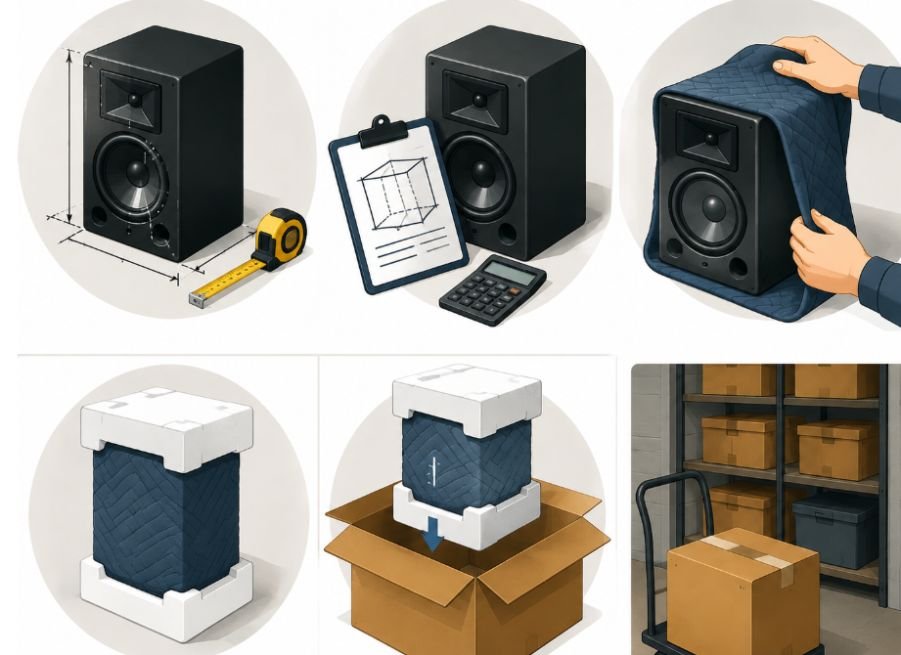
If your goal is simply to determine how much physical space a speaker needs, the process is easier.
Measure the speaker’s maximum external height, width, and depth. Multiply those three measurements and divide by 1,728 if you want the result in cubic feet.
Remember that this gives you a rectangular bounding volume. It does not mean the speaker physically fills every bit of that imaginary box, especially if the cabinet has angled sides or an unusual shape.
This approach can be useful when planning shelves, closets, moving boxes, vehicle space, or storage areas. The same basic calculation can also help estimate the space required for a gaming console and its packaging, using their external dimensions rather than internal enclosure measurements.
A Quick Way to Avoid Measurement Mistakes
Before calculating, decide what you actually need to measure.
If you want the space the speaker occupies, use external dimensions. If you want the airspace inside a speaker cabinet, use internal dimensions. If you are designing an enclosure for a particular driver, go one step further and subtract the displacement of the driver, port, bracing, and other internal components.
For a rectangular cabinet, the process is simple:
- Measure the correct height, width, and depth.
- Multiply the three measurements.
- Divide by 1,728 when using inches.
- Subtract internal component displacement when calculating net enclosure volume.
Taking those few extra seconds to identify the correct type of volume can prevent a surprisingly large measurement error.
Frequently Asked Questions
1. How many cubic feet is a typical speaker?
There is no single standard size. Speaker cabinets range from small fractions of a cubic foot to several cubic feet depending on their design and purpose.
2. How do I calculate speaker box volume?
Measure the internal height, width, and depth in inches, multiply them together, then divide by 1,728 to convert cubic inches into cubic feet.
3. Should I use inside or outside dimensions?
Use outside dimensions when estimating the physical space the speaker occupies. Use inside dimensions when calculating the enclosure’s internal airspace.
4. What is net speaker enclosure volume?
Net volume is the usable internal airspace after subtracting the space occupied by the driver, ports, bracing, dividers, and other internal components.
Why the Right Measurement Matters
Figuring out how many cubic feet a speaker occupies is simple once you know which volume you actually need. For moving or storage, external dimensions give you the practical footprint. For enclosure design, internal dimensions provide the starting point, and net volume becomes the more meaningful figure after internal components are accounted for.
The math is easy. Choosing the right measurements is what makes the answer useful.

Ryan Mitchell
Ryan Mitchell holds a degree in Civil Engineering and spent over a decade working in construction project estimation, where accurate volume and material calculations were part of his daily work — from concrete pours to landscaping material orders. He founded this site to bring that same precision to everyday calculations, helping DIYers, contractors, and students get fast, accurate cubic footage results without the guesswork. Ryan reviews every calculator and formula on this site for accuracy and writes guides based on real-world measurement scenarios he's encountered on job sites.


