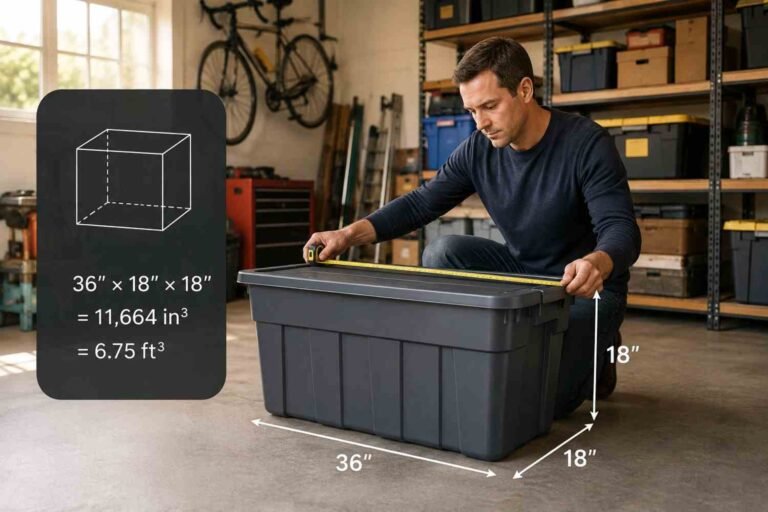

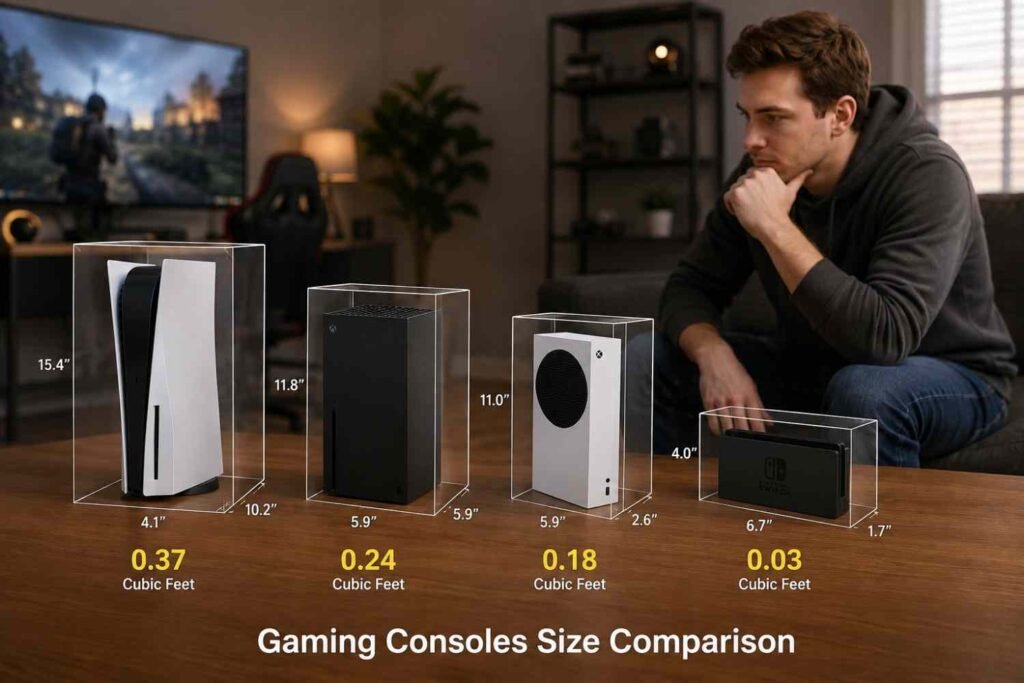
I started thinking about console size differently when I had to make room for gaming equipment rather than simply deciding where a console looked best. The measurements on a specification sheet seemed small enough, but converting them into cubic feet made the actual space easier to understand. It also became clear that the console itself and the box it comes in are two very different space calculations.
I found the same thing when comparing different systems. A large home console can take up several times the volume of a compact or hybrid system, even though the difference may not seem dramatic when you look at them sitting on a shelf. For storage, moving, or shipping, that distinction matters because the packaging, cables, controller, and extra clearance can quickly increase the amount of space you need.
How Do You Calculate the Cubic Feet of a Gaming Console?
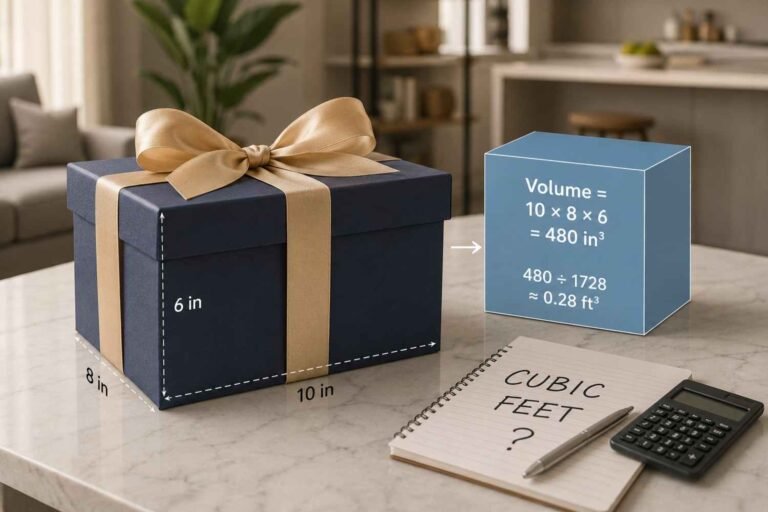
Calculating the cubic volume of a gaming console is straightforward when you have its length, width, and height.
The basic formula is:
Length × Width × Height ÷ 1,728 = cubic feet
The 1,728 comes from converting cubic inches into cubic feet because one cubic foot contains 12 × 12 × 12, or 1,728, cubic inches.
For example, if a console measures 15 inches long, 4 inches wide, and 10 inches high, its volume would be:
15 × 4 × 10 = 600 cubic inches
600 ÷ 1,728 = approximately 0.35 cubic feet.
This is the mathematical volume of the rectangular dimensions. It does not necessarily represent the exact amount of empty space around the console or the room needed for ventilation and accessories.
How Many Cubic Feet Is a Gaming Console?
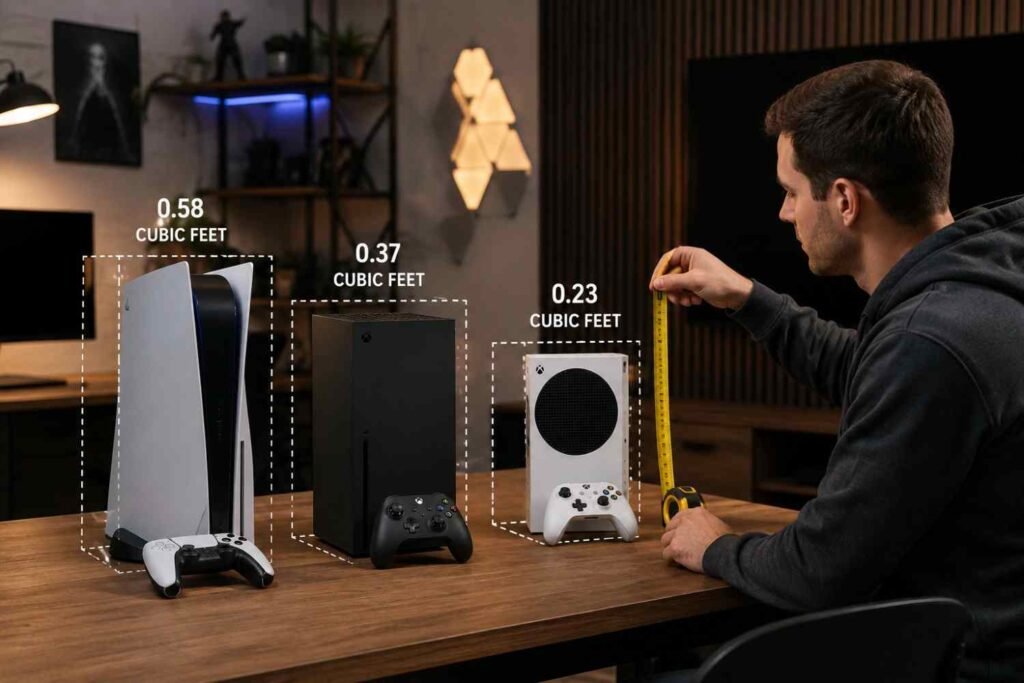
There is no single answer because gaming consoles vary considerably in size and shape. Based on the dimensions of modern systems, a typical full-size home console generally falls somewhere around 0.20 to 0.38 cubic feet in raw volume.
That range makes sense when comparing larger systems with more compact designs. A tall console can have a relatively modest footprint while still producing a larger cubic-foot measurement because of its height.
Compact and hybrid systems occupy much less space. Some can come in below 0.05 cubic feet, making them far easier to store in small entertainment centers, drawers, or travel bags.
The important distinction is that cubic feet measure three-dimensional volume. Two consoles can have similar volumes but completely different shapes, which can affect how easily they fit into a particular space.
How Much Space Do Common Gaming Consoles Take?
The best way to understand console volume is to compare actual dimensions.
A PlayStation 5 has an approximate original chassis size of 15.4 inches long, 4.1 inches wide, and 10.2 inches high. Multiplying those dimensions gives roughly 643 cubic inches, or about 0.37 cubic feet. Sony’s specifications list the dimensions at approximately 390 × 104 × 260 mm.
The newer, slimmer PlayStation 5 design is smaller. Its dimensions are approximately 14.1 × 3.8 × 8.5 inches, which puts its rectangular volume around 455 cubic inches, or approximately 0.26 cubic feet. The exact figure can vary slightly depending on the model and how its dimensions are measured.
The Xbox Series X has dimensions of about 15.1 × 5.9 × 5.9 inches. That produces roughly 526 cubic inches, or around 0.30 cubic feet. Its tall, box-like design makes the calculation relatively simple because its overall shape closely follows the dimensions used for the measurement.
The Xbox Series S is considerably smaller. Its compact form makes it a good example of how a console can deliver a much lower cubic-foot volume than larger home systems.
Nintendo’s hybrid approach produces an even smaller physical footprint when you consider the Switch tablet itself. However, its total storage requirements depend heavily on whether you are storing the console with its dock, controllers, power adapter, and other accessories.
Console Volume Is Not the Same as Storage Space
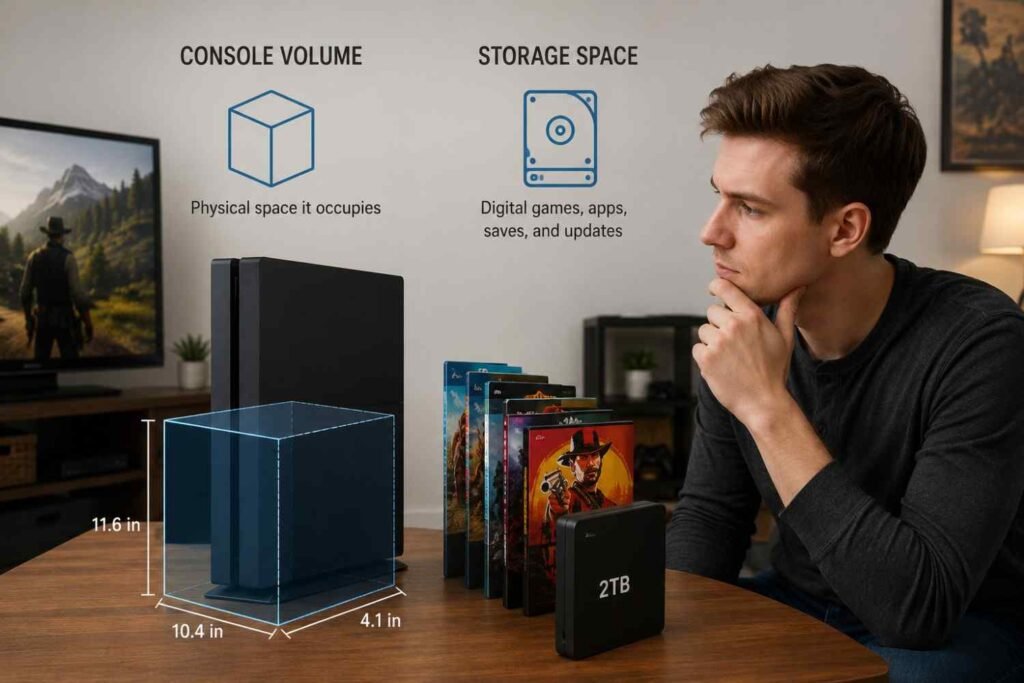
A raw cubic-foot calculation is useful, but it should not be treated as the exact amount of space you need.
A console needs room around it. Ventilation openings cannot be blocked, and you may need additional space for cables, a controller, a power adapter, or a stand. A tight mathematical fit may work on paper but be impractical in a real entertainment center.
The same issue appears when calculating speaker enclosure volume. The cubic-foot measurement provides a useful baseline, but the actual space needed depends on the speaker’s shape, placement, and required clearance.
Think of raw volume as the starting point. Actual storage space is the practical measurement.
What About the Gaming Console’s Box?
The retail box can require much more space than the console itself.
A modern home console may occupy roughly 0.20 to 0.38 cubic feet as a bare unit, while its retail or shipping packaging can require approximately 0.8 to 1.2 cubic feet. The difference comes from protective material, molded inserts, cables, controllers, manuals, and the extra dimensions required to safely enclose the system.
That distinction becomes important when moving or shipping a console. If you are calculating space for a storage unit based only on the console’s dimensions, you may underestimate your needs significantly.
For shipping, measure the actual packed box rather than estimating from the console’s dimensions. The formula stays the same, but the measurements should come from the outside of the package.
How to Measure Your Own Gaming Console
If you have a model that is not listed above, measuring it yourself is easy.
- Measure the longest point from end to end.
- Measure the widest point.
- Measure the highest point.
- Multiply the three measurements together.
- Divide the result by 1,728 if your measurements are in inches.
For example, a console measuring 14 inches long, 5 inches wide, and 9 inches high has a volume of 630 cubic inches. Dividing 630 by 1,728 gives about 0.36 cubic feet.
If the console has an unusual shape, use the largest overall dimensions for a simple storage estimate. This will usually overstate the true physical volume because the console may have curved edges or recessed sections, but it gives you a safer figure when planning space.
How Much Space Should You Allow for Storage?
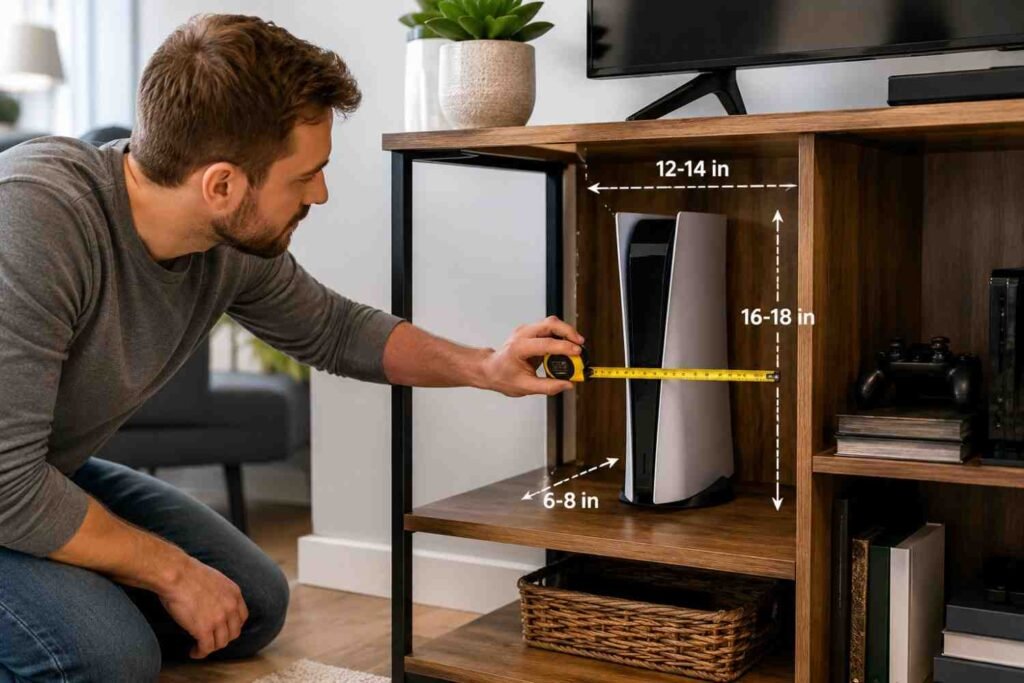
If you are storing only the console, the raw cubic-foot number can help you compare systems. But if you are organizing a gaming setup, leave additional room for accessories and airflow.
For long-term storage, keep the original packaging if possible. It can make moving the system safer and gives you a known container when you eventually need to transport it.
If you are working out space for multiple consoles, do not simply multiply their raw volumes and assume the result represents the size of the storage area you need. Their shapes may prevent efficient stacking, and protective packaging can add considerable volume.
A practical estimate should account for the console, its packaging, and the way you intend to arrange everything.
Gaming Consoles Compared With Other Electronics
Looking at other electronics can make cubic-foot measurements easier to understand. For example, home theater system space requirements can vary considerably depending on the number of components, speaker size, and overall setup.
For example, the amount of space taken by a printer depends on whether it is a compact home model or a larger multifunction machine. A scanner can vary just as much, particularly when comparing a thin flatbed unit with a larger office model.
That is why asking how many cubic feet a printer occupies or how much volume a scanner takes is only useful when the specific dimensions are known. The same principle applies to gaming consoles. Model-specific measurements produce a much more meaningful number than a generic estimate.
For anyone planning shelves, moving boxes, storage bins, or shipping containers, comparing cubic volume across electronics can also help reveal where space is actually being used.
FAQs: How Many Cubic Feet Is a Gaming Console? Comparing Common Sizes
1. How many cubic feet does a typical gaming console take?
Most modern full-size home consoles fall around 0.20 to 0.38 cubic feet in raw rectangular volume. The exact figure depends on the model and its dimensions.
2. How much space does a console box need?
Retail and shipping packaging can require roughly 0.8 to 1.2 cubic feet for a modern home console. The exact amount varies by model and included accessories.
3. Is cubic-foot volume the same as shelf space?
No. Cubic volume measures three-dimensional space, while shelf space also depends on the console’s shape, orientation, ventilation, cables, and accessories.
4. How do I calculate a console’s cubic feet?
Multiply its length, width, and height in inches, then divide the result by 1,728. This provides an approximate rectangular volume in cubic feet.
Why the Number Matters More Than It First Appears
A gaming console may look like a simple piece of hardware, but its space requirements change depending on what you are doing with it. A shelf calculation, moving plan, storage estimate, and shipping measurement can all produce different practical requirements even when they involve the same console. The raw cubic-foot number gives you a useful starting point, but the real-world setup determines how much room you should reserve.
For planning purposes, measure the actual system and its packaging whenever accuracy matters. A small amount of extra space can make the difference between a console that simply fits and one that can be stored, protected, and accessed comfortably.

Ryan Mitchell
Ryan Mitchell holds a degree in Civil Engineering and spent over a decade working in construction project estimation, where accurate volume and material calculations were part of his daily work — from concrete pours to landscaping material orders. He founded this site to bring that same precision to everyday calculations, helping DIYers, contractors, and students get fast, accurate cubic footage results without the guesswork. Ryan reviews every calculator and formula on this site for accuracy and writes guides based on real-world measurement scenarios he's encountered on job sites.