

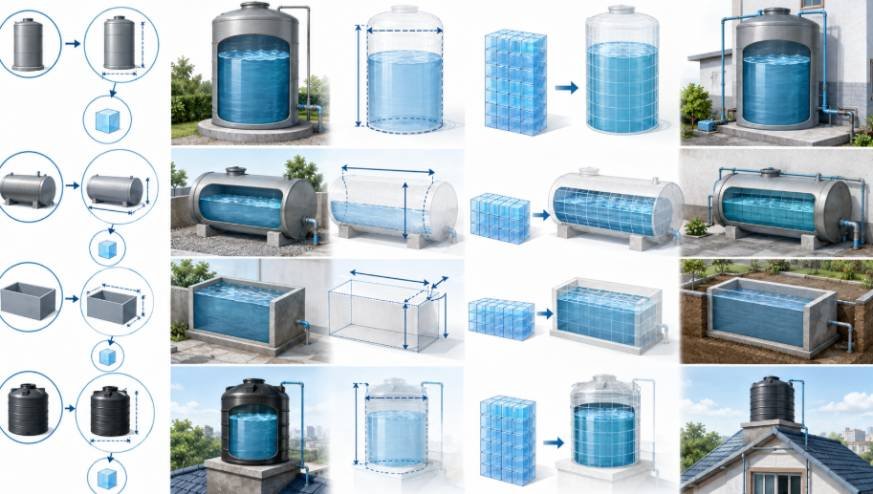
The first time I compared water tanks, I found gallons, liters, cubic feet, and physical dimensions competing for my attention. A tank advertised as “1,000 gallons” sounded substantial, but that number did not tell me how much three-dimensional space it represented. That led me to ask, How Many Cubic Feet Is a Water Tank? A 1,000-gallon model contains approximately 133.68 cubic feet, while a 500-gallon model contains about 66.84 cubic feet.
There is no single standard volume because water tanks vary considerably in capacity, shape, and purpose. Understanding the relationship between gallons and cubic feet makes it easier to compare tanks, plan installation space, estimate water weight, and confirm whether a product suits a property.
How to Convert Water-Tank Gallons to Cubic Feet
One cubic foot holds approximately 7.48052 US gallons. To convert an advertised tank capacity into cubic feet, divide the gallon capacity by 7.48052.
The basic formula is:
Cubic feet = US gallons ÷ 7.48052
Using that formula, a 50-gallon tank contains approximately 6.68 cubic feet. A 100-gallon tank holds 13.37 cubic feet, and a 250-gallon model holds about 33.42 cubic feet. A 500-gallon tank provides approximately 66.84 cubic feet.
Larger tanks scale quickly. A 1,000-gallon model contains around 133.68 cubic feet, while 1,500 gallons equals approximately 200.52 cubic feet. Capacities of 2,500, 5,000, and 10,000 gallons equal roughly 334.20, 668.40, and 1,336.81 cubic feet, respectively.
For another practical comparison involving much larger volumes of water, understanding swimming pool water capacity can make cubic-foot measurements easier to visualize across different types of water storage.
These are nominal conversions. The usable amount may be lower when a tank cannot be filled to its uppermost edge.
How to Calculate Cubic Feet From Tank Dimensions
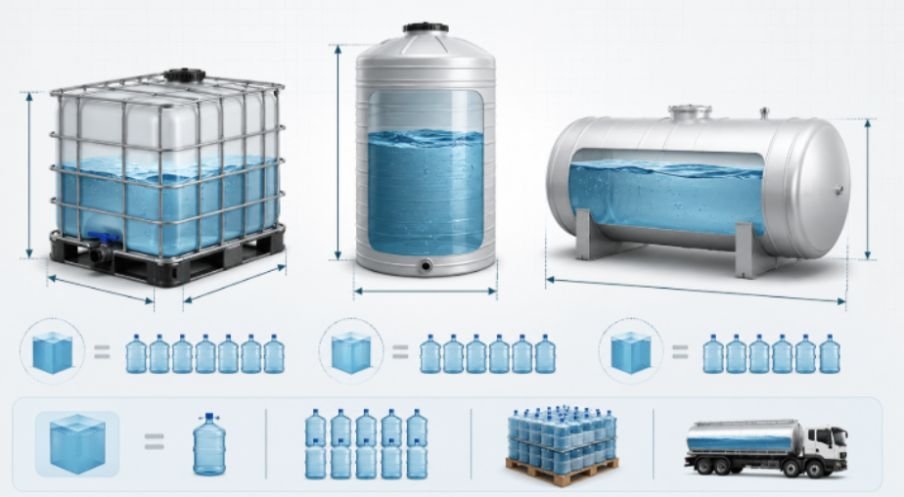
If a capacity label is missing, the tank’s internal dimensions can be used instead. The correct calculation depends on its shape.
Internal measurements matter because exterior dimensions include wall thickness. Exterior measurements are useful for delivery and placement, but they can workout water tank capacity.
Rectangular Tank Formula
For a rectangular tank, multiply its internal length, width, and height:
Cubic feet = length × width × height
A rectangular tank measuring 6 feet long, 4 feet wide, and 5 feet high has a theoretical volume of 120 cubic feet. Multiplying 120 by 7.48052 produces a capacity of approximately 897.66 US gallons.
When measurements are taken in inches, multiply the length, width, and height and divide the result by 1,728. This conversion is necessary because one cubic foot contains 1,728 cubic inches.
Vertical Cylindrical Tank Formula
Vertical water tanks commonly have cylindrical bodies. Their volume is calculated with this formula:
Volume = π × radius² × height
The radius equals half the internal diameter. If a cylindrical tank has an 8-foot internal diameter and stands 6 feet high, its radius is 4 feet. Multiplying 3.14159 by 4 squared and then by 6 gives approximately 301.59 cubic feet. This is equivalent to roughly 2,256 US gallons.
Using the diameter as the radius would make the result four times too large, so this distinction is essential.
Horizontal Cylindrical Tank Formula
A completely full horizontal cylindrical tank uses the same total-volume formula. Multiply pi by the radius squared and then by the internal length.
The calculation becomes more complicated when the tank is only partially filled. Water in a horizontal cylinder forms a curved circular segment. The percentage of its height that is filled does not always equal the percentage of its capacity that remains. A shape-specific calculator is generally the easiest option for this situation.
Total Volume and Usable Capacity Are Different
Geometric volume represents all the theoretical space enclosed by a tank’s internal shape. Rated or usable capacity describes the amount of water the tank can hold during normal operation.
Overflow outlets, internal fittings, pipes, level sensors, baffles, rounded corners, sloping floors, and required freeboard can reduce usable storage. Sediment may also occupy part of the lower section over time. As a result, a measurement-based calculation might not match the capacity printed by the manufacturer.
For purchasing or system design, the manufacturer’s rated capacity should normally take priority. A manual calculation is better used as an estimate or a way to verify whether a specification is realistic.
Measuring Water in a Partially Filled Tank
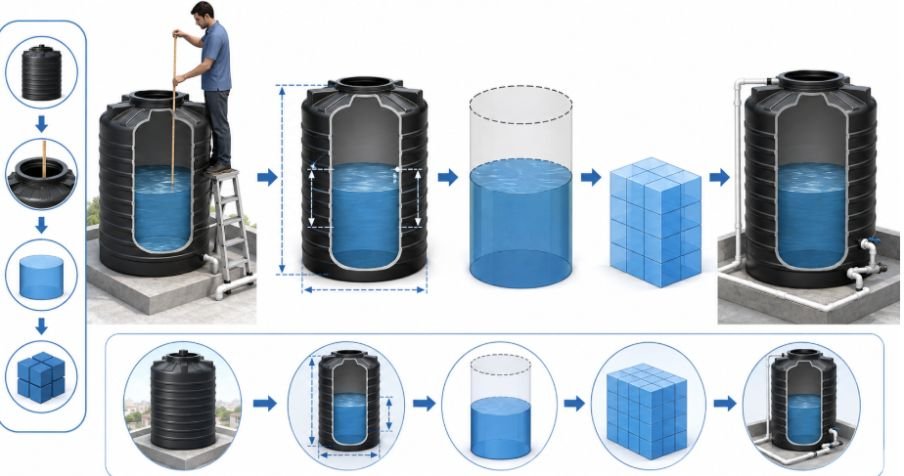
Calculating the contents of a partially filled rectangular tank is straightforward. Replace the full height in the original formula with the current water depth.
The same principle applies to bathtub usable water capacity, where the practical fill volume is usually lower than the full geometric volume because of the overflow drain, tub shape, and normal water level.
For example, a tank measuring 6 feet long and 4 feet wide with 3 feet of water contains 72 cubic feet. Multiplying that figure by 7.48052 gives approximately 538.6 gallons.
For example, a tank measuring 6 feet long and 4 feet wide with 3 feet of water contains 72 cubic feet. Multiplying that figure by 7.48052 gives approximately 538.6 gallons. A cubic feet calculator for water tank capacity can perform this conversion instantly and reduce the risk of manual calculation errors.
Horizontal cylinders, elliptical containers, capsule tanks, and cone-bottom designs require more advanced formulas. Dividing fill depth by total height may provide an inaccurate answer for these shapes.
Water Weight and Structural Planning
Capacity is only part of the planning process. Stored water is extremely heavy. One US gallon weighs approximately 8.34 pounds, while one cubic foot of water weighs about 62.4 pounds under ordinary conditions.
The contents of a full 500-gallon tank weigh approximately 4,170 pounds. A 1,000-gallon tank carries roughly 8,340 pounds of water before the empty tank, valves, pipes, pumps, and supporting frame are included.
Large tanks need firm, level, and properly designed support. The foundation must carry the entire loaded weight without settling or tilting. Tanks installed on elevated stands, rooftops, decks, or indoor floors may require professional structural assessment.
Exterior Space Versus Internal Storage
Internal cubic footage answers how much water the tank can contain. Exterior cubic footage answers how much physical space the tank occupies.
Installation planning should use exterior length, width, and height. Additional clearance may be needed for inlet and outlet connections, valves, access covers, pumps, inspection, cleaning, ventilation, and future maintenance.
A tank that technically fits into an available space may still be difficult to install or service. Doorways, gates, staircases, roof overhangs, and delivery equipment should also be considered before ordering.
Frequently Asked Questions
1. How Many Cubic Feet Is a Water Tank?
The answer depends on its rated gallon capacity or internal dimensions. Divide US gallons by 7.48052 to obtain cubic feet. A 500-gallon tank contains approximately 66.84 cubic feet, while a 1,000-gallon tank contains about 133.68 cubic feet.
2. How many gallons fit in one cubic foot?
One cubic foot contains approximately 7.48052 US gallons. It also equals approximately 28.32 liters.
3. Should I use internal or external tank measurements?
Use internal dimensions to estimate water capacity. Use exterior dimensions to plan placement, clearance, transportation, and installation.
4. Does tank shape affect cubic footage?
Yes. Rectangular, cylindrical, elliptical, capsule, and cone-bottom tanks require different formulas. Shape becomes especially important when calculating the contents of a partially filled tank.
Final Perspective
I find water-tank capacity much easier to understand once I separate three measurements: rated gallons, internal cubic footage, and exterior installation space. Each measurement answers a different practical question.
For a quick conversion, I divide gallons by 7.48052. When only dimensions are available, I use the formula matching the tank’s shape and measure the interior whenever possible. I also account for freeboard, fittings, water weight, and service clearance rather than assuming every theoretical cubic foot will be usable. This approach gives me a more reliable capacity estimate and helps prevent expensive mistakes during selection and installation.

Ryan Mitchell
Ryan Mitchell holds a degree in Civil Engineering and spent over a decade working in construction project estimation, where accurate volume and material calculations were part of his daily work — from concrete pours to landscaping material orders. He founded this site to bring that same precision to everyday calculations, helping DIYers, contractors, and students get fast, accurate cubic footage results without the guesswork. Ryan reviews every calculator and formula on this site for accuracy and writes guides based on real-world measurement scenarios he's encountered on job sites.


