

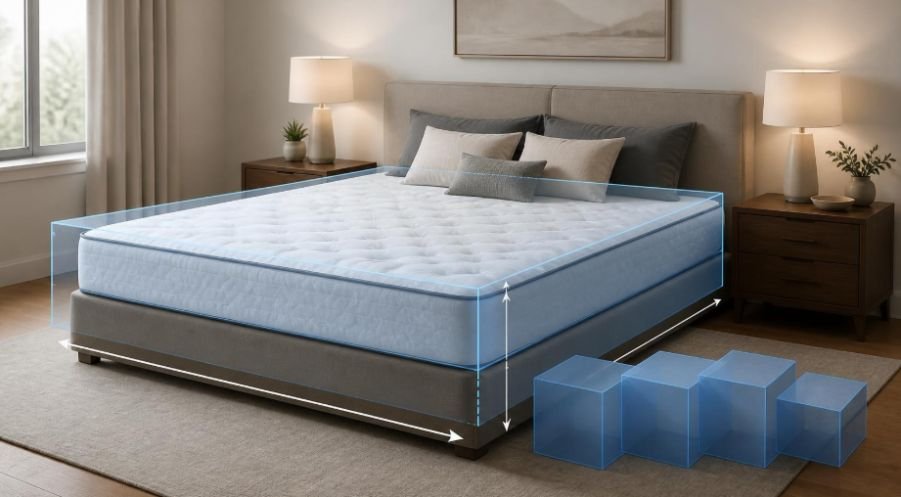
A standard king mattress occupies more physical volume than a full-size refrigerator, yet thousands of homeowners rent moving trucks or storage units every day without measuring its actual three-dimensional footprint.
When you plan a move or clear out a bedroom, guessing mattress dimensions based on floor space alone leads to crammed vans, scratched furniture, and extra rental fees. Knowing exactly how many cubic feet is a king mattress allows you to calculate payload capacity accurately, select the right box truck, and optimize your self-storage footprint.
Calculating mattress volume requires evaluating three distinct dimensions rather than simple length and width. Height varies significantly across modern sleep products, directly altering the spatial volume required for transit and storage.
Why Mattress Volume Matters for Moving and Storage
Most consumers view mattresses as two-dimensional objects because they focus on surface area. A king bed occupies 6,080 square inches of room real estate. However, shipping, logistics, and moving operations function in three dimensions.
Understanding volumetric space prevents costly logistical missteps:
- Moving Truck Selection: Small cargo vans offer roughly 240 to 450 cubic feet of capacity. A single king mattress, along with its box spring, can claim up to 30% of that total usable space.
- Storage Unit Sizing: A standard 5×10 storage unit provides roughly 400 cubic feet of total volume. Storing a king mattress flat consumes a major portion of that floor layout, whereas stacking it properly on its edge requires careful vertical headroom planning.
- Freight and Parcel Shipping: Freight carriers use dimensional weight (Dim Weight) to set rates, charging based on total volume rather than actual scale weight alone.
According to logistics data published by the U.S. Department of Transportation, optimizing spatial load factors in personal cargo transport drastically reduces unsafe driving conditions caused by overloaded or improperly balanced vehicles.
The Math Behind Mattress Cubic Footage
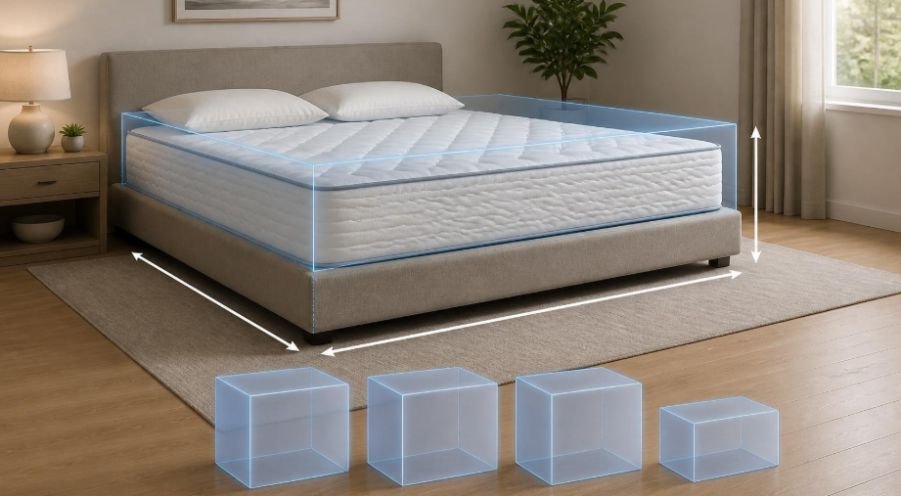
Calculating total volume requires a simple geometric formula converted into feet. Because American mattress sizes are measured in inches, you calculate total cubic inches first and divide by the total number of cubic inches in a single cubic foot (1,728).
A standard U.S. king mattress measures 76 inches wide by 80 inches long.
The variable that changes your calculation is height or depth. Basic foam mattresses start around 8 inches deep, while multi-layer hybrid or pillow-top models reach 14 to 16 inches.
The Volume Spectrum: Standard vs. Luxury King Mattresses
- 10-Inch Standard King: $76 \times 80 \times 10 = 60,800 \text{ cubic inches}$. Dividing by 1,728 yields 35.19 cubic feet.
- 12-Inch Medium/Hybrid King: $76 \times 80 \times 12 = 72,960 \text{ cubic inches}$. Dividing by 1,728 yields 42.22 cubic feet.
- 14-Inch Luxury Pillow-Top King: $76 \times 80 \times 14 = 85,120 \text{ cubic inches}$. Dividing by 1,728 yields 49.26 cubic feet.
If you are packing up an entire household, comparing different bed sizes helps you allocate space across your moving truck.
Volume Comparison Across Common King Variations
Not all king mattresses share the exact same footprint. Specialized dimensions like the California King or Split King alter final cubic volume calculations.
| Mattress Type | Width (in) | Length (in) | Thickness (in) | Total Volume (Cubic Feet) |
| Slim King (Foam) | 76 | 80 | 8 | 28.15 |
| Standard King (10″) | 76 | 80 | 10 | 35.19 |
| Hybrid King (12″) | 76 | 80 | 12 | 42.22 |
| Luxury King (15″) | 76 | 80 | 15 | 52.78 |
| California King (12″) | 72 | 84 | 12 | 42.00 |
| Split King (2 Twin XLs, 12″) | 76 (combined) | 80 | 12 | 42.22 |
While a California King is 4 inches longer than a standard king, it is also 4 inches narrower. Consequently, a 12-inch California King yields roughly 42 cubic feet, almost identical in total volume to a standard 12-inch king model. Explore about the size of twin mattress when organizing children’s rooms or daybeds.
Real-World Moving and Storage Scenarios
Knowing the volume is step one; applying it to physical spaces ensures a smooth move.
Fitting a King Mattress in Rental Trucks
- 10-Foot Cargo Van/Truck: Offers around 300 to 380 cubic feet of volume. A 42-cubic-foot king mattress consumes roughly 11% to 14% of total capacity. However, because of wheel-well protrusions, carrying it flat limits cargo height.
- 15-Foot Box Truck: Delivers roughly 800 cubic feet of usable space. Storing the mattress vertically along the wall consumes less than 6% of the floor footprint while keeping central space open for stacked boxes.
Storage Unit Headroom and Spatial Efficiency
Research from the Self Storage Association indicates that consumer packing mistakes waste up to 25% of rented self-storage volume.
When storing a king mattress in a standard unit:
- Avoid Storing Flat: Laying a 42-cubic-foot mattress flat on the floor takes up 42.2 square feet of ground space—nearly the entire floor of a 5×10 unit.
- Upright Positioning: Storing the mattress on its long edge reduces floor footprint to under 7 square feet, utilizing vertical ceiling headroom instead.
- Box Springs Matter: Remember that a traditional king box spring is usually split into two units (Twin XL size). Each split box spring section measures $38 \times 80 \times 9 \text{ inches}$, adding another 31.6 cubic feet of combined volume.
Step-by-Step Method: Calculate Your Mattress Volume
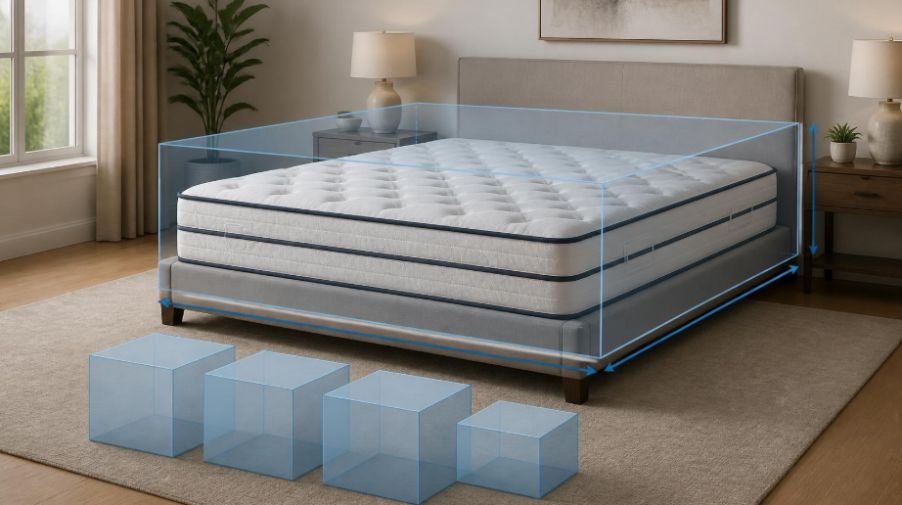
To find the exact cubic footage of your specific bed setup, follow this quick process:
- Measure Width: Lay a tape measure horizontally across the head of the bed (standard is 76 inches).
- Measure Length: Extend the tape from the head of the bed down to the footboard (standard is 80 inches).
- Measure Depth: Place a straight edge on top of the mattress surface and measure down to the bottom seam, excluding toppers or protectors.
- Multiply: Calculate $\text{Width} \times \text{Length} \times \text{Depth}$ to get total cubic inches.
- Convert: Divide the result by 1,728 to establish final cubic feet.
Limitations, Exceptions, and Misconceptions
While geometric math works for rigid structures, mattresses present unique physical exceptions:
- Memory Foam Compression: All-foam mattresses can be vacuum-sealed and rolled. A compressed king mattress shrinks its transport volume by up to 60–70%, dropping from 42 cubic feet down to roughly 12 to 15 cubic feet inside a box.
- Innerspring Rigidity: Spring mattresses feature border wires that prevent bending or compression. Attempting to fold an innerspring mattress to save volume damages the internal structure and voids manufacturer warranties.
- Non-Standard Shapes: Custom luxury mattresses featuring deep pillow tops, sewn-in handles, or irregular quilting increase actual operational footprint beyond simple rectangular math.
Guidelines published by the Federal Trade Commission (FTC) on consumer product disclosures remind buyers that advertised mattress dimensions carry a standard manufacturing tolerance of $\pm 0.5 \text{ inches}$, which slightly alters precise cubic volume.
Frequently Asked Questions
1. Will a king mattress fit in a 5×10 storage unit?
Yes. A king mattress fits easily in a 5×10 storage unit when placed vertically on its edge, leaving substantial floor space for boxes and furniture.
2. How many cubic feet is a king box spring?
A full king box spring system—typically split into two Twin XL bases—measures approximately 31.6 cubic feet total for a standard 9-inch depth.
3. Can you compress a king mattress to save cubic footage?
You can vacuum-compress all-foam mattresses using specialized seal bags, reducing total volume by over 60%. Never compress innerspring or hybrid mattresses containing steel coils.
4. How much does a king mattress weigh per cubic foot?
Most mattresses weigh between 2.5 and 4 pounds per cubic foot. A 42-cubic-foot hybrid king mattress typically weighs between 100 and 130 pounds.
Final takeaways
Accurately calculating your mattress footprint transforms moving logistics from a guessing game into a predictable process. By accounting for height alongside floor dimensions, you can select the correct truck size, maximize storage unit headroom, and protect your mattress throughout transit. Before loading your transport vehicle, measure your mattress depth, calculate its cubic volume, and plan vertical loading strategies to keep your move efficient.

Ryan Mitchell
Ryan Mitchell holds a degree in Civil Engineering and spent over a decade working in construction project estimation, where accurate volume and material calculations were part of his daily work — from concrete pours to landscaping material orders. He founded this site to bring that same precision to everyday calculations, helping DIYers, contractors, and students get fast, accurate cubic footage results without the guesswork. Ryan reviews every calculator and formula on this site for accuracy and writes guides based on real-world measurement scenarios he's encountered on job sites.


