

I started paying attention to cubic footage when I realized how quickly soft household items can fill a moving truck. Curtains look small when they are hanging at the window, but once several panels are folded, boxed, and packed with their hardware, they can take up more room than expected. That made me curious about how much space a typical curtain package really needs when planning a move.
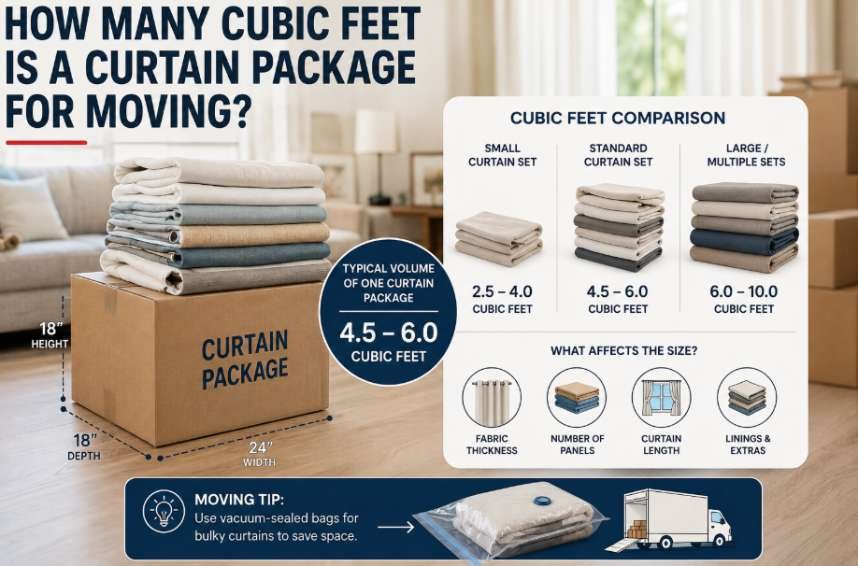
What I found is that there is no single number that applies to every curtain package. For moving purposes, a practical estimate is around 3 to 4.5 cubic feet for a boxed group of curtains, depending on the box size, fabric weight, number of panels, and whether other items are packed with them. The only way to get an exact figure is to measure the package itself.
A Typical Curtain Package Takes About 3 to 4.5 Cubic Feet
For a moving estimate, 3 to 4.5 cubic feet is a reasonable range for many curtain packages. A medium 3-cubic-foot box can handle a smaller collection of folded curtains, while a 4.5-cubic-foot box gives more room for bulky, lined, or multiple sets of drapes. Standard moving-box sizes commonly fall into these ranges, with 3.0 and 4.5 cubic feet being practical options for household soft goods.
That range is an estimate, not a rule. Two curtain packages can look similar but occupy different amounts of space after folding. Thick blackout curtains, thermal curtains, velvet panels, and heavily lined drapes generally need more room than lightweight sheers.
Curtain rods also change the calculation. Long hardware may need to be packed separately because its shape does not use a rectangular box as efficiently as folded fabric.
How to Calculate the Cubic Feet of a Curtain Package
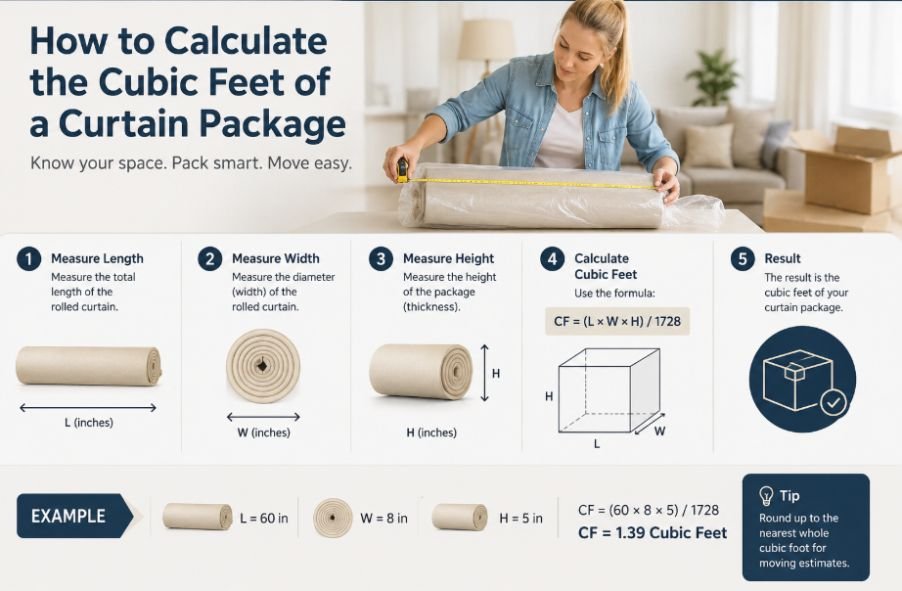
The basic calculation is simple:
Cubic feet = length × width × height
When your measurements are in inches, multiply the three dimensions and divide the result by 1,728. One cubic foot contains 1,728 cubic inches.
For example, imagine your packed curtain box measures 24 inches long, 18 inches wide, and 12 inches high.
24 × 18 × 12 = 5,184 cubic inches
5,184 ÷ 1,728 = 3 cubic feet
So that package occupies 3 cubic feet.
A larger box measuring 24 × 18 × 18 inches would occupy 4.5 cubic feet. That is why box size can give you a useful starting point when you are estimating moving space.
Measure the Package, Not the Curtain
This is where many volume estimates go wrong.
A curtain may be advertised as 84 inches long and 52 inches wide, but those measurements describe the curtain when it is hanging or fully spread. They do not tell you how much space it occupies after folding.
For moving purposes, measure the outside dimensions of the packed box, carton, or container. Package-volume calculations are based on the space occupied by the packed item, not the unfolded product dimensions.
If the curtains are packed in a soft bag rather than a rigid box, measure the longest, widest, and deepest points of the filled package. Try to measure it after the fabric has been packed in the same way you plan to move it.
This gives you a much more useful number for truck, storage, or moving estimates.
How Curtain Type Changes the Space You Need
Not every curtain folds down to the same size.
Lightweight sheer curtains usually compress easily and may fit into a smaller box. Standard polyester or cotton panels take somewhat more room, while lined curtains and blackout panels can become surprisingly bulky.
The number of panels matters as well. One pair of curtains may fit comfortably in a medium box, while several pairs can push you toward a larger carton.
Packaging also makes a difference. If you use tissue paper, protective covers, hangers, or individual bags, those materials add a little volume. That extra space may seem insignificant for one package, but it becomes noticeable when you have several boxes.
For that reason, it is better to estimate from the final packed dimensions rather than trying to calculate the volume of the fabric itself.
How Much Space Do Multiple Curtain Packages Need?
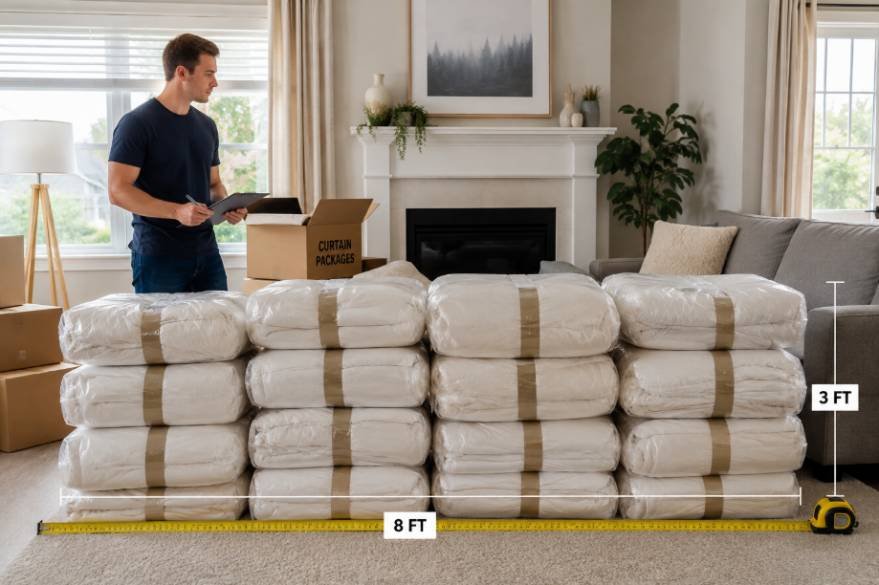
If you are moving an entire house, you probably have more than one curtain package to account for.
The simplest approach is to calculate each box separately and add the results. Three 3-cubic-foot boxes would require about 9 cubic feet of physical volume. Two 4.5-cubic-foot boxes would require 9 cubic feet as well.
The same method works when the boxes are different sizes. A 3-cubic-foot box plus a 4.5-cubic-foot box equals 7.5 cubic feet.
Keep in mind that calculated volume is not always the same as perfectly usable truck space. Boxes have to be stacked, irregular gaps remain around furniture, and some items cannot be placed underneath heavier belongings. Cubic footage is therefore best treated as a planning measurement rather than a guarantee of exactly how much truck space you will use.
Compare Curtains With Other Bulky Household Items
Curtains are one of many soft household items that can be deceptive when estimating moving volume. They compress more easily than furniture but can still occupy several cubic feet when packed together.
The comparison is useful because moving loads contain many different shapes. A curtain carton may stack neatly, while a carpet roll may create unused gaps around it.
Should You Use a Larger Box for Curtains?
A larger box is not automatically better.
Curtains are lightweight, so it can be tempting to fill a large carton completely. But an oversized box can become awkward to carry if you add other household textiles, and loosely packed fabric may shift during transportation.
A 3-cubic-foot box can be a sensible choice for a moderate amount of curtains. A 4.5-cubic-foot box provides more room for bulky drapes, several panels, or other lightweight linens. Moving-box references commonly recommend larger cartons for bulky, lightweight household items such as bedding and linens.
The better choice is the box that holds the curtains securely without forcing the fabric into a tight bundle or leaving a large amount of unused space.
What About Vacuum-Packed Curtains?

Vacuum bags can reduce the space occupied by soft fabrics, but they change the package dimensions enough that you should recalculate the volume after compression.
For example, curtains that normally fill a 3-cubic-foot box might occupy less space when compressed into a sealed bag. However, the final volume depends on the fabric, how much air is removed, and how the package is shaped.
If you are estimating a moving load, measure the compressed package rather than relying on the original carton dimensions.
Give Yourself a Little Extra Room
If you do not have the final package dimensions yet, using 3 to 4.5 cubic feet per curtain package gives you a practical starting point for a moving estimate.
For a more accurate number, pack the curtains first, measure the outside dimensions, and calculate the volume. If you are planning an entire move, repeat the process for each box and add the totals.
That small amount of measuring can prevent the common problem of discovering that your estimated moving volume was based on the size of the products rather than the space they actually occupy.
Frequently Asked Questions
1. How many cubic feet does a typical curtain box hold?
A typical moving box used for curtains may provide around 3 to 4.5 cubic feet. The right size depends on the number, thickness, and type of curtains being packed.
2. Are curtain dimensions the same as package dimensions?
No. Curtain dimensions describe the fabric when installed or fully spread. Package dimensions describe the folded and packed item and are the measurements used to calculate moving volume.
3. How do I calculate cubic feet from inches?
Multiply the package’s length, width, and height in inches, then divide the result by 1,728. The answer is the package volume in cubic feet.
4. Do curtain rods count toward the same volume?
They should be measured separately if they do not fit inside the curtain box. Their long, narrow shape can make them difficult to pack efficiently with folded fabric.
Why Measuring the Packed Curtains Is Worth It
Estimating curtain volume does not need to become complicated. A rough 3-to-4.5-cubic-foot range works for initial moving plans, but the actual package dimensions give you a much better answer. The difference comes down to the type of curtains, how many panels you have, how tightly they are folded or compressed, and what packaging you use.
For a move, the simplest approach is also the most reliable: pack the curtains, measure the package, calculate its volume, and add it to the rest of your household inventory. That gives you a realistic picture of the space your belongings will actually occupy.

Ryan Mitchell
Ryan Mitchell holds a degree in Civil Engineering and spent over a decade working in construction project estimation, where accurate volume and material calculations were part of his daily work — from concrete pours to landscaping material orders. He founded this site to bring that same precision to everyday calculations, helping DIYers, contractors, and students get fast, accurate cubic footage results without the guesswork. Ryan reviews every calculator and formula on this site for accuracy and writes guides based on real-world measurement scenarios he's encountered on job sites.


