

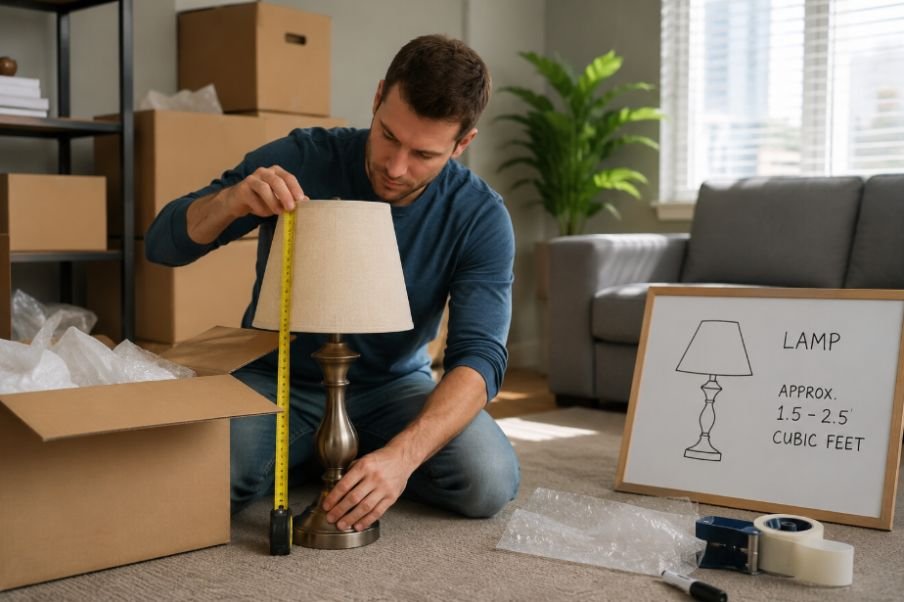
I used to think estimating moving space was as simple as measuring an item and multiplying the numbers together. Lamps changed that assumption pretty quickly. A lamp may look small in a room, but once the shade, base, wrapping, and moving box are involved, it can take up noticeably more room than its bare dimensions suggest.
I also found that lamps are one of those household items where packing decisions can change the estimate quite a bit. A compact table lamp may fit neatly into a medium box, while a large shade needs its own space to avoid getting crushed. For moving estimates, the useful number is not just the lamp’s physical size. It is the amount of packed space the lamp is likely to occupy.
So, How Many Cubic Feet Is a Lamp?
A standard table lamp generally takes about 2 cubic feet of moving space when packed, while a floor lamp commonly requires around 3 to 4 cubic feet. These are practical moving estimates rather than exact measurements because the final volume depends on the lamp’s shape, box size, packing material, and whether the lamp can be taken apart.
There is also an important distinction between the lamp itself and its moving volume. A lamp base might occupy relatively little physical space, but the box needs room for cushioning and protection. A lampshade can create an even larger difference because its shape makes it difficult to pack tightly without risking damage.
For moving purposes, think of cubic feet as the space your packed item claims inside the truck or storage area, not simply the empty geometric volume of the lamp.
Typical Cubic-Foot Estimates for Different Lamps
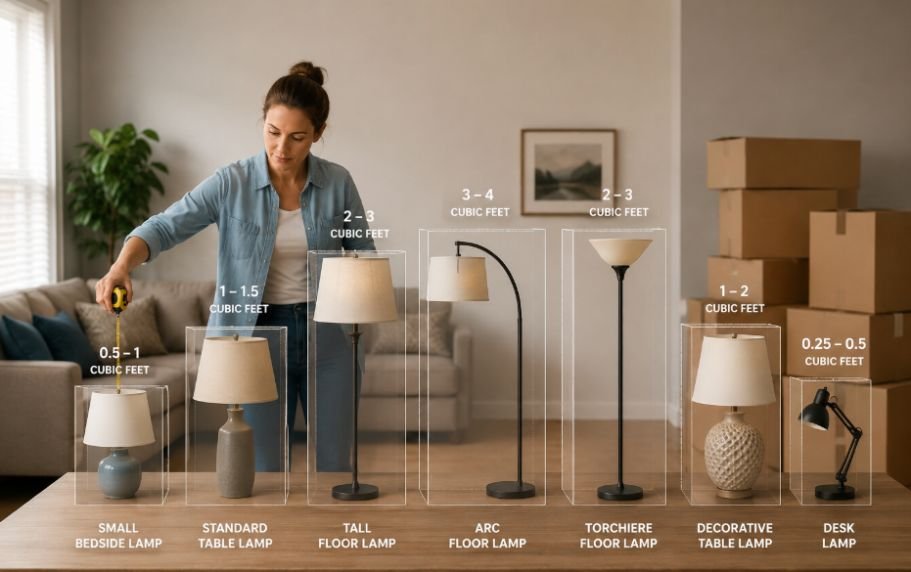
A practical estimate can make household inventory planning much easier. Here are reasonable numbers to work with:
- Table lamp base: about 2 cubic feet when packed in a suitable moving carton
- Lampshade: around 4.5 cubic feet when a large protective box is needed
- Floor lamp: about 3 to 4 cubic feet, depending on its design and how it is packed
These numbers should be treated as planning estimates rather than universal measurements. A small bedside lamp with a narrow shade could use less space, while a large ceramic base or oversized decorative shade could require considerably more.
The lampshade deserves special attention. Its low weight can be misleading. Because it is fragile and difficult to compress, the box may be much larger than the shade itself. Moving professionals commonly recommend giving shades their own appropriately sized boxes and leaving enough room for protective packing.
Why Packed Volume Matters More Than Bare Dimensions
Suppose a table lamp is 12 inches wide, 12 inches deep, and 24 inches tall. Multiplying those dimensions gives 2 cubic feet. That calculation is useful, but it does not necessarily tell you how much truck space the packed lamp will consume.
You need additional room for cardboard, cushioning, and protection. The lamp may also have an irregular base that does not fit neatly into a rectangular box.
That is why moving estimates often work with the approximate space occupied after packing. If you are planning a truck load, it is safer to allow a little extra room than to assume every item will fit into a perfectly efficient cube.
How to Calculate Your Lamp’s Cubic Feet
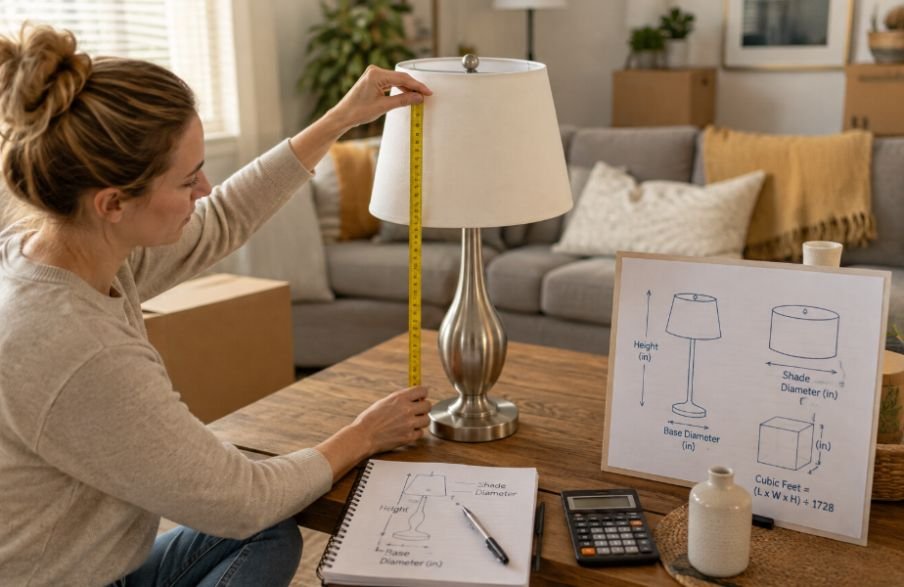
If you want a more personalized estimate, measure the lamp or the packed components in inches.
Use this formula:
Cubic feet = length × width × height ÷ 1,728
For example, a box measuring 18 inches by 18 inches by 24 inches has a volume of 4.5 cubic feet.
This is especially useful for lamps because you can measure the actual box you intend to use instead of guessing from the lamp’s appearance. If the base and shade need separate cartons, calculate each box individually and add them together.
For a more accurate moving inventory, measure the packed dimensions whenever possible. The difference between an unpacked lamp and its final boxes can be significant.
The Lampshade Can Change the Estimate
The shade is often the awkward part of the equation. It cannot simply be squeezed into a smaller box because pressure can bend the frame, crease fabric, or damage delicate materials.
A better approach is to remove the shade from the lamp and pack it separately. Use clean packing paper or another suitable protective material, and avoid placing heavy objects on top. Smaller compatible shades can sometimes be nested inside larger ones when their materials and shapes allow it, which can reduce wasted space.
If you are estimating a household move, do not count only the lamp base. Include the shade and its packaging in your total.
This same principle matters with other awkward household items too. For example, when estimating the space required for a rolled floor covering, the dimensions of the packed roll matter more than the material spread out on the floor. That is why understanding carpet roll volume can be useful when building a broader moving inventory.
How to Pack a Table Lamp Without Wasting Space
Start by unplugging the lamp and removing the bulb. Take off the shade and any removable hardware, such as the finial or harp. Keep small pieces together in a labeled bag so they do not disappear during the move.
Wrap the base carefully and place it upright in a sturdy box. Fill gaps with appropriate cushioning so the base cannot shift during transportation. The goal is to protect the lamp without leaving large empty spaces that unnecessarily increase the box size.
Keep the lampshade separate from the heavier base. A base can damage a shade if they move against each other inside the same carton.
What About Floor Lamps?
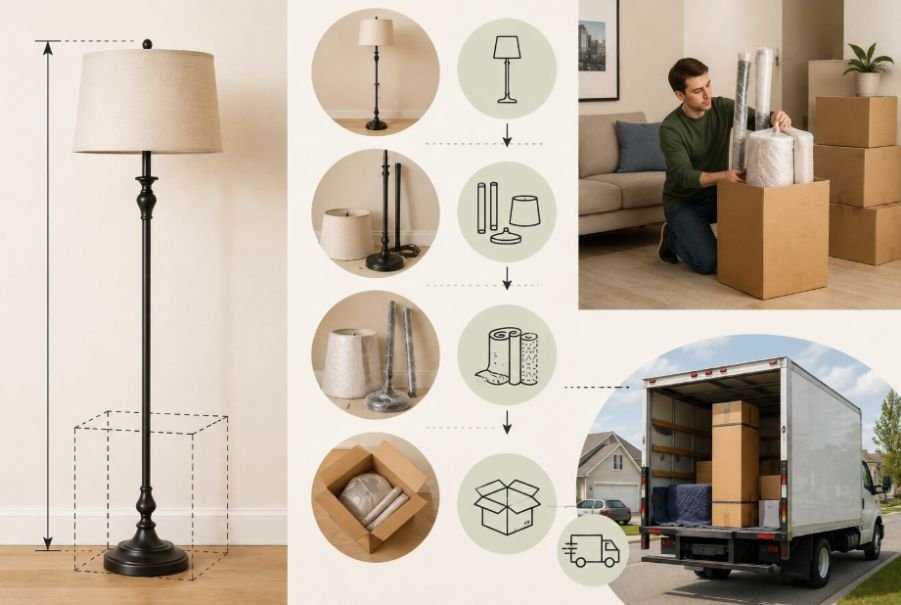
Floor lamps can take up more room because of their height, but many designs can be broken down into smaller sections. If the pole unscrews, separate the sections and wrap them individually. Remove the shade and bulb before packing.
This can reduce the footprint considerably. Instead of trying to protect a tall lamp as one long piece, you can pack the base, pole sections, and shade according to their individual shapes.
If a floor lamp cannot be disassembled, measure its packed length, width, and height. You may need a specialty box or enough protected space to keep the long structure from being bent or crushed. Current packing guidance also recommends measuring lamp components before selecting boxes rather than trying to force them into undersized cartons.
How Many Lamps Can Fit in One Moving Box?
That depends on the bases, box dimensions, and how well the pieces can be protected. Several smaller lamp bases may fit in one sturdy carton if they are individually wrapped and separated with cushioning.
Lampshades are different. Packing several shades together may work when they can safely nest, but each shade needs protection from pressure and movement. Delicate materials may need individual boxes instead.
Do not chase maximum box capacity at the expense of protection. A slightly less efficient box is usually preferable to a damaged lamp.
Add Extra Space for Fragile Packing
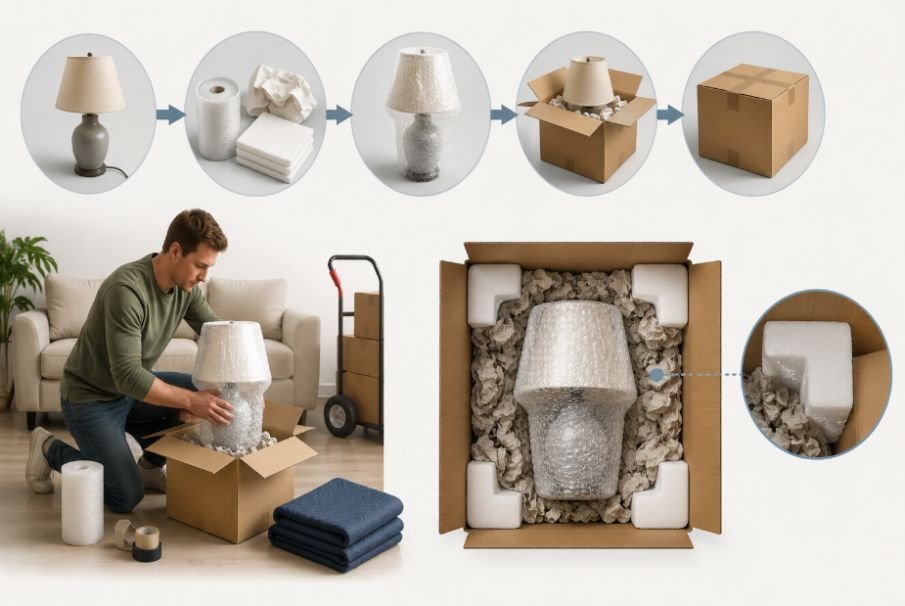
A lamp does not travel through a moving truck in the same condition it sits on a table. It needs protection from vibration, shifting boxes, and contact with other belongings.
Use the actual packed dimensions when you can. If you are still in the planning stage, the 2-cubic-foot estimate for a typical table lamp and 3-to-4-cubic-foot range for a floor lamp provide a reasonable starting point. Oversized shades should be estimated separately because their boxes can consume more space than expected.
A little extra allowance is also useful when calculating the total cubic footage of an entire household. Small differences across dozens of items can add up quickly.
Frequently Asked Questions
1. How many cubic feet does a table lamp take?
A typical packed table lamp can account for about 2 cubic feet of moving space. The exact amount depends on its base, shade, box, and protective materials.
2. How many cubic feet does a floor lamp need?
A floor lamp commonly takes around 3 to 4 cubic feet when packed. Disassembling the pole can reduce its overall footprint.
3. Should I count the lampshade separately?
Yes. A shade may require its own box and can take more space than expected because it cannot be compressed safely.
4. How do I calculate lamp volume?
Multiply the packed length, width, and height in inches, then divide the result by 1,728 to convert cubic inches to cubic feet.
Why Lamp Volume Is Worth Estimating Carefully
A lamp may be a relatively small household possession, but its moving footprint can be surprisingly large once you account for boxes and protection. The best estimate comes from looking at the item as it will actually travel, not as it sits in your home. Measuring packed components, separating fragile shades, and disassembling floor lamps when possible can give you a much clearer picture of how much space your move requires.
The number does not need to be perfect. It needs to be realistic enough to help you plan the truck, storage unit, or moving inventory without running out of room.

Ryan Mitchell
Ryan Mitchell holds a degree in Civil Engineering and spent over a decade working in construction project estimation, where accurate volume and material calculations were part of his daily work — from concrete pours to landscaping material orders. He founded this site to bring that same precision to everyday calculations, helping DIYers, contractors, and students get fast, accurate cubic footage results without the guesswork. Ryan reviews every calculator and formula on this site for accuracy and writes guides based on real-world measurement scenarios he's encountered on job sites.


