When I first tried to estimate how many cubic feet is a delivery box, I expected to find one standard capacity. Instead, I discovered that the answer depends on what “delivery box” means. It could describe a cardboard shipping carton, a secure parcel box outside a home, or even the cargo compartment of a delivery truck. A small carton may occupy less than 0.25 cubic feet, while a residential parcel box may advertise 4 to 7 cubic feet of storage.
The most accurate answer comes from measuring the box and calculating its volume. However, exterior size, interior capacity, delivery openings and security mechanisms can produce very different measurements.
Quick Answer: Typical Delivery Box Capacity
A small cardboard delivery carton generally occupies 0.1 to 0.5 cubic feet. Medium shipping boxes frequently range from 0.5 to 1.5 cubic feet, while large cartons may occupy 3 to 6 cubic feet.
Residential package-delivery boxes are considerably larger. Many models advertise capacities between 30 and 55 gallons, equivalent to approximately 4 to 7.4 cubic feet. Using a cubic feet calculator in delivery box comparisons can simplify these conversions. However, that figure describes total storage capacity rather than the largest individual package the box can accept.
Delivery trucks operate on a different scale. A small 10-foot box truck may provide about 400 cubic feet of cargo space. A 16-foot model can offer roughly 800 cubic feet, while 24- and 26-foot trucks commonly provide around 1,400 to 1,800 cubic feet.
What Is Considered a Delivery Box?
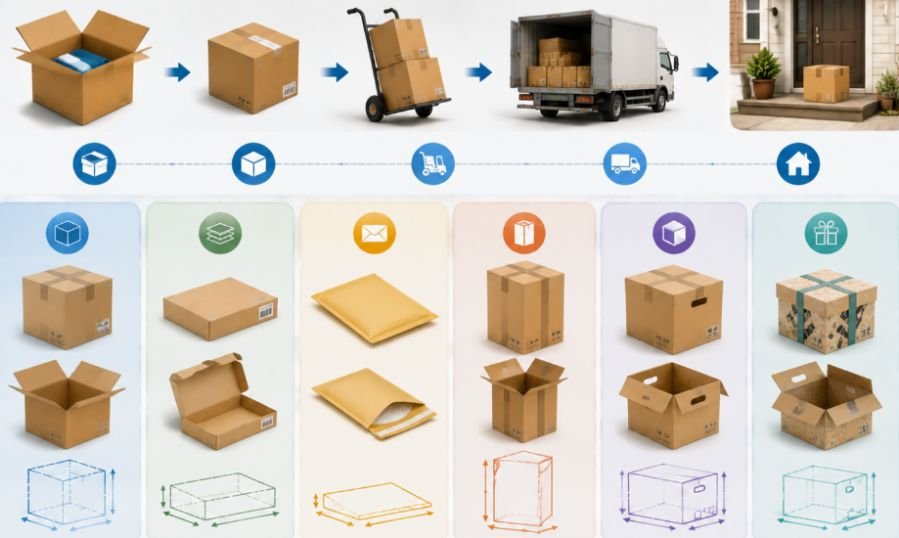
The term does not identify one regulated size or design. Understanding the intended box type prevents misleading comparisons.
Cardboard Shipping Box
A cardboard delivery box is the ordinary carton used to send products, household goods or commercial orders. Its cubic footage is based on its length, width and height. Retailers and delivery carriers commonly use exterior dimensions because those measurements represent the space occupied during transportation.
Interior dimensions are more helpful when determining whether an item will fit. Corrugated walls, inserts, dividers and cushioning materials reduce usable room.
Residential Package-Delivery Box
A residential delivery box is a lockable container placed near a door, driveway or property entrance. It protects packages from weather, animals and unauthorized removal.
These boxes may have a hinged lid, one-way parcel chute, anti-theft baffle or locked lower compartment. Although the entire structure can be large, its opening may accept only a relatively small parcel. Buyers should therefore compare maximum package dimensions rather than relying entirely on gallons or exterior volume.
Delivery Box Truck
A box truck has an enclosed rectangular cargo body attached to a chassis. Its capacity depends on the internal cargo length, width, and height. When you pack boxes for moving, remember that wheel wells, walls, liftgates, and loading requirements can reduce the practical amount of merchandise that fits inside.
How to Calculate Delivery Box Cubic Feet
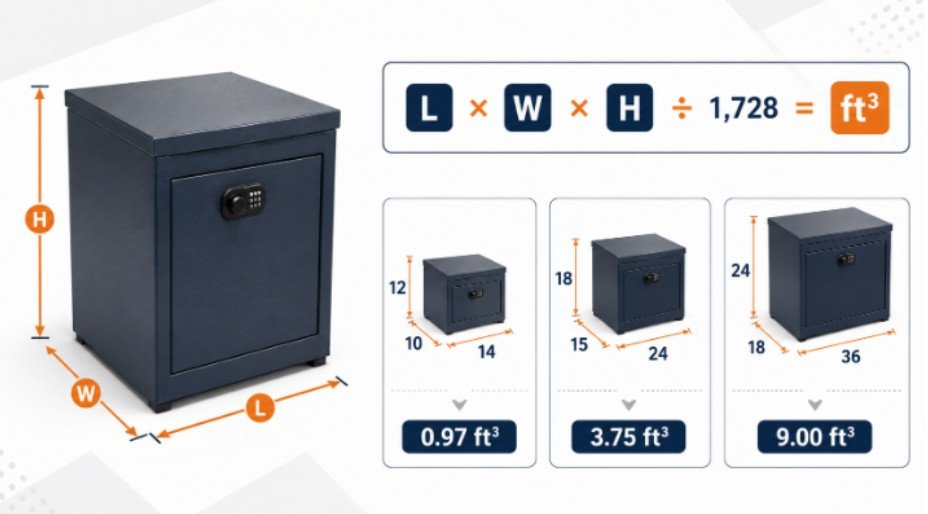
When all measurements are in inches, use this formula:
Length × Width × Height ÷ 1,728 = cubic feet
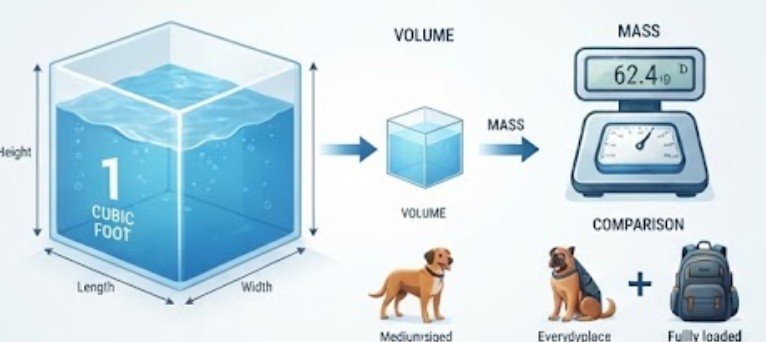
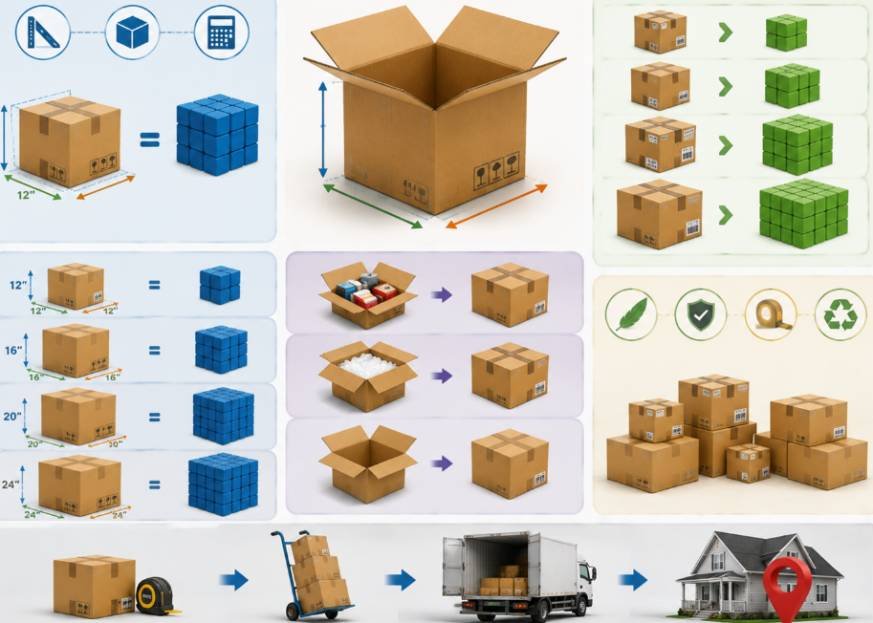
One cubic foot contains 1,728 cubic inches. For example, a carton measuring 18 inches long, 12 inches wide and 12 inches high has a volume of 2,592 cubic inches. Dividing 2,592 by 1,728 produces 1.5 cubic feet.
If the measurements are already in feet, simply multiply them. A compartment measuring 4 feet long, 3 feet wide and 2 feet high occupies 24 cubic feet.
Measure the longest point of each side, particularly if the carton is bulging, uneven or covered by protruding hardware. Mixing inches, feet and centimeters in one calculation will produce an incorrect result.
Common Cardboard Delivery Box Sizes
An 8-by-6-by-4-inch carton occupies approximately 0.11 cubic feet and works well for compact products. A 12-by-9-by-4-inch mailer provides 0.25 cubic feet, while a 12-inch cube holds exactly 1 cubic foot.
A 16-by-12-by-8-inch carton occupies about 0.89 cubic feet. An 18-by-12-by-12-inch box provides 1.5 cubic feet, and a 24-by-18-by-18-inch carton occupies 4.5 cubic feet.
These figures describe rectangular exterior volume. They do not guarantee that an object with the same calculated volume will fit because shape and individual dimensions also matter.
Converting Gallons to Cubic Feet
Some residential parcel boxes are advertised in gallons instead of cubic feet. Divide the number of gallons by 7.4805 to make the conversion.
A 30-gallon model holds approximately 4.01 cubic feet. A 33.5-gallon box equals about 4.48 cubic feet, while a 50-gallon model equals approximately 6.68 cubic feet. A 55-gallon container provides about 7.35 cubic feet. These conversions use a standard volume formula rather than a predictive system such as a generative adversarial network.
These are advertised capacity conversions. Walls, locks, parcel chutes and anti-theft components may reduce the genuinely usable compartment.
Exterior Volume vs. Usable Capacity
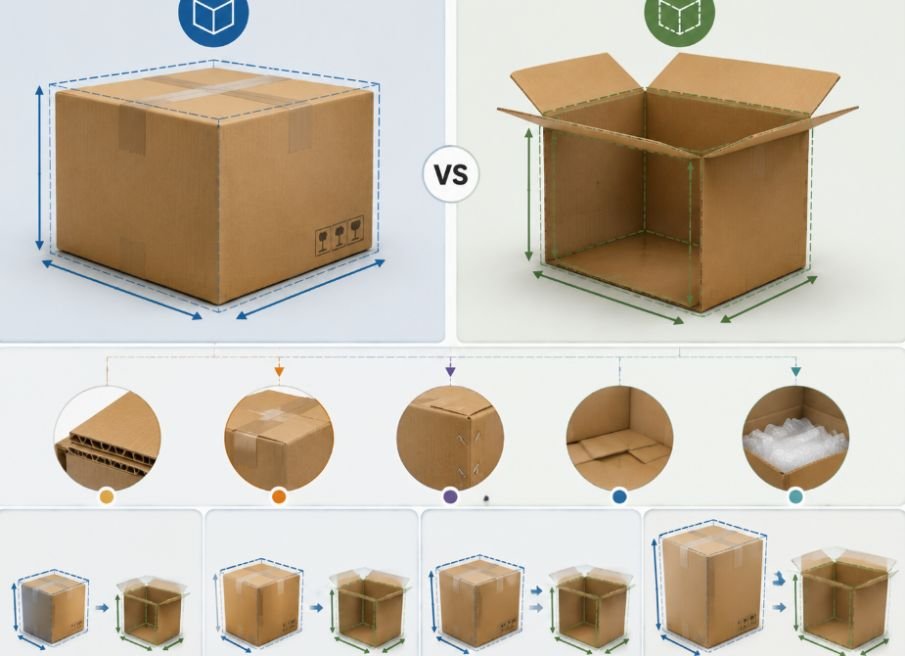
Exterior volume shows how much physical space the container occupies. It is useful for planning a porch installation, warehouse layout, vehicle load or storage area.
Interior volume measures space behind the walls and is more helpful for estimating total package capacity. Maximum parcel size is different again because a package must pass through the opening and any internal security mechanism.
For example, a residential box rated at approximately 4.48 cubic feet may accept individual parcels no larger than 14 by 18 by 8 inches. That parcel occupies only about 1.17 cubic feet. A large total capacity therefore does not guarantee an equally large delivery opening.
This same gap between advertised volume and the actual usable opening shows up with garage storage too my garage storage cabinet guide covers how shelf and door layout can shrink what a cabinet’s exterior cubic footage suggests.
Does Cubic Volume Affect Shipping Cost?
Yes. Delivery companies may compare a package’s scale weight with its dimensional weight. Dimensional weight reflects the amount of vehicle space a parcel consumes rather than its physical heaviness.
Carriers generally calculate cubic size by multiplying the rounded exterior measurements. They then divide that figure by a dimensional divisor established for the applicable service. The billable weight may be whichever is greater: actual weight or dimensional weight.
This same actual-versus-dimensional pricing logic applies to larger freight shipments I break it down in my freight package size guide, including how density affects the final quote.
Cubic feet and dimensional weight should not be treated as identical measurements. Cubic feet represents volume, whereas dimensional weight converts that volume into a pricing weight.
Frequently Asked Questions
1. How many cubic feet is a delivery box on average?
A cardboard delivery carton commonly occupies 0.1 to 4.5 cubic feet, depending on its dimensions. Residential parcel boxes frequently advertise approximately 4 to 7 cubic feet, although their individual package openings can be much smaller.
2. Is a 12-by-12-by-12-inch box one cubic foot?
Yes. Multiplying 12 by 12 by 12 produces 1,728 cubic inches. Dividing that number by 1,728 gives exactly 1 cubic foot.
3. Should I measure inside or outside the box?
Use exterior measurements to calculate shipping, storage or occupied space. Use interior measurements to estimate usable capacity. For a secure parcel box, also measure its smallest opening.
4. Can two differently shaped boxes have the same volume?
Yes. A long, shallow carton and a compact cube can have identical cubic footage. However, they may accommodate entirely different products because each side has different dimensions.
Final Thoughts
After comparing the different meanings, I find the best way to answer how many cubic feet is a delivery box is to begin with its intended use. Shipping cartons generally hold a fraction of a cubic foot to several cubic feet, residential parcel containers commonly advertise 4 to 7 cubic feet, and box trucks provide hundreds or thousands.
I would never choose a delivery container by its advertised volume alone. Measuring the interior, exterior and smallest delivery opening gives a far more dependable picture of what it can actually hold.

Ryan Mitchell
Ryan Mitchell holds a degree in Civil Engineering and spent over a decade working in construction project estimation, where accurate volume and material calculations were part of his daily work — from concrete pours to landscaping material orders. He founded this site to bring that same precision to everyday calculations, helping DIYers, contractors, and students get fast, accurate cubic footage results without the guesswork. Ryan reviews every calculator and formula on this site for accuracy and writes guides based on real-world measurement scenarios he's encountered on job sites.