

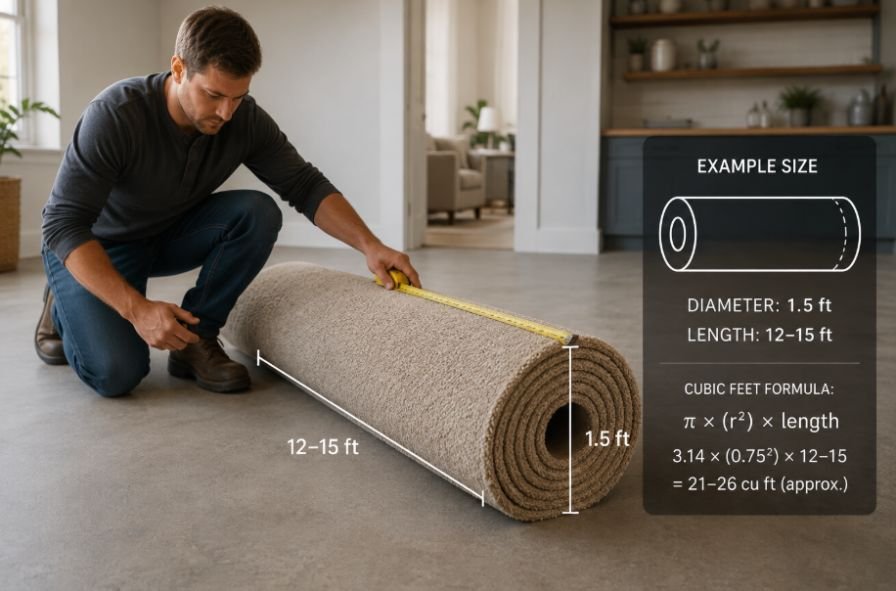
I used to think a carpet roll was easy to size because the width is usually obvious and the length is listed in feet. The confusing part starts when you need to know how much physical space that roll actually takes up. A roll is no longer a flat rectangle at that point. It becomes a large cylinder, and its diameter can make a surprisingly big difference in the space it occupies.
I found the easiest way to think about it is to separate carpet quantity from storage volume. A roll might contain hundreds of square feet of carpet, but that does not mean it takes up the same number of cubic feet. For storage, moving, or shipping, the outside diameter and width of the rolled carpet matter much more than the flat dimensions alone.
How Many Cubic Feet Is a Carpet Roll?
A typical residential carpet roll can occupy roughly 20 to 45 cubic feet, but there is no single standard answer. A common 12-foot-wide roll with an 18- to 24-inch outside diameter works out to about 21 to 38 cubic feet when treated as a simple cylinder.
The basic formula is:
Cubic feet = π × radius² × width
For example, a 12-foot-wide roll with a 2-foot diameter has a 1-foot radius:
3.1416 × 1² × 12 = 37.7 cubic feet
A 12-foot roll with an 18-inch diameter is smaller:
3.1416 × 0.75² × 12 = 21.2 cubic feet
That difference comes entirely from the diameter. Since the radius is squared in the formula, even a modest change in roll thickness can noticeably change the volume. The standard cylinder formula is also consistent with established volume calculations for cylindrical objects.
What Determines a Carpet Roll’s Cubic Feet?
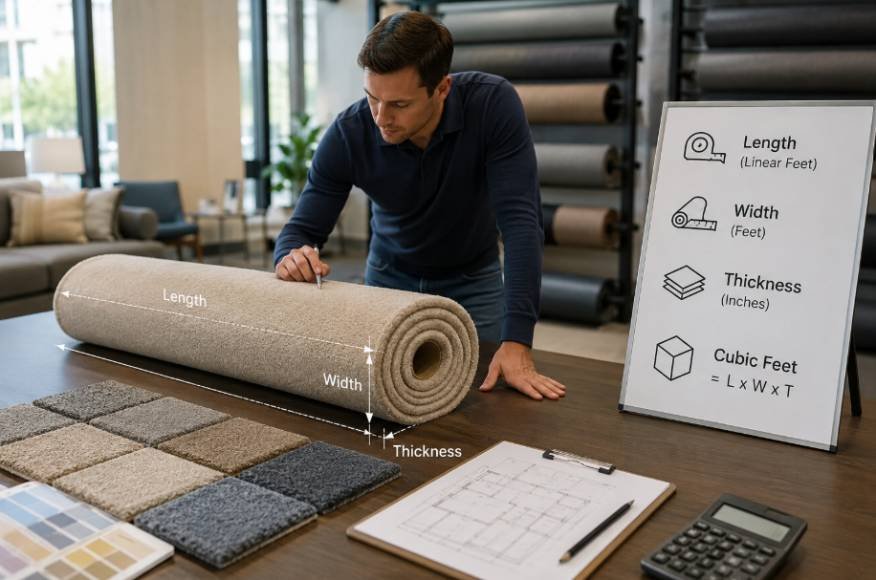
Three measurements matter most when estimating the outside storage volume of a carpet roll: width, diameter, and the shape of the roll.
Roll width
Residential broadloom carpet commonly comes in 12-foot widths, while 15-foot options are also available. Some products use other widths, so the actual measurement should always come from the specific roll rather than an assumed standard.
The width becomes the height of the cylinder in the volume calculation. That means a wider roll takes up more cubic space even when its diameter stays exactly the same.
Roll diameter
Diameter is usually the biggest variable. It measures straight across the rolled carpet from one outer edge to the other.
A tightly wound carpet may have a smaller diameter than a loosely wound roll containing the same general amount of material. Carpet thickness and construction also affect how much space the layers occupy.
Length and thickness
Length does not appear directly in the cylinder-volume formula, but it matters because more carpet wrapped around the core generally produces a larger outside diameter. Thicker carpet can also reach a larger diameter with less linear footage.
That is why two rolls with the same width can have very different cubic-foot measurements.
How to Calculate the Volume of a Carpet Roll
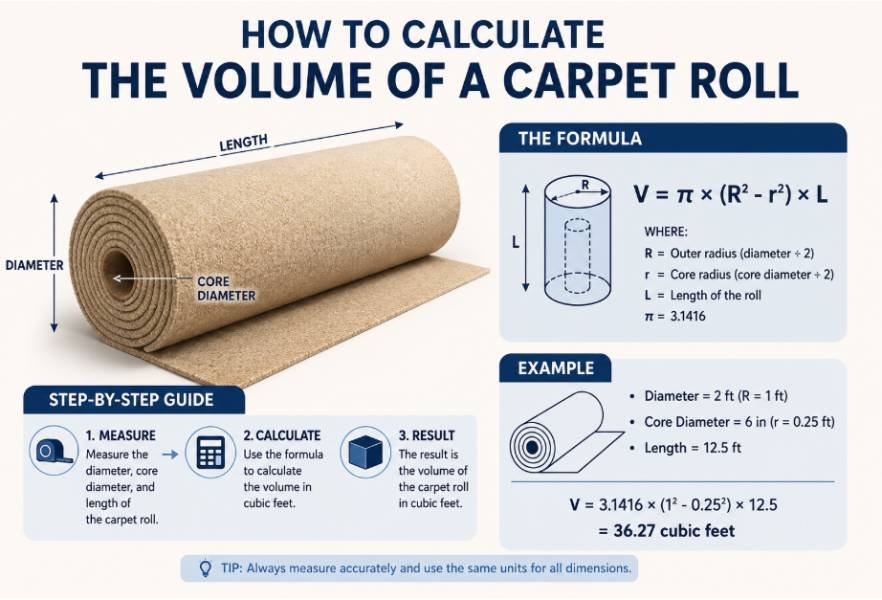
The simplest approach is to treat the roll as a cylinder.
First, measure the outside diameter in feet. If your tape measure gives you inches, divide by 12.
Then divide the diameter by two to get the radius.
Finally, multiply π by the radius squared and the roll width.
For example, suppose you have a 12-foot-wide roll with a 24-inch diameter.
24 inches ÷ 12 = 2 feet
2 ÷ 2 = 1-foot radius
3.1416 × 1 × 1 × 12 = 37.7 cubic feet
So the roll occupies approximately 37.7 cubic feet of outside volume.
For a 15-foot-wide roll with the same 24-inch diameter, the result would be about 47.1 cubic feet. That shows why the roll width needs to be measured instead of guessed.
Why Carpet Thickness Changes Roll Volume
Carpet thickness can make two rolls with similar dimensions behave differently.
Thicker pile and backing add material to every layer as the carpet winds around the core. Over many layers, those small increases build outward and can produce a noticeably larger roll diameter.
The way the carpet is wound matters, too. A tightly wound roll and a loosely wound roll may not occupy exactly the same space. Real carpet does not form a mathematically perfect cylinder, and bending, compression, and small gaps between layers can affect the result.
That is why a formula gives you a useful estimate, while an actual measurement gives you the best answer for a particular roll.
Carpet Roll Volume vs. Carpet Area
This is where many measurements get mixed up.
Carpet area is normally discussed in square feet or square yards. A 12-foot-wide roll containing 50 linear feet of carpet, for example, represents 600 square feet of flat carpet.
Cubic feet answers a completely different question. It tells you how much three-dimensional space the rolled material occupies.
The distinction becomes important when planning storage. You may know that a roll contains 600 square feet of carpet, but that number does not tell you whether the roll will fit inside a particular storage area. For that, you need its physical width and outside diameter.
The same principle applies when comparing how much space a household textile takes up. Blanket storage volume can help put folded or compressed fabric into a storage-volume context, but a rolled carpet needs to be treated as a cylinder because its shape is different.
How Much Space Do You Need to Store a Carpet Roll?
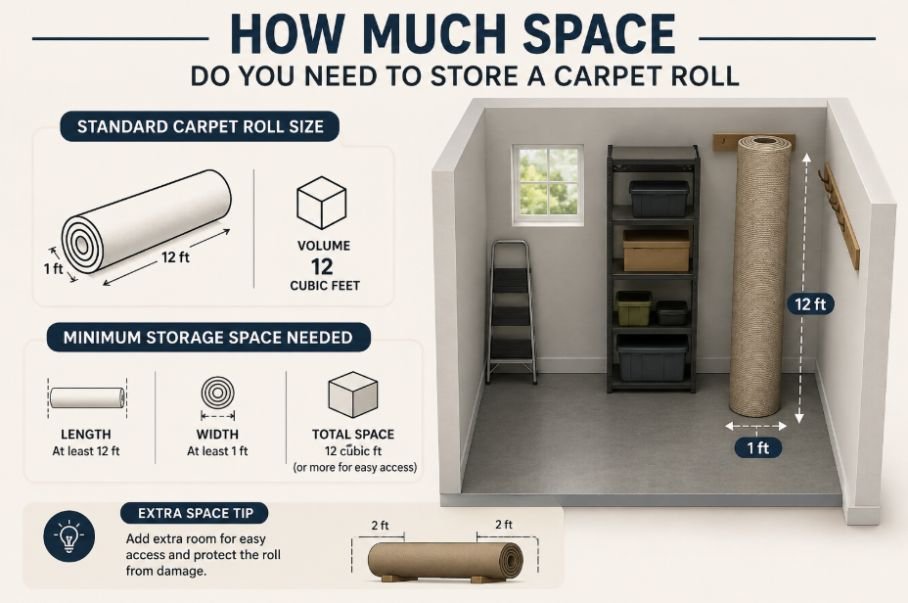
The calculated cubic footage gives you a starting point, but storage planning should leave some extra room.
A 12-foot-wide carpet roll measuring 24 inches across may occupy about 37.7 cubic feet by the simple cylinder calculation. You still need enough clearance to move the roll into position and account for the actual shape of the roll.
If you have several rolls, calculate each one separately rather than multiplying a generic estimate. Different carpet styles, lengths, and thicknesses can produce different diameters.
For transportation, also check the physical length and diameter of each roll. Cubic footage alone does not tell you whether a roll will fit through a doorway, inside a vehicle, or alongside other cargo.
A Simple Way to Estimate Any Carpet Roll
Once you know the outside diameter and width, the calculation becomes straightforward. Measure the diameter, convert it to feet, divide it by two, square the radius, and multiply by π and the roll width.
For a quick storage estimate, treating the roll as a cylinder is usually enough. For a more precise calculation involving the actual carpet material, include the core diameter and recognize that winding and compression can affect the result.
If you are comparing bulky bedding for the same reason, comforter storage volume provides a useful comparison, but the measurement method changes because a comforter is folded or compressed rather than wound into a cylinder.
Frequently Asked Questions
1. How many cubic feet is a standard carpet roll?
A typical 12-foot-wide residential roll with an 18- to 24-inch diameter occupies roughly 21 to 38 cubic feet. Larger diameters or wider rolls can exceed that range.
2. What formula calculates carpet roll volume?
Treat the roll as a cylinder: π × radius² × width. Convert the diameter and width to feet before calculating so the result comes out in cubic feet.
3. Does carpet length affect cubic feet?
Yes, but indirectly. More carpet generally creates a larger roll diameter. Because diameter has a squared effect in the volume formula, changes in roll size can significantly affect cubic footage.
4. Do I need the core diameter?
Not for a basic storage-volume estimate. You need the outside diameter and width. The core diameter becomes important when estimating the actual volume or amount of carpet material.
Why the Actual Roll Matters More Than the Average
A general estimate can tell you what to expect, but the physical roll in front of you is always the better reference. Two rolls with the same advertised width can occupy different amounts of space because their diameter, length, thickness, backing, and winding can differ. If the calculation is being used for a storage unit, truck, warehouse, or shipping decision, a tape measure is worth using before you commit to a space.
Once you know the outside diameter and width, the math is simple. The useful part is knowing which measurements actually matter.

Ryan Mitchell
Ryan Mitchell holds a degree in Civil Engineering and spent over a decade working in construction project estimation, where accurate volume and material calculations were part of his daily work — from concrete pours to landscaping material orders. He founded this site to bring that same precision to everyday calculations, helping DIYers, contractors, and students get fast, accurate cubic footage results without the guesswork. Ryan reviews every calculator and formula on this site for accuracy and writes guides based on real-world measurement scenarios he's encountered on job sites.


