

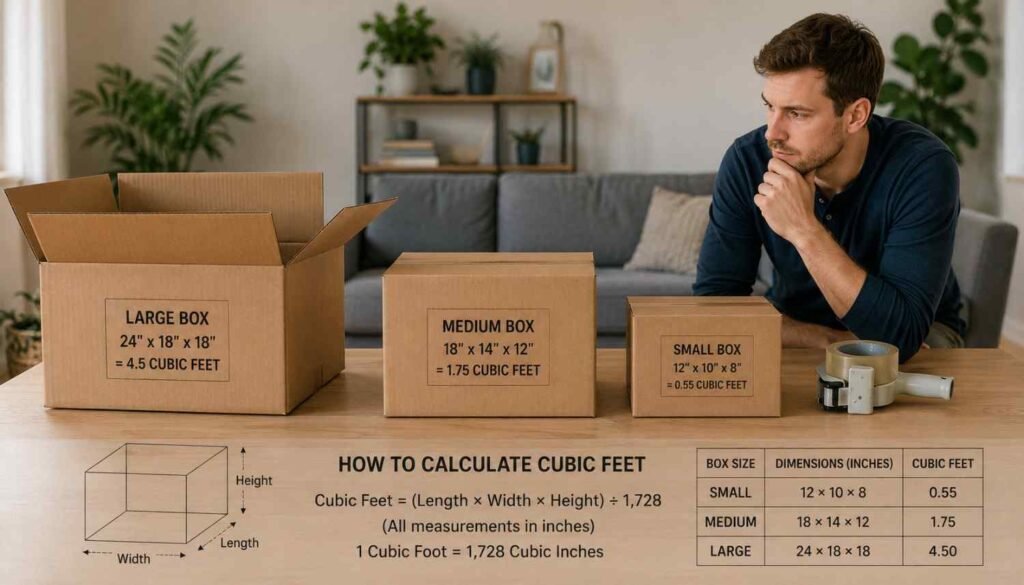
I used to think a cardboard box had a fairly obvious size until I started comparing boxes that looked similar on a shelf. One could hold noticeably more than another, even when the difference was hard to spot by eye. That made me realize that “small” or “large” does not tell you much when you need to know how much space a box actually occupies.
I also found that calculating box volume is much easier than it sounds. Once the length, width, and height are measured in the same unit, the math is straightforward. For moving, storage, packing, or shipping, knowing the cubic footage can make it easier to estimate capacity and choose a box that fits the job.
So, How Many Cubic Feet Is a Cardboard Box?
There is no single cubic-foot measurement for a cardboard box because boxes come in many dimensions. A small moving box may hold around 1.5 cubic feet, while medium boxes are commonly around 3 cubic feet. Large boxes often reach 4.5 cubic feet, and extra-large moving boxes can reach roughly 6 cubic feet or a little more.
Those figures are useful benchmarks, not universal standards. Actual capacity depends on the box dimensions and manufacturer. For example, a 16 x 12 x 12-inch box has a volume of 2,304 cubic inches, which equals about 1.33 cubic feet. A box sold as 1.5 cubic feet may therefore have slightly different dimensions. This makes cubic footage especially helpful when comparing products that use different proportions, because two boxes with similar labels can occupy surprisingly different amounts of physical space.
How to Calculate Box Volume
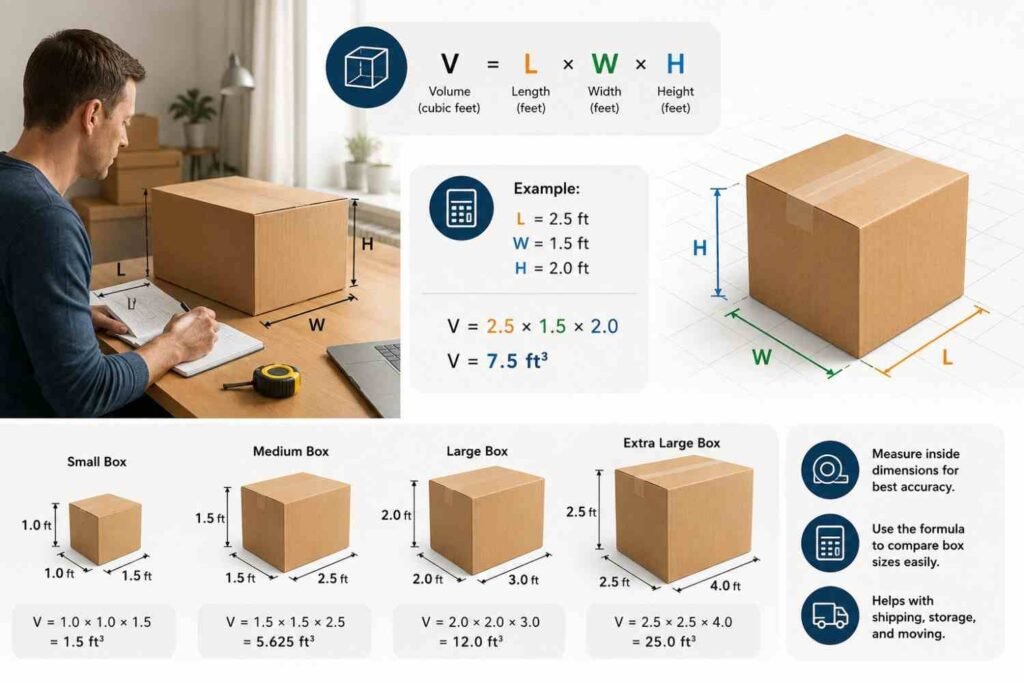
The basic formula is:
Cubic feet = (length × width × height) ÷ 1,728
Measure all three sides in inches, multiply them together, and then divide the result by 1,728.
Take a box measuring 18 x 18 x 16 inches. Multiplying those measurements gives 5,184 cubic inches. Divide 5,184 by 1,728, and the answer is exactly 3 cubic feet.
If the measurements are already in feet, you can skip the conversion. Simply multiply the length, width, and height in feet.
Common Cardboard Box Sizes
Standard moving boxes provide a useful reference point when estimating cubic footage. Current moving and packaging guidance commonly groups boxes into four broad sizes.
|
Box type |
Typical dimensions | Approx. volume |
| Small | 16 x 12 x 12 in. |
1.5 cu. ft. |
|
Medium |
18 x 18 x 16 in. | 3.0 cu. ft. |
| Large | 18 x 18 x 24 in. |
4.5 cu. ft. |
|
Extra-large |
24 x 18 x 24 in. |
6.0 cu. ft. |
A small box is generally better for dense, heavy belongings such as books, canned goods, or tools. Medium cartons work well for toys, kitchen items, decor, and everyday household goods. Large and extra-large cartons provide more room for lighter items such as bedding, pillows, blankets, and linens.
Does Inside or Outside Size Matter?
It depends on what you are trying to calculate. If the goal is to estimate how much you can physically pack inside a box, internal dimensions are the more useful measurement. Cardboard walls take up some space, and thicker corrugated construction can make the usable interior smaller than the exterior dimensions suggest.
If you are planning transportation or storage, outside dimensions can matter more because they describe the space the packed carton occupies. Shipping calculations can also depend on package dimensions rather than just the amount of empty space inside.
A box can have a certain advertised capacity while the usable packing space is slightly lower because of cardboard thickness, flaps, protective inserts, or other packaging materials.
Why Cubic Feet Helps With Moving and Storage
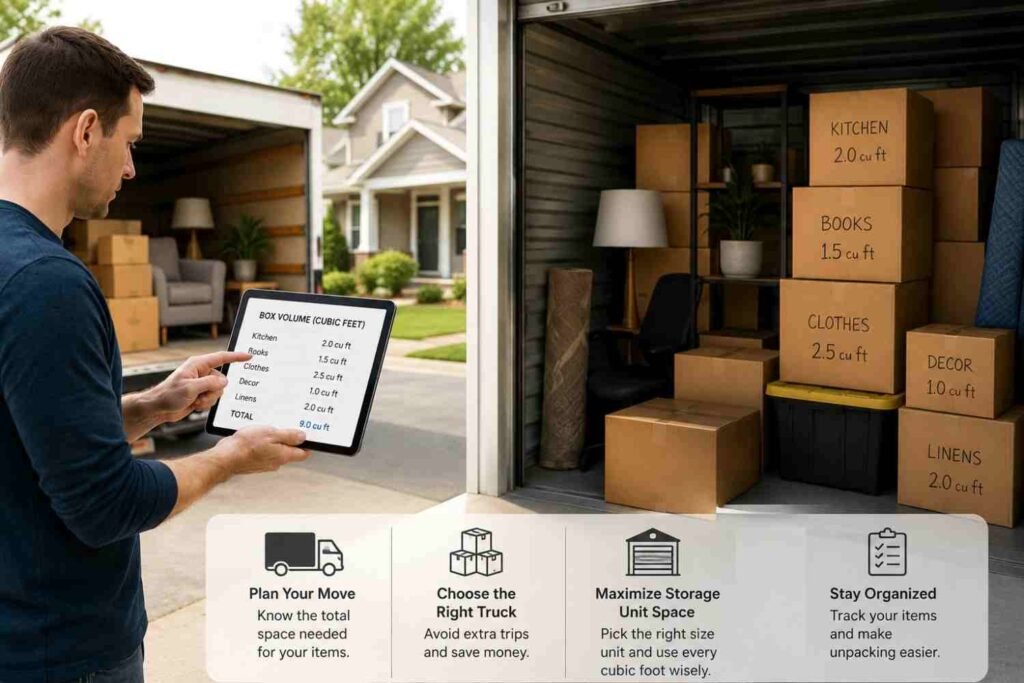
Cubic footage becomes especially useful when you have several boxes to account for. If ten boxes each hold 3 cubic feet, their combined nominal volume is 30 cubic feet. That does not mean every cubic inch of a storage unit or moving truck can be filled perfectly, because gaps between cartons reduce practical efficiency.
Box volume provides an estimate. Match box size to the weight and shape of the contents. Dense items usually belong in smaller cartons, while lightweight bulky items can make better use of larger boxes.
For specialized packaging, the same volume calculation applies. Electronics box volume can be useful when a device needs controlled dimensions, while a camera bag may require a different approach because its shape is not a simple rectangular carton. Curved sides, pockets, or rounded sections can make the interior irregular.
Common Mistakes When Measuring a Box
The biggest mistake is mixing units: measuring one dimension in feet and the others in inches. Keep all three measurements in inches until the final conversion, or convert everything to feet first.
Another mistake is confusing square feet with cubic feet. Square feet measure surface area, while cubic feet measure three-dimensional volume. Box capacity requires length, width, and height.
For a rectangular carton, identify the three dimensions clearly before calculating. If the box is crushed, tapered, or unusually shaped, a simple rectangular formula may only provide an estimate.
When buying boxes, check the listed capacity as well as the dimensions. Retailers sell cardboard boxes with different proportions and construction, so a familiar size label may not have exactly the same volume as another box in that category.
FAQs: How Many Cubic Feet Is a Cardboard Box? From Small to Large Boxes
1. What is the average cubic feet of a cardboard box?
There is no single average. Common moving boxes range from about 1.5 cubic feet for small cartons to around 6 cubic feet for extra-large cartons.
2. How do I calculate cubic feet from inches?
Multiply length, width, and height in inches, then divide the result by 1,728. The answer is the box’s volume in cubic feet.
3. Is a 3-cubic-foot box considered medium?
Yes. A box around 18 x 18 x 16 inches is commonly categorized as a 3-cubic-foot medium moving box.
4. Does cardboard thickness change the cubic-foot measurement?
It can. Exterior dimensions describe the overall package, while interior dimensions provide a better estimate of usable packing space.
The Right Box Is About More Than a Number
Cubic footage gives you a practical way to understand a cardboard box without relying on vague labels like small, medium, or large. A box with plenty of volume may still be a poor choice if it is too heavy when filled, awkward for the item, or inefficient for the space where it needs to go. Looking at dimensions, intended contents, and usable capacity together produces a more realistic estimate. Irregular camera bag volume needs careful measurement.
Measure the three sides, multiply, divide by 1,728, and you have a useful number for planning. It can prevent wasted space and packing headaches and surprises.

Ryan Mitchell
Ryan Mitchell holds a degree in Civil Engineering and spent over a decade working in construction project estimation, where accurate volume and material calculations were part of his daily work — from concrete pours to landscaping material orders. He founded this site to bring that same precision to everyday calculations, helping DIYers, contractors, and students get fast, accurate cubic footage results without the guesswork. Ryan reviews every calculator and formula on this site for accuracy and writes guides based on real-world measurement scenarios he's encountered on job sites.


