

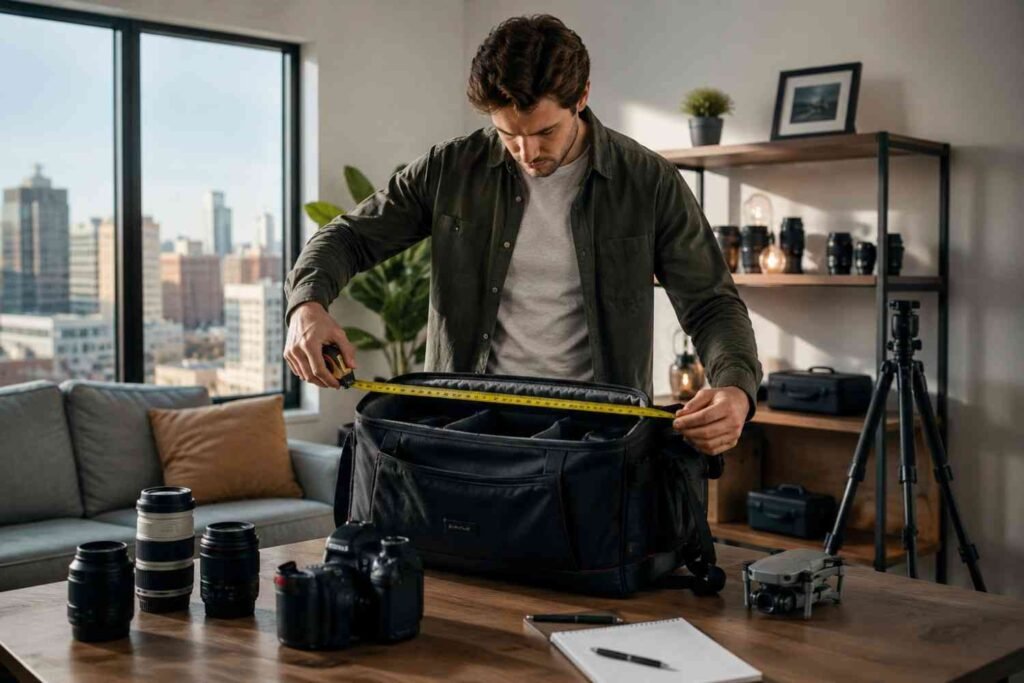
I used to think camera bag capacity was mostly about whether a bag looked big enough for my gear. Then I started comparing bags listed in liters and realized the numbers were harder to picture than the bags themselves. A 20-liter backpack sounds useful, but knowing it holds roughly 0.71 cubic feet makes the measurement easier to compare with other equipment.
I also found that a cubic-foot number does not tell the whole story. Two bags can have similar capacities while offering different usable space because of padding, dividers, pockets, and shape. That matters when fitting a real camera kit together.
Camera Bags Are Usually Measured in Liters
Most camera bags are described using liters because liters are convenient for comparing backpacks, slings, shoulder bags, and travel packs. Cubic feet is less common, but the conversion is simple: one liter equals about 0.0353 cubic feet.
A camera bag can have a surprisingly small cubic-foot measurement while still being useful. A 10-liter bag is about 0.35 cubic feet, while a 30-liter bag is roughly 1.06 cubic feet.
How Many Cubic Feet Is a Camera Bag?
A typical camera bag can hold about 0.18 to 1.76 cubic feet, corresponding to roughly 5 to 50 liters. Smaller pouches and compact slings sit near the lower end, while large backpacks, rolling cases, and expedition-style packs can reach the upper range.
Here is a practical breakdown:
- Small bags from 5 to 10 liters hold about 0.18 to 0.35 cubic feet and generally suit a small camera body with one additional lens.
- Medium bags from 15 to 30 liters provide about 0.53 to 1.06 cubic feet and can accommodate a body, several lenses, accessories, and a few personal items.
- Large bags from 35 to 50 liters provide about 1.24 to 1.76 cubic feet or more, giving room for multiple bodies, larger lenses, a laptop, and substantial accessories.
These ranges are useful benchmarks, not strict categories.
How to Calculate Camera Bag Volume
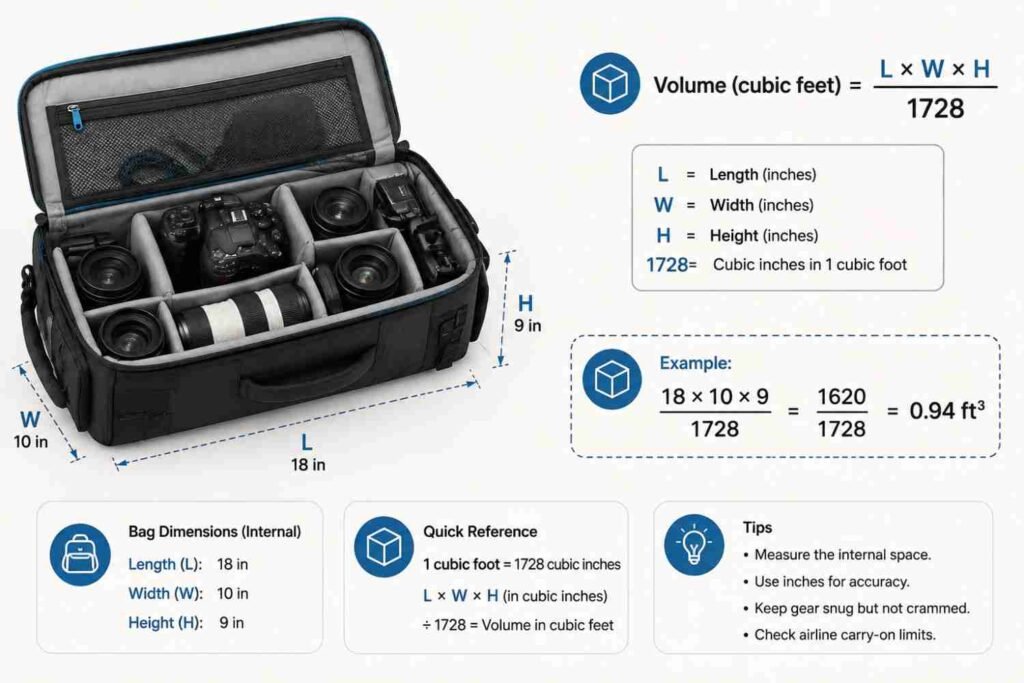
If a bag has a rectangular interior, volume can be estimated by multiplying length by width by height. Convert cubic inches to cubic feet by dividing by 1,728.
For example, an interior measuring 16 inches by 10 inches by 8 inches contains 1,280 cubic inches, or about 0.74 cubic feet.
Real camera bags make this calculation less reliable. Rounded corners, tapered sides, padding, dividers, and separate compartments all change the usable space. A manufacturer’s stated capacity is often more useful than calculating the entire exterior shell.
What Fits in Different Camera Bag Sizes?
Capacity becomes easier to understand when connected to actual equipment. A compact 5 to 10-liter bag works well for a mirrorless body, a standard lens, a spare battery, memory cards, and a charger.
A 15 to 20-liter bag gives photographers more flexibility. It can accommodate a body, two or three lenses, batteries, cables, and a light jacket. A photographer who needs more may prefer 20 to 30 liters for travel or a full day outdoors.
At 35 liters or more, the emphasis shifts toward extensive kits and longer trips. Telephoto lenses, extra bodies, flashes, tripods, laptops, and clothing can quickly consume available space. Organization and weight distribution become just as important as raw volume.
If you are comparing equipment storage with other household gear, a measurement such as a home theater system can also provide a useful volume comparison. Equipment rarely uses every inch of a container.
Why Advertised Capacity Can Be Misleading
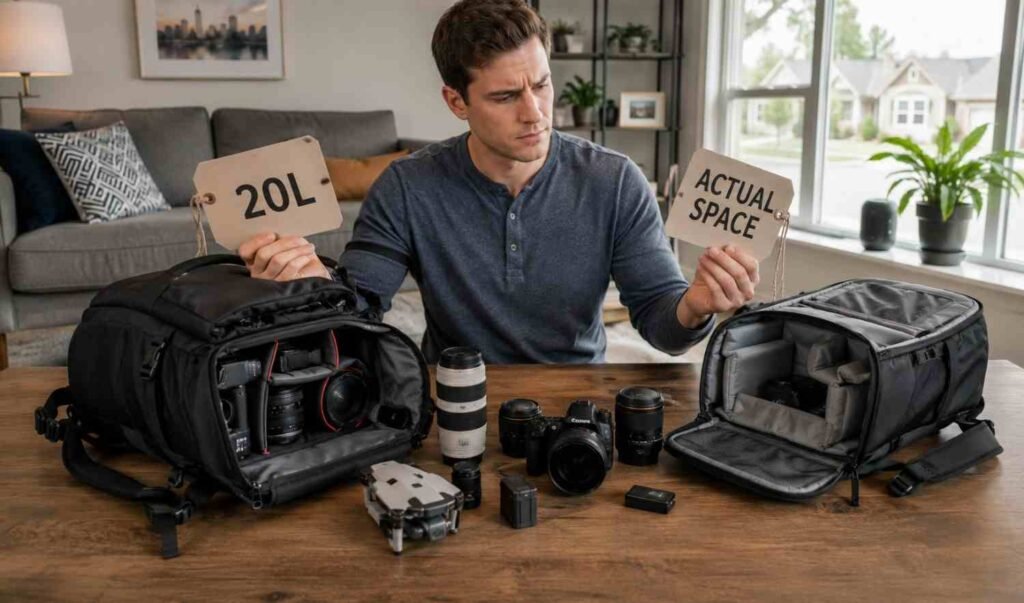
A bag labeled 30 liters does not necessarily give you 30 liters of open camera storage. The number may represent total volume across several areas, including front pockets, laptop sleeves, and separate compartments.
Padding is another factor. Protective walls and dividers take up space that an ordinary backpack might leave open. Dividers add flexibility but can change how efficiently lenses and bodies fit together.
Gear shape matters, too. A telephoto lens may not use a narrow corner efficiently, while small accessories can occupy awkward gaps. Two bags with similar capacities may feel very different once loaded.
How to Choose the Right Capacity
Start with the equipment you actually carry rather than buying the largest bag available. List the bodies, lenses, batteries, accessories, and personal items that normally travel together. The largest item often determines required depth and compartment dimensions.
Leave some room for practical use. A completely full bag can be difficult to close, uncomfortable to carry, and frustrating to organize. Extra space helps when you add a battery, filter, rain cover, or another accessory later.
Pay attention to interior dimensions as well as liters. If you are comparing a camera backpack with another equipment container, the same principle applies to measurements such as speaker capacity: stated volume is only part of the story. Shape and compartment design determine what you can actually fit.
FAQs: How Many Cubic Feet Is a Camera Bag? Understanding Bag Capacity
1. What is the average cubic-foot capacity of a camera bag?
Many camera bags fall between about 0.18 and 1.76 cubic feet, or roughly 5 to 50 liters. Compact bags sit near the lower end, while large professional packs occupy the upper range.
2. How many liters are in one cubic foot?
One cubic foot equals approximately 28.32 liters. For a quick estimate, divide liters by 28.32 to convert a camera bag’s capacity into cubic feet.
3. Is a 20-liter camera bag big enough?
A 20-liter bag is a versatile medium-size option. It can often hold a camera body, two or three lenses, batteries, accessories, and a few personal items, depending on the bag’s layout.
4. Are camera bag dimensions more useful than liters?
They can be. Liters provide a useful overall capacity comparison, but interior length, width, and height show whether specific cameras and lenses will physically fit. Both measurements are worth checking.
Why Capacity Is Only the Starting Point
Cubic feet gives camera bag capacity a useful common language, especially when comparing products measured in different ways. Still, the number should be treated as a starting point rather than a promise of usable storage. A thoughtfully designed 20-liter bag can be more practical than a poorly organized bag with greater volume.
The best choice comes down to the gear you carry, how you move with it, and how much organization you need. Considering liters, cubic feet, dimensions, and layout makes choosing a camera bag far less of a guessing game.

Ryan Mitchell
Ryan Mitchell holds a degree in Civil Engineering and spent over a decade working in construction project estimation, where accurate volume and material calculations were part of his daily work — from concrete pours to landscaping material orders. He founded this site to bring that same precision to everyday calculations, helping DIYers, contractors, and students get fast, accurate cubic footage results without the guesswork. Ryan reviews every calculator and formula on this site for accuracy and writes guides based on real-world measurement scenarios he's encountered on job sites.


