A shipping container may look like a simple steel box from the outside, but inside it holds thousands of cubic feet of potential storage space. Whether you are planning a cross-country move, expanding business inventory, or looking for affordable storage in the US, the container size you choose can make a major difference.
The biggest mistake people make is judging capacity only by the container’s length. A 20-foot container and a 40-foot container may seem straightforward, but their actual storage depends on interior dimensions, container height, and how efficiently the space is packed.
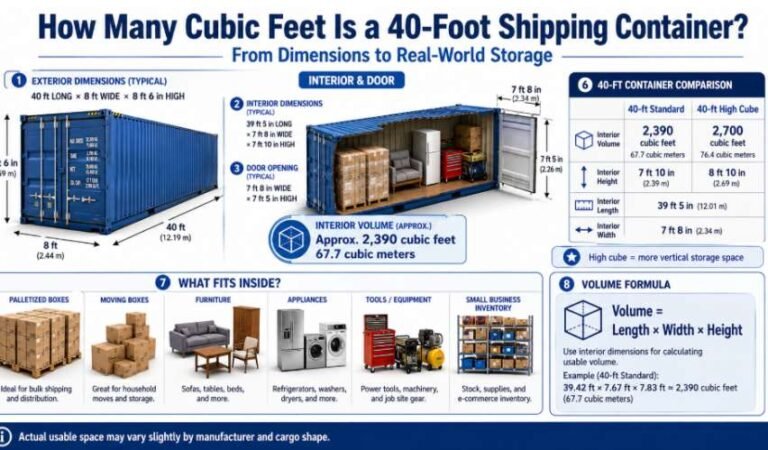
So, How Many Cubic Feet Is a Shipping Container? A standard 20-foot shipping container provides around 1,172 cubic feet of interior space, while a 40-foot container offers approximately 2,391 cubic feet. For those who need extra room, a 40-foot high cube container increases capacity to nearly 2,694 cubic feet with its additional height.
Understanding these numbers helps homeowners, businesses, and shipping professionals choose the right container without paying for space they do not need or discovering later that their cargo does not fit.
Shipping Container Cubic Feet by Size
Shipping containers are available in multiple sizes, but 10-foot, 20-foot, and 40-foot models are the most commonly used options in the United States.
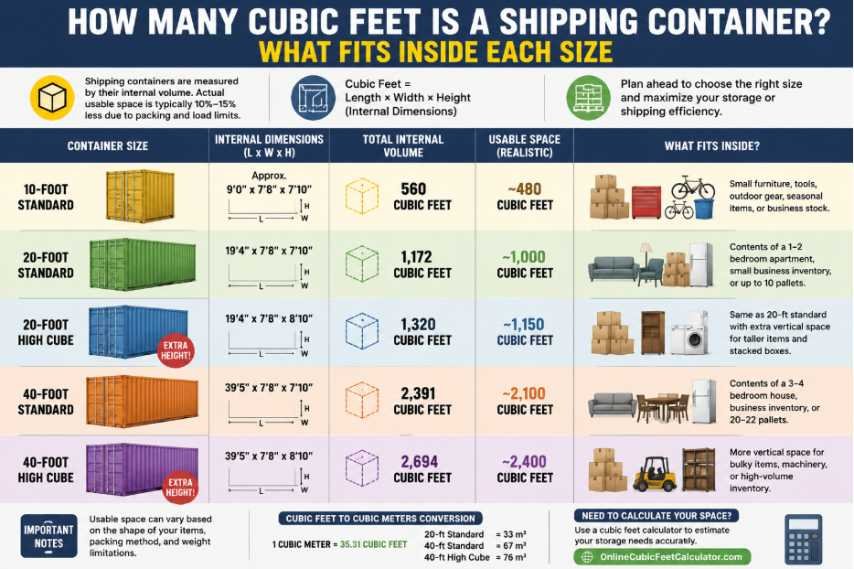
| Container Type | Internal Dimensions | Total Internal Volume | Realistic Usable Space |
| 10-foot standard | Approx. 9 ft × 7 ft 8 in × 7 ft 10 in | 560 cubic feet | About 480 cubic feet |
| 20-foot standard | 19 ft 4 in × 7 ft 8 in × 7 ft 10 in | 1,172 cubic feet | About 1,000 cubic feet |
| 20-foot high cube | Approx. 19 ft 4 in × 7 ft 8 in × 8 ft 10 in | 1,320 cubic feet | About 1,150 cubic feet |
| 40-foot standard | 39 ft 5 in × 7 ft 8 in × 7 ft 10 in | 2,391 cubic feet | About 2,100 cubic feet |
| 40-foot high cube | 39 ft 5 in × 7 ft 8 in × 8 ft 10 in | 2,694 cubic feet | About 2,400 cubic feet |
Exact measurements can vary slightly depending on the manufacturer, container condition, and design specifications. Standard and high cube containers are the two main categories, with high cube models providing roughly one additional foot of vertical clearance.
How Much Space Does a 20-Foot Shipping Container Have?
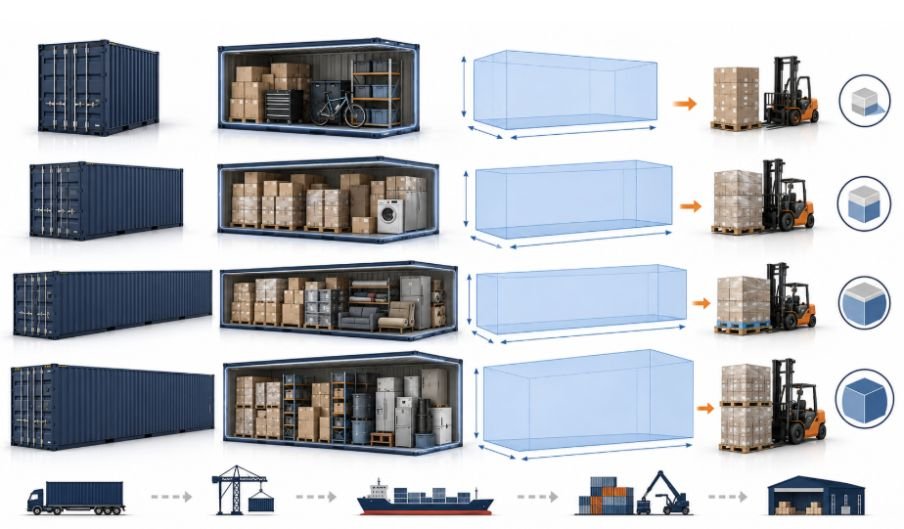
A 20-foot shipping container is one of the most popular choices for residential storage, small businesses, and domestic shipping.
The 20-foot shipping container capacity is approximately 1,172 cubic feet based on its internal measurements. While that number represents the theoretical volume, most users can expect closer to 1,000 cubic feet of practical storage because not every corner can be filled efficiently.
A 20-foot container can typically store:
- Contents of a one- to two-bedroom apartment
- Household furniture and appliances
- Small business inventory
- Construction supplies
- Around 10 standard pallets when loaded efficiently
For many US homeowners, this size provides a good balance between affordability and storage capacity without requiring the space needed for a larger container.
How Many Cubic Feet Does a 40-Foot Shipping Container Hold?
A 40-foot container is designed for larger shipments and commercial storage needs. The 40 foot shipping container cubic feet capacity is approximately 2,391 cubic feet, which is nearly double the volume of a standard 20-foot container.
A typical 40-foot container has internal dimensions close to 39 feet 5 inches long, 7 feet 8 inches wide, and 7 feet 10 inches high.
This larger container is commonly used for:
- Three- to four-bedroom household moves
- Large inventory storage
- Manufacturing supplies
- Retail shipments
- Warehouse overflow
A 40-foot container can usually hold around 20 to 22 standard pallets, depending on pallet dimensions and loading arrangements.
What Is a High Cube Shipping Container?
A high cube container is designed for users who need additional vertical storage space. It looks similar to a standard shipping container but provides extra height.
The high cube container volume is:
- 20-foot high cube: approximately 1,320 cubic feet
- 40-foot high cube: approximately 2,694 cubic feet
The additional height is useful for cargo that cannot fit efficiently in standard containers, including tall equipment, stacked inventory, and bulky items.
For businesses shipping large quantities of goods, a high cube container can improve packing efficiency without increasing the container footprint.
How Do You Calculate Shipping Container Volume?
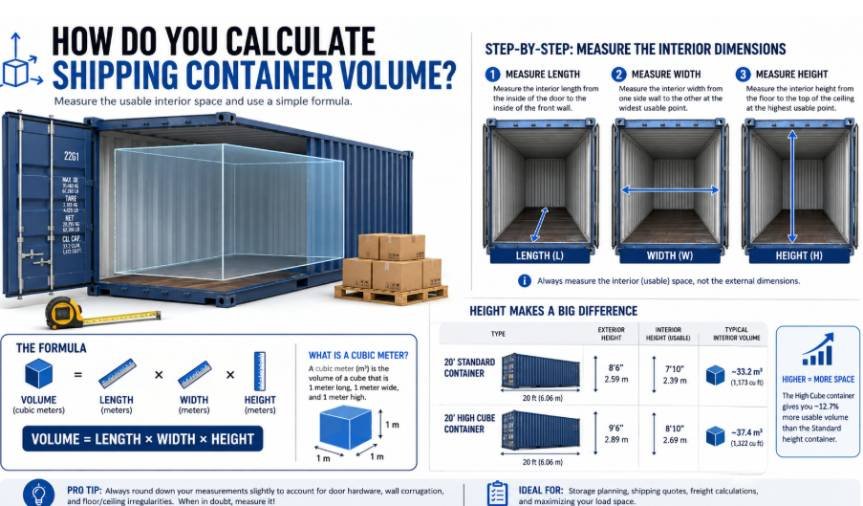
Calculating container volume is simple when you know the internal measurements.
The formula is:
Length × Width × Height = Cubic Feet
For example, a container with:
- Length: 39.5 feet
- Width: 7.7 feet
- Height: 7.8 feet
would provide:
39.5 × 7.7 × 7.8 = approximately 2,373 cubic feet
A shipping container volume calculator can make this process faster when comparing different container sizes for storage, moving, or freight planning.
Shipping Container Cubic Feet vs Cubic Meters
International shipping companies often measure cargo in cubic meters instead of cubic feet. Understanding both measurements is useful, especially for US businesses working with global suppliers.
The conversion is:
1 cubic meter = 35.31 cubic feet
Approximate conversions:
- 20-foot container: about 33 cubic meters or 1,172 cubic feet
- 40-foot container: about 67 cubic meters or 2,391 cubic feet
- 40-foot high cube: about 76 cubic meters or 2,694 cubic feet
Many freight providers use cubic meters because international shipping standards commonly rely on metric measurements.
What Reduces a Container’s Usable Storage Space?
Boxes with uniform shapes stack better than furniture, machinery, or irregular items. Empty spaces between objects can significantly reduce available storage. The same principle applies when comparing hatchback cargo space, where the shape and layout of the vehicle can affect how much luggage or cargo can actually be accommodated.
Although a container may have thousands of cubic feet available, you rarely use 100% of the interior volume.
Several factors affect actual cargo capacity.
Item Shape and Packaging
Boxes with uniform shapes stack better than furniture, machinery, or irregular items. Empty spaces between objects can significantly reduce available storage.
Weight Restrictions
A container may have enough physical space but still reach its maximum weight limit before it is completely full.
Loading Strategy
Using properly sized boxes, stacking vertically, and organizing items carefully can help maximize container storage capacity.
Door Opening Size
The container interior may be large, but the door opening can limit how easily oversized items can be loaded.
How Do I Choose the Right Shipping Container Size?
Choosing the correct container depends on what you need to store or transport.
A 20-foot container is usually suitable for smaller residential moves, personal storage, and limited inventory. A 40-foot container works better for large households, commercial shipments, and businesses requiring more space.
If your cargo includes tall items or you want to maximize vertical storage, a high cube container may be the better option.
Before renting or buying, I recommend measuring your items and comparing those measurements with the container’s internal dimensions instead of relying only on the container length.
A similar approach can help when evaluating SUV cargo area capacity for transporting bulky or irregular items.
Frequently Asked Questions
1. How many cubic feet is a standard shipping container?
A standard 20-foot shipping container holds approximately 1,172 cubic feet, while a standard 40-foot container provides about 2,391 cubic feet of interior volume.
2. How much can fit inside a 20-foot shipping container?
A 20-foot container can usually hold the contents of a one- to two-bedroom apartment or around 10 standard pallets when packed efficiently.
3. How much larger is a high cube container?
A high cube container is about one foot taller than a standard container, creating additional vertical space and increasing total storage capacity.
4. Can I calculate shipping container volume myself?
Yes. Multiply the interior length, width, and height measurements in feet to determine the approximate cubic feet.
Final Thoughts
Understanding How Many Cubic Feet Is a Shipping Container? helps you make better decisions when choosing storage or shipping solutions. A 20-foot container provides enough room for smaller moves and storage projects, while a 40-foot or high cube container offers significantly more capacity for businesses and larger households.
The most important thing to remember is that advertised cubic footage represents maximum theoretical space. Real-world storage depends on your cargo type, packing method, and weight limitations. By comparing both total volume and realistic usable space, you can select the container that fits your needs without paying for unnecessary capacity.
For more accurate measurements, you can use an online cubic feet calculator to quickly estimate container volume, storage requirements, and cargo space before making a decision.

Ryan Mitchell
Ryan Mitchell holds a degree in Civil Engineering and spent over a decade working in construction project estimation, where accurate volume and material calculations were part of his daily work — from concrete pours to landscaping material orders. He founded this site to bring that same precision to everyday calculations, helping DIYers, contractors, and students get fast, accurate cubic footage results without the guesswork. Ryan reviews every calculator and formula on this site for accuracy and writes guides based on real-world measurement scenarios he's encountered on job sites.